

Al Green stood on the House floor in mid-July and declared that Donald Trump “will face articles of impeachment.” He wasn’t the first Democrat to say it this year, and he almost certainly won’t be the last. By summer 2026, three separate impeachment resolutions had already been filed in the House, one covering thirteen articles at once, and the question keeps resurfacing in headlines, prediction markets, and dinner-table arguments alike.
But intent to impeach and actual removal from office are two very different things, separated by a constitutional wall most people have never had to think carefully about. Understanding that wall, not the political noise around it, is what actually tells you whether this is a real risk to plan around or a recurring news cycle to tune out.
The Big Picture: Why This Question Keeps Returning
Data/Facts: As of mid-2026, House members have introduced at least three formal impeachment resolutions against Trump in the 119th Congress, including H.Res.353, H.Res.537, and H.Res.939. Representative John Larson filed a thirteen-article resolution in April, tying it explicitly to the administration’s military campaign against Iran. No Senate trial has begun, and House Republican leadership has not scheduled a floor vote on any of the resolutions.
The View: These filings function more as political messaging than procedural first steps. Individual members can introduce impeachment articles at any time, but that alone triggers nothing. What matters is whether House leadership brings a resolution to a floor vote, and Speaker-controlled Republican leadership has shown no inclination to do so. The repeated filings tell you more about Democratic base energy heading into the midterms than about the actual mechanics of removal.
Why now, specifically? Three forces are converging: an active, contested war with Iran that critics argue exceeded presidential war powers, a prime-time address reviving 2020 election disputes that opponents call destabilizing, and a midterm election just months away that both parties are using every available lever to shape.
Deep Dive: How Removal Actually Works
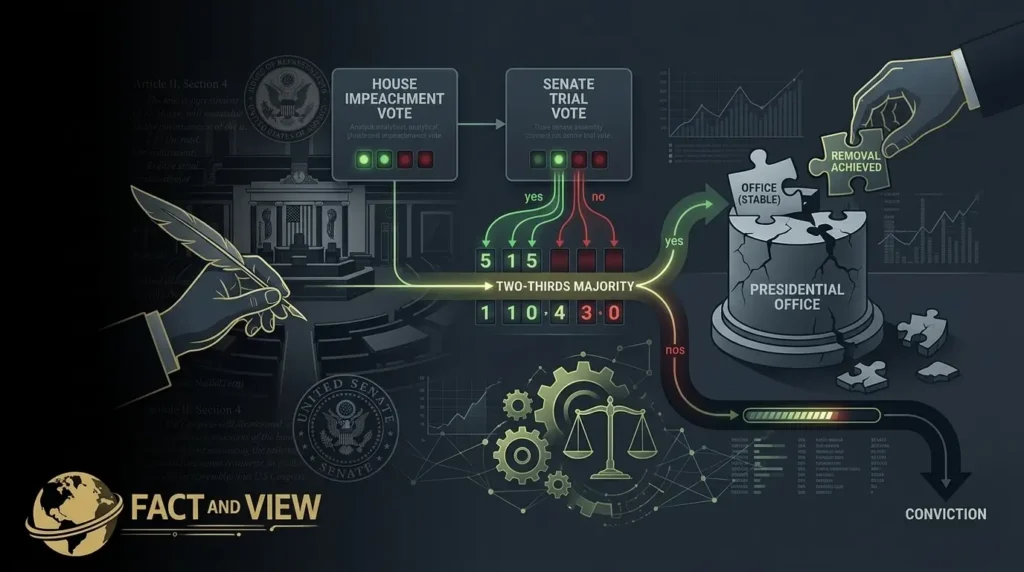
The Constitution offers exactly two paths to remove a sitting president. Both are demanding by design, and conflating them is where most public confusion starts.
Path One: Impeachment and Conviction
- The House impeaches with a simple majority vote, formally charging the president, similar to an indictment rather than a conviction.
- The Senate tries the case, presided over by the Chief Justice, with House-appointed managers acting as prosecutors.
- Conviction and removal require a two-thirds Senate supermajority, 67 of 100 votes, an extraordinarily high bar that has never been reached against any sitting US president.
- Three presidents have been impeached (Andrew Johnson, Bill Clinton, and Trump himself twice), and every single Senate trial has ended in acquittal.
Path Two: The 25th Amendment
- Section 4 allows the vice president and a majority of the Cabinet to declare the president unable to discharge his duties, temporarily transferring power.
- If the president contests that declaration, as any president certainly would, Congress must resolve it, and reaffirming the president’s incapacity requires a two-thirds vote in both chambers, an even steeper bar than impeachment.
- This mechanism was designed for incapacitation, not policy disagreement or alleged misconduct, and legal scholars broadly agree it was never intended as a political weapon.
Data/Facts: Representative Larson explicitly called for Cabinet invocation of the 25th Amendment in his April filing, tying it to Trump’s Iran war conduct. No Cabinet member has publicly supported such a move.
The View: The 25th Amendment path is, practically speaking, closed here. It requires the president’s own appointees to act against him, something with essentially no historical precedent for a sitting Cabinet loyal to the president who appointed them. Treat any 25th Amendment talk as rhetorical pressure, not a live procedural threat.
The Current Math in Congress
Data/Facts: Republicans control the House of Representatives heading into the 2026 midterms, and Republicans also hold the Senate majority. Removing a president requires 67 Senate votes for conviction, meaning even a united Democratic caucus would need to peel off well over a dozen Republican senators.
The View: This is the number that actually settles the question, more than any speech, resolution, or petition. No realistic combination of current Senate votes produces 67 for conviction. Impeachment, if the House ever passed it, would functionally end at “acquitted,” just as it did in both of Trump’s prior impeachments in 2020 and 2021.
A few additional factors worth tracking:
- Public opinion polling on impeachment varies sharply depending on who commissions it; advocacy-funded polls have reported majority support among self-identified likely 2026 voters, while independent surveys show a more divided electorate closely tracking existing partisan lines.
- Prediction markets, which aggregate real money bets on political outcomes, have assigned only modest odds to impeachment or removal occurring by year-end, reflecting the same procedural math described above rather than any judgment on the underlying allegations.
- A competing House effort, led by Republican Darrell Issa, seeks to formally expunge Trump’s two prior impeachments from the congressional record, illustrating how thoroughly this question has become a partisan proxy fight rather than a shared legal inquiry.
Risks and Opportunities: Three Scenarios
Base case (most likely): Impeachment resolutions continue circulating as messaging tools through the midterms without a House floor vote, or with a vote that fails or narrowly passes without any realistic Senate conviction path. Government functions largely as normal, with political energy channeled into November’s elections rather than a removal fight.
Negative scenario (low probability): A major, verifiable new development, a documented national security failure, credible evidence of serious legal violations, or Republican-held seats shifting dramatically after the midterms, changes the political calculus enough to make impeachment proceedings more than symbolic. Even here, removal itself remains unlikely without a broader Senate realignment.
Positive scenario (from a stability standpoint): Ongoing diplomatic progress on Iran and a stabilizing labor market reduce the intensity of current grievances, and impeachment talk fades as a dominant news cycle the way it did after both prior acquittals, redirecting political energy toward the midterms themselves.
How This Actually Affects Your Wallet and Business
Data/Facts: Neither of Trump’s prior impeachments produced a sustained market downturn; equity indices moved on unrelated macro news during both episodes far more than on impeachment headlines. July 2026 payroll data showed hiring slowed sharply, with a net loss of 23,000 jobs and prior months revised down by 103,000, while the Federal Reserve under new Chair Kevin Warsh held interest rates steady at its June meeting amid still-elevated inflation.
The View: Impeachment talk itself is not the economic risk investors and small business owners should be tracking closely. History strongly suggests markets treat a low-probability, no-removal outcome as background noise. The real transmission channel to your wallet runs through the war in Iran and its effect on energy prices, through a labor market that’s already showing cracks, and through a Federal Reserve trying to balance both at once. Political conflict compounds that uncertainty at the margins, mostly by consuming legislative bandwidth that might otherwise go toward fiscal policy, appropriations, or economic relief measures, rather than by threatening the presidency’s stability directly.
For a business owner, the more practical planning question isn’t “will Trump be removed,” it’s “how do I manage costs if oil prices stay elevated and hiring stays soft while Washington is consumed by this fight instead of legislating.”
The Bottom Line
Congress has the constitutional tools to remove a president, but the Constitution deliberately makes that a near-impossible bar to clear without overwhelming, bipartisan consensus. Multiple impeachment resolutions filed in 2026 reflect genuine political conviction from their sponsors, but they run into the same 67-vote wall that stopped Trump’s two prior impeachments and every other Senate trial in American history.
What deserves your attention instead is the economic backdrop this fight is playing out against: a softening labor market, a war shaping energy costs, and a Fed trying to navigate both. That’s where your wallet is actually exposed, regardless of how the impeachment headlines resolve.
For a deeper breakdown of the Iran war’s economic ripple effects and what the Fed’s next moves could mean for your portfolio, check out our latest analysis on the FACT AND VIEW NEWS YouTube channel.
Frequently Asked Questions
Can the House impeach Trump with a simple majority?
Yes. Impeachment itself, the formal charge, only requires a simple majority in the House. It does not remove the president from office by itself.
How many Senate votes are needed to remove a president?
Sixty-seven, a two-thirds supermajority. No Senate trial in US history has reached that threshold against a sitting president.
Has Trump been impeached before?
Yes, twice, in 2019 and 2021. The Senate acquitted him both times, falling well short of the 67 votes needed for conviction.
Is the 25th Amendment a realistic path to removing Trump?
Not currently. It requires the vice president and a majority of the Cabinet to act, or a two-thirds vote in both chambers if the president objects, and no Cabinet official has signaled support for invoking it.
Does impeachment news typically move financial markets?
Historically, no, not on its own. Prior Trump impeachments coincided with market moves driven by unrelated economic events rather than the impeachment proceedings themselves.
Could the 2026 midterms change the outcome?
Potentially, but even a Democratic House majority after the midterms wouldn’t guarantee Senate conviction, since that chamber’s composition changes more slowly and the 67-vote threshold remains extremely high.
Sources
- Congress.gov — H.Res.353, H.Res.537, and H.Res.939, 119th Congress
- Congressman John Larson — “Larson Files Articles of Impeachment, Calls for 25th Amendment”
- Congressman Al Green — “Rep. Al Green Declares President Trump Will Face Articles of Impeachment”
- Connecticut Public — “Rep. John Larson files articles of impeachment against Trump”
- National Constitution Center — background on Article I and Article II impeachment provisions and the 25th Amendment
- U.S. Bureau of Labor Statistics — Employment Situation Summary, July 2026
- Federal Reserve Board — June 2026 FOMC statement and press conference
Disclaimer: This article explains constitutional procedure and current political developments for informational purposes. It does not represent an endorsement of any impeachment effort or political position, and does not constitute financial or investment advice.