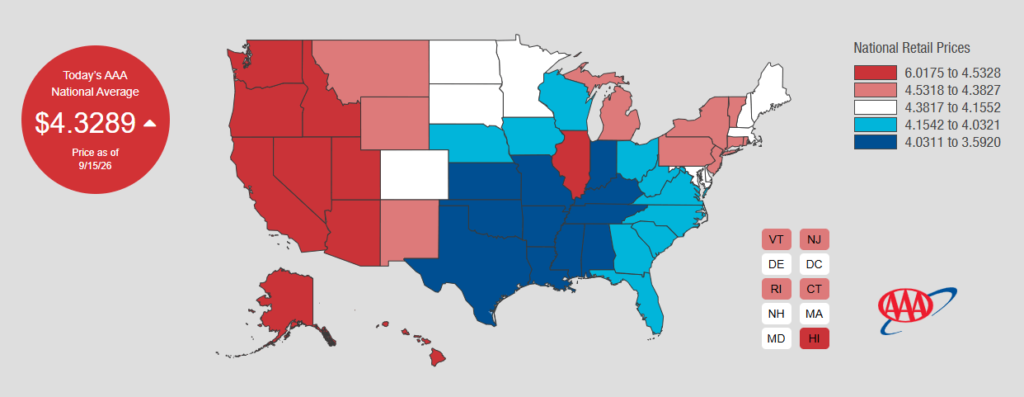
Gasoline is averaging $4.32 a gallon nationally. Diesel is averaging $6.23. Both are the highest prices AAA has ever recorded.
That alone would be a significant economic story. What makes it a potential U.S. fuel crisis, rather than just an expensive month at the pump, is what’s happening one step upstream, inside the refineries that turn crude oil into the fuel Americans actually buy.
The Big Number
AAA’s national average put regular gasoline at $4.32 a gallon and diesel at $6.23 a gallon this week, according to AAA’s daily price data. A year earlier, gasoline was trading closer to $2.80 and diesel around $3.70, according to the same AAA series, an increase of more than 50% for gasoline and roughly 65% for diesel.
Diesel’s climb past $6 a gallon for the first time on record came in mid-September, per AAA data cited by the Associated Press and CNN. Gasoline’s September reading is also the highest AAA has ever recorded for this point in the calendar year, according to CNN.
What Is Happening to Fuel Supplies?
The crude oil supply itself isn’t the primary bottleneck. U.S. commercial crude inventories stood at 424.5 million barrels in the week ending August 28, according to the EIA’s Weekly Petroleum Status Report, about 1% above the five-year average for that week.
The pressure is concentrated further down the supply chain, in refined products. Gasoline inventories that same week were 6% below their five-year average, and distillate inventories, the category that includes diesel and heating oil, were 14% below their five-year average, per the same EIA report. Total product supplied to the market, a measure of demand, averaged 20.4 million barrels a day over the trailing four weeks, down 4% year-over-year, with distillate product supplied down 6%.
U.S. refineries, meanwhile, are running close to flat out. For the week ending September 4, refiners processed 17.6 million barrels of crude a day at 97.8% capacity utilization, according to the EIA, up from 97.8% and 17.5 million barrels a day the week before. There is very little spare domestic refining capacity left to bring online.
Globally, the shortfall is larger. More than 7 million barrels a day of Middle Eastern and Russian refined-product flows were offline as of mid-September, and global refinery throughput was running 4.2 million barrels a day below year-ago levels, according to OilPrice.com’s market analysis.
Why Refining Matters
Crude oil has to be converted into gasoline, diesel and jet fuel before anyone can use it, and that conversion capacity is not something that expands quickly. Building a new refinery takes years and billions of dollars; idled units and permanent closures, several of which have removed U.S. refining capacity over the past decade, can’t be reversed on short notice.
That’s why a barrel of crude sitting in inventory doesn’t automatically translate into cheaper gasoline if the refineries needed to process it are already running near their limits. The gap between what refiners pay for crude and what they earn selling finished fuel, known as the crack spread, is the clearest real-time signal of this squeeze.
What the Oil Companies Are Saying
ExxonMobil CEO Darren Woods told CNBC’s “Squawk Box” in late July that refining constraints had created a “disconnect” between crude oil and pump prices, meaning additional crude supply wouldn’t necessarily bring gasoline prices down quickly.
Refiners’ own financial disclosures point the same direction. Phillips 66’s second-quarter 2026 SEC filing describes its “realized refining margin per barrel” as a measure comparable to industry crack spreads, the same metric analysts have flagged as running far above historical norms this year, according to the company’s Form 10-Q.
Financial results back that up in dollar terms. Marathon Petroleum’s refining and marketing margin rose from $17.58 to $36.33 per barrel year-over-year, roughly doubling, according to the company’s reported second-quarter 2026 results. Combined second-quarter profits at Marathon Petroleum, Phillips 66 and Valero Energy reached $12.6 billion, up from $2.9 billion in the same quarter of 2025, per OilPrice.com’s review of company earnings.
What the Data Shows
The market data and the companies’ results tell a consistent story, even though neither side has framed it as a “crisis” outright.
- The diesel crack spread, the premium refiners earn converting crude into diesel, hit a record above $90 a barrel in mid-August; Investing.com put the ultra-low-sulfur diesel futures crack at $93.84 on August 10, while 24/7 Wall St. cited a separate realized crack spread measure at $102.20 the same week. The two figures differ because they track different benchmarks, but both point to the same historic extreme.
- The broader 3-2-1 crack spread, the standard industry profitability gauge, traded as high as the $59-to-$70-per-barrel range this year, according to CNBC and Investing.com, against a 2010-2021 historical average of roughly $19-to-$22 a barrel.
- Refiner stocks have moved accordingly: Marathon Petroleum and Valero each gained more than 80% to nearly 125% in 2026 through mid-August, and Phillips 66 gained more than 50%, according to CNBC, far outpacing an S&P 500 gain of around 11% over the same period.
BofA analyst Francisco Blanch has forecast that diesel markets will remain tight and expensive well into next year, according to 24/7 Wall St., a specific attributed forecast rather than an established fact. Not every analyst is convinced the current margins are permanent. One brokerage, Freedom Broker, cautioned in a client note reported by Investing.com that current refiner earnings reflect “temporary supply disruptions rather than structural improvement in mid-cycle profitability.”
Why Diesel Is Particularly Important
Diesel isn’t just another grade of fuel. It powers the trucks that move most consumer goods, the trains that haul freight long-distance, the ships that carry imports and exports, the equipment used in construction, and much of the machinery used in agriculture.
Distillate inventories running 14% below their five-year average, per EIA data, means there is less cushion than usual to absorb any new disruption without prices moving sharply. Analysts covering the trucking and freight sector have already flagged diesel costs as a direct pressure point on shipping rates, which typically feed into the price of delivered goods with a lag of weeks rather than months.
What This Means for American Drivers
At $4.32 a gallon, filling a 15-gallon tank costs roughly $65, compared with roughly $42 a year ago at prices near $2.80. For a household that fills up weekly, that’s an additional expense of close to $100 a month.
For businesses running diesel fleets, the math is steeper. A long-haul truck burning 150 gallons on a cross-country run now costs roughly $935 in fuel at $6.23 a gallon, versus about $555 a year ago, a difference trucking companies either absorb or pass along through freight rates.
None of this guarantees a proportional jump in the price of any single grocery item or delivered package; transportation is only one input among many. But it is a genuine, quantifiable cost increase moving through the supply chain, not a hypothetical one.
What to Watch Next
- The EIA’s weekly Petroleum Status Report, released each Wednesday, particularly gasoline and distillate inventory changes.
- Refinery utilization rates; any drop from the current high-97% range would signal either new outages or planned maintenance removing more capacity from an already tight market.
- The 3-2-1 and diesel crack spreads, which show whether the refining margin squeeze is easing or intensifying.
- AAA’s daily national gasoline and diesel averages.
- Third-quarter earnings from Marathon Petroleum, Valero and Phillips 66, due in the coming weeks, for updated margin guidance.
- Global refinery outage data, given that more than 7 million barrels a day of Middle Eastern and Russian product capacity remained offline as of mid-September.
The evidence points toward something more specific than a simple crude oil price shock. U.S. crude inventories are roughly in line with historical norms, but gasoline and especially distillate inventories are running well below their five-year averages, refineries are operating close to full capacity with little room to increase output, and refining margins have reached levels rarely seen in the industry’s recent history. That combination, a genuine bottleneck in converting crude into finished fuel, layered on top of already-elevated crude prices, is a different and arguably more structural problem than a temporary spike in oil prices alone. Whether it resolves quickly likely depends less on crude supply and more on how fast global refining capacity, both in the U.S. and in the Middle East and Russia, can come back online.
Sources
- AAA — Daily national average gasoline and diesel prices
- U.S. Energy Information Administration — Weekly Petroleum Status Report, week ending September 4, 2026
- U.S. Energy Information Administration — Weekly Petroleum Status Report data, week ending August 28, 2026, via IndexBox summary
- OilPrice.com — “Global Fuel Squeeze Triggers U.S. Refiners Stocks Rally”
- Investing.com — “3-2-1 crack spread near $70 a barrel: what it means for refining stocks”
- 24/7 Wall St. — “Diesel Prices Are Breaking Records: 3 Refiners Turning the Crisis Into Record Profits”
- CNBC — “Refiner stocks are on a nearly unprecedented run. History says it could end soon”
- Phillips 66 — Form 10-Q, Q2 2026, filed with the U.S. Securities and Exchange Commission
- Yahoo Finance — “Oil Above $100 Is Creating a New Opportunity Beyond the Major Producers”
- CNN Business — “Why Trump’s effort to boost refining capacity won’t lower gas prices”
Disclaimer: This article separates verified data, company disclosures, and attributed analyst opinions throughout. It is a news analysis, not investment advice or political commentary.