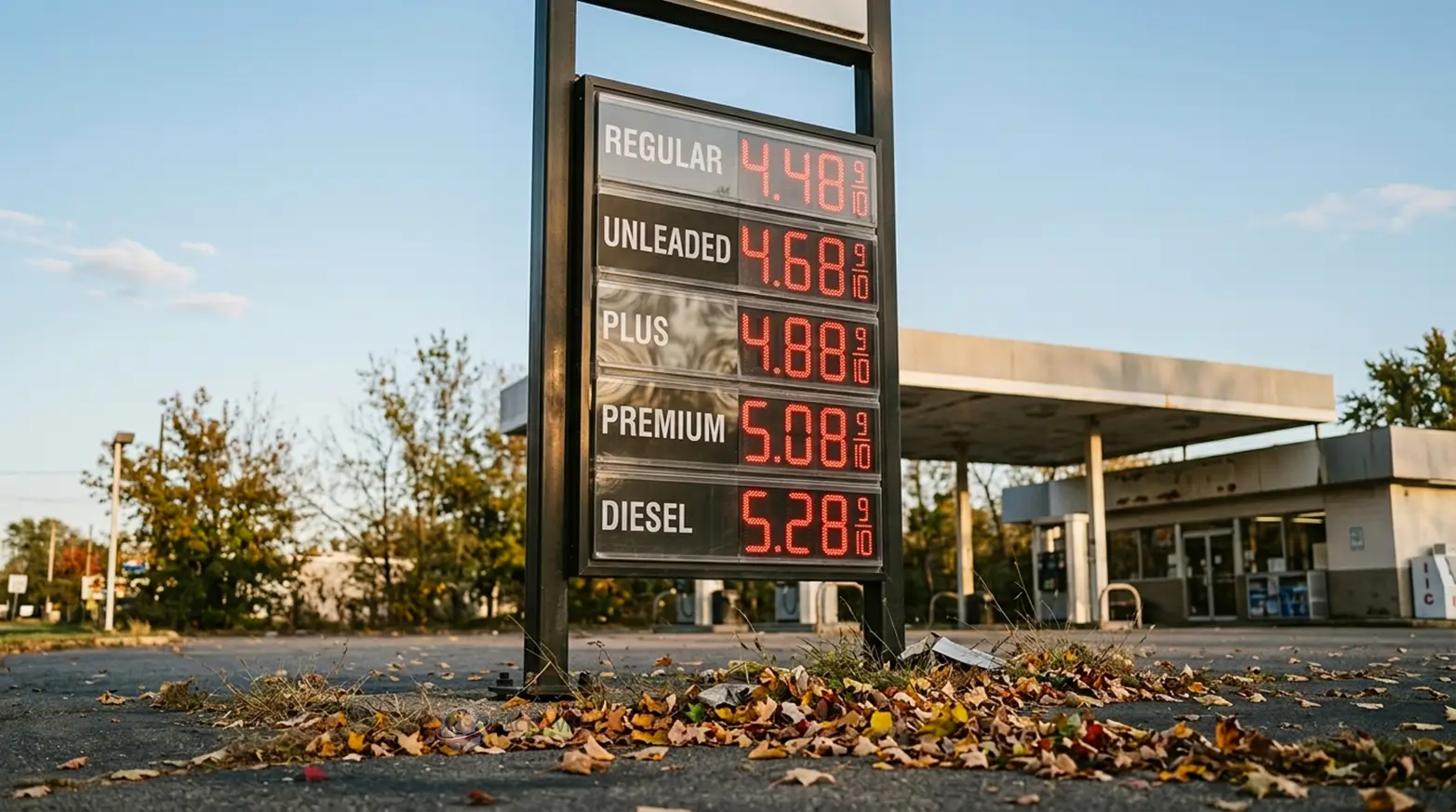
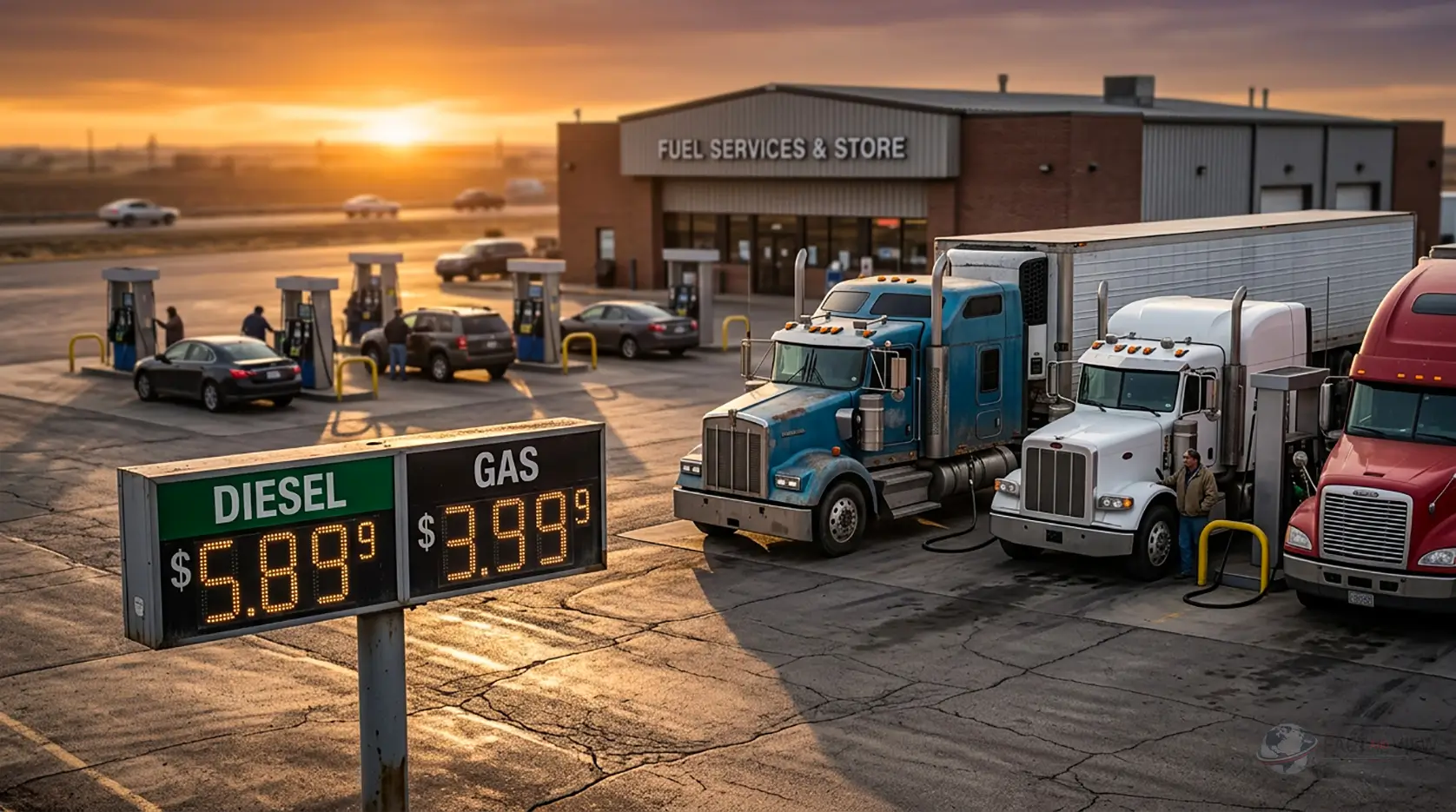
Gas prices get the headlines. Diesel sets the cost of moving almost everything Americans buy, and right now diesel is trading nearly two dollars above gasoline, the widest gap on record.
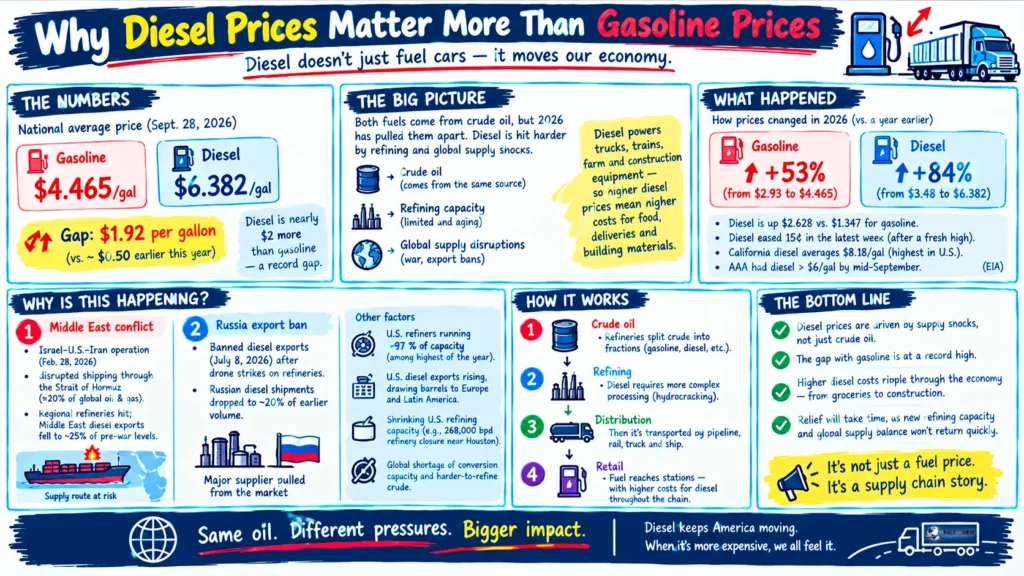
As of the week ending September 28, 2026, the national average stood at $4.465 a gallon for regular gasoline and $6.382 a gallon for on-highway diesel, a premium of about $1.92. Earlier this year, before a series of overseas supply shocks, that gap ran closer to 50 cents, a far more typical spread between the two fuels.
That shift matters because diesel does not just fuel personal vehicles. It fuels the trucks, trains, and farm and construction equipment that move food, fuel, and freight across the country. When diesel gets more expensive relative to gasoline, the pain shows up less at the pump for most drivers and more in the price of groceries, deliveries, and building materials.
The Big Picture
Gasoline and diesel both come from crude oil, but 2026 has pulled them apart. Diesel’s price surge is not mainly an oil story. It’s a refining and global-supply story, tied to overseas conflict and a Russian export ban, that has hit diesel-type fuels far harder than gasoline. Because diesel moves the trucks that carry nearly everything Americans buy, that distinction matters well beyond the price on a gas station sign.
What Happened
EIA data show how fast the gap opened. Early in 2026, the U.S. average ran near $2.93 a gallon for gasoline and $3.48 for diesel. By late September, gasoline had climbed to $4.465, up about 53%, while diesel had jumped to $6.382, up roughly 84% over the same stretch.
A few other data points from EIA’s weekly survey:
- Diesel is up $2.628 from a year earlier, compared with a $1.347 increase for gasoline.
- Diesel eased slightly in the most recent week, down 15 cents, after touching a fresh high of $6.529 the week before.
- California diesel remains the most extreme in the country, averaging $8.18 a gallon.
AAA’s daily survey, which uses a different sample and methodology, had already shown diesel crossing $6 a gallon by mid-September. The exact figure varies by tracker, but every major source agrees on the direction: diesel is at or near record highs, and its gap with gasoline has rarely, if ever, been this wide.
Why Is This Happening?
Two overlapping shocks explain most of the move.
The first is the war involving Israel, the United States, and Iran, which began with a joint military operation in the early hours of February 28, 2026, and disrupted shipping through the Strait of Hormuz, a passage that normally carries roughly a fifth of the world’s oil and natural gas. Regional refineries, not just crude production, have been hit directly, and Middle East diesel exports have fallen to roughly a quarter of pre-war levels even as the region’s crude exports have largely recovered.
The second is Russia’s move to halt diesel exports, banning them starting July 8, 2026, after Ukrainian drone strikes damaged Russian refineries. Russian diesel shipments dropped to about a fifth of their earlier volume, pulling a major supplier out of a market that was already tight.
Both shocks hit refining capacity specifically, not crude oil supply. U.S. refiners have responded by running close to full tilt, with utilization hitting roughly 97% of capacity, among the highest rates of the year, even as distillate production kept falling. U.S. diesel exports climbed at the same time, pulling barrels toward Europe and Latin America even as domestic inventories fell. The result: domestic supply stayed tight even as refiners worked flat out.
Gasoline hasn’t faced these specific constraints. Its price still tracks crude oil fairly closely, which is a big part of why it rose less than diesel even as crude itself climbed.
The squeeze also predates the war. U.S. refining capacity had already been shrinking for years, including the closure of a roughly 268,000-barrel-a-day refinery near Houston. Analysts who track global refining describe the underlying problem as sitting in the machinery rather than the oil itself: aging plants, limited new conversion capacity worldwide, and a lighter global crude slate that is harder to turn into distillate fuel. China’s spare refining capacity could realistically add only an estimated 150,000 to 200,000 barrels a day, nowhere near enough to offset what the Middle East and Russia have lost. That left the war and the export ban hitting a market with very little spare capacity to begin with.
How Does It Work?
A barrel of crude oil doesn’t become one product. Refineries split it into fractions: lighter ones become gasoline, while heavier “middle distillate” fractions become diesel, heating oil, and jet fuel. Diesel, heating oil, and jet fuel essentially compete for the same refining units and crude slate, so a disruption to that conversion capacity squeezes diesel much harder than it squeezes gasoline.
That scarcity shows up in the refiner’s margin, known as the crack spread. The ultra-low-sulfur diesel crack spread has recently traded above $100 a barrel, a record level reflecting how much more refiners can charge to turn crude into diesel right now versus turning it into gasoline.
EIA’s own breakdown of what goes into a gallon illustrates the difference. For gasoline at $4.48 a gallon in May 2026, crude oil made up about 52% of the retail price, refining about 22%, distribution and marketing about 15%, and taxes about 12%. For diesel at $5.60 a gallon that same month, crude oil’s share was smaller, around 42%, while refining and distribution and marketing made up a larger combined piece of the price. In plain terms: diesel’s price is driven less by the oil itself and more by how scarce the capacity to refine and move it has become. That’s exactly where the current shortage lives.
What It Means for Americans
Most drivers don’t buy diesel directly, so the headline pump price touches fewer households than gasoline does. The bigger channel runs through freight. Trucks move roughly 70% of all domestic freight tonnage, carrying groceries, clothing, appliances, and e-commerce packages from warehouses to stores and doorsteps.
Carriers typically pass fuel costs to shippers through a surcharge tied to the week’s average diesel price, so higher diesel usually flows into freight bills within days or weeks rather than months. Diesel surged more than 40% in under two months early in 2026, and one industry study modeled that a mid-sized Texas fleet on a standard monthly surcharge reset schedule could have failed to recover roughly $168,000 in fuel costs during that stretch, since surcharge schedules often lag real-time price swings.
That cost pressure is starting to show up in official data. Producer prices for truck transportation of freight rose about 2% in August 2026 alone, part of a broader producer price increase that accelerated to 5.4% year-over-year, though diesel is one contributor among several, including tariffs and other input costs. Separately, government inflation data for July showed headline personal consumption expenditures inflation running at 3.7% year-over-year, with the energy component up more than 15%.
What this probably doesn’t mean is an immediate jump in grocery prices. Diesel is a cost that gets built into contracts and pricing cycles over time, not instantly at the register. One simple statistical analysis found that diesel price swings have historically explained under half the variation in trucking’s own producer price index, with driver availability and freight demand also playing a role. The relationship is real, but partial and lagged, not mechanical.
A few groups feel this more directly:
- Owner-operators and small trucking fleets, who have less room to negotiate rapid surcharge adjustments and absorb more volatility in the meantime.
- Diesel pickup and work-truck owners, paying close to $2 more per gallon than gasoline buyers. A work truck driven 25,000 miles a year at 12 miles per gallon burns about 2,083 gallons; at current diesel prices, that’s roughly $13,300 a year in fuel, versus closer to $9,300 at today’s gasoline price.
- Northeast households that heat with oil, since diesel and heating oil are chemically similar distillates drawn from the same tight supply pool heading into winter.
Car owners and businesses further removed from diesel have been comparatively insulated so far, since gasoline has risen by less and the cost of a diesel-dependent supply chain spreads across millions of transactions rather than landing on one bill.
Small retailers and restaurants sit in between. They don’t buy diesel, but nearly everything on their shelves arrived by truck. Bulky goods like furniture, appliances, and building materials are especially exposed, since they take up more truck capacity per dollar of value, meaning freight is a larger share of their final price.
What to Watch Next
A few signals will show whether this gap narrows or widens:
- EIA’s weekly Petroleum Status Report, tracking distillate inventories, refinery runs, and exports. A sustained inventory build alongside lower exports would signal rebalancing.
- Developments in the Israel-Iran war and Russia’s export ban. Energy officials have cautioned that restoring normal oil and gas flows from the region could take around six months, even after fighting stops.
- The winter heating season, which typically tightens distillate markets further as heating oil demand competes with diesel for the same barrels.
- Upcoming CPI and PPI releases, which will show how much of the distillate shock works its way into broader consumer prices.
- How the Federal Reserve weighs that risk. Persistently high diesel and freight costs add to the case for caution on inflation even if headline gasoline prices stay more contained.
The Bottom Line
Diesel is trading near record highs, and its premium over gasoline is close to the widest on record. The evidence points to a refining and global-supply problem specific to diesel-type fuel, driven by war-related disruption in the Middle East and Russia’s export ban, rather than a shortage of crude oil itself. U.S. refiners are already running close to capacity, which limits how quickly more diesel can reach the market even with ample crude supply.
What remains uncertain is timing and scale: how long the overseas disruptions last, how much of the cost gets absorbed by carriers versus passed on to shippers and consumers, and how a tight winter heating season might add further pressure. The clearest way to track this story is EIA’s weekly price and inventory data, updated every Monday.
Read more :
- Iran rejection / Hormuz / Camp David → US-Iran Deal: Will Reopening Hormuz Lower Gas Prices? and US This Week: Xi Summit, Iran Vote, Press Ban Blocked
- Diesel export ban / fuel prices → same Hormuz piece above, plus How Tariffs Actually Raise Prices for the broader pattern of trade restrictions raising US consumer costs
- Jobs report / Fed / Treasury yields → US Debt Has Passed $40 Trillion and Trump’s $5,000 Dividend: Who Will Really Pay?
Sources:
- U.S. Energy Information Administration — Gasoline and Diesel Fuel Update
- U.S. Energy Information Administration — Weekly Petroleum Status Report
- U.S. Bureau of Labor Statistics — Producer Price Index
- U.S. Bureau of Economic Analysis — Personal Consumption Expenditures Price Index
- American Trucking Associations — Economics and Industry Data