
Why Emergency Savings Matter More When the Cost of Living Is High
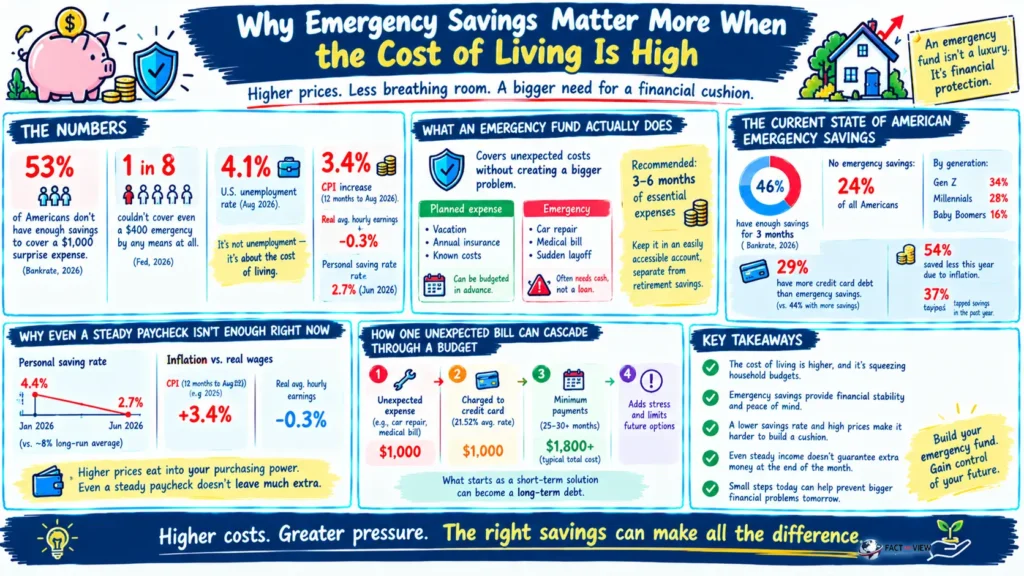
More than half of Americans, 53%, don’t have enough readily available savings to cover a surprise $1,000 expense, according to Bankrate’s 2026 Annual Emergency Savings Report. Using a stricter, longer-running measure, the Federal Reserve’s Survey of Household Economics and Decisionmaking has found that roughly 1 in 8 adults couldn’t cover even a $400 emergency by any means at all, not savings, not credit, not borrowing from family.
This isn’t primarily a story about unemployment. The U.S. unemployment rate sat at 4.1% in August 2026, close to historically normal levels. It’s a story about the gap between what a typical paycheck covers and what it used to cover, a gap that’s widened enough that even steady income no longer guarantees a cushion.
Here’s why that cushion matters more right now than it has in years, and why building one has gotten harder even for households doing everything right.
What an Emergency Fund Actually Does
An emergency fund has one job: covering a cost you didn’t plan for, without creating a new, more expensive problem to solve the first one.
That distinction matters. A planned expense, a vacation, a known annual insurance bill, can be budgeted for in advance. An emergency, a car transmission failing, an unplanned medical bill, a sudden layoff, can’t. Without liquid savings to absorb it, the expense typically gets paid for with borrowed money instead, usually a credit card.
Financial planners commonly recommend keeping three to six months of essential expenses in an easily accessible account, separate from retirement savings or investments that can lose value or carry withdrawal penalties. The size of that target depends heavily on job stability and household circumstances; a dual-income household with stable employment needs a smaller cushion than a single-income household or a freelancer with variable pay.
The point isn’t the specific number. It’s liquidity: money that’s there, in cash or its equivalent, the moment it’s needed, without having to sell an asset, wait for a loan approval, or pay interest to access funds that are technically already yours.
The Current State of American Emergency Savings
The data shows a country that is, on average, thinly cushioned.
According to Bankrate’s 2026 survey, only 46% of Americans have enough emergency savings to cover three months of expenses. Nearly a quarter, 24%, have no emergency savings at all, a figure that climbs to 34% of Gen Z respondents and 28% of Millennials, compared with 16% of Baby Boomers.
The same survey found that 29% of Americans currently carry more credit card debt than they have in emergency savings, versus 44% who have more savings than debt. Fifty-four percent of people who said they saved less this year pointed to inflation and rising prices as the reason, and 37% reported tapping their emergency savings at some point in the past year.
Asked specifically what they’d do to cover a $1,000 emergency, only 30% of Bankrate respondents said they’d pay it from savings. Thirty-three percent said they’d go into debt to cover it, and the remainder said they’d rely on current income, cut spending elsewhere, or find another way to manage it.
Why Even a Steady Paycheck Isn’t Enough Right Now
Here’s the part that surprises people who assume a stable job should be enough: the national personal saving rate has been falling through 2026, even with unemployment low.
According to the Bureau of Economic Analysis, Americans saved about 4.4% of disposable income in January 2026. By June, that had dropped to 2.7%, well below the long-run average of roughly 8%. That decline happened during a period when most people who wanted jobs had them.
The explanation lies in why inflation affects savings even when a paycheck looks steady on paper. The Consumer Price Index rose 3.4% over the twelve months ending in August 2026. Real average hourly earnings, what an hour of work actually buys after accounting for prices, fell 0.3% over that same period, according to the Bureau of Labor Statistics. When the cost of groceries, rent, insurance, and utilities rises faster than take-home pay, there’s simply less left over at the end of the month to set aside, regardless of how reliable that paycheck is.
This is the core reason a growing cost of living makes emergency savings both more necessary and harder to build at the same time. The same pressures that make an unexpected bill more dangerous also shrink the amount available to prepare for one.
How One Unexpected Bill Can Cascade Through a Budget
Without savings, an unplanned expense doesn’t just cost money once. It often costs money twice: once for the expense itself, and again in interest if it gets charged to a credit card and not paid off quickly.
The average credit card interest rate stood at 21.00% across all accounts in the first quarter of 2026, according to the Federal Reserve’s G.19 Consumer Credit release, and 21.52% for accounts carrying a balance. A $1,000 emergency charged to a card at that rate, paid down only at the minimum required payment, can take years to clear and ultimately cost well more than the original $1,000, a dynamic this publication has broken down in detail elsewhere.
The cascading effect goes further than interest. A household now making a larger monthly credit card payment has less room in next month’s budget, which raises the odds that the next unexpected cost, even a smaller one, also ends up on credit. Bankrate’s finding that 29% of Americans now carry more credit card debt than emergency savings is a snapshot of that cycle already in motion for a meaningful share of the country.
Why “Just Save More” Misses the Point
A common response to weak savings data is that households should simply cut discretionary spending and build a cushion. That advice isn’t wrong, but it’s incomplete, and treating it as the whole answer overstates how much control many households actually have.
Economists generally distinguish between two different pressures on savings: structural pressure, where the rising cost of necessities leaves less income available no matter how disciplined a household is, and behavioral pressure, where discretionary spending choices crowd out saving that would otherwise be possible. Bankrate’s survey data suggests both are at play, inflation is the most commonly cited reason for reduced saving, but income changes and job instability are cited too.
Financial advisors generally still recommend building even a small cushion, since any savings reduce reliance on high-interest debt. But the honest picture is that for a household already spending most of its income on necessities, the broader gap between falling inflation and financial strain means “save more” is a harder instruction to follow than it sounds.
Who’s Most Exposed
The risk isn’t distributed evenly.
Younger adults carry the thinnest cushions: Bankrate’s data shows roughly a third of Gen Z and more than a quarter of Millennials have no emergency savings at all, compared with 16% of Baby Boomers, a gap that reflects both lower accumulated savings over time and, for many younger workers, lower or less stable income.
Renters and workers with variable or gig income face a similar structural disadvantage: no employer-provided sick leave to fall back on during a health issue, no home equity to borrow against, and often less predictable monthly income to plan around in the first place.
Households carrying existing credit card debt are doubly exposed. They’re more likely to have used savings to cover past emergencies, more likely to face a new emergency with less cushion left, and more likely to see a new unexpected bill compound an existing balance rather than start a fresh one.
What Could Help
A few developments could ease the pressure, though none solves the underlying affordability problem on its own.
If real wage growth turns positive again and inflation continues cooling toward the Federal Reserve’s 2% target, households would have more breathing room to rebuild savings without cutting other spending. That outcome isn’t guaranteed; it depends on inflation and wage data still to come.
A newer policy tool is also starting to reach workplaces. The SECURE 2.0 Act, signed into law in 2022, allows employers to offer workers a linked emergency savings account inside their retirement plan, capped at $2,500, with withdrawals available at least once a month and no penalty for accessing the funds. The same law allows one penalty-free withdrawal of up to $1,000 a year directly from retirement savings for a personal or family emergency, repayable over three years. Adoption by employers has been gradual since the provision took effect in 2024, but it represents a concrete, low-cost path to building a cushion for workers who struggle to save outside a payroll deduction.
For households starting from zero, most financial educators and Bankrate itself point to a smaller first target, often $500 to $1,000, rather than the full three-to-six-month goal, as a more realistic starting point that still meaningfully reduces reliance on credit for the first emergency that comes along.
What to Watch
A few releases each year show whether the national savings picture is improving or deteriorating:
- Bankrate’s Annual Emergency Savings Report, typically published in January, for the clearest year-over-year read on how many Americans have a cushion and how large it is.
- The Federal Reserve’s Survey of Household Economics and Decisionmaking, for the $400-expense question and other resilience measures, using a consistent methodology over time.
- BEA’s monthly Personal Income and Outlays report, for the personal saving rate.
- The BLS Real Earnings release, for whether paychecks are gaining or losing ground against inflation month to month.
The Bottom Line
Emergency savings matter more when the cost of living is high for a simple reason: the margin for error shrinks. A smaller gap between income and expenses means a single unplanned bill is more likely to force a choice between debt and going without, and the data shows millions of American households are already making that choice regularly.
What’s genuinely uncertain is how quickly that margin recovers. It depends on whether real wages keep pace with prices, something that has gone in both directions over the past five years and could do so again. What’s clear from the data already in hand is that a steady paycheck, by itself, hasn’t been sufficient to guarantee a financial cushion in 2026, and that gap is the real reason this topic deserves more attention than generic savings advice usually gives it.
Sources:
- Bankrate — 2026 Annual Emergency Savings Report (SSRS/YouGov Plc survey)
- Federal Reserve — Survey of Household Economics and Decisionmaking (SHED)
- U.S. Bureau of Labor Statistics — Consumer Price Index and Real Earnings News Releases, August 2026
- U.S. Bureau of Labor Statistics — The Employment Situation, August 2026
- U.S. Bureau of Economic Analysis — Personal Saving Rate, Personal Income and Outlays
- Federal Reserve — G.19 Consumer Credit Release
- Internal Revenue Service / U.S. Congress — SECURE 2.0 Act of 2022, emergency savings account provisions