

Why Health Care Costs Remain a Financial Burden for American Families
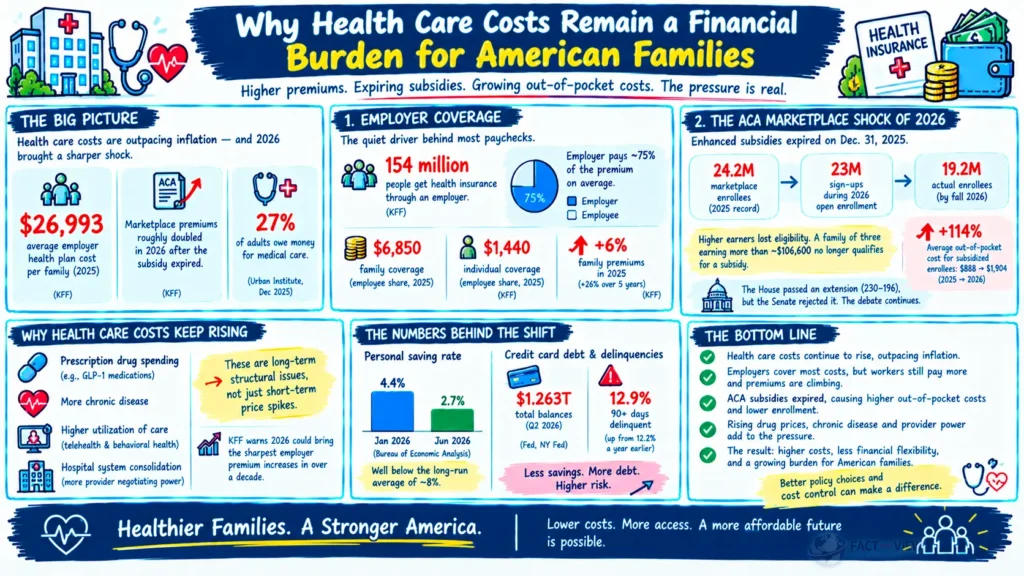
The average family health insurance plan through an employer now costs $26,993 a year, roughly the price of a new compact car, according to KFF’s 2025 Employer Health Benefits Survey. Separately, millions of Americans who buy coverage through the Affordable Care Act marketplace saw their premiums roughly double in 2026 after a pandemic-era subsidy expired. And across the country, 27% of adults report owing money for medical care, according to a December 2025 Urban Institute survey, insured and uninsured alike.
Health care costs have outpaced general inflation for years, but 2026 added a sharper, more immediate shock on top of that slower climb. Some of it is structural and has been building for a decade. Some of it is the direct result of a policy fight still playing out in Washington. Here’s what’s driving each piece, and what it means for a typical household’s budget.
Employer Coverage: The Quiet Driver Behind Most Paychecks
More Americans get health insurance through an employer than any other source, about 154 million people, according to KFF. For most of them, the real cost is partly hidden, since employers cover roughly three-quarters of the premium on average.
That doesn’t mean workers are shielded. The average worker contributed $6,850 toward family coverage and $1,440 toward individual coverage in 2025, according to KFF’s annual survey, the 27th in a series that has tracked employer coverage since the late 1990s. Including both the employer and employee share, family premiums rose 6% in 2025 and have climbed 26% over the past five years, a steeper increase than wage growth over the same period in dollar terms once rising worker contributions are factored in.
Employers surveyed by KFF pointed to a consistent set of cost drivers: rising prescription drug spending, including strong demand for GLP-1 weight-loss medications, higher rates of chronic disease, and increased utilization of care, particularly behavioral health services accessed through telehealth. Hospital system consolidation has also strengthened providers’ negotiating leverage over insurers, a trend health economists have linked to higher prices independent of how much care is actually delivered.
KFF’s own survey language is notably direct about what comes next: early indicators suggest 2026 could bring the sharpest employer premium increases in over a decade, absent significant changes to plan design or cost-sharing.
The ACA Marketplace Shock of 2026
The sharpest, most immediate change, hit people who buy their own insurance through the Affordable Care Act marketplace.
Enhanced premium tax credits, first enacted in 2021 under the American Rescue Plan Act and extended through 2025 by the Inflation Reduction Act, had expanded eligibility for ACA subsidies and increased their value. They helped drive marketplace enrollment from about 11 million people before 2021 to a record 24.2 million by 2025. Those enhanced credits expired on December 31, 2025, as scheduled under existing law.
Congress had the opportunity to extend them and didn’t. The House passed a three-year extension in January 2026 by a 230-196 vote, with 17 Republicans joining Democrats. The Senate subsequently rejected that measure, along with a Republican alternative from Senators Bill Cassidy and Mike Crapo that would have redirected subsidy funding into health savings accounts rather than extending the existing tax credit structure. Neither bill reached the 60 votes needed to advance.
With the enhanced credits gone, subsidized marketplace enrollees reverted to a smaller, pre-2021 credit structure, and some higher earners lost eligibility for any subsidy at all; a family of three earning more than roughly $106,600 no longer qualifies. KFF estimated the change would roughly double what subsidized enrollees pay out of pocket on average, from $888 a year in 2025 to $1,904 in 2026, a 114% increase. Enrollment data bears out the impact: sign-ups during the main 2026 open enrollment period fell to about 23 million from 24.2 million the year before, and KFF Health News later reported effectuated enrollment, meaning people who actually kept paying for their plan, had dropped further, to roughly 19.2 million by the fall.
Democrats who pushed the extension argued it was necessary to prevent a sharp rise in the uninsured population; Republicans who opposed it generally argued the subsidies had grown too costly and too broadly available to higher earners, and that the marketplace needed structural reform rather than a straight renewal. Both positions were debated extensively in Congress, and the matter remains unresolved.
A Developing Policy Fight, Not a Settled One
As recently as October 14, 2026, the Trump administration’s Centers for Medicare & Medicaid Services announced it was ending ACA subsidies for another 189,000 enrollees identified as having duplicate government coverage or being deceased, part of a broader fraud-prevention effort that had already removed roughly 551,000 enrollees in 2025. The administration says this step alone will prevent about $738 million in improper payments this year.
That framing isn’t uncontested. KFF Health News reported that outside researchers have pushed back on the idea that improper enrollment explains the broader decline in ACA sign-ups this year, noting the scale of the drop goes well beyond the number of enrollees removed for duplicate coverage. Bipartisan groups in the Senate have also continued negotiating a possible two-year extension with new income limits, though no deal had passed as of this writing. This is a live, developing story, not a closed chapter, and the final shape of ACA affordability for 2027 and beyond is still being negotiated.
Why Premiums Keep Rising Faster Than Almost Everything Else
Set aside the 2026 ACA shock, and health care costs have still been outrunning general inflation for a long stretch, for structural reasons that don’t resolve quickly.
Hospital and physician group consolidation has reduced the number of competing providers in many regions, giving the remaining systems more leverage to negotiate higher rates with insurers, a dynamic documented extensively in health economics research independent of any single year’s inflation rate. Prescription drug spending, particularly for GLP-1 medications used for both diabetes and weight loss, has grown rapidly enough that several major employers have begun restricting or redesigning coverage for those drugs specifically to manage costs. The broader gap between falling inflation and financial strain that households feel elsewhere in their budget shows up here too, since health care’s rate of cost growth rarely tracks the headline inflation number consumers see reported.
Telehealth expansion has increased access to care, which is generally a good outcome for patients, but it has also increased overall utilization, especially for behavioral health services that were previously harder to access. More utilization, even appropriate utilization, shows up as higher total claims costs that eventually factor into next year’s premiums.
When Insurance Isn’t Enough: Medical Debt in America
Having insurance reduces the risk of medical debt. It doesn’t eliminate it.
According to the Urban Institute’s December 2025 Well-Being and Basic Needs Survey, 27% of U.S. adults reported that they or a family member owed medical debt, including 26% of adults who had insurance at the time the debt was incurred. Among adults carrying medical debt, 52% owed money to a hospital specifically, more than any other type of provider, and 54% owed at least $1,000, with 16% owing $5,000 or more.
The burden isn’t distributed evenly. Adults with disabilities reported medical debt at nearly double the rate of adults without disabilities, 41% versus 22%, and researchers found meaningful racial disparities as well, with Black adults reporting medical debt at notably higher rates than white adults across multiple surveys. Researchers at the Urban Institute have also flagged a specific concern looking forward: if more people lose Medicaid coverage in the next few years, as some current projections suggest, medical debt could become more widespread rather than less.
Who’s Most Exposed
A few groups face a disproportionate share of this burden.
Middle-income ACA marketplace enrollees who earned just above the old subsidy cutoff are now fully exposed to list-price premiums for the first time since 2021, a group that includes many early retirees, gig workers, and small-business owners who buy their own coverage. People managing chronic conditions or disabilities face both higher baseline health care utilization and, per the Urban Institute data, a meaningfully higher chance of carrying medical debt regardless of insurance status. And employees at smaller firms tend to pay more: KFF’s data shows smaller employers generally negotiate less favorable rates than large companies, passing more of the cost onto workers’ paychecks.
What Could Change
A few paths could ease the pressure, though none would resolve it quickly.
If the bipartisan Senate talks on a scaled-back, income-capped ACA subsidy extension succeed, premium costs for marketplace enrollees could fall somewhat for 2027, though any deal would likely be narrower than the subsidies that expired. If they don’t, Congressional Budget Office estimates suggest the number of uninsured Americans will keep climbing by roughly 2 to 4 million annually relative to where it would be with the enhanced credits in place.
On the employer side, companies facing another steep premium cycle in 2026 are expected to lean on the tools they’ve used before: higher deductibles, narrower drug formularies, and increased cost-sharing, which lower the sticker-price premium increase but shift more of the actual cost onto employees at the point of care.
What to Watch
A handful of releases and decisions will show where this is headed before it shows up in next year’s renewal notice:
- KFF’s Employer Health Benefits Survey, published each fall, for the clearest annual read on employer premium trends.
- CMS marketplace enrollment reports, for whether ACA sign-ups stabilize or continue declining.
- Any Senate vote on a scaled-back ACA subsidy deal, since bipartisan talks were ongoing as of this writing.
- The Urban Institute’s Well-Being and Basic Needs Survey, for an updated read on medical debt prevalence.
The Bottom Line
Health care costs are a financial burden for American families for two layered reasons. The structural one, hospital consolidation, rising drug costs, and growing utilization, has been building for years and shows no sign of reversing on its own. The acute one, the 2026 expiration of enhanced ACA subsidies after Congress failed to agree on an extension, hit millions of households at once and remains a live political fight rather than a settled outcome.
What’s genuinely uncertain is how the ACA piece resolves. Bipartisan negotiations were ongoing as of this writing, and any deal could meaningfully change the 2027 picture for marketplace enrollees. What’s already clear from the data in hand is that for a large share of American families, insured or not, health care now ranks among the most unpredictable and fastest-growing costs in the household budget.
Sources
- KFF — 2025 Employer Health Benefits Survey (27th annual survey)
- KFF — ACA Marketplace Premium Payments analysis, 2026
- KFF Health News — ACA enrollment and enhanced subsidy expiration reporting, 2026
- Centers for Medicare & Medicaid Services (CMS) — 2026 Open Enrollment data; October 2026 subsidy integrity announcement
- Urban Institute / Robert Wood Johnson Foundation — Well-Being and Basic Needs Survey, Medical Debt findings (December 2025 data)
- Congressional Budget Office — estimates on enhanced premium tax credit expiration and uninsured projections
- U.S. House and Senate roll call records — January 2026 ACA subsidy extension votes