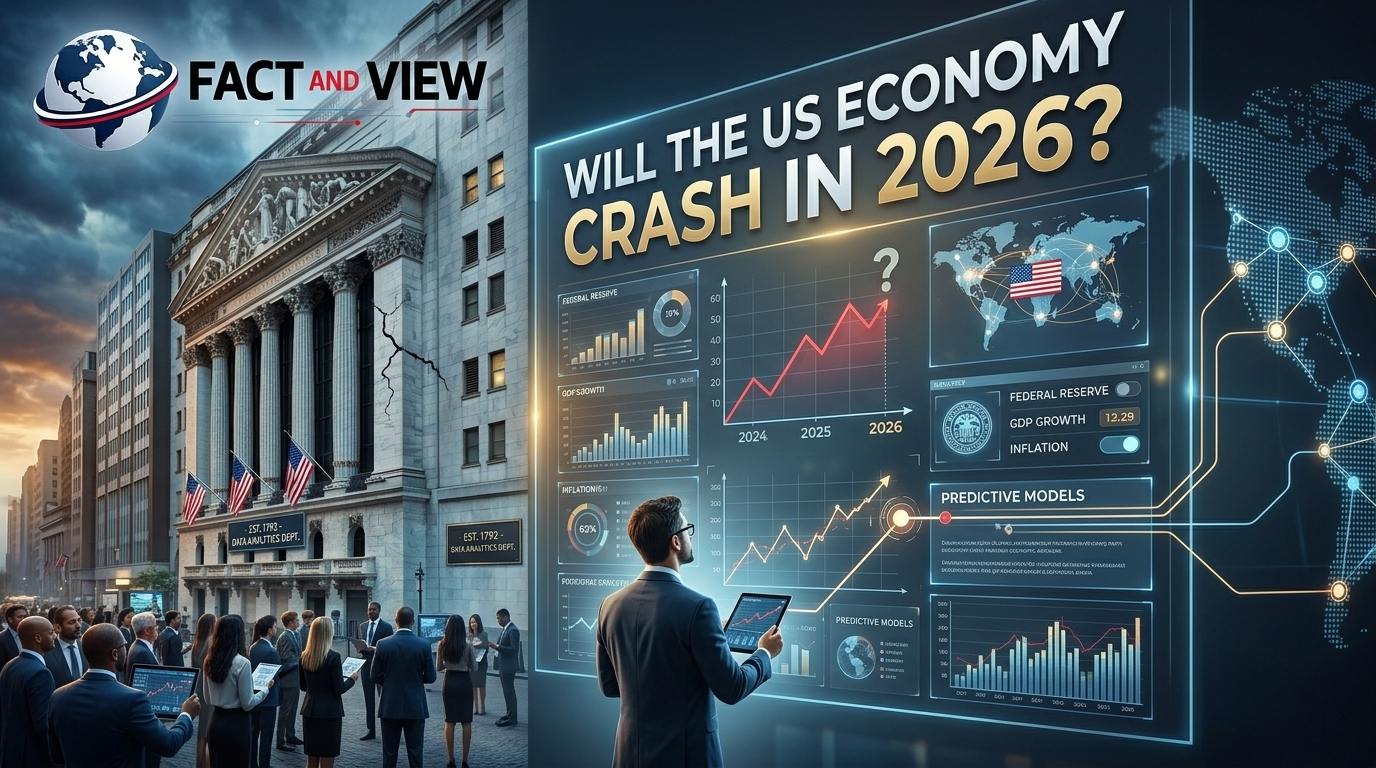
Will the US Economy Crash in 2026?
The question of whether the US economy will crash in 2026 is becoming increasingly common among investors, businesses, and everyday Americans. With rising interest rates, persistent inflation concerns, and global instability, many are wondering if a major downturn is approaching.
While headlines often focus on worst-case scenarios, the reality is more nuanced. Economic slowdowns, recessions, and full-scale crashes are very different outcomes — and understanding those differences is key.
In this analysis, we break down the current state of the US economy, examine the biggest risks, and explain what could happen next.
What Is Happening in the US Economy Right Now
The US economy in 2026 shows mixed signals.
On one hand, the labor market remains relatively strong, with steady job creation and consumer spending. On the other hand, high interest rates set by the Federal Reserve continue to slow borrowing, investment, and housing activity.
Inflation has decreased compared to previous peaks, but prices remain elevated across essential sectors like housing, healthcare, and food.
At the same time, economic growth has started to slow, raising concerns about a potential recession.
Key Warning Signs to Watch
Several indicators suggest increased economic risk:
1. High Interest Rates
The Federal Reserve has maintained elevated rates to control inflation. While effective in reducing price growth, this also reduces business expansion and consumer borrowing.
2. Slowing Economic Growth
GDP growth has weakened, signaling reduced economic momentum.
3. Rising Debt Levels
Both government and consumer debt remain historically high, increasing vulnerability during downturns.
4. Global Instability
Conflicts, trade tensions, and geopolitical uncertainty continue to impact global markets.
Will the US Economy Actually Crash?
A full economic crash — similar to the 2008 financial crisis — is currently considered unlikely by most analysts.
However, a mild or moderate recession is a realistic possibility.
Key reasons why a crash is less likely:
- Strong banking system
- Low unemployment
- Ongoing consumer activity
That said, economic conditions can change quickly, especially if external shocks occur.
What This Means for Americans
For individuals, the impact depends on how the situation develops.
If the economy slows:
- borrowing becomes more expensive
- job growth may weaken
- spending power may decline
However, not all sectors are affected equally, and some industries may continue to grow.
What This Means for Investors
For investors, uncertainty creates both risk and opportunity.
Historically:
- markets tend to decline before a recession
- but recover before the economy improves
This means timing the market is extremely difficult.
A long-term strategy often performs better than reacting to short-term fears.
What Happens Next?
Looking ahead, several scenarios are possible:
Scenario 1: Soft Landing
Inflation decreases without a major recession.
Scenario 2: Mild Recession
Economic slowdown with limited damage.
Scenario 3: Severe Downturn
Triggered by unexpected global or financial shocks.
At this stage, a soft landing or mild recession remains the most likely outcome.
While fears of a US economic crash in 2026 are understandable, current data does not strongly support the likelihood of a severe collapse.
Instead, the more realistic scenario is a period of slower growth or a mild recession. For both individuals and investors, the key is preparation, not panic.
Understanding the underlying trends — rather than reacting to headlines — is essential for navigating uncertainty in today’s economic environment.