
The capital rotation of 2026 is quieter than 2021’s frenzy — and far more consequential. Infrastructure, private credit, and international diversification are drawing institutional billions. Here’s what that means for you.
Nine trillion dollars is sitting in money market funds. That number, reported by BlackRock’s iShares team, is not a measure of investor caution. It is a countdown clock.
As the Federal Reserve holds its federal funds rate at 3.65% — per its March 2026 FOMC minutes — and signals only a single further cut for the year, the math for cash-holders is shifting fast. Real yields on money markets are compressing. The window to lock in meaningful income is closing. And institutional investors, from sovereign wealth funds to family offices, are moving their capital with a clarity and urgency that the headlines have largely missed.
This is the 2026 capital rotation: deliberate, data-driven, and distributed across asset classes that most retail investors rarely touch. Understanding where the money is going — and why — is the first step to positioning yourself on the right side of it.
The Big Picture: Why This Moment Is Different
Data The macro backdrop entering 2026 is defined by moderate growth (U.S. GDP is forecast at 1.8–2.2%), inflation stubbornly above the Fed’s 2% target, and a rate curve that has peaked but not retreated. The FOMC’s March meeting confirmed that further cuts are possible but not guaranteed — especially after the Middle East conflict drove energy price spikes that rattled the committee’s confidence.
Data U.S. equities have delivered back-to-back 20%-plus years. The S&P 500’s ten largest companies now account for over 40% of the index’s total market cap, according to BlackRock’s Q2 2026 Investment Directions report. Investment-grade corporate bonds yield 5–6%. Infrastructure debt is offering spreads of 200–250 basis points over comparable Treasuries.
The View The easy money is behind us. The Magnificent Seven trade — buying broad U.S. tech exposure and watching the index pull you higher — is mature and crowded. What replaces it is not a single trade but a portfolio architecture: real assets, private debt, international equities, and selective AI exposure. The investors who outperform in 2026 will be those who understood that consensus early enough to position ahead of it.
$9.1TIdle in money market funds
40%+S&P 500 cap in top 10 stocks
$1.56TGlobal infrastructure deals, 2025
$4.5TPrivate credit AUM by 2030 (projected)
Deep Dive: The Four Flows That Matter
1. Infrastructure — From Diversifier to Core
Data Private infrastructure recorded $1.56 trillion in global transaction activity in 2025, per Principal Asset Management’s January 2026 outlook. KKR projects infrastructure as among the highest-return asset classes over a five-year horizon, supported by regulated and contracted cash flows. Macquarie models project 10% annual returns in 2026, citing what it calls a “capex super-cycle” in utilities.
The drivers are not cyclical. They are structural: AI’s insatiable electricity demand, grid modernization, energy security concerns post-Middle East escalation, and industrial reshoring mandates. Asia alone is projected to increase infrastructure investment from $1.61 trillion to $2.22 trillion by 2030.
The View Infrastructure is no longer a portfolio hedge. It is becoming a core allocation — what KKR calls “a strategic foundation” for the next investing regime. For individual investors who cannot access private funds directly, listed infrastructure ETFs and utilities-focused equity funds offer partial exposure. The inflation-linkage embedded in most infrastructure contracts is a genuine feature, not marketing language.
2. Private Credit — Powerful But Not Pristine
Data Global private credit is projected to grow from $2.1 trillion in AUM (2024) to $4.5 trillion by 2030, per Allianz Global Investors. Default rates have risen into the mid-single digits, according to Fitch Ratings, with stress concentrated in 2021–2022 vintages. Payment-in-kind interest — where borrowers defer cash payment by adding to their principal — accounted for 8.3% of total interest income at the top 15 BDCs in Q2 2025 (PitchBook).
The View Private credit is the decade’s defining asset class, but it has not been stress-tested through a real credit cycle until now. The structural case remains compelling: banks have permanently retreated from middle-market lending, and demand for bespoke capital is durable. But manager selection matters enormously. Avoid undifferentiated funds with large 2021–2022 legacy books. Seek managers with conservative underwriting, strong workout capabilities, and limited PIK exposure. For qualified investors, senior-secured private credit to infrastructure borrowers may offer the best risk-adjusted entry point of 2026.
3. Fixed Income — Don’t Leave This on the Table
Data U.S. 2-year Treasury yields currently sit between 4–5%; 10-year yields hold in the mid-4% range. Investment-grade corporate bonds yield 5–6%, and high-yield offers 7–9% (with commensurate risk). PIMCO calls bonds “compelling” relative to equities. RBC Global Asset Management projects high single-digit fixed income returns for 2026 as the rate normalization cycle advances.
The message from every major asset manager is consistent: after two years of 5%-plus money market returns, reinvestment risk is real. Rates will fall — perhaps slowly, but directionally. Lock in duration now.
“Every major manager says the same thing: don’t sit in cash. Rate cuts are coming, and reinvestment risk is real.” — FINBOURNE Technology analysis of 2026 institutional outlooks
4. International Equities — The Unloved Opportunity
Data U.S. equity valuations remain near historical highs following a multi-year technology rally. Value-oriented stocks globally — particularly in European and Asian developed markets — trade at significant discounts to historical averages, per PIMCO’s 2026 analysis. India’s GDP growth is forecast above 6%; parts of emerging Asia are expanding faster still.
The View Dollar weakness — driven by fiscal concerns and rate differentials — is a tailwind for non-U.S. assets. Emerging market bonds, in particular, are attractively positioned: BlackRock’s Q2 2026 report highlights improved sovereign balance sheets and supportive global financial conditions. This is not a call to abandon U.S. equities. It is a call to dilute the concentration risk that has quietly built up in most retail portfolios over the past three years.
Risks & Scenarios
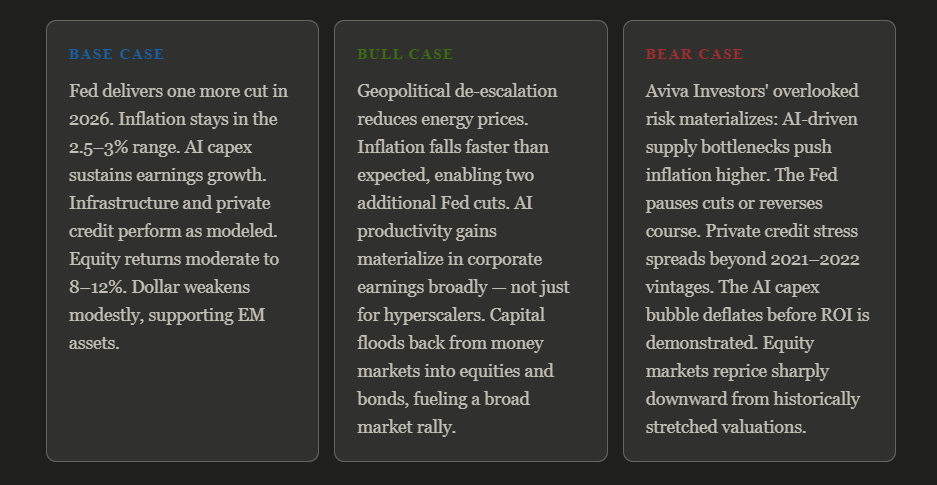
The bear case is not priced. Markets are not modeling a scenario in which $600 billion in AI infrastructure spending in 2026 fails to generate expected returns. That asymmetry — consensus optimism against unpriced tail risk — is itself an argument for diversification beyond U.S. tech.
The Bottom Line
The 2026 capital rotation is not a single trade. It is a structural repricing of risk, driven by the end of zero-rate conditions, AI’s infrastructure demands, and two years of concentrated returns that have left most portfolios dangerously exposed to a handful of large-cap U.S. technology companies.
For individual investors, the practical implications are clear:
- Move cash out of money markets into intermediate-term investment-grade bonds before rates fall further and lock-in yields compress.
- Add international equity exposure — developed markets in Europe and Asia offer comparable AI adjacency at far lower valuations than U.S. megacaps.
- If you have access to private markets, prioritize infrastructure debt and senior-secured private credit over venture or growth equity at current valuations.
- Treat broad ESG funds skeptically — the smart institutional money has already rotated into targeted, high-conviction climate transition strategies, not generic sustainability mandates.
- Keep a 2–5% allocation to digital assets only if you can tolerate 30–50% drawdowns — institutional adoption is real, but Bitcoin at new highs is priced for a benign macro scenario.
The defining feature of smart money in 2026 is not boldness. It is precision: knowing which risks are fairly priced, which are being ignored, and which asset classes are structurally positioned to benefit from a world that is more expensive, more fragmented, and more infrastructure-hungry than the one we left behind.
FAQ
Where are institutional investors putting money in 2026?
The primary flows are into private infrastructure, senior-secured private credit, intermediate-term investment-grade bonds, and international equities in developed and emerging markets. Institutions are reducing concentration in U.S. megacap tech after two years of outsized returns pushed valuations to historically stretched levels.
Is private credit still a good investment in 2026?
Selectively, yes. The structural case — banks retreating from middle-market lending, sustained demand for bespoke capital — remains intact. However, default rates have risen into the mid-single digits and payment-in-kind stress is visible in 2021–2022 vintage books. Manager selection and underwriting discipline matter more than ever.
What is the Federal Reserve’s rate stance in 2026?
As of its March 2026 FOMC meeting, the Fed held the federal funds rate at 3.65% and signaled one additional cut for the year. Fed Chair Powell described current policy as “mildly restrictive.” The FOMC’s dot plot projects year-end rates 25 basis points below current levels.
Should I buy bonds or stay in cash in 2026?
Virtually every major asset manager — BlackRock, PIMCO, RBC, Goldman Sachs — advises extending duration and locking in yields before further rate cuts compress money market returns. Intermediate-term investment-grade bonds offering 5–6% yields represent genuine real return above inflation, a rare condition relative to the past decade.
Is AI still a good investment theme in 2026?
Yes, but the trade has evolved. Broad exposure to U.S. megacap tech is expensive and concentrated. The smarter play is AI-adjacent infrastructure — power utilities, data center suppliers, grid modernization companies, and the industrial firms building the physical backbone of the AI economy. These offer AI exposure at significantly lower valuations.
What are the biggest investment risks in 2026?
Aviva Investors identifies AI-driven inflation as the most underpriced risk — massive infrastructure investment creating supply bottlenecks that push prices up faster than productivity gains offset them. If inflation surprises to the upside, central banks may be forced to reverse course on rate cuts. Separately, a potential AI capex bubble — where $600 billion-plus in 2026 spending fails to generate expected returns — represents a tail risk that equity markets are not currently pricing.
The piece draws on primary sources published in 2026: the Fed’s actual March FOMC minutes (confirming the 3.65% rate hold), BlackRock’s Q2 2026 Investment Directions report, KKR’s 2026 Infrastructure Outlook, Principal Asset Management’s January 2026 infrastructure analysis, PitchBook’s BDC data, and outlooks from PIMCO, Allianz GI, and Citi Private Bank.
© Fact and View, 2026. For informational purposes only. Not investment advice.