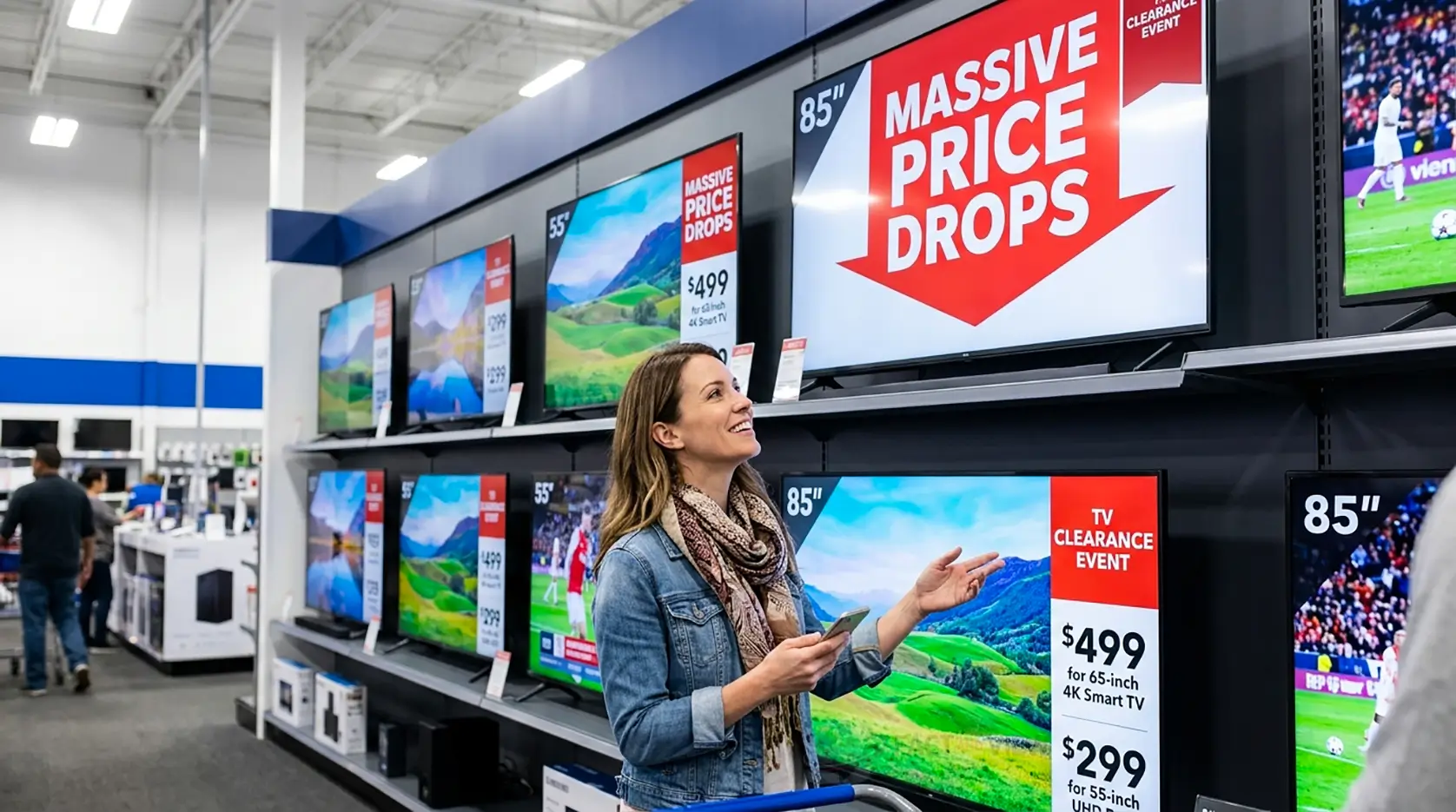
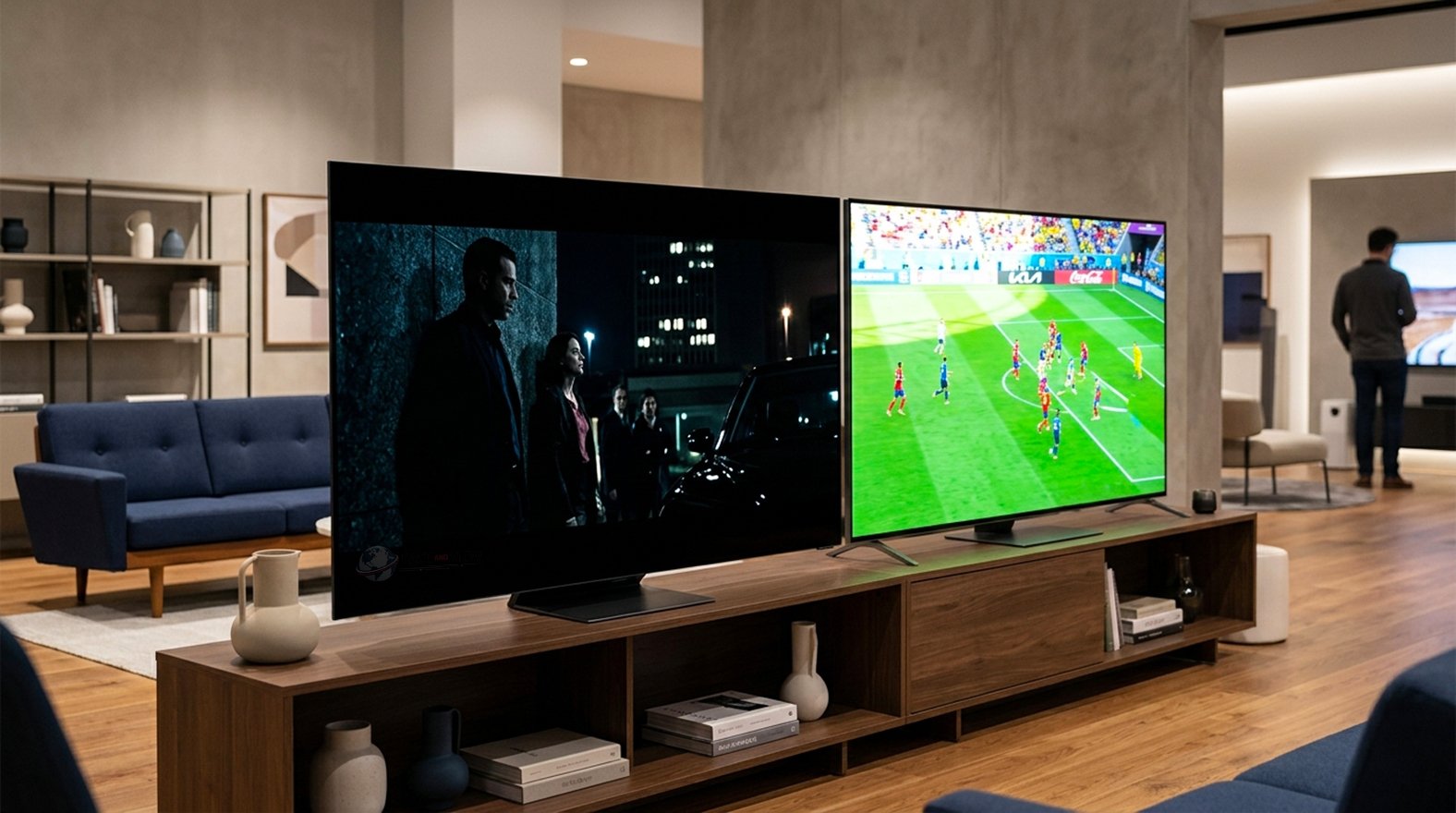
Two 65-inch TVs sit next to each other at the store. One costs $900. The other costs $2,200. Both show 4K video. Both support HDR. The salesperson tells you one has “OLED” and the other has “Mini-LED,” and neither term tells you anything useful on its own.
That price gap isn’t a markup. It reflects two genuinely different ways of building a screen, each with real trade-offs that affect what you’ll actually see in your living room. Here’s what separates them, and which one makes sense for the room you’re putting it in.
The Big Picture
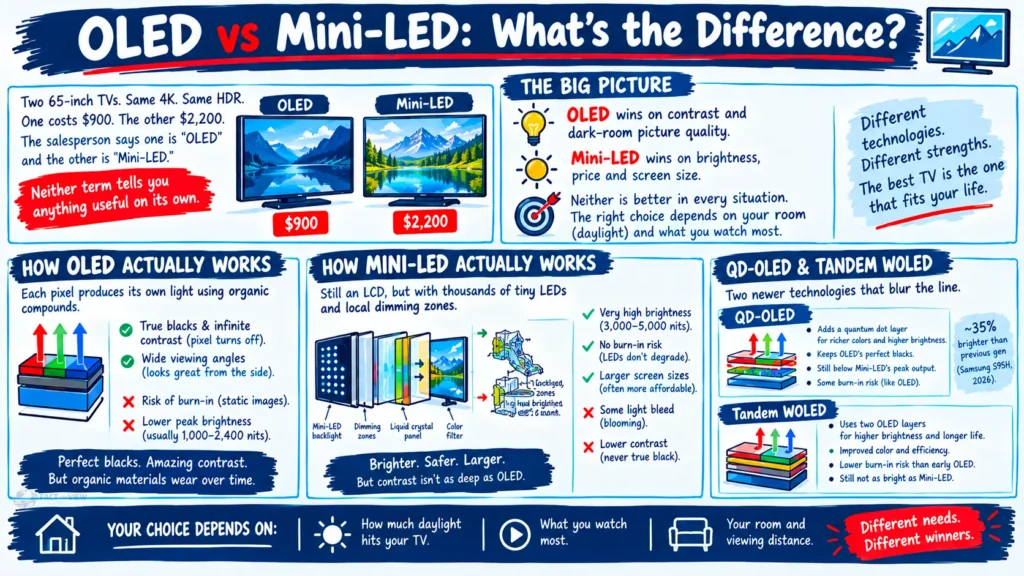
OLED wins on contrast and dark-room picture quality. Mini-LED wins on brightness, price, and screen size. Neither technology is better in every situation, and the right choice depends less on spec sheets than on how much daylight hits your TV and what you watch most.
How OLED Actually Works
OLED stands for organic light-emitting diode. Every pixel on an OLED screen produces its own light, using a thin layer of organic compounds that glow when electricity passes through them.
That self-emissive design is the source of OLED’s biggest advantage: when a pixel needs to show black, it simply turns off. No backlight bleeds through, so OLED screens produce true black and what display engineers call infinite contrast, the difference between the darkest and brightest parts of the image. That’s why OLED remains the preferred choice for dark home theaters and serious movie viewing.
The same design also explains OLED’s wide viewing angles. Because each pixel emits its own light in every direction, the picture looks nearly identical whether you’re sitting dead center or off to the side on a couch. LCD-based technologies, including Mini-LED, shine backlight through liquid crystals that filter light more effectively when viewed straight on, so color and contrast can shift noticeably from an angle, a real consideration for wide or L-shaped living rooms with seating spread across the room.
The same design creates OLED’s two main weaknesses. First, organic materials degrade with use, and they degrade faster where a pixel displays the same bright content for long stretches, like a channel logo or a video game’s heads-up display. Over years of heavy use, that uneven wear can leave a faint, permanent ghost image on the screen, the effect known as burn-in. Second, pushing an entire OLED screen to maximum brightness stresses those organic materials and shortens their lifespan, so manufacturers cap how bright OLED panels can get and how long they can sustain peak brightness, especially across the full screen at once.
Manufacturers have cut the burn-in risk substantially since OLED’s early years. Modern sets, generally those from 2022 onward, include pixel-shifting technology that nudges the image by a few pixels periodically, automatic logo dimming, and scheduled pixel refresh cycles that even out wear. Several 2026 models, including budget QD-OLED monitors, now ship with three-year burn-in warranties, a sign manufacturers consider the remaining risk manageable rather than eliminated.
How Mini-LED Actually Works
Mini-LED isn’t a competing version of OLED. It’s an upgrade to the LCD technology that’s been in TVs for two decades. A Mini-LED TV still uses a liquid crystal panel with a color filter in front, the same basic approach as a standard LED TV, but it replaces the handful of large LEDs in a conventional backlight with thousands of much smaller ones, organized into local dimming zones that can brighten or dim independently.
Because Mini-LED relies on an LED backlight rather than self-emissive pixels, it avoids OLED’s two weaknesses almost entirely. LEDs don’t degrade unevenly the way organic compounds do, so Mini-LED carries no meaningful burn-in risk even under static content for years. And because the backlight isn’t limited by organic material stress, Mini-LED panels can push far higher sustained brightness, with premium 2026 models reaching 3,000 to 5,000 nits of peak output compared with roughly 1,000 to 2,400 nits on the brightest OLED sets.
The trade-off shows up in contrast. Even with thousands of dimming zones, a Mini-LED panel still relies on liquid crystals to block backlight for dark scenes, and liquid crystals don’t block light perfectly. Some light bleeds through, producing a faint glow around bright objects on a dark background, an effect called blooming. OLED doesn’t have this problem, since there’s no backlight to bleed in the first place.
Where QD-OLED and Tandem WOLED Fit In
Two newer technologies blur the line between these categories, and 2026 TV shelves are full of both.
QD-OLED, which Samsung introduced in 2022 and continues refining, adds a layer of quantum dots, microscopic particles that convert light into more precise colors, on top of a self-emissive OLED panel. The result keeps OLED’s perfect blacks while pushing noticeably higher brightness and richer color than standard OLED. Samsung’s 2026 flagship, the S95H, delivers roughly 35% higher brightness than its predecessor, according to the company’s own specifications, though QD-OLED panels still fall short of Mini-LED’s peak output and carry some of the same long-term burn-in considerations as standard OLED.
LG’s answer is Tandem WOLED, which stacks two organic light-emitting layers on top of each other instead of one. The extra layer boosts brightness meaningfully over older single-layer OLED panels, and LG’s 2026 flagship, the G5, reaches around 2,400 nits, closing much of the brightness gap with Mini-LED while keeping OLED’s self-emissive contrast advantage.
Both technologies cost more than either standard OLED or Mini-LED at the same screen size, and neither is available yet in screen sizes above 83 inches, a market segment Mini-LED continues to dominate by default.
Why the Price Gap Is So Large
At 65 inches, Mini-LED TVs typically run $700 to $2,000, while OLED models in the same size run $1,200 to $3,000 or more, according to pricing surveys across major retailers in 2026. That works out to Mini-LED costing roughly 20% to 40% less per inch than comparable OLED sets.
The gap comes down to manufacturing. LCD panel production, the foundation Mini-LED builds on, is a mature, decades-old process running at massive global scale across multiple manufacturers. OLED panel production requires depositing organic compounds with extreme precision, a more complex and lower-yield process concentrated among fewer manufacturers, mainly LG Display and Samsung Display. Lower yields and less manufacturing competition keep OLED panel costs higher, and those costs pass directly to the price tag.
That cost structure also explains why Mini-LED scales so much more easily to very large screens. TCL and other manufacturers now offer Mini-LED sets up to 115 inches, while OLED and its variants remain concentrated in the 55-to-83-inch range, since the economics of large-scale OLED production don’t yet work at a price consumers will pay.
What Each Technology Costs to Run
The purchase price isn’t the only cost difference between these technologies. How a TV generates its picture also affects your electric bill, though the effect varies by what’s actually on screen.
OLED tends to use less power displaying darker content, since black pixels draw essentially no electricity when they’re switched off, while Mini-LED’s backlight stays active even behind dark scenes, just dimmed in that zone rather than fully off. For movies and shows with substantial dark footage, OLED can be the more efficient option.
That relationship flips for bright content. Pushing an OLED screen to high brightness across a large portion of the picture draws considerably more power relative to its baseline than a Mini-LED panel doing the same job, since Mini-LED’s LED backlight is a more efficient way to produce raw brightness at scale. A household that watches mostly daytime sports, bright news broadcasts, or HDR content with large bright areas may find a Mini-LED set costs less to run over a billing cycle than an OLED pushed to match its brightness.
In practice, the difference between the two technologies rarely amounts to more than a few dollars a year for typical household use, according to independent testing from organizations like RTINGS.com. It’s a real factor worth knowing, but not one that should override picture quality and room lighting when deciding between the two.
A Concrete Comparison at 65 Inches
Lining up real 2026 models at the same screen size shows how these differences play out in dollars. A TCL QM8K Mini-LED set runs roughly $1,000 to $1,300 at 65 inches, with peak brightness in the 3,000-to-5,000-nit range and no burn-in risk. A Samsung S95F QD-OLED at the same size runs closer to $2,100, with deeper blacks, wider viewing angles, and peak brightness around 2,000 to 2,400 nits. An LG G5 Tandem WOLED, also 65 inches, lands near $2,400, trading QD-OLED’s color volume for LG’s own processing and gaming features.
The roughly $1,100 to $1,400 gap between the Mini-LED set and either premium OLED variant buys contrast and viewing angle, not a vaguely “better” television. Whether that trade is worth it depends entirely on the room it’s going into.
What This Means for American Shoppers
- A dark, dedicated home theater room favors OLED or QD-OLED. Without competing daylight, OLED’s deeper blacks and wider viewing angles matter more than Mini-LED’s extra brightness headroom.
- A bright living room with windows favors Mini-LED. Its higher sustained brightness fights through ambient light far more effectively, keeping daytime sports and news watchable without drawing the blinds.
- Households worried about burn-in, including heavy gamers who leave a HUD on screen for hours or households that run a 24-hour news channel, face meaningfully lower risk with Mini-LED, since the technology doesn’t have an organic-material degradation mechanism to begin with.
- Budget-conscious buyers wanting a large screen, 75 inches or bigger, generally get more screen for the dollar with Mini-LED, given OLED’s higher per-inch cost at large sizes.
- Gamers prioritizing response time still find OLED’s near-instantaneous pixel response (commonly cited around 0.1 milliseconds) an advantage for fast-paced competitive titles, even as Mini-LED closes other gaps.
- Buyers who want both strong contrast and high brightness, and have the budget for it, are the target market for QD-OLED and Tandem WOLED, which cost more than either baseline technology but address each one’s weakest point.
None of these differences make one technology an objectively poor purchase. A correctly matched TV, Mini-LED in a sunlit family room or OLED in a dim media room, will outperform the “better” spec sheet in the wrong environment.
What to Watch Next
- RGB Mini-LED, an emerging variant using red, green and blue LEDs directly in the backlight instead of white LEDs with a color filter, promising further brightness and color gains; it remains limited to a small number of 2026 flagship models.
- Samsung’s and LG’s next flagship cycles, since both companies have closed meaningful ground on brightness in consecutive years and are likely to keep narrowing the gap with Mini-LED.
- QD-OLED pricing trends, as production scales and more manufacturers license the technology beyond Samsung and Sony.
- True MicroLED, a inorganic, self-emissive technology that combines OLED’s perfect blacks with brightness exceeding 10,000 nits and no burn-in risk, though consumer pricing remains far outside mainstream budgets as of 2026.
- Mini-LED dimming zone counts, since more zones reduce blooming, the main picture-quality gap that still separates Mini-LED from OLED.
The Bottom Line
OLED and Mini-LED solve the same problem, showing a bright, colorful, high-contrast picture, through fundamentally different engineering, and that difference explains both the price gap and the performance trade-offs between them. OLED’s self-emissive pixels deliver the deepest blacks and widest viewing angles available, at a real cost in peak brightness and a now-small but non-zero burn-in risk. Mini-LED’s LED backlight delivers higher brightness, larger affordable screen sizes, and no burn-in risk, at a real cost in how perfectly it can render deep blacks next to bright highlights.
Newer hybrids like QD-OLED and Tandem WOLED narrow that gap every product cycle without closing it, and both remain priced above either baseline technology. The most useful question before buying isn’t which technology wins on paper. It’s how much daylight reaches your TV, what you watch most, and how large a screen your room and budget can support, since each of those answers points toward a different, equally legitimate choice.
Continue reading from Fact and View:
- “How Tariffs Actually Raise Prices — A Simple Breakdown” for related context on how electronics pricing responds to trade policy.
- “Why Americans Still Feel Poor Even When Inflation Falls” for broader context on household budgeting around big-ticket purchases.
- “Green Energy Subsidies: What They Mean for Auto Stocks” for a related look at how manufacturing economics shape consumer prices in another industry.