“Foreign countries will pay for the tariffs” is one of the most repeated claims in American trade policy debates, and one of the most consistently contradicted by economic data. Tariffs are real, and they do raise prices, but not in the way that phrase suggests. Understanding exactly how a tax collected at a U.S. port ends up on a U.S. price tag months later is one of the more useful pieces of economic literacy available to American consumers, regardless of which administration is setting trade policy at any given moment.
This is a mechanism, not a political position, and it works the same way no matter who imposes the tariff or why. Here’s how tariffs actually raise prices, step by step, using the recent, well-studied 2025-2026 US tariff episode as a real-world example of the theory playing out in practice.
What Is a Tariff, Really?
A tariff is a tax on imported goods, paid not by the foreign country selling the product, but by the domestic company importing it. When a U.S. retailer brings in a container of furniture, electronics, or clothing from overseas, that company, not the foreign manufacturer, pays the tariff to U.S. Customs and Border Protection before the goods are released.
This single fact resolves most of the confusion around who actually bears a tariff’s cost. The foreign exporter typically still receives its agreed price for the goods; the additional cost is layered on top, paid by the American business bringing those goods into the country. What happens next, whether that business absorbs the cost, passes it along, or splits the difference, is where the real economics begins.
The Basic Mechanism: How Tariffs Raise Prices, Step by Step
The process by which a tariff turns into a higher price on a store shelf involves several distinct stages, and research published by the National Bureau of Economic Research helps map them clearly.
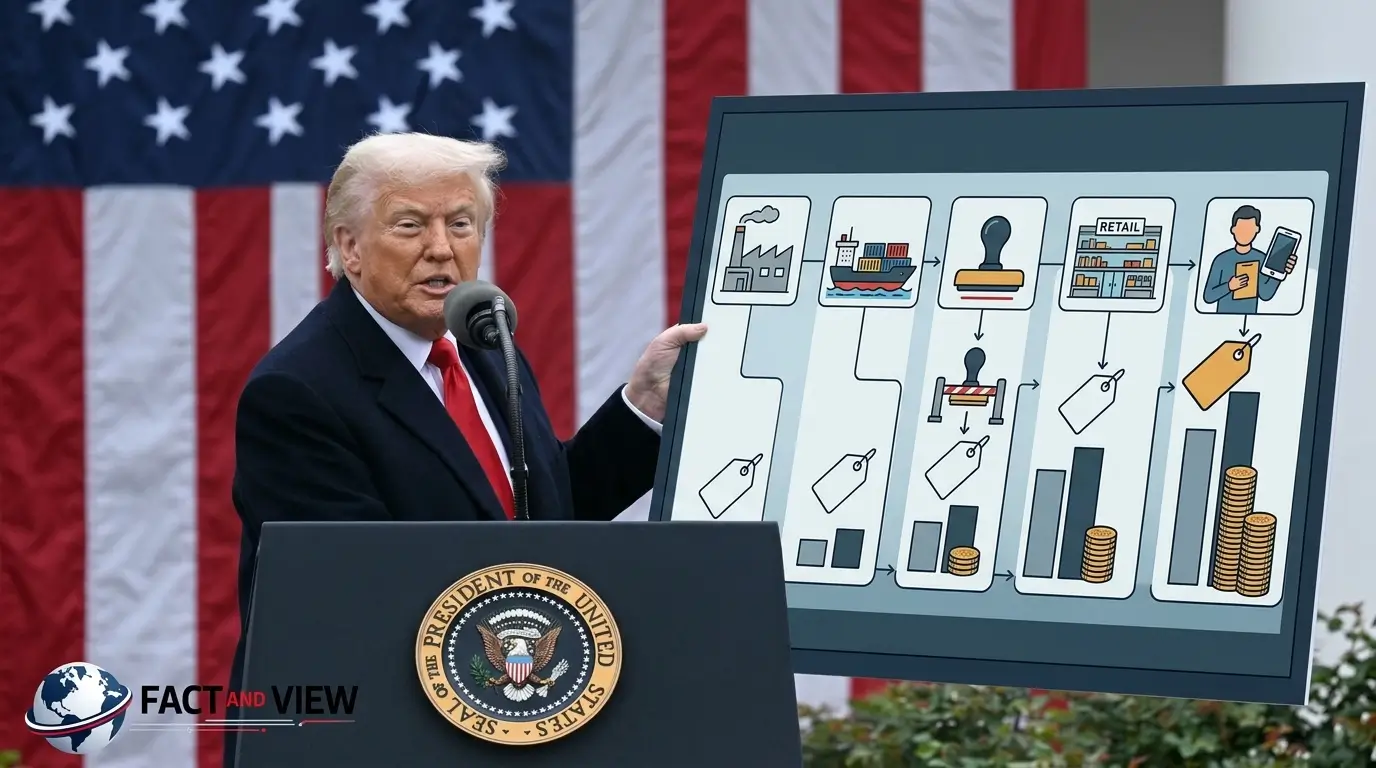
Step one: the direct effect. The tariff raises the cost of the specific imported good almost immediately. If a 15% tariff applies to imported washing machines, the importer’s cost for those washing machines rises by roughly that amount at the moment of import.
Step two: the pass-through decision. The importer decides how much of that added cost to absorb through lower profit margins versus pass along through higher prices. Multiple studies, including work by economists Mary Amiti, Sebastian Heise, and David Weinstein, along with separate analyses by Pinelopi Goldberg and colleagues, have found that US importers and consumers together have absorbed the overwhelming majority of recent tariff costs, with estimates from several 2026 studies converging around 90% of the burden falling on American buyers rather than foreign sellers.
Step three: the indirect, supply-chain effect. This is the part most consumers don’t see coming. Many products aren’t simply imported and resold; they’re assembled domestically using imported components, or imported goods are used as inputs by other US businesses. NBER research found that while the direct price effect shows up almost immediately, this indirect effect, the tariff cost working its way through multi-step supply chains, takes nine to twelve months to fully appear in consumer prices.
Step four: full pass-through. Combining both effects, at least one 2026 academic study (Minton, Ray, and Somale) found that pass-through to consumer prices becomes essentially complete, a roughly one-to-one relationship between the tariff rate and the price increase, about seven months after a tariff takes effect.
Related Reading
- Green Energy Subsidies: What They Mean for Auto Stocks — another example of how federal policy shifts ripple through supply chains and consumer prices unevenly across companies.
- Immigration Crackdown: The Hidden Cost to US Farms and Restaurants — a related look at how a different federal policy creates supply-side cost pressure that eventually reaches consumer prices.
- What Is Stagflation? Why Economists Fear It Again — background on how supply-side cost shocks, including tariffs, factor into the broader inflation picture.
Why the Price Increase Isn’t Instant
This lag is one of the most consistently misunderstood parts of tariff policy, and it cuts both ways politically: a tariff’s inflationary impact isn’t fully visible in the first few months, which can make it look “free” in the short run, but the delayed effect doesn’t disappear, it simply arrives later.
The Federal Reserve Bank of Minneapolis documented this pattern directly in its own 2026 research. In an earlier analysis, Minneapolis Fed economists found little relationship between tariff exposure and inflation in categories through the end of 2025. By July 2026, that relationship had turned clearly positive: goods facing higher tariffs were now measurably more likely to show excess price increases than goods that weren’t. The bank’s own description of the shift was direct: pass-through that was initially delayed had, by mid-2026, arrived.
The Federal Reserve Bank of New York found supporting evidence from the business side. In a survey of firms that had directly paid tariffs over the prior twelve months, 44% of manufacturers and 47% of service firms said they still had additional tariff-related price increases in the pipeline, roughly 30% to 40% of them planning further increases within six months of being surveyed. In other words, even well into a tariff regime, a meaningful share of the total price impact still hasn’t reached consumers yet.
A Real-World Case Study: The 2025-2026 Tariff Episode
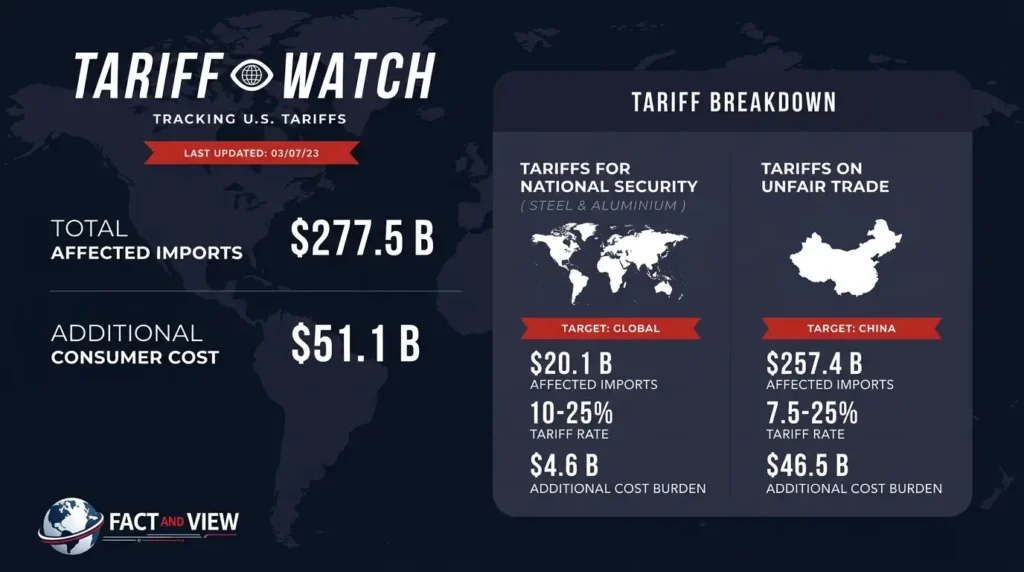
The most extensively studied recent example of this mechanism comes from a sweeping set of US tariffs implemented starting in 2025. Before that policy shift, the average effective US tariff rate, total tariff revenue collected divided by the value of all imports, stood at roughly 2.4%. Following the new tariffs, that rate climbed sharply, reaching close to 11.8% by spring 2026 according to Yale University’s Budget Lab, a level multiple economists have described as the highest since the early 1940s.
The Tax Foundation estimated these tariffs functioned as an effective tax increase of roughly $1,000 per US household in 2025 alone, with a projected $700 per household impact continuing into 2026 as certain tariff provisions were adjusted. Separately, the Budget Lab estimated that in June 2026 alone, somewhere between 61% and 80% of the specific tariffs implemented that year had already passed through into consumer prices for core goods, consistent with the broader academic findings described above.
This episode also illustrates that tariff policy isn’t static. In February 2026, the U.S. Supreme Court ruled that a significant portion of these tariffs, imposed under emergency executive authority, had been implemented unlawfully, leading to a partial reduction in the effective tariff rate as some levies were removed while others, imposed under different legal authorities, remained in place or were introduced. By several Federal Reserve regional bank analyses, the inflationary contribution from tariffs peaked in the first quarter of 2026 and had partially stabilized by mid-year, both because the effective rate declined somewhat and because businesses and consumers began shifting purchases toward lower-tariff products and countries, a process economists call substitution.
Why Not All Prices Rise Equally
Tariffs don’t affect every product category the same way, which is part of why the “prices went up” story is more nuanced than a single average number suggests. The Budget Lab’s research found implied pass-through rates ranging from roughly 40% to 76% for core imported goods generally, but considerably higher, 47% to 106%, for durable goods specifically, items like appliances and electronics with fewer easy domestic substitutes.
Interestingly, some categories showing significant price increases during this period had little to do with tariffs at all. Minneapolis Fed researchers specifically excluded video and information-processing equipment from their tariff analysis because that category’s price increases were driven primarily by unrelated demand tied to the broader AI investment boom, a useful reminder that not every price increase during a tariff period is actually caused by tariffs, even when the two coincide.
Common Misconceptions About Tariffs
Myth: Foreign countries pay tariffs directly, so domestic prices shouldn’t be affected. Reality: The importing company pays the tariff at the border. Multiple 2026 studies found that US firms and consumers together bore roughly 90% of the resulting cost.
Myth: If a tariff doesn’t raise prices immediately, it isn’t inflationary. Reality: Indirect, supply-chain-driven price effects can take nine to twelve months to fully appear, meaning early data can understate a tariff’s eventual impact.
Myth: Tariff revenue is essentially “free” government income with no offsetting cost. Reality: Tariffs did generate substantial federal revenue, with one estimate putting 2025 collections nearly $195 billion above the prior three-year average, but that revenue is generated precisely because domestic buyers are paying more, not instead of it.
What This Means for Your Wallet
Categories with fewer domestic substitutes, durable goods, certain electronics, and products with globally concentrated supply chains, tend to show the largest and most direct tariff-driven price increases. Because the full effect unfolds over the better part of a year, consumers often notice cumulative price creep on specific items well after the tariff itself made headlines, rather than all at once. Businesses in tariff-exposed industries have also been candid, through Federal Reserve surveys, that a meaningful share of pending price increases simply hadn’t been passed along to shoppers yet as of mid-2026, suggesting the adjustment period for any significant tariff regime realistically runs closer to a year than a few weeks.
The economics behind how tariffs raise prices are well documented and consistent across multiple independent research teams: importers, not foreign governments, pay the tax at the border; the overwhelming majority of that cost historically flows through to domestic consumers and businesses; and the process takes months, not days, to fully show up in the prices Americans pay. The 2025-2026 US tariff episode offers a clear, heavily studied illustration of this pattern, useful not because of who implemented it, but because it’s one of the most data-rich tariff events in modern American economic history. The underlying mechanism will apply just as directly to whatever tariff policy comes next.
Sources
- Peterson Institute for International Economics (PIIE) — “Who pays for tariffs? Insights from recent research”
- Federal Reserve Bank of St. Louis — “Tariff Effects on Inflation Stabilize in Recent Months”
- Yale Budget Lab — “State of U.S. Tariffs: April 8, 2026”
- Yale Budget Lab — “Tracking the Economic Effects of Tariffs”
- Yale Budget Lab — “Short-Run Effects of 2025 Tariffs, So Far”
- Federal Reserve Bank of Minneapolis — “Initially delayed, the pass-through of tariffs to consumer prices has arrived”
- Federal Reserve Bank of New York, Liberty Street Economics — “More Tariff Pass-Through Is in the Pipeline” (libertystreeteconomics.newyorkfed.org)
- National Bureau of Economic Research — Amiti, Heise, and Weinstein, “The Anatomy of Tariff Pass-through into Consumer Prices,” NBER Working Paper 35561 (nber.org)
- Federal Reserve Bank of Dallas — “Effects of realized tariff changes on PCE prices peaked in first quarter 2026” (dallasfed.org)
- NBC News — “How Are Tariffs Impacting Consumer Prices in 2026? Experts Explain” (nbcnews.com)
Disclaimer: This article explains general economic mechanisms and cites third-party research for informational purposes. It is not a political statement about any administration’s trade policy and does not constitute financial or investment advice.