Twelve people sitting in a conference room in Washington, D.C., just decided that your mortgage rate isn’t coming down yet. That your credit card APR stays elevated. That businesses will keep paying more to borrow. They made this call with no vote from Congress, no presidential signature, and no public referendum. And they were entirely within their legal authority to do so.
On April 29, 2026, the Federal Open Market Committee — the Fed’s rate-setting body — voted 8 to 4 to hold the benchmark federal funds rate at 3.5% to 3.75% for the third consecutive meeting. It was the most divided FOMC vote since October 1992. Four members dissented: one wanted to cut rates immediately, three opposed even the suggestion that cuts might be coming. The last time four members dissented was 34 years ago.
If you’ve ever wondered why the Fed matters — why its decisions dominate financial news, why markets swing on a single sentence from the Fed chair, why your home loan costs what it does — this article gives you the full picture. No jargon barriers. Just the mechanics, the stakes, and exactly how it connects to your wallet in 2026.
The Big Picture: What Is the Federal Reserve, Actually?
The Federal Reserve is the central bank of the United States. It was created by Congress in 1913 to solve a recurring 19th-century problem: periodic bank panics that wiped out savings and triggered depressions. Before the Fed existed, there was no institution empowered to inject liquidity into the banking system during a crisis. Banks failed, depositors lost everything, and the broader economy collapsed with them.
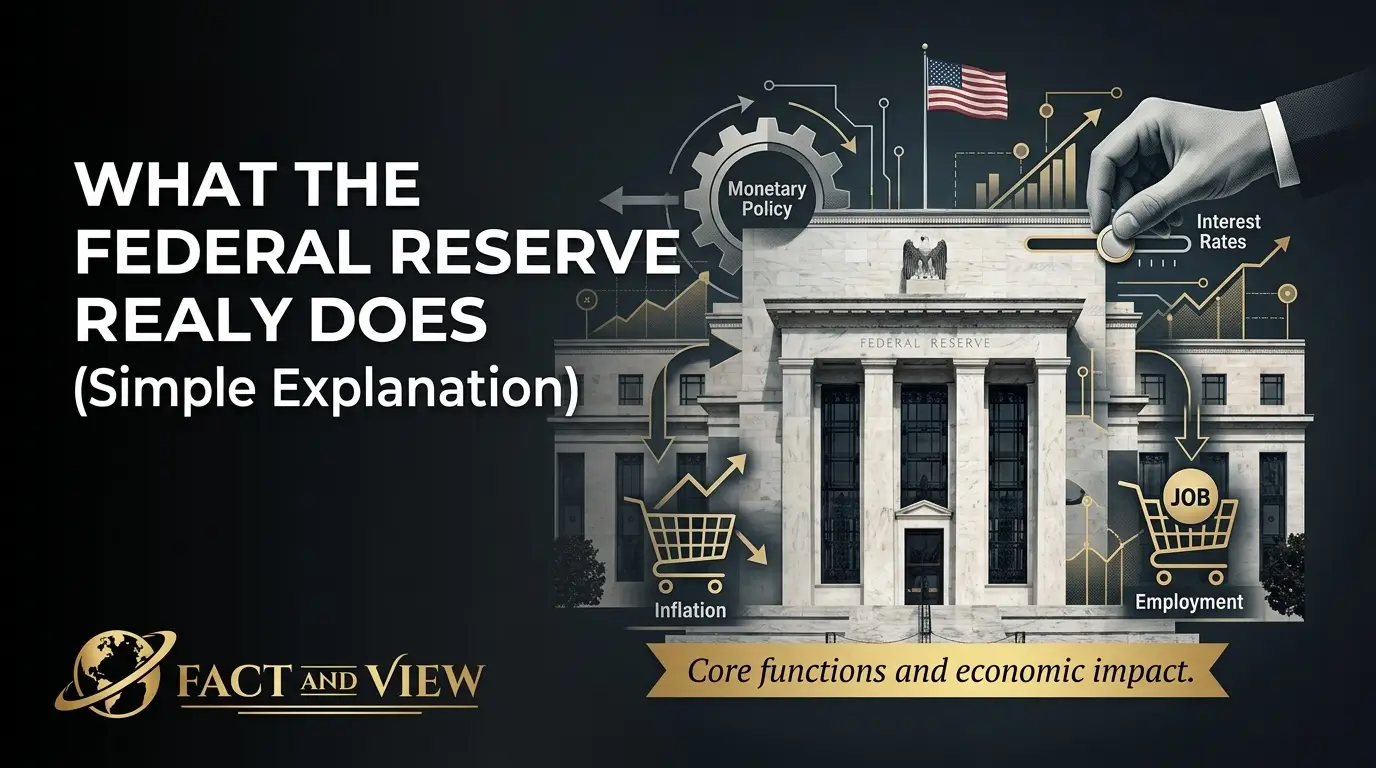
Today, the Fed has three core functions that shape almost every financial decision made in America:
- Setting monetary policy — controlling interest rates and money supply to manage inflation and employment
- Supervising and regulating banks — ensuring the financial system doesn’t take on catastrophic risk
- Maintaining financial stability — acting as the “lender of last resort” when the system faces collapse
Fact: The Federal Reserve is structured as a quasi-governmental institution. It has 12 regional Federal Reserve Banks — in cities including New York, Chicago, San Francisco, and Dallas — plus a seven-member Board of Governors in Washington, appointed by the President and confirmed by the Senate. The rate-setting body, the FOMC, has 12 voting members: all seven governors plus five regional bank presidents on a rotating basis.
Fact: The Fed is operationally independent. It does not require Congressional approval for its interest rate decisions. Its budget is self-funded through investment income, not taxpayer appropriations. Governors serve 14-year terms, specifically designed to insulate them from short-term political pressure.
The View: The Fed’s independence is its most valuable and most contested feature. In April 2026, the parallels to the 1948 Truman-era conflict are explicit — President Trump has publicly pressured the Fed to cut rates to reduce borrowing costs on the national debt and ease the housing market. Fed Chair Jerome Powell, finishing what may have been his final meeting as chair, explicitly referenced the Fed’s independence in his press conference. The 1951 Treasury-Fed Accord, which formalized that independence after a similar confrontation, took three years to negotiate. The current tension is not resolved.
Deep Dive: How the Fed Actually Moves the Economy
Tool #1: The Federal Funds Rate — The Rate That Moves Everything
The federal funds rate is the interest rate at which banks lend money to each other overnight. It sounds arcane. Its effects are anything but.
When the Fed raises the federal funds rate, borrowing becomes more expensive across the entire economy — not just for banks. Credit card issuers raise their APRs. Auto loan rates climb. Mortgage rates follow (with a slight lag, since they track the 10-year Treasury yield more directly). Business loans get pricier. The cost of financing inventory, buying equipment, or expanding a factory all increase. This is deliberate. Higher borrowing costs slow spending, reduce demand, and — the Fed’s intention — cool inflation.
When the Fed cuts rates, the reverse happens. Cheaper borrowing stimulates spending, investment, and hiring. But it also risks reigniting inflation if the economy is already running hot.
Fact: The current federal funds rate target is 3.5% to 3.75%, held unchanged at the April 29, 2026 meeting, per the official Federal Reserve press release. This follows three consecutive 25-basis-point rate cuts in September, October, and December 2025. The Fed has now held rates steady at January, March, and April 2026 meetings.
Fact: The March 2026 CPI came in at 3.3% year-over-year, with core CPI (excluding food and energy) at 2.6%, per U.S. Bank’s April 2026 analysis. Core PCE — the Fed’s preferred inflation gauge — stood at 3.0% in February 2026, still above the 2% target. This is precisely why the Fed is holding. Oil prices — up more than 76% from late February to early April due to the Middle East conflict — threaten to push headline inflation higher again.
Fact: The FOMC’s March 2026 dot plot — the quarterly projection of each member’s rate expectations — shows most participants anticipate the federal funds rate holding between 3.25% and 3.75% through end of 2026. Markets are currently pricing in zero rate movements for 2026 and just one 25-basis-point cut in December 2027.
The View: The Fed is trapped between two legitimate economic objectives that currently point in opposite directions. Inflation at 3.3% argues for holding or even tightening. Labor market softening — job gains described as “low, on average” in the April FOMC statement — argues for easing. The Middle East energy shock adds a third variable the Fed cannot control. When a supply-side shock drives inflation, rate hikes don’t solve it — they only impose additional economic pain. The Fed knows this. It also knows that cutting rates while inflation is above target would destroy its credibility. This is the stagflationary trap in its purest form, and the divided April vote reflects exactly how uncomfortable that position is.
Tool #2: Open Market Operations — The Invisible Hand
Most people have never heard of open market operations. They are arguably the Fed’s most powerful tool.
When the Fed wants to inject money into the banking system, it buys U.S. Treasury securities from banks. The banks receive cash, have more reserves, and can lend more — stimulating the economy. When the Fed wants to tighten, it sells Treasuries back to the market, draining cash and reducing the money available for lending.
This process — buying and selling securities to control the money supply — is called open market operations. It is the mechanism through which the Fed’s rate decisions become reality in financial markets. The FOMC directs the Federal Reserve Bank of New York’s “Desk” to execute these transactions daily, as detailed in every policy implementation note.
Fact: Per the April 29, 2026 implementation note, the FOMC directed the New York Fed to “undertake open market operations as necessary to maintain the federal funds rate in a target range of 3-1/2 to 3-3/4 percent” and to “increase System Open Market Account holdings through purchases of Treasury bills… to maintain an ample level of reserves.”
The View: The Fed’s balance sheet — which expanded from roughly $900 billion before the 2008 crisis to nearly $9 trillion at its 2022 peak through asset purchases — remains the single least-understood aspect of Fed policy for most people. When the Fed buys bonds, it is creating new money. When it sells them (quantitative tightening), it is destroying money. The political controversy around this power is real: “money printing” is not a metaphor. It is a literal description of one of the Fed’s core tools. Whether that tool is used wisely depends entirely on who controls the institution and what they prioritize.
Tool #3: Bank Supervision and the Lender of Last Resort
The Fed supervises the largest U.S. banks — reviewing their risk models, stress-testing their balance sheets, and determining how much capital they must hold against potential losses. This function is less visible than rate decisions but equally consequential.
When the banking system faces a crisis — as it did in 2008 and briefly in March 2023 with the Silicon Valley Bank failure — the Fed acts as the lender of last resort. It provides emergency credit to solvent institutions facing liquidity crises, preventing a bank run from becoming a bank collapse. This function, written into the Fed’s founding mandate, is the reason the U.S. avoided a repeat of the 1930s in both 2008 and 2023.
Fact: The Federal Reserve’s Board of Governors voted unanimously to maintain the interest rate paid on reserve balances at 3.65%, effective April 30, 2026, per the official implementation note. Reserve balances — the amount of cash banks hold at the Fed — are a direct measure of banking system liquidity.
The Dual Mandate: Balancing Two Objectives That Often Conflict
The Fed operates under what Congress has defined as a “dual mandate”: maximum employment and price stability (defined as 2% inflation). In normal economic conditions, these two goals align — healthy growth produces both jobs and manageable prices. In 2026, they are in tension.
Fact: The unemployment rate has moved between 4.3% and 4.5% over the past nine months, per Advisor Perspectives’ April 2026 rate analysis. This is slightly elevated above the Fed’s estimated “natural rate” of unemployment (around 4.0–4.1%), suggesting some labor market slack. Job gains have been “low, on average” — the Fed’s own characterization in its April 29 statement — due in part to lower immigration and declining labor force participation.
Fact: Inflation, meanwhile, is running at 3.3% CPI (March 2026) — 165 basis points above the 2% target. Core PCE at 3.0% has been “stuck at 3% plus since the end of 2023,” as CNBC’s reporting on the April FOMC meeting noted. The March personal consumption expenditure report showed additional pressure from energy costs tied directly to the Middle East conflict.
The View: The dual mandate was designed for a world where inflation and unemployment move in opposite directions — when one rises, the other falls. The traditional policy response is straightforward: high inflation means tighten; high unemployment means ease. The 2026 environment breaks this model. The U.S. faces simultaneously above-target inflation and a softening labor market — classic stagflation. The Fed’s tools are designed for one problem at a time. When both problems arrive together, every rate decision imposes costs on at least one side of the mandate. That’s the uncomfortable reality behind the April vote’s 8-4 split.
The Leadership Transition: Why It Matters Right Now
April 29’s FOMC meeting was, in what may have been a historic moment, Jerome Powell’s final meeting as Fed chair. Powell was appointed by President Trump in 2018, reappointed by President Biden in 2022, and his second term as chair expires in May 2026. Kevin Warsh — former Fed governor and Trump ally — has been nominated to succeed him.
Fact: Per CNBC’s reporting on April 29, Powell signaled he would remain on the Board of Governors as a regular member — a rare move that would mark only the second time in modern history a former chair remained on the board after their chair term ended. This means Warsh and Powell will serve simultaneously, creating an unprecedented institutional dynamic. As ClearBridge Investments analyst Josh Jamner noted: “The addition of Kevin Warsh to the FOMC will not swing the balance between doves and hawks, as Warsh will take Stephen Miran’s seat given Powell’s seat will not be open for the time being.”
The View: The leadership transition is not just a personnel change. It is a test of institutional credibility. Markets price Fed policy partly on expectations of future behavior — if Warsh is perceived as more politically responsive to White House rate-cut pressure, long-term interest rate expectations shift. That would be reflected in Treasury yields, mortgage rates, and dollar strength within weeks of his confirmation, regardless of what the FOMC formally decides. Morgan Stanley’s Ellen Zentner said it plainly: “A changing of the guard at the top of the Fed isn’t going to change the central bank’s calculus, or its process.” The market will find out whether that’s true.
Risks & Opportunities: Three Scenarios for Fed Policy in 2026–2027
Base Case (~50% probability): Extended Hold, One Cut in Late 2027
The Fed holds rates at 3.5–3.75% through year-end 2026. Inflation gradually retreats toward 2.5–2.8% as energy prices stabilize. The new chair (Warsh) signals continuity on independence. Markets price in one 25-basis-point cut in December 2027. Mortgage rates stay in the 6.0–6.5% range through 2026.
What this means for you: Rate relief is not coming this year. If you’re waiting for lower mortgage rates to buy a home, plan your finances around 6%+ borrowing costs through at least Q1 2027. High-yield savings accounts and CDs continue to offer 4–5%, which is historically attractive — lock in rates now if you have cash sitting idle.
Upside Scenario (~25% probability): Faster Disinflation, Two Cuts in H2 2026
Oil prices ease as Middle East tensions de-escalate. Rent inflation continues its lagged decline into official CPI data. Core PCE drops toward 2.3–2.5% by summer. The Fed delivers two cuts by December, bringing the rate to 3.0–3.25%. Mortgage rates fall toward 5.5–5.75%.
What this means for you: Refinancing becomes viable for homeowners who purchased at 7%+ rates in 2023–2024. Bond prices rise as yields fall. Equities get a liquidity tailwind. This is the scenario rate-sensitive sectors — housing, utilities, REITs — are waiting for. Watch monthly CPI releases at BLS.gov for the first signal this scenario is materializing.
Downside Scenario (~25% probability): Resurgent Inflation Forces Hold Through 2027
Middle East conflict escalates further. Oil sustained above $115. CPI spikes back above 4%. Fed is forced to abandon easing bias and hold rates through 2027 at current levels or higher. If inflation becomes entrenched, a rate hike becomes possible in early 2027.
What this means for you: Mortgage rates return toward 7–7.5%. Business borrowing costs remain elevated, compressing investment and hiring. Consumer spending weakens on fuel and food costs. The economy approaches a technical recession but the Fed cannot respond with cuts without reigniting inflation. This is the hardest environment to navigate — and the one where holding cash, short-duration Treasuries, and real assets provides the most protection.
The Bottom Line
What does the Federal Reserve actually do? It controls the price of money in the U.S. economy through three tools — the federal funds rate, open market operations, and bank supervision — and in doing so, it shapes the cost of every loan, the return on every savings account, the price of every bond, and the growth trajectory of the entire economy.
In 2026, the Fed is navigating the most difficult policy environment since Paul Volcker’s inflation-fighting era in the early 1980s: above-target inflation, softening labor markets, a geopolitical energy shock it cannot control, political pressure on its independence, and a leadership transition — all simultaneously.
For consumers:
- High-yield savings accounts paying 4–5% are a genuine opportunity while rates hold. Lock in 12-month CD rates now before the eventual cut cycle begins.
- Don’t count on mortgage rate relief in 2026. Budget for 6%+ and model what a refinance looks like if rates fall to 5.5% in 2027.
- Credit card APRs follow the Fed funds rate. At 20%+, carrying a balance is financially destructive. Paying down high-interest debt is the highest guaranteed return available to any consumer right now.
For businesses:
- The cost of capital is elevated and likely stays elevated through 2026. Capital-intensive projects with marginal returns should be deferred, not accelerated.
- Monitor the Fed’s dot plot quarterly — it is the clearest forward guidance the institution provides. The March 2026 dot plot is available directly at federalreserve.gov.
- The leadership transition from Powell to Warsh is a genuine unknown. Political pressure for rate cuts could be positive for borrowing costs — or could undermine dollar confidence in ways that raise long-term yields regardless of the Fed’s short-term rate decision.
For investors:
- Bond investors benefit from the extended hold: locking in 4.3–4.5% on Treasuries today provides real yield above inflation if disinflation continues. Track current yields at FRED.
- The Fed’s extended hold is a headwind for growth equities valued on discounted future cash flows. Value stocks, dividend payers, and real assets perform better in this environment.
- The most important Fed meeting of 2026 may not be the June FOMC — it may be the Senate confirmation hearing of Kevin Warsh, which will reveal more about the future direction of U.S. monetary policy than any rate decision.
The Federal Reserve is not mysterious. Its tools are well-defined, its mandate is public, and its meeting minutes are released — with a three-week lag — at federalreserve.gov. What makes the Fed consequential is not its secrecy. It’s the size of the lever it controls — and the difficulty of knowing, in real time, which direction to pull it.
FAQ
What is the Federal Reserve in simple terms?
The Federal Reserve is the central bank of the United States — the institution that controls the supply and cost of money in the economy. Created by Congress in 1913, it sets the interest rate at which banks lend to each other overnight (the federal funds rate), supervises major U.S. banks, and acts as an emergency lender to prevent bank failures from cascading into broader economic collapses. Its decisions directly affect your mortgage rate, credit card APR, savings account yield, and the overall pace of U.S. economic growth. The Fed’s official educational resources are available at federalreserveeducation.org.
Why did the Fed hold rates in April 2026?
The FOMC held the federal funds rate at 3.5%–3.75% because inflation remains above the 2% target — CPI came in at 3.3% in March 2026 and core PCE at 3.0% in February. The Middle East conflict has pushed oil prices up more than 76% since late February, threatening to push inflation higher again. Cutting rates in this environment would risk reigniting inflation. The April vote was unusually divided — 8 to 4 — reflecting genuine disagreement about whether the risk tilts toward inflation or economic slowdown. Read the official April 29, 2026 FOMC statement directly on the Fed’s website.
How does the Fed’s decision affect mortgage rates?
Mortgage rates are not set directly by the Fed. They track the 10-year U.S. Treasury yield, which is influenced — but not controlled — by the federal funds rate. When the Fed holds rates high, it signals that short-term borrowing costs will remain elevated, which keeps Treasury yields up and mortgage rates up. The average 30-year fixed mortgage rate currently stands at approximately 6.3–6.4%, per Freddie Mac’s weekly survey. The extended hold in 2026 means meaningful mortgage rate relief is unlikely before late 2026 at the earliest. Monitor the weekly Freddie Mac Primary Mortgage Market Survey at freddiemac.com.
What is the FOMC and how does it work?
The Federal Open Market Committee (FOMC) is the 12-member body within the Federal Reserve that sets U.S. interest rate policy. It consists of the seven members of the Board of Governors (appointed by the President, confirmed by the Senate) and five of the 12 regional Federal Reserve Bank presidents on a rotating basis (the New York Fed president votes at every meeting; the others rotate annually). The FOMC meets eight times per year. Decisions require a majority vote. Meeting minutes are released three weeks after each meeting. The current April 2026 minutes will be released in mid-May and are available at federalreserve.gov/monetarypolicy.
What is the Fed’s “dual mandate” and why does it matter in 2026?
Congress gave the Federal Reserve two objectives: maximum employment (keeping unemployment low) and price stability (keeping inflation at 2%). In normal conditions, these goals work together — a healthy economy produces both jobs and manageable prices. In 2026, they conflict. Inflation at 3.3% argues for holding or raising rates. An unemployment rate of 4.3–4.5% with slowing job growth argues for cutting. The Fed cannot fully satisfy both mandates simultaneously. This tension is why the April FOMC vote was so divided — different members weight the two sides of the mandate differently. Follow the unemployment data monthly at the Bureau of Labor Statistics and inflation data at BLS CPI.
Who is replacing Jerome Powell as Fed chair?
Kevin Warsh, a former Federal Reserve governor and investment banker, has been nominated by President Trump to succeed Jerome Powell. Powell’s term as chair expires in May 2026, though he has signaled he will remain on the Board of Governors as a regular member — an arrangement not seen since Marriner Eccles in the 1940s. Warsh’s confirmation hearing will be closely watched by markets for signals about his stance on rate cuts, Fed independence, and the political pressure the White House has applied to the central bank. A Fed chair who is perceived as politically responsive could change long-term market expectations for rates, the dollar, and inflation even before casting a single vote.
What can I do right now based on the Fed’s 2026 stance?
Three concrete actions based on the current rate environment:
Don’t time the mortgage market. If you need to buy a home, buy at today’s rates and refinance when rates fall. Waiting for a rate drop that may not arrive until 2027 means paying rent in the meantime and missing potential home equity appreciation. Use the Consumer Financial Protection Bureau’s mortgage calculator to model different rate scenarios.
Maximize high-yield savings now. Online savings accounts and money market funds are paying 4–5% — among the highest real yields since 2007. Lock in 12-month CD rates before the rate cut cycle eventually begins. Compare current rates at Bankrate’s CD rate tracker.
Pay down variable-rate debt aggressively. Credit card rates at 20%+ represent a guaranteed return equal to that rate when you pay them down. No investment in 2026 offers a guaranteed 20% return. Prioritize this above almost any other financial action.
Sources: Federal Reserve FOMC Statement, April 29, 2026 · Federal Reserve Implementation Note, April 29, 2026 · FOMC Minutes, March 17–18, 2026 · FOMC Minutes, January 27–28, 2026 · CNBC — Fed Rate Decision April 2026 · Advisor Perspectives — Fed Rate Decision April 29 · U.S. Bank — Federal Reserve Monetary Policy · J.P. Morgan — Fed Meeting January 2026 · Fox Business — Powell’s Final Meeting
© Fact and View, 2026. For informational purposes only. Not investment advice.