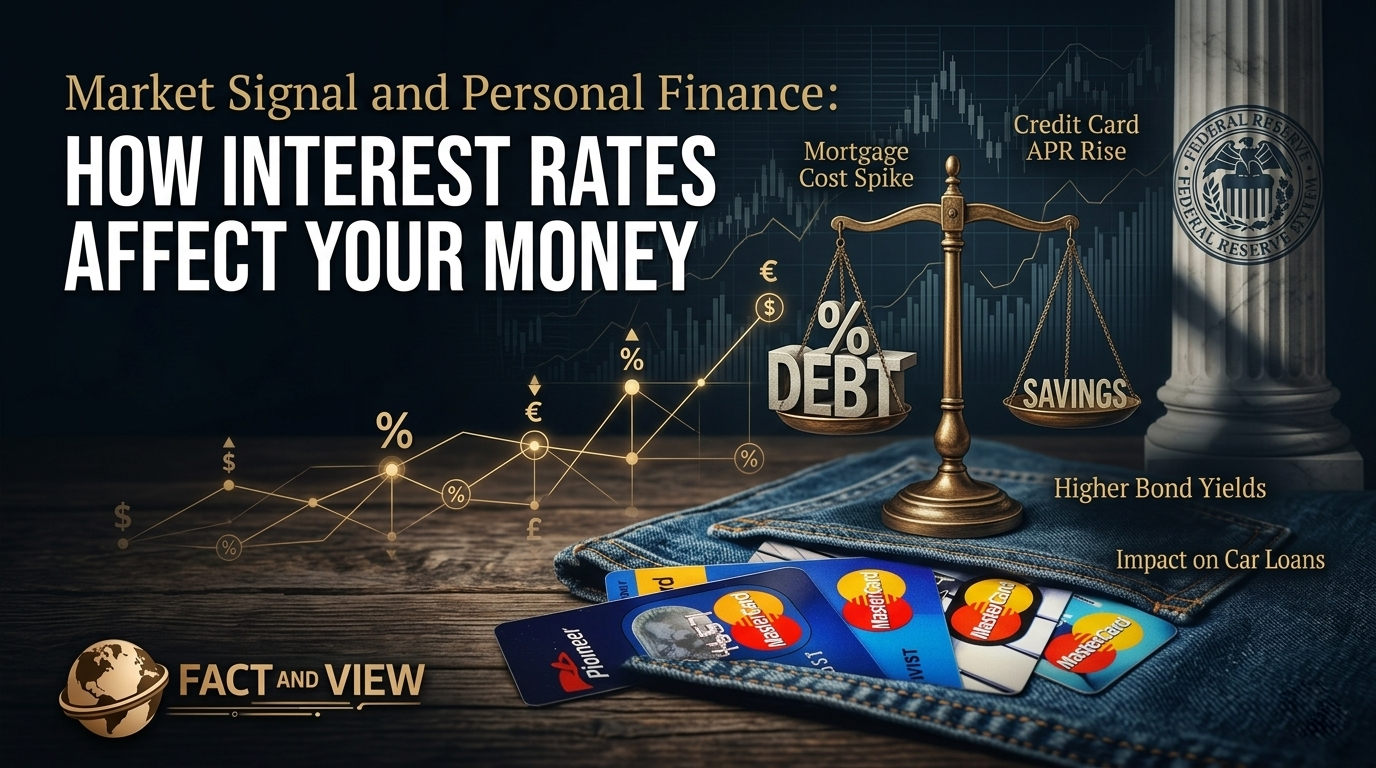
The Federal Reserve hasn’t moved its benchmark rate in four months. It held at 3.5%–3.75% in January, March, and again on April 29. Markets are now pricing in zero cuts for the rest of 2026. And yet the rate freeze isn’t neutral. It has a precise, measurable cost — on your mortgage, your car loan, your credit card balance, your savings, and the business you’re trying to grow.
On May 7, 2026, the average 30-year fixed mortgage APR is 6.54%. A five-year new car loan runs near 7%. The average monthly new-car payment hit $773 in Q1 2026 — an all-time high. Credit card APRs remain north of 20%. These aren’t abstract numbers from a financial report. They are the actual price of borrowing money in America right now.
Understanding how interest rates work — and exactly how they flow from one Fed decision into your monthly budget — is the most valuable financial literacy skill you can have in 2026. This is the full breakdown.
The Big Picture: Where Rates Stand and Why They’re Stuck
The federal funds rate is the overnight lending rate between banks, set by the Federal Open Market Committee. It is the pivot point around which every other interest rate in the economy rotates. When it moves, borrowing costs across the entire financial system shift within days.
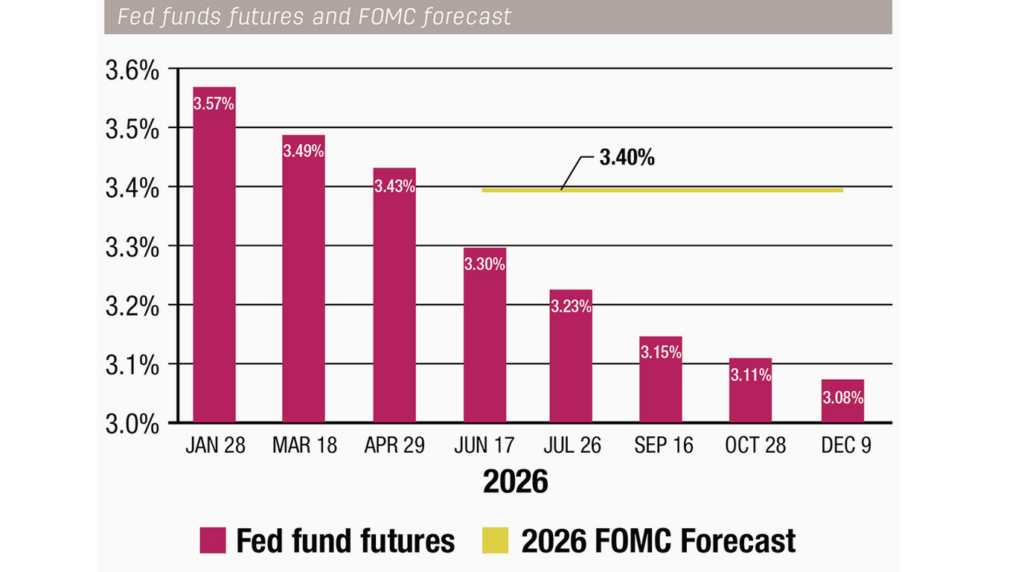
Fact: The FOMC voted 8-to-4 to hold the federal funds rate at 3.5%–3.75% on April 29, 2026 — the most divided vote since October 1992, per the Federal Reserve’s official statement. The decision marked the third consecutive hold following three rate cuts in late 2025.
Fact: The FOMC’s March 2026 dot plot shows most participants expect the rate to hold between 3.25%–3.75% through year-end. Futures markets are now pricing in zero cuts in 2026 and a single 25-basis-point cut in December 2027.
Why is the Fed frozen? Two converging forces. First, inflation remains above the 2% target — March CPI came in at 3.3% year-over-year, with core PCE at 3.0% in February. Second, the Middle East conflict pushed oil prices up over 76% from late February to early April, threatening a new inflation wave before the old one is fully extinguished. Cutting rates into that environment would risk reigniting what four years of tightening just brought under partial control.
The View: The Fed’s extended hold in 2026 isn’t indecision — it’s arithmetic. If you cut while inflation sits at 3.3% and energy prices are surging, you signal that the 2% target was aspirational rather than binding. That destroys the credibility the institution spent 2022–2024 rebuilding through painful hikes. The cost of that credibility is paid directly by every borrower in the country in the form of elevated rates that stay elevated longer.
Deep Dive: How Rates Flow Into Six Areas of Your Financial Life
1. Mortgages: The Biggest Ticket Item
Mortgage rates don’t follow the federal funds rate directly — they track the 10-year U.S. Treasury yield. But Treasury yields are heavily influenced by Fed policy expectations. When the Fed signals rates will stay high, 10-year yields stay elevated, and mortgage rates follow.
Fact: As of May 7, 2026, the national average 30-year fixed mortgage APR is 6.54% and the interest rate is 6.47%, according to Bankrate’s daily survey. The 15-year fixed APR is 5.88%. Freddie Mac’s weekly Primary Mortgage Market Survey shows a 30-year average of 6.30%.
Fact: Mortgage rates moved lower in early May as hopes for an Iran ceasefire increased, per Money.com’s May 6 update. But they reversed course as “there appears to be no clear path toward a permanent resolution.” This price action illustrates the direct geopolitical transmission mechanism — every news cycle from the Middle East moves the 10-year yield, which moves mortgage rates within 24 hours.
What does 6.47% actually cost you?
- A $400,000 30-year mortgage at 6.47% costs $2,520/month in principal and interest
- The same loan at 3.0% (the 2021 rate) cost $1,686/month — a difference of $834 per month
- Over 30 years, that gap represents $300,240 in additional interest
The View: The mortgage rate pain isn’t distributed evenly. Americans who locked in 2.75%–3.5% rates in 2020–2021 are effectively frozen in their homes — selling means accepting a new mortgage at 6.5%+, which dramatically reduces what they can afford to buy. This “lock-in effect” is suppressing housing supply, keeping home prices elevated, and making the affordability crisis worse even without a further rate increase. The Fed’s hold is compounding a problem it didn’t create but is currently making harder to escape.
2. Auto Loans: The $773/Month Squeeze
Car buyers are experiencing the convergence of two independent cost increases: elevated vehicle prices and elevated financing costs. Neither is close to resolving.
Fact: The five-year new car loan rate currently runs near 7%, according to CNBC’s April 29, 2026 consumer rate analysis. The average monthly payment on a new vehicle hit $773 in Q1 2026 — an all-time high. “Car buyers are in a tough spot right now because they’re getting squeezed from both ends: high sticker prices and high interest rates,” said Joseph Yoon, consumer insights analyst at Edmunds.
Fact: Auto loan rates vary dramatically by credit score, per Experian’s Q4 2025 data: super-prime borrowers (781+ credit score) pay 4.66% on new car loans; deep-subprime borrowers (below 580) pay 16.01%. A borrower with excellent credit saves over $9,500 in interest over the life of a $30,000 auto loan compared to a poor-credit borrower.
The View: The $773 average monthly payment is a data point with enormous downstream consequences. When that much of a household’s budget is committed to a depreciating asset, discretionary spending contracts. Restaurants, travel, electronics, and clothing all feel the downstream effect of consumers who are “car-payment poor.” This is one of the more overlooked transmission channels from Fed policy to consumer sentiment — and it’s why retail sales data has been softer than headline employment numbers would suggest.
3. Credit Cards: The 20%+ Trap
Credit card rates are the most immediately responsive consumer product to Fed policy — they typically adjust within one to two billing cycles of a Fed move. And they compound.
Fact: Average credit card APRs have tracked persistently above 20% throughout 2025 and into 2026, per Bankrate’s weekly APR index. At 20.5% APR, a $5,000 balance that you pay only the minimum on costs you approximately $1,025 in interest in the first year — and takes nearly 15 years to pay off if you only make minimum payments.
The View: Credit card debt is the financial equivalent of quicksand at 20%+ APR. Every dollar of high-interest revolving balance you carry is simultaneously making you poorer and making a rate cut less impactful when it eventually arrives — because the card issuer’s spread above the Fed rate doesn’t compress meaningfully until competition forces it. Paying down credit card debt is the highest-certainty, risk-free return available to any American consumer in 2026. A 20% guaranteed return beats the S&P 500’s historical average by more than double.
4. Savings Accounts and CDs: The Silver Lining
Elevated rates don’t only create costs. For savers — particularly those with cash sitting idle — the current environment offers returns not seen since before the 2008 financial crisis.
Fact: High-yield online savings accounts are currently paying 4.0%–5.0% APY. Certificates of deposit (CDs) with 12-month terms are available at 4.5%–5.1% from FDIC-insured institutions. Per CNBC’s April 29 analysis, “although rates on certificates of deposit and high-yield savings accounts have fallen from recent highs, they are holding above the annual rate of inflation” — meaning real (inflation-adjusted) returns on safe cash deposits are genuinely positive for the first time in years.
The View: The window for locking in elevated CD rates is closing, not opening. Each time the Fed moves closer to its first cut — even if that’s December 2027 — rates on new CDs will begin pricing in the expected future rate environment. If you have cash reserves you won’t need for 12–18 months, locking in a CD at 4.5%–5% now is rational financial planning, not speculation. Don’t confuse the eventual certainty of lower rates with an argument to wait — lower rates mean lower CD yields on new issuances.
5. Business Borrowing: Capital Costs That Shape Hiring
For small and medium-sized businesses, interest rates determine the viability of expansion, equipment purchases, inventory financing, and new hires. When borrowing costs are elevated, marginal projects that would create jobs and growth at 4% interest rates become unviable at 7–9%.
Fact: The prime rate — the benchmark for most small business loans, HELOCs, and variable-rate business credit — currently sits at 6.75%, directly derived from the federal funds rate by adding 3 percentage points. Small Business Administration (SBA) 7(a) loan rates range from approximately 9.5%–13% depending on term and lender, per the SBA’s current rate schedule.
The View: Business lending conditions in 2026 are structurally restrictive. They’re not at the crisis levels of 2023 — but they’re tight enough to meaningfully suppress the small-business formation and expansion that drives employment growth at the margin. Companies that need capital for 12-month payback investments are the most affected. Long-cycle capital projects (three to five years) are less sensitive to current rates because they’re modeled on normalized rate assumptions. The businesses hurting most right now are those needing working capital, bridge financing, or short-term credit — exactly the businesses that create the most employment per dollar borrowed.
6. Bond Markets and Investment Returns
Rates don’t just affect what you pay to borrow — they shape what your investments return.
Fact: The 10-year U.S. Treasury yield is currently trading in the range of 4.32%–4.45%, testing nine-month highs in late April 2026 before easing slightly on Iran ceasefire hopes. TIPS (Treasury Inflation-Protected Securities) offer real yields of approximately 1.25%–2.0%. Per FRED’s daily rate data, yields remain significantly above the post-2008 norm of 1.5%–3.0%.
Fact: The earnings yield on the S&P 500 — the inverse of the P/E ratio — currently sits at approximately 3.7%, below the risk-free 10-year Treasury yield of 4.35%. This negative equity risk premium is structurally unusual and historically precedes periods of below-average equity returns.
The View: The relationship between interest rates and asset valuations is mechanical, not theoretical. Higher rates compress the present value of future earnings, which pushes equity multiples lower over time — unless earnings grow fast enough to offset it. In 2026, with the S&P 500 trading at a P/E of 26–27 and bond yields above equity earnings yields, the fixed income case is stronger than it has been since 2007. A barbell bond strategy — short-duration high-yield for income, long-duration quality bonds for capital appreciation when rates eventually fall — is the institutional consensus for a reason.
Risks & Opportunities: Three Rate Scenarios for 2026–2027
Base Case (~50% probability): Hold Through 2026, One Cut in Late 2027
Rates remain at 3.5%–3.75% through December 2026. CPI gradually retreats toward 2.5%–2.8% as energy prices stabilize. Mortgage rates hover in the 6.0%–6.5% range. The first cut arrives in Q4 2027 — limited relief.
For your wallet: Budget for elevated borrowing costs through the end of 2026. Maximize savings rates now. Use CD laddering to lock in current yields before they fall.
Upside Scenario (~25% probability): Faster Disinflation, Two Cuts in H2 2026
Oil eases, shelter inflation continues its lagged decline into CPI. Core PCE drops to 2.3%–2.5% by summer. The Fed delivers two cuts by December, pushing mortgage rates toward 5.5%–5.75%.
For your wallet: Refinancing becomes viable for borrowers who bought at 7%+ in 2023–2024. Business credit loosens. Housing inventory unlocks as the lock-in effect partially reverses. Watch monthly BLS CPI releases for the first signal — a reading below 2.5% on core PCE triggers the cut discussion.
Downside Scenario (~25% probability): Resurgent Inflation, Hold Through 2027+
Middle East conflict escalates. Oil sustained above $115. Headline CPI spikes back toward 4%. The Fed abandons its easing bias and holds indefinitely — or hikes once in early 2027.
For your wallet: Mortgage rates return toward 7%–7.5%. Average car payments push past $800. Credit card balances cost even more to carry. Real estate transactions freeze further. Short-duration Treasuries and TIPS are your best financial protection in this scenario.
The Bottom Line
Interest rates in 2026 are not a problem for “the economy” in the abstract. They are a tax on every American who borrows money — and a subsidy to every American who saves it. Knowing which side of that equation you sit on determines your financial playbook.
Three actions, ranked by impact:
1. Pay down credit card debt immediately. At 20%+, no investment reliably beats the return on eliminating this debt. This is your highest-priority financial action in 2026, period. Use Bankrate’s debt payoff calculator to model your specific timeline.
2. Lock in CD or high-yield savings rates now. Online banks are offering 4.5%–5.0% on 12-month CDs. Compare current rates at Bankrate’s CD rate tracker and NerdWallet’s savings comparison. This window closes when the Fed starts cutting.
3. Reframe the mortgage decision. If you need to buy a home, calculate the real cost of waiting — rent versus ownership, equity accumulation, and the probability that rates fall meaningfully before 2027. Use the CFPB’s mortgage calculator to stress-test your budget at current rates. A rate at 6.5% today that you refinance at 5.0% in two years is a manageable long-term outcome. Perpetual waiting is not.
The Fed’s hold isn’t a pause in the story. It is the story — and it runs directly through your monthly budget until the data changes its calculus.
FAQ
Why are mortgage rates so high in 2026 if the Fed already cut rates in 2025?
Mortgage rates track the 10-year U.S. Treasury yield, not the federal funds rate directly. The Fed cut its short-term rate by 0.75% in late 2025, but long-term Treasury yields didn’t fall proportionally — because they reflect market expectations about long-run inflation and the enormous supply of new government debt being issued. With a $1.9 trillion federal deficit adding Treasury supply to the market, long-term yields face structural upward pressure that short-term rate cuts can’t fully offset. Track the real-time 10-year Treasury yield at FRED and Bankrate’s daily mortgage rate tracker for the latest.
When will mortgage rates come down to 5% or below?
Not in 2026 — and probably not in early 2027. Markets are pricing in a single 25-basis-point Fed cut in December 2027. Even with that cut, the 10-year Treasury yield would need to fall significantly for 30-year mortgage rates to reach 5%. The Charles Schwab 2026 fixed income outlook projects 10-year yields not falling much below 3.75% even in a rate-cutting cycle, which implies mortgage rates staying above 5.5%–6.0% for the foreseeable future. Plan your housing budget accordingly, and use Freddie Mac’s weekly survey to monitor actual rate movement.
Is it worth refinancing my mortgage in 2026?
Only if your current rate is significantly above today’s market rate — roughly above 7.25%–7.5%. The standard rule of thumb is that a refinance makes financial sense when the new rate is at least 0.75%–1.0% below your current rate and you plan to stay in the home long enough to recover closing costs (typically 2%–3% of the loan amount). Use the Consumer Financial Protection Bureau’s mortgage refinance calculator to run your specific numbers before committing.
What’s the best thing to do with cash savings in a high-rate environment?
A three-tier approach: keep 3–6 months of living expenses in a high-yield savings account earning 4.0%–5.0% (liquid, FDIC-insured); put medium-term savings (12–24 months) in CDs at 4.5%–5.1% to lock in today’s rates before they fall; and consider 1–2 year Treasury notes for amounts above $250,000 where FDIC limits apply. The TreasuryDirect.gov platform allows direct purchases of government securities with no brokerage fees. Don’t leave significant cash in a traditional bank savings account earning 0.1%–0.5% when online competitors are paying 40–50x more.
How do rising interest rates affect the stock market?
Rates affect equities through three channels. First, they raise the “discount rate” applied to future earnings — making those earnings worth less today, which compresses P/E ratios. Second, they make bonds more competitive with stocks, diverting capital away from equities. Third, they raise business borrowing costs, reducing corporate profits for capital-intensive companies. In 2026, with the S&P 500 trading at a trailing P/E of approximately 27 and the 10-year Treasury yielding 4.35% — actually above the stock market’s earnings yield of ~3.7% — the rate environment is structurally unfavorable for equity valuations. This doesn’t mean stocks fall immediately; it means long-run expected returns from current levels are lower than historical norms.
Do small businesses have any good options for financing in 2026?
Yes — but you have to look beyond traditional banks. The SBA’s 7(a) loan program offers longer repayment terms that can reduce monthly payments even at elevated rates, partially offsetting the rate environment. Credit unions often offer rates 1–2 percentage points below commercial bank equivalents for the same borrower profile. For businesses with receivables, invoice factoring provides working capital without taking on interest-rate risk. The SBA’s official loan comparison tool is the most reliable resource for mapping current options to your business profile.
Where can I track current consumer interest rates in real time?
The most reliable, updated primary sources:
Federal Reserve FOMC Calendar — upcoming meeting dates and official statements
Bankrate Mortgage Rates — daily national average 30-year and 15-year fixed rates
Freddie Mac PMMS — the official weekly 30-year mortgage rate benchmark
Bankrate CD Rates — best available CD and savings rates by institution
Bankrate Credit Card APR Index — weekly average credit card rates from the 50 largest issuers
FRED — Federal Funds Rate — historical and current Fed rate data
CME FedWatch Tool — live market-implied probability of future Fed rate moves
Sources: Federal Reserve FOMC Statement, April 29, 2026 · Bankrate Mortgage Rates, May 7, 2026 · Money.com Current Mortgage Rates, May 6, 2026 · CNBC Fed Rate Impact on Consumers, April 29, 2026 · U.S. News Auto Loan Rates, April 6, 2026 · Bankrate Average Auto Loan Rates by Credit Score · Bankrate Credit Card APR Data Center, April 28, 2026 · Advisor Perspectives — FOMC April 29 Analysis · FOMC March 2026 Dot Plot — Federal Reserve · FRED — 10-Year Treasury Yield
© Fact and View, 2026. For informational purposes only. Not financial advice.