

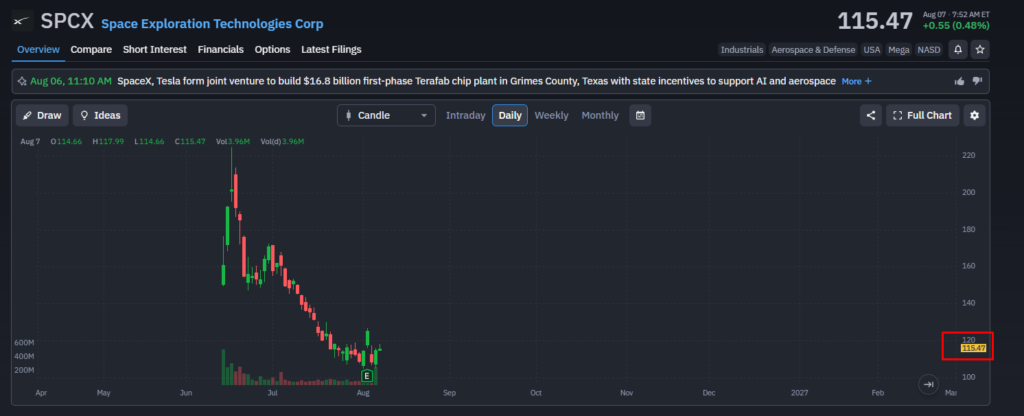
Few debuts in market history have moved as violently, or as quickly, as SpaceX’s. The company priced its June IPO at $135 a share, watched the stock rocket to an all-time high of $225.64 within days, then lost roughly half its value by early August — before reporting its first quarterly results as a public company and swinging nearly 20 percentage points in a single trading session.
That single session tells you almost everything you need to know about where SpaceX stock stands right now. On August 4, the company beat Wall Street’s revenue, earnings, and profitability estimates across the board. Shares jumped as much as 10% in regular trading — the strongest single-day move since the IPO. Then, within minutes of the results hitting after hours, the stock reversed and fell roughly 8%, as investors fixated on a single number buried deeper in the report: capital expenditures nearly double what analysts had modeled.
That whiplash is the story of SpaceX stock in one afternoon. Whether strong fundamentals or a wall of newly unlockable shares wins the next round is the question every investor watching ticker SPCX is now trying to answer.
Why SpaceX Stock Beat Expectations
SpaceX’s first earnings report as a public company cleared nearly every bar Wall Street had set for it — a notable outcome given how little verified financial history existed before the company’s IPO prospectus.
Fact: For the second quarter of 2026, SpaceX reported revenue of $7.81 billion, comfortably ahead of the roughly $6.8–6.93 billion analysts polled by FactSet and LSEG had projected, and up 92% from $4.1 billion in the same quarter a year earlier.
Fact: The company’s net loss narrowed to $541 million, down sharply from a $1 billion loss in the year-ago period, and well inside the $1.9 billion loss analysts had forecast. Loss per share came in at 9 cents, versus a projected loss of 26 cents.
Fact: Adjusted EBITDA — a measure of core operating profitability before interest, taxes, depreciation, and amortization — reached $3.5 billion, up 191% year-over-year, reflecting meaningfully improved operating leverage as revenue scaled faster than costs across most of the business.
Fact: All three of SpaceX’s reported business segments beat analyst estimates for the quarter, according to the company’s own results — a broad-based beat rather than one division carrying the entire report.
The View: A 92% revenue growth rate at a company already generating nearly $8 billion in quarterly revenue is a genuinely rare combination — most businesses see growth rates compress sharply once they clear that kind of scale. That’s precisely why the initial market reaction was so strongly positive. What makes the subsequent reversal instructive is that it wasn’t a story about disappointing fundamentals at all — it was a story about the market discovering, in the same report, that the company’s ambitions are even more capital-hungry than previously modeled.
Related reading: Is It Too Late to Invest in AI Stocks? — how capital-intensive infrastructure buildouts across the technology sector are testing investor patience with heavy near-term spending.
What Drove SpaceX’s Strong Earnings?
Behind the headline beat sits a set of specific operating drivers that explain why the quarter looked as strong as it did.
Fact: SpaceX’s Space segment — which includes launch services for outside government and commercial customers — generated $962 million in revenue, up 55% sequentially from the prior quarter and 29% year-over-year, driven by a higher volume of large customer launches and a favorable shift in customer mix compared with the year-ago period.
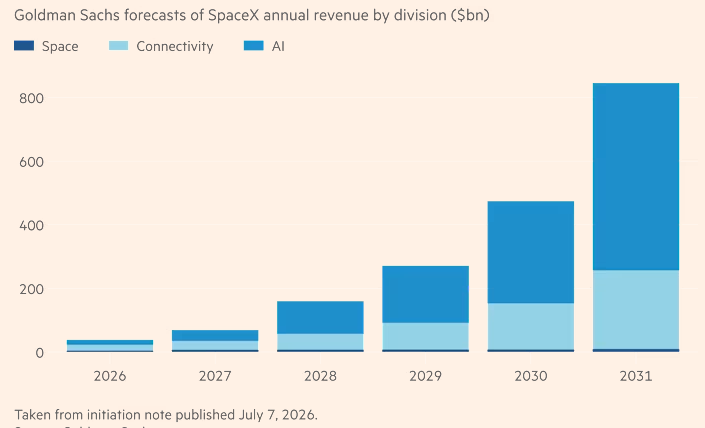
Fact: The company completed 78 launches and deployed 1,041 metric tons of mass to orbit over the first six months of 2026, with the large majority of that launch capacity allocated to deploying its own Starlink satellite constellation rather than outside commercial payloads.
Fact: SpaceX ended the quarter holding $100 billion in cash, cash equivalents, and marketable securities, alongside a $47.5 billion revenue backlog — a balance sheet position that gives the company substantial flexibility to fund its next phase of expansion without immediately returning to capital markets.
The View: The launch business’s return to meaningful growth is worth pausing on, because it had been the company’s slowest-growing, least glamorous segment for some time — overshadowed almost entirely by Starlink in investor attention. A 29% year-over-year increase in Space segment revenue, driven by genuine customer demand rather than one-off contracts, suggests the traditional rocket-launch business retains real pricing power even as the broader investment narrative has shifted almost entirely toward connectivity and orbital computing.
How Starlink Is Powering Revenue Growth
Starlink, SpaceX’s satellite internet business, remains the dominant engine behind the company’s overall growth story — even as its economics have shifted in a way that deserves close attention.
Fact: Starlink’s subscriber base has grown explosively, crossing 10 million active customers in February 2026 and continuing to add tens of thousands of new users daily across more than 160 countries and territories.
Fact: That growth has come with a deliberate trade-off. Average revenue per subscriber fell sharply — by roughly 18% to 22% depending on the measurement period — as the company expanded aggressively into international markets and introduced lower-priced service tiers to accelerate global adoption.
Fact: In May 2026, SpaceX moved to partially reverse that trend, raising Starlink plan prices by up to $10 per month — an early signal that the company is shifting from a pure subscriber-growth phase toward more deliberately monetizing its now-substantial installed base.
The View: The ARPU decline is not, on its own, a red flag — it’s a classic and often rational subscription-business strategy: prioritize market share and network effects first, then raise prices once the installed base is large enough to support it. The May price increase suggests SpaceX’s own management believes that inflection point has arrived. The more interesting long-term question is whether Starlink’s growth engine — international expansion into lower-income markets — is structurally compatible with the higher-margin monetization Wall Street will eventually demand from a company carrying SpaceX’s valuation.
Related reading: Where Smart Money Is Moving Right Now — how institutional capital is being allocated across major infrastructure and connectivity plays.
Is AI Spending a Long-Term Risk?
Alongside its traditional rocket and satellite internet businesses, SpaceX has moved aggressively into orbital AI infrastructure — a strategic pivot that is reshaping both the bull and bear case for the stock simultaneously.
Fact: In February 2026, SpaceX merged with Elon Musk’s artificial intelligence company xAI, in a transaction that valued the combined entity in the range of $1.25 trillion to $1.5 trillion — folding a capital-intensive, still-unprofitable AI lab directly into SpaceX’s balance sheet and strategic roadmap.
Fact: SpaceX has begun deploying orbital, satellite-connected AI data center infrastructure. One such facility, described as its “Colossus 1” data center, secured a contract with AI company Anthropic reportedly worth $1.25 billion per month running through May 2029 — a single agreement of a scale that illustrates how central orbital AI computing has become to the company’s forward strategy.
Fact: That strategic ambition shows up directly in the spending figures that spooked investors after the Q2 report. Capital expenditures for the quarter reached $18.4 billion, nearly double the $10.1 billion spent in the prior quarter and well above the roughly $13 billion analysts had modeled — driven substantially by continued Starship development and the buildout of AI-related infrastructure.
Fact: SpaceX executives have signaled some internal caution about how quickly the orbital AI opportunity will translate into near-term returns, with one company leader telling analysts the firm is “maybe a little bit more conservative” than some of the most bullish outside analysts, while still describing the opportunity as significant — but on a timeline stretching “into the next decade” rather than the next several quarters.
The View: This is arguably the single most important dynamic determining SpaceX stock’s trajectory from here. The xAI merger and orbital AI data center buildout are exactly the kind of speculative, capital-intensive bets that can define a company’s next decade — and exactly the kind of spending that public markets have historically punished in the short term, long before the revenue catches up. The Anthropic data center deal offers real evidence the strategy can generate committed, contracted revenue rather than remaining purely aspirational — but the $18.4 billion quarterly capex figure shows just how much cash this ambition consumes before it pays off.
Related reading: Is It Too Late to Invest in AI Stocks? — the broader pattern of AI infrastructure spending currently testing investor patience across the technology sector.
What Wall Street Expects Next
Analyst sentiment on SpaceX stock remains broadly constructive, though tempered by genuine uncertainty about how to value a business this unusual just weeks into its life as a public company.
Fact: Street-high price targets on SpaceX have reached as high as $227 per share, reflecting bullish analyst conviction in the combination of Starlink’s subscription economics, launch dominance, and the optionality embedded in the company’s AI and orbital computing ambitions.
Fact: Even bullish coverage generally frames the AI and orbital computing opportunity as a multi-year, rather than multi-quarter, story — consistent with SpaceX management’s own more measured public framing of that specific business line’s near-term revenue contribution.
Fact: Short interest in SpaceX stock climbed dramatically in the weeks following the IPO, reaching approximately 219.3 million shares by late July — representing roughly 34% of the company’s limited public float of about 640 million tradable shares, according to data from S3 Partners widely cited in market coverage.
The View: That short-interest figure is unusually high for a company with genuinely strong, beat-and-raise fundamentals, and it points to a market still deeply divided on valuation rather than on business quality. Bulls are underwriting SpaceX’s optionality in orbital AI and Starlink’s global scale; skeptics are underwriting the sheer size of the capital SpaceX is burning to pursue that optionality, against a valuation that assumes much of it succeeds.
Can SpaceX Stock Continue the Rally?
The single biggest near-term determinant of SpaceX stock’s direction has little to do with the business itself, and everything to do with the mechanics of a freshly public mega-cap company.
Fact: A major lockup expiration arrived just two days after the Q2 earnings report, freeing more than $100 billion worth of previously restricted shares — reported at roughly 911.5 million shares — for public trading, according to Bloomberg reporting cited across multiple outlets.
Fact: SpaceX structured its post-IPO lockup in staggered tranches specifically to avoid a single-day supply shock: an initial roughly 20% of locked shares became tradable following the Q2 earnings release, with additional tranches of about 7% scheduled to unlock through the following months.
Fact: The stock’s reaction to the earnings report itself illustrated this dynamic directly — rising as much as 10% in regular trading before the report, then reversing to fall roughly 8% after hours once investors weighed the strong results against the imminent flood of newly tradable shares and the outsized capital expenditure figure.
The View: This is the central tension defining SpaceX stock in its first months as a public company: strong, improving fundamentals colliding with a structural supply overhang that has nothing to do with the business’s health. Historically, lockup expirations at large, high-profile IPOs create real but temporary selling pressure as early investors and employees take some liquidity — pressure that tends to fade once the initial wave of selling clears and the market refocuses on underlying fundamentals. Whether that pattern repeats here depends on how much of the current short interest is structural skepticism versus a tactical bet on exactly this kind of unlock-driven pressure.
Related reading: Is the Stock Market Overvalued? — broader market valuation context for evaluating a newly public, premium-priced growth stock like SpaceX.
Key Risks Every Investor Should Consider
Several distinct risk factors are converging on SpaceX stock simultaneously, and separating them matters for anyone evaluating the position.
Execution risk on Starship remains real and immediate. During a July test flight, SpaceX encountered difficulty reigniting the Raptor engines on the rocket’s first stage — a setback that contributed to a string of consecutive down days for the stock, and a reminder that Starship, which the company calls the “key enabler” of its long-term growth strategy, is still an experimental vehicle carrying genuine technical risk.
Valuation remains demanding by conventional metrics. Even after its roughly 50% pullback from peak, SpaceX traded at a revenue multiple far above historical norms for large-cap companies — a premium that leaves comparatively little room for execution missteps relative to a more conservatively valued peer.
Capital intensity is structural, not temporary. The $18.4 billion in quarterly capital expenditures reflects a company simultaneously scaling Starlink, developing Starship, and building orbital AI infrastructure — three capital-hungry initiatives running in parallel, none of which is likely to meaningfully slow in the near term.
Governance concentration is unusually high. Elon Musk retains more than 80% of voting control while holding roughly 42% of total equity, a structure that gives outside shareholders limited influence over strategic decisions — including exactly the kind of high-stakes capital allocation choices, like the xAI merger, that are currently dividing analyst opinion.
Near-term technical pressure from the lockup overhang compounds all of the above, since it introduces a wave of potential selling that is disconnected from the company’s actual quarterly performance.
The Bottom Line
SpaceX’s first earnings report as a public company delivered exactly what a growth-stock bull case requires: revenue, earnings, and profitability all ahead of expectations, with 92% year-over-year growth at a scale most companies never approach. That the stock fell anyway is not a contradiction — it’s a reflection of just how much this specific stock’s near-term price action is currently being driven by IPO-related mechanics — lockup expirations and extraordinarily high short interest — layered on top of genuine, ongoing debate about whether the company’s AI and orbital computing ambitions justify their enormous capital cost.
For investors, that means the “strong earnings, weak stock reaction” pattern seen on August 4 may repeat in the near term, until the lockup-driven share supply is absorbed by the market. The more durable question — whether Starlink’s global scale, the launch business’s returning growth, and the orbital AI bet can together justify SpaceX’s valuation — will likely take several more quarters of results, not one, to answer with any real confidence.
Continue reading from Fact and View:
- Is It Too Late to Invest in AI Stocks? — the broader AI infrastructure investment landscape SpaceX’s orbital computing bet is now part of
- Where Smart Money Is Moving Right Now — how institutional investors are positioning across major technology and infrastructure plays
- Is the Stock Market Overvalued? — valuation context for premium-priced growth stocks navigating their first years as public companies
Sources: CNBC — SpaceX (SPCX) Q2 2026 Earnings Report: Live Updates · Yahoo Finance / Quartz — SpaceX Q2 2026 Earnings: Revenue Beats, Stock Falls After Hours · Investing.com — Earnings Call Transcript: SpaceX Beats Revenue Estimates in Q2 2026 · Teslarati — SpaceX $SPCX Reports Beat in First Earnings While Minimizing Losses · BingX — SpaceX (SPCX) Q2 2026 Earnings Overview: Can 92% Revenue Growth Offset the August 6 Share Unlock? · BitMEX — SpaceX IPO Guide: S-1 Breakdown, Valuation & Trading Strategy · Sacra — SpaceX Revenue, Valuation & Funding · ValueAdd VC — SpaceX Valuation 2026: From a $350B Tender Offer to a $2 Trillion Nasdaq Market Cap · KeepTrack.Space — Who Owns SpaceX in 2026?
© Fact and View. For informational purposes only. Not investment advice. Analyst price targets, short-interest data, and lockup schedules change frequently and should be independently verified before making investment decisions.