A company already valued in the trillions of dollars, reporting quarterly revenue growth rates that would be remarkable for a startup a hundredth its size, is still rated a “Buy” by the overwhelming majority of the analysts who cover it. That’s the peculiar position Nvidia stock occupies right now — a business so large that ordinary rules of gravity would suggest its growth should be slowing, generating forecasts that suggest the opposite.
Of the 61 Wall Street analysts currently covering Nvidia, 58 rate the stock a Buy or Strong Buy, two rate it a Hold, and just one rates it a Sell. Their median 12-month price target sits around $300 a share — implying upside north of 40% from recent trading levels, according to consensus data compiled by TickerNerd and reported alongside The Wall Street Journal’s own analyst survey.
That’s an unusually one-sided verdict for a company this large. Understanding why Wall Street remains this convinced — and where the real cracks in that conviction lie — is the clearest way to evaluate whether the optimism is justified or overextended.
Why Wall Street Remains Bullish on Nvidia Stock
The bull case on Nvidia stock isn’t built on speculation about future potential the way many growth-stock theses are. It’s built on results that have, so far, consistently exceeded even aggressive analyst expectations.
Fact: Nvidia’s most recent quarterly report — for the first quarter of its fiscal year 2027 — showed total revenue of $81.6 billion, extending a streak of outperformance that Wall Street has come to treat as close to routine for the company, even as the absolute dollar figures involved have become almost startling for a business of Nvidia’s size.
Fact: Data center revenue, which includes the AI accelerator chips (such as the Hopper and Blackwell GPU families) that now define the company’s business, reached $75.2 billion in that same quarter — 92% year-over-year growth, and more than 90% of total company revenue.
Fact: Nvidia holds an estimated 92% share of the data center GPU market, according to Motley Fool analysis — a dominance so pronounced that Wedbush Securities analyst Dan Ives has argued the market still underestimates the company’s centrality to the entire AI technology stack, from model training through inference and real-world deployment.
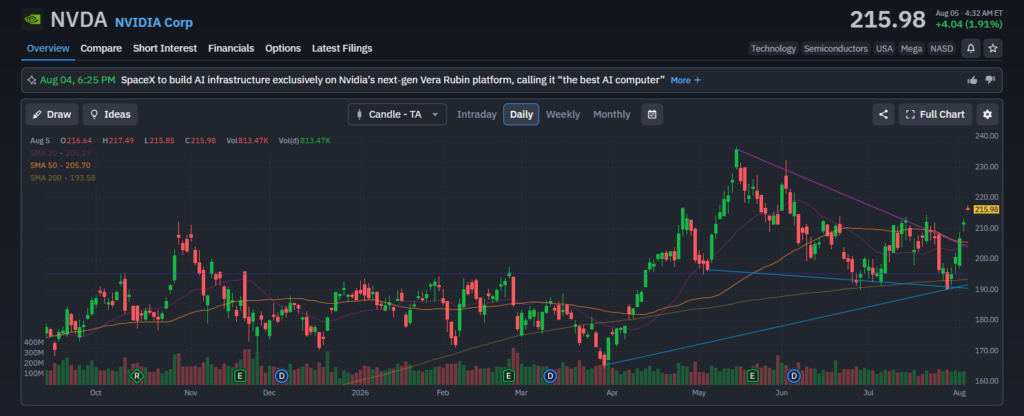
The View: What separates this bull case from typical hype-driven tech optimism is the sheer consistency of the delivery. Growth-stock narratives usually rely on investors extending faith through several quarters of promise before results catch up. Nvidia has largely reversed that pattern — analysts have repeatedly had to raise estimates after results came in, rather than watching the company grow into expectations set in advance. That track record is precisely why 58 of 61 analysts remain unwilling to bet against the stock, even at its current scale.
Related reading: Is It Too Late to Invest in AI Stocks? — the broader AI infrastructure buildout that sits behind Nvidia’s growth numbers.
Latest Nvidia Stock Price Targets
Price targets on Nvidia stock have moved meaningfully higher over the course of the year, tracking — and in some cases exceeding — the stock’s own gains.
Fact: As of early August, the 61 Wall Street analysts covering Nvidia held a median 12-month price target of approximately $300, with individual estimates ranging as low as $180 and as high as $500 — a wide dispersion that itself signals genuine disagreement about how far the growth story can extend, even among analysts who broadly agree on the direction.
Fact: That $300 median target represented roughly 45% implied upside from the stock’s most recent closing price at the time, according to TickerNerd’s tracking of consensus estimates.
Fact: Individual price targets have shifted upward over the year as results came in ahead of expectations. In April, The Wall Street Journal’s analyst survey placed the median target at $265, implying roughly 50% upside from the stock’s price at that time. By August, both the stock price and the median target had risen in tandem — a pattern consistent with a market repeatedly revising its expectations upward rather than the stock simply catching up to a static target.
Fact: Some of the more aggressive individual calls have pushed even higher. Wedbush’s Dan Ives set a $250 price target with a base case forecast, explicitly built on the view that “numbers are significantly underestimated” — citing what he sees as durable underappreciation of Nvidia’s role across the full AI value chain, not just chip sales in isolation.
The View: The dispersion between the $180 low estimate and the $500 high estimate is worth sitting with. It’s not simply noise — it reflects a genuine, unresolved debate among professional analysts about whether Nvidia’s current growth rate is a temporary function of an unusually early, unusually concentrated AI infrastructure buildout, or a more durable position that persists once that buildout matures. Both scenarios are represented in the current price target range, and investors should treat the median figure as a midpoint of real disagreement, not a consensus certainty.
What’s Driving Nvidia’s AI Growth?
Behind the headline revenue figures sits a specific set of structural advantages that analysts consistently cite as the foundation of Nvidia’s pricing power and market position.
Fact: Nvidia’s CUDA software platform — the programming framework developers use to build AI applications on Nvidia hardware — has become what Motley Fool’s analysis describes as “the industry standard in AI application development,” creating a software-driven switching cost that reinforces Nvidia’s hardware dominance well beyond raw chip performance alone.
Fact: The company’s competitive advantage extends into vertical integration — controlling not just the chip design but significant portions of the surrounding hardware ecosystem, including networking equipment critical to connecting thousands of GPUs into the large-scale computing clusters that modern AI training requires.
Fact: Beyond the current core business, Motley Fool’s ongoing coverage identifies AI inference (running trained models in production, as opposed to training them), enterprise software, and robotics as potential next-generation growth engines for the company — categories that could extend Nvidia’s addressable market well beyond its current data-center-training-dominated revenue base.
The View: The CUDA ecosystem is arguably the single most underappreciated element of the Nvidia bull case in casual market commentary, which tends to focus almost entirely on chip specifications and competitive benchmarks. Hardware alone is a commodity business over time — better chips get built by competitors eventually. Software ecosystems with genuine developer lock-in are a different, much stickier kind of advantage, and it’s the combination of the two that analysts point to when explaining why Nvidia’s market share has proven so difficult to erode despite years of well-funded competitive attempts.
Related reading: Where Smart Money Is Moving Right Now — how institutional investors are positioning across the broader AI infrastructure trade, Nvidia included.
Can NVDA Reach New Highs?
Whether Nvidia stock can push meaningfully past its current levels depends on a specific, testable question: can the company’s growth rate hold up against a base that keeps getting larger?
Fact: Wall Street’s current consensus earnings estimate for Nvidia’s fiscal 2027 (ending January 2027) sits at approximately $7.46 per share, according to Motley Fool’s compiled analyst data — a figure that, if achieved, would support continued upward revision of price targets on a straightforward earnings-multiple basis.
Fact: The most bullish individual forecasts explicitly build in continued outperformance rather than simple trend continuation. Motley Fool contributor Trevor Jennewine’s independent model projected Nvidia reaching $276 per share by the end of one recent year — modestly above the Street’s own median target at the time — based on the view that consensus estimates were still underestimating the pace of data center buildout.
Fact: Nvidia’s own historical trajectory supports the case that skepticism about “the law of large numbers” catching up with the company has repeatedly proven premature. The stock was reported up nearly 1,000% over a three-year period through early December of one recent year, a run that occurred entirely during a period when critics were already warning that such growth rates couldn’t be sustained from an increasingly large base.
The View: The “can a company this large keep growing this fast” question is legitimate, but it’s also one that’s been asked — and answered in Nvidia’s favor — at multiple points over the past several years. That doesn’t guarantee it will keep being answered the same way. But it does suggest that betting against Nvidia purely on the mathematical argument that “it’s already too big to keep growing” has been a consistently losing strategy so far, which is precisely why most Wall Street analysts continue framing the debate around growth rate deceleration rather than growth reversal.
Key Risks for Nvidia Investors
Even Nvidia’s most enthusiastic analysts don’t describe the stock as risk-free, and several specific concerns recur across more cautious coverage.
Fact: Investor Michael Burry — known for his early, prescient bet against the U.S. housing market ahead of the 2008 financial crisis — has publicly warned about risks in the broader AI trade, suggesting the market may be extrapolating current growth rates too far into the future without adequately pricing the possibility of a slowdown.
Fact: Nvidia’s price-to-earnings ratio trades at a substantial premium to the broader market, which critics argue reflects expectations that may be difficult to satisfy even with continued strong execution — a classic “priced for perfection” concern that shows up in cautious analyst commentary even among firms that maintain a Buy rating.
Fact: Competitive pressure is intensifying from multiple directions. Elon Musk has publicly stated he is building a chip he claims will be “2-3x better than Nvidia” at roughly 10% of the cost — an explicit, high-profile challenge to Nvidia’s pricing power, even though such claims from any competitor typically require years of validation before materially affecting market share.
Fact: Motley Fool’s own longer-term analysis flags that competition and the rise of custom AI chips developed in-house by major cloud providers will likely pressure Nvidia’s margins over time, even while the company’s near-term revenue growth remains strong — a distinction between near-term revenue trajectory and longer-term margin durability that sophisticated investors are watching closely.
The View: The most credible version of the bear case on Nvidia isn’t that the AI buildout stops — it’s that Nvidia’s share of the profits from that buildout gradually compresses as customers diversify their chip suppliers, invest in custom silicon, and negotiate harder on pricing once alternatives mature. That’s a fundamentally different risk than the AI trade “popping” as a bubble, and it’s the one that shows up most consistently in analyst notes that maintain bullish price targets while still flagging genuine long-term uncertainty.
Related reading: Best Investments During Inflation — diversification strategies relevant to investors concerned about single-stock concentration risk in a portfolio heavy on AI names.
How Nvidia Compares With Other AI Stocks
Nvidia’s position within the broader AI stock landscape is distinct in ways that matter for how investors should think about it relative to competitors and adjacent plays.
Fact: While competitors including AMD and various custom silicon developers backed by major cloud providers have made competitive claims and gained selective traction in specific workloads, none has matched Nvidia’s combined hardware performance, software ecosystem, and vertically integrated networking position at scale, according to the consensus view reflected in current analyst coverage.
Fact: Ticker Nerd’s systematic factor model — an independent, quantitative ranking system applied across roughly 4,600 U.S. stocks — placed Nvidia in the 80th percentile overall, driven heavily by a near-top-decile “Quality” score reflecting the company’s ability to generate solid, repeatable profits from its asset base, though the same model flagged a comparatively weak “Accruals” reading, a technical signal that a meaningful share of reported profit has not yet converted to cash — worth monitoring, though not unusual for a company scaling capital expenditure this aggressively.
Fact: Nvidia’s position differs structurally from pure AI software or application-layer companies, since its revenue is tied directly to infrastructure capital expenditure decisions made by a relatively concentrated group of hyperscale cloud customers — a dynamic that creates both the current growth tailwind and a specific customer-concentration risk not shared equally by companies operating further up the AI value chain.
The View: The clearest way to think about Nvidia’s relative position is that it sits closer to being an AI infrastructure toll-collector than a single application bet — every major AI lab and cloud provider currently needs its chips regardless of which specific AI application or model ultimately wins in the market. That positioning has historically been viewed as a relatively lower-risk way to gain AI exposure compared to betting on any single downstream AI product or company, though it comes with its own concentration risk tied to the small number of customers currently driving the bulk of data center capital spending.
What Investors Should Watch Next
For anyone tracking Nvidia stock going forward, a handful of specific signals offer the clearest read on whether the current bull case remains intact.
- Quarterly data center revenue growth rates, watching specifically whether the pace of year-over-year growth begins decelerating meaningfully from recent triple-digit and near-triple-digit readings.
- Capital expenditure guidance from Nvidia’s largest customers — the major hyperscale cloud providers — since their AI infrastructure spending plans directly determine Nvidia’s near-term order book.
- Gross margin trends, the clearest early signal of whether competitive pressure from custom silicon and rival chipmakers is beginning to erode Nvidia’s pricing power.
- The pace of analyst price target revisions following each earnings report, since the historical pattern of upward revisions after results — rather than results simply catching up to pre-set targets — has been a defining feature of the stock’s run so far.
- Emerging competitive announcements, including custom chip developments from major cloud providers and high-profile challengers, tracked for actual production timelines and benchmarked performance rather than early claims alone.
The Bottom Line
Nvidia stock’s current Wall Street consensus — 58 of 61 analysts rating it a Buy or Strong Buy, with a median price target implying more than 40% upside — reflects a genuinely unusual level of professional conviction for a company already valued among the largest in the world. That conviction rests on a track record of consistently exceeding already-aggressive expectations, a dominant and software-reinforced market position, and a growth trajectory that has repeatedly outrun skepticism about the limits of scale.
It does not mean the stock is without risk. Valuation multiples remain elevated by conventional standards, competitive pressure from custom silicon and rival chipmakers is real and intensifying, and prominent skeptics have raised legitimate questions about how much of the AI infrastructure buildout’s future growth is already priced in. The most sophisticated version of the bull case and the most sophisticated version of the bear case increasingly agree on the near-term trajectory — continued strong data center demand — and disagree instead on the multi-year durability of Nvidia’s margins once today’s most aggressive competitive threats mature from claims into shipped products.
Continue reading from Fact and View:
- Is It Too Late to Invest in AI Stocks? — the full AI infrastructure investment landscape beyond Nvidia alone
- Where Smart Money Is Moving Right Now — how institutional investors are currently allocating across the AI trade
- Is the Stock Market Overvalued? — broader market valuation context for evaluating premium-priced growth stocks like Nvidia
Sources: Public.com — NVIDIA (NVDA) Stock Forecast: Analyst Ratings, Predictions & Price Target · Intellectia AI — NVIDIA Stock Analysis & Price Prediction · The Motley Fool / Yahoo Finance — Prediction: This Will Be Nvidia’s Stock Price by the End of the Year · The Motley Fool — Nvidia (NVDA) Stock Predictions for 2026 and Beyond · TickerNerd — NVDA Stock Forecast: NVIDIA Corp. Price Targets & Predictions · TheStreet — Popular Analyst Sets Bold Price Target on Nvidia Stock · CNN Markets — NVDA Stock Quote, Price and Forecast
© Fact and View. For informational purposes only. Not investment advice. Analyst price targets and ratings change frequently and should not be relied upon as guarantees of future performance.