
The average American buying a new car now signs up for a $765 monthly payment. That’s not a down-market estimate. It’s the national average, according to Experian’s Q2 2026 data on new-vehicle loans, and it sits on top of an average loan balance of $43,610 stretched across nearly six years.
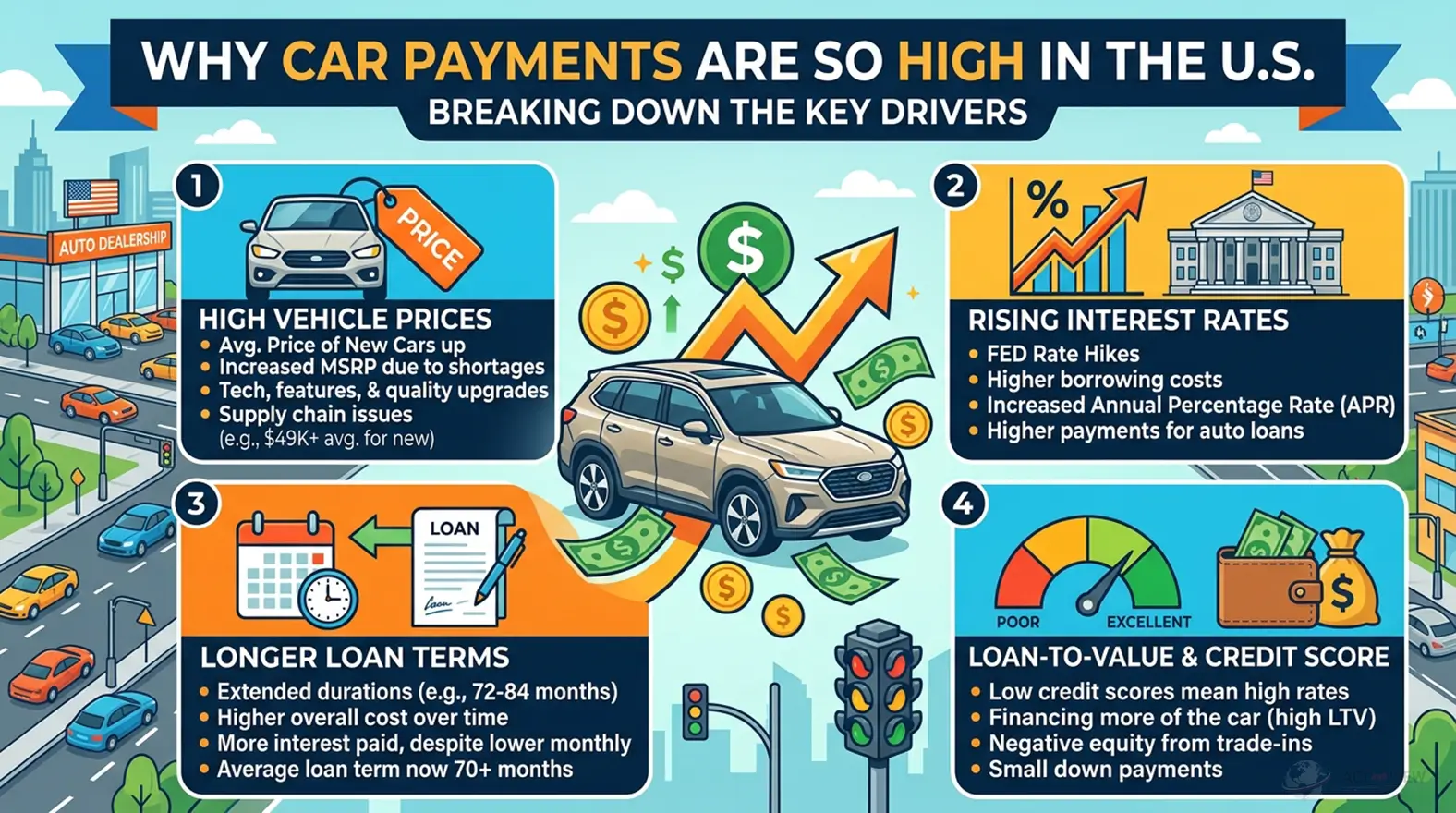
Car payments have climbed faster than wages for most of the past decade. The reasons aren’t a mystery, and they aren’t really about any single factor. Vehicle prices rose. Borrowing got more expensive. Loan terms stretched longer to make the monthly number look survivable. Each change fed the next one.
The Big Picture
A car payment is built from three numbers: the price of the vehicle, the interest rate on the loan, and the length of the loan. All three have moved in the wrong direction for buyers at the same time, which is why the monthly payment has grown faster than any one factor alone would suggest.
What’s Pushing Prices Higher
New-vehicle prices moved back above $50,000 in August 2026, according to Kelley Blue Book, with the average sticker price (MSRP) reaching $51,852. That’s roughly 2.2% higher than a year earlier.
Tariffs explain part of that increase. A 25% tariff on imported vehicles has been in place through 2026, and Cox Automotive estimates it touches close to 85% of new cars sold in the U.S. in some form, whether the vehicle itself is imported or built with imported parts. Industry analysts put the added cost at $2,000 to $6,000 per affected model. Automakers haven’t passed on the full tariff cost to buyers. Instead, they’ve absorbed part of it through thinner profit margins while raising prices gradually, which is why the increase shows up over many months of transaction-price data rather than one sharp jump.
Vehicle mix matters too. Buyers are choosing midsize SUVs and trucks over compact cars at a higher rate than in past years, and those vehicles carry higher base prices. A full-size pickup now averages close to $66,000. A compact car averages under $28,000. When more buyers choose the pricier end of the lineup, the industry-wide average price climbs even if no individual model gets more expensive.
Used cars have stayed comparatively cheaper, averaging around $27,000, but the gap with new-car prices has narrowed over the past few years as used-vehicle demand rose alongside new-car sticker shock. Automakers have leaned on incentives to keep sales moving even as list prices climb; discounts made up roughly 7% of the average new-vehicle transaction price in mid-2026. Without those incentives, the gap between MSRP and what buyers actually pay would be even smaller than it already is.
Why Loans Cost More Each Month
Price is only half the equation. The other half is what it costs to borrow the money.
The average new-car loan carries a 6.35% interest rate, and used-car loans average 11.19%, according to Experian. Those rates trace back to the Federal Reserve. When the Fed raises its benchmark rate, as it did by a quarter point in September 2026 to fight inflation tied partly to rising energy costs, banks and auto lenders raise what they charge borrowers to match. A car loan isn’t directly tied to the Fed’s rate the way a credit card often is, but lenders price auto loans off the same broader cost of borrowing, and that cost has stayed elevated through 2026.
Credit score widens the gap further. A buyer with a subprime credit score pays 13.44% on a new-car loan, more than double the 6.23% a prime borrower pays on the same loan amount, a difference worth more than $5,000 in interest over the life of a typical loan. Used-car buyers with deep subprime credit pay even more: rates above 21% are common, roughly three times what a buyer with top-tier credit pays for the same used vehicle.
How Longer Loan Terms Changed the Math
Lenders and dealers have one dependable tool for keeping a monthly payment from looking unaffordable: stretch the loan out. The average new-car loan term now runs 69.5 months, just short of six years. Nearly a quarter of new-car loans now run 84 months or longer, a term that barely existed in mainstream auto lending a decade ago.
A longer term lowers the monthly payment on paper, but it adds years of interest and keeps the loan balance above the car’s actual value for longer. Experian found that nearly 30% of trade-ins carry negative equity, meaning the owner still owes more than the car is worth, by an average of $6,884. Buyers who roll that negative balance into a new loan, rather than paying it off separately, end up with an average monthly payment of $944, roughly $180 higher than the typical new-car payment.
Why More Buyers Are Leasing Instead of Buying
A growing number of buyers are sidestepping the full loan payment by leasing instead. The average new lease payment runs $617 a month, roughly $148 less than the average loan payment, because a lease only requires the buyer to cover the vehicle’s depreciation over the lease term rather than its full price.
Fuel type changes the payment picture too. Experian found the average new-loan payment for a hybrid runs $646 a month, compared with $692 for an electric vehicle and $721 for a gasoline vehicle. Hybrids now account for nearly 17% of new-vehicle financing, up from under 13% a year earlier, partly because buyers see them as a middle ground between a gas vehicle’s fuel costs and an EV’s higher upfront price.
The Hidden Costs Beyond the Loan
The loan payment is the number buyers budget around, but it isn’t the full cost of owning a car.
Auto insurance has climbed sharply over the past several years. The average full-coverage policy cost $1,630 a year in 2019. By the first half of 2026, that average reached $2,237, a 37% increase, according to Insurify. Rates eased slightly in 2025 before climbing again this year, and insurers expect increases in 32 states by the end of 2026, driven by repair costs on vehicles packed with sensors and cameras that can cost $8,000 to $15,000 to replace after a collision.
Maintenance and repair costs have followed a similar path, rising roughly 45% over the past five years according to industry data. None of this shows up in the advertised monthly payment, but it shows up in the household budget every month regardless.
Who’s Feeling the Pressure Most
The strain isn’t evenly spread. Borrowers with strong credit are managing these payments without much trouble. The pressure concentrates almost entirely among subprime and near-prime borrowers, who make up a much larger share of distressed loans than their share of total borrowing would suggest.
Subprime auto loans more than 60 days past due hit 6.9% in January 2026, the highest rate in 32 years, according to Fitch Ratings, a mark that exceeds even the peak of the 2008 financial crisis. The rate eased to 5.67% by June, but it remains far above pre-pandemic norms. Across all auto loans, 5.5% of balances were 90 or more days delinquent in the second quarter of 2026, a record that also tops the Great Recession’s previous high of 5.3%.
Repossessions have followed the delinquencies higher. Lenders took back 1.73 million vehicles last year, the most since 2009. Total outstanding auto debt in the U.S. has climbed to roughly $1.7 trillion.
The buyer pool for new cars has shifted alongside these numbers. Households earning more than $150,000 a year made up 29% of new-vehicle retail buyers in 2020. By 2025, that share had grown to 42%, according to Cox Automotive’s Car Buyer Journey Study. That shift doesn’t mean fewer lower-income Americans need cars. It means a growing share of them are being priced out of the new-car market entirely and pushed toward older, cheaper used vehicles, or toward used-car loans that now carry their own elevated rates.
A New Tax Break Offsets Only Part of the Cost
Congress built a partial offset into the tax code. Under the One Big Beautiful Bill Act, signed into law in July 2025, buyers who finance a new vehicle assembled in the U.S. can deduct up to $10,000 a year in loan interest on their federal tax return through 2028, even without itemizing. The deduction phases out for single filers above $100,000 in taxable income and joint filers above $200,000, and it applies only to new personal vehicles bought with a loan, not leased or used vehicles.
The practical savings are smaller than the headline number suggests. Cox Automotive estimates a typical buyer in the 15% to 20% tax bracket would see less than $750 in actual tax savings in the first year, and the benefit shrinks each year after that as the interest portion of a loan payment declines relative to principal. The deduction lowers the effective cost of a new-car loan for eligible buyers, but it doesn’t change the sticker price, the interest rate, or the monthly payment due each month.
What It Means for American Households
A car is one of the few major purchases most working Americans can’t avoid, which is what makes the rising cost different from, say, a luxury good getting more expensive. Buyers who can’t stretch their budget further are increasingly choosing used cars over new ones, holding onto older vehicles longer, or financing with longer terms that leave them owing more than the car is worth for years at a time.
By one measure, the typical household now needs 34.9 weeks of median income to buy the average new vehicle, up from 33.7 weeks a decade ago, according to the Cox Automotive/Moody’s Analytics Vehicle Affordability Index. Over that same ten-year stretch, the average car payment rose 60% while incomes grew more slowly.
The effects reach beyond the car itself. A household carrying a $765 car payment, a rising insurance bill, and a mortgage or rent payment at today’s rates has less room for savings, retirement contributions, or an unexpected expense. For lower-income and younger buyers in particular, a car loan that was manageable at approval can become unmanageable after a job loss or a rate reset on a variable-rate loan, which is part of why delinquencies are concentrated among borrowers who had the least room to begin with.
What to Watch Next
A few variables will decide whether car payments keep climbing or start to ease.
The Federal Reserve’s rate decisions matter directly. Another rate increase would push auto loan APRs higher still; a cut would ease new borrowing costs, though it wouldn’t undo the balances already locked into existing loans. Tariff policy remains unsettled too, and any expansion or rollback would show up in transaction prices within a few months. Delinquency and repossession data, tracked monthly by the New York Fed and Fitch Ratings, will show whether the subprime stress stays contained to lower-credit borrowers or starts spreading into prime lending, which would signal a broader problem for the auto finance industry and, by extension, for consumer spending overall.
The Bottom Line
Car payments are high because three things happened at once: vehicle prices rose, borrowing costs stayed elevated, and lenders stretched loan terms to keep monthly payments from looking unaffordable on paper. That combination has pushed the average new-car payment to $765 and left nearly a third of trade-ins underwater.
The pressure isn’t evenly distributed. Borrowers with strong credit are paying more than they used to but managing it. Subprime and near-prime borrowers are carrying the bulk of the delinquencies and repossessions, a pattern that mirrors broader strain across household budgets rather than a problem unique to the auto market.
What happens next depends on factors still in motion: Fed policy, tariff decisions, and whether delinquency trends ease or spread. The data available through September 2026 shows a market under real strain, not a collapse, with the clearest risk concentrated among the borrowers who had the least cushion to start with.
Read more :
- “How the Federal Reserve Sets Interest Rates, and Why It Affects Your Loans“
- “Why Tariffs Raise Prices for American Consumers“
- “US Household Debt: What’s Driving It and Who’s Most at Risk“
Source:
- Experian — State of the Automotive Finance Market, Q2 2026
- Kelley Blue Book / Cox Automotive — Average New-Vehicle Transaction Price Report, August 2026
- Fitch Ratings — U.S. Auto ABS Delinquency Index
- Federal Reserve Bank of New York — Quarterly Report on Household Debt and Credit
- Insurify — 2026 State of Insurance, Auto Trend Report