

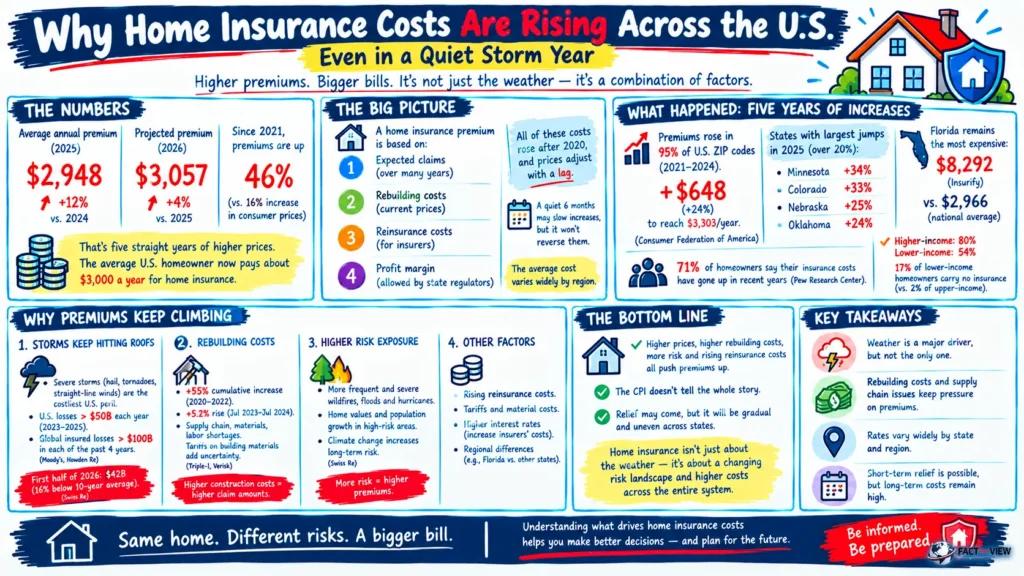
The typical American homeowner now pays about $3,000 a year to insure a house, and the bill keeps climbing. Insurify, an online comparison site, found that the average premium rose 12% in 2025 to $2,948, and it projects another 4% increase, to $3,057, by the end of 2026.
That makes five straight years of higher prices. Since 2021, the average cost has risen 46%, about three times the 16% increase in consumer prices.
This year adds a puzzle. Swiss Re Institute put global insured natural catastrophe losses in the first half of 2026 at $42 billion, below its $66 billion long-term trend. Reinsurance prices fell. Florida’s insurers reported stronger results. Premiums rose anyway, and the reasons show how insurers set prices and why relief arrives slowly.
The Big Picture
A home insurance premium reflects more than last year’s weather. Insurers price a policy on the claims they expect to pay over many years, the cost of rebuilding a house, the price of the backup insurance they buy for themselves, and the profit their state regulator allows. Each of those inputs rose after 2020, and prices adjust with a lag.
A quiet six months slows the increases without reversing them. A household with a mortgage feels each one in its monthly payment, because lenders bundle insurance into escrow. Prices also differ sharply by region, so the national average hides wide gaps between Florida, California, the Midwest hail belt and everywhere else.
What Happened: Five Years of Increases
The Consumer Federation of America found that premiums rose in 95% of U.S. ZIP codes between 2021 and 2024, adding $648, or 24%, to reach an average of $3,303 a year. Dollar figures differ by source because each analysis draws on different policies and coverage levels.
Some states took harder hits. In 2025, premiums jumped more than 20% in six states, including Minnesota (+34%), Colorado (+33%), Nebraska (+25%) and Oklahoma (+24%). Insurify’s mid-2026 update found rates kept rising in the first half of the year, and some counties saw increases of up to 33%.
Florida remains the most expensive state. Insurify puts a typical Florida premium at $8,292, nearly three times the national average. The Zebra, another comparison site, reports $9,449 for Florida and $2,966 nationally.
The gap between expensive and cheap states is widening. Premiums rose 14% on average in the 25 most expensive states in 2025 and 5% in the 25 least expensive.
Homeowners have noticed. A Pew Research Center survey conducted March 16-22, 2026, found that 71% of homeowners say their insurance costs have gone up in recent years, and 42% say they have gone up a lot. Upper-income homeowners reported increases more often (80%) than lower-income homeowners (54%). The survey shows a coverage gap: 17% of lower-income homeowners said they carry no homeowners insurance, compared with 2% of upper-income homeowners.
Why Premiums Keep Climbing
Storms keep hitting roofs
Severe convective storms are the costliest U.S. weather peril for insurers. The term covers thunderstorms that produce hail, tornadoes and straight-line winds. Moody’s reports that U.S. losses from these storms topped $50 billion in each year from 2023 through 2025. Hail damages roofs, siding and windows, and insurers pay to replace them. Howden Re notes that global insured natural catastrophe losses have exceeded $100 billion in each of the past four years.
The first half of 2026 broke that pattern. Swiss Re estimated global insured losses at $42 billion, 16% below the ten-year average and the lowest first-half total since 2020. Fewer of the biggest storm outbreaks struck Texas and the Southeast, where dense insured property raises the cost of each storm. Swiss Re also cautioned that a single major hurricane, earthquake or wildfire can change the year quickly.
Rebuilding costs
A policy pays to repair or replace a home at current prices, and those prices jumped. Triple-I, the industry’s research group, cites a 55% cumulative increase in replacement costs from 2020 through 2022, driven by supply chain disruption, costlier materials and labor shortages. Verisk, a data firm, measured another 5.2% rise in reconstruction costs from July 2023 to July 2024.
Higher rebuilding costs raise the coverage limit on a policy and the size of every claim. Tariffs on building materials add another variable, though estimates of their effect on premiums differ and the size remains uncertain.
Homeowners see this too. In Pew’s survey, fewer homeowners named extreme weather than named repair costs or insurer profits as reasons for rising premiums.
Reinsurance
Insurers buy reinsurance, which is insurance for insurers. When a hurricane or hailstorm produces losses beyond what a company can absorb, its reinsurers pay. After several costly years, reinsurers charged more, and primary insurers passed that cost to policyholders.
That cost is now falling. Guy Carpenter reported that global property catastrophe reinsurance prices fell about 16% at the mid-year renewals, the steepest annual decline in 25 years by one industry measure. Industry tallies put reinsurance capital at a record $785 billion at the end of 2025. In Florida, risk-adjusted catastrophe pricing fell about 15% to 20% across many layers at the June 1 renewals. Fitch Ratings expects further softening in 2027 unless a large hurricane or other loss event hits in the second half of 2026.
Homeowners will not see that saving in full. Insurers set rates months ahead, regulators in many states must approve changes, and claims costs have not dropped. Howden Re also warned that another decline of the same size could push large segments of the reinsurance industry below their cost of capital by 2027, which would end the price cuts.
Wildfire and regulation in California
California shows what happens when risk and price stop matching. A study summarized by United Policyholders found that the FAIR Plan, the state’s insurer of last resort, covered about 2% of single-family homes in late 2020 and 5% by March 2026, and it now covers nearly half of homes in the highest fire-risk ZIP codes.
The FAIR Plan raises rates 29.1% for certain homeowners starting Oct. 15, 2026. The plan says individual changes will vary, and higher-risk properties face larger increases.
Rate approval adds delay. Proposition 103 requires regulators to approve rate changes before they take effect, and decisions took an average of 236 days between 2018 and 2022. Slow approvals can let costs outrun prices and set up larger catch-up increases later.
Florida shows how recovery works
Florida changed its legal rules in December 2022. More than 1.4 million policies have moved away from the state-backed insurer Citizens since then. Citizens’ policy count fell to just over 293,000 in June 2026 from more than 779,500 a year earlier, and Florida domestic insurers posted a 77% combined ratio in 2025.
A combined ratio divides claims and expenses by premiums collected, so a figure below 100% means an underwriting profit. Even so, Floridians still pay the highest premiums in the country. Recovery starts on insurers’ balance sheets and reaches customers later.
How Insurers Turn Risk Into Your Bill
The chain runs in a fixed order:
- Storms, wildfires and repair costs determine the claims an insurer pays.
- The insurer feeds that claims history into catastrophe models and sets a target price for each area.
- Reinsurance costs and a profit target get added to the price.
- State regulators review the rate filing, and in some states they must approve it before it takes effect.
- The new price reaches you at renewal. Some insurers also change deductibles and roof-payment terms, which raises your out-of-pocket cost without changing the printed premium.
- If you have a mortgage, your servicer pays the bill from escrow and raises your monthly payment when the account runs short.
Catastrophe models matter here. They simulate thousands of possible storms and fires against the homes in a ZIP code, so a neighborhood can see its price rise because modelers now estimate higher future losses, even if nothing has hit it recently. A homeowner with no claims can still receive a bigger renewal bill for that reason.
That last step moves insurance into the household budget. ICE Mortgage Technology found that from December 2019 to December 2025, total mortgage payments rose 33.1%, while the insurance portion rose 71.8%, compared with 31.2% for property taxes, 34.8% for interest and 22% for principal. Taxes and insurance together now make up about 21% of monthly mortgage payments in ICE’s data.
What It Means for Americans
Your monthly payment. Escrow turns a yearly insurance bill into a higher mortgage payment. Cotality has called rising escrow payments one of the biggest risks for the housing market in 2026. Borrowers with fixed-rate loans often miss that the payment can still change.
First-time buyers. Buyers with small down payments are more likely to pay taxes and insurance through escrow. The Zebra found first-time buyers expected to pay $2,692 a year for insurance but paid $2,887 on average.
Where you live. A Florida coastal homeowner, a California homeowner near wildland and a Minnesota homeowner with hail damage face different problems. The national average does not describe any of them.
Coverage gaps. Homeowners without mortgages can drop coverage, and Pew’s data shows that some carry none. An uninsured house turns a storm into a personal financial event.
Selling a home. Insurance adds to the monthly cost of owning a house, so buyers in high-premium areas can afford less home for the same payment. Local demand, mortgage rates and inventory also shape sale prices, and no source cited here isolates the insurance effect. Treat that link as plausible but unproven.
Renters. Landlords face higher insurance bills too. That can feed into rents, though the size of the effect is hard to isolate.
Official inflation data understates the picture. The Bureau of Labor Statistics measures a tenants’ and household insurance index, but it excludes insurance on physical damage to structures and the liability coverage in homeowners policies. The part of the bill that rose fastest sits outside the gauge.
Homeowners have a few general options. Comparing quotes at renewal, asking an agent how different deductibles change the price, asking about discounts for roof and wind upgrades, and reading the annual escrow statement all give you information before the bill arrives. This is general information, not personal financial advice.
What to Watch Next
- Hurricane season. The Atlantic season runs through Nov. 30. Forecasts pointed to a mild 2026 season, though warm Gulf and Caribbean waters still leave the U.S. exposed. One landfalling storm can change the reinsurance outlook.
- January 1 reinsurance renewals. Whether prices keep falling will shape 2027 rate filings.
- California. The FAIR Plan increase takes effect Oct. 15, and state decisions on insurer rate requests will show whether private carriers return to high-risk areas.
- Escrow statements. Annual reviews will show how much of the 2025 and 2026 increases has reached monthly payments.
- Year-end premium data. Updates from Insurify and others will test the 4% national projection.
The Bottom Line
Home insurance costs have risen for five years because claims, rebuilding costs and reinsurance prices all rose together. Insurers and regulators have been repricing for that damage, and the repricing continues even after a quieter 2026 first half. Homeowners in high-risk states carry the heaviest burden, while households in other states face smaller increases.
Evidence on relief is mixed. Reinsurance prices are falling, Florida’s market has stabilized and catastrophe losses ran below trend through June. Against that, premiums lag costs, California’s market remains strained, and the second half of the hurricane season can still change the picture.
The numbers to track are the national average premium, the cost of reinsurance at the next renewal, and the escrow line on your mortgage statement. Data in this article is current as of Oct. 5, 2026.
Read more :
- “Why Americans Still Feel Poor Even When Inflation Falls” for the household debt and sentiment data referenced here.
- “How Interest Rates Affect Your Everyday Life” for background on how Fed policy affects the wage-dependent households described above.
- “Why Prices Are Still Rising in 2026 Even as Inflation Cools” for related coverage of the gap between aggregate data and lived experience.
- “How Inflation Affects Your Savings” for the savings side of the divide between asset owners and everyone else.
Source:
- Swiss Re Institute, first-half 2026 insured catastrophe losses
- Gallagher Re, H1 2026 Natural Catastrophe and Climate Report
- Guy Carpenter, June 1, 2026 Florida renewals
- Pew Research Center, homeowners insurance survey (May 2026)
- Insurify, 2026 home insurance price projections
- Insurify, first-half 2026 rate update
- Moody’s, U.S. severe convective storm losses, first half 2026