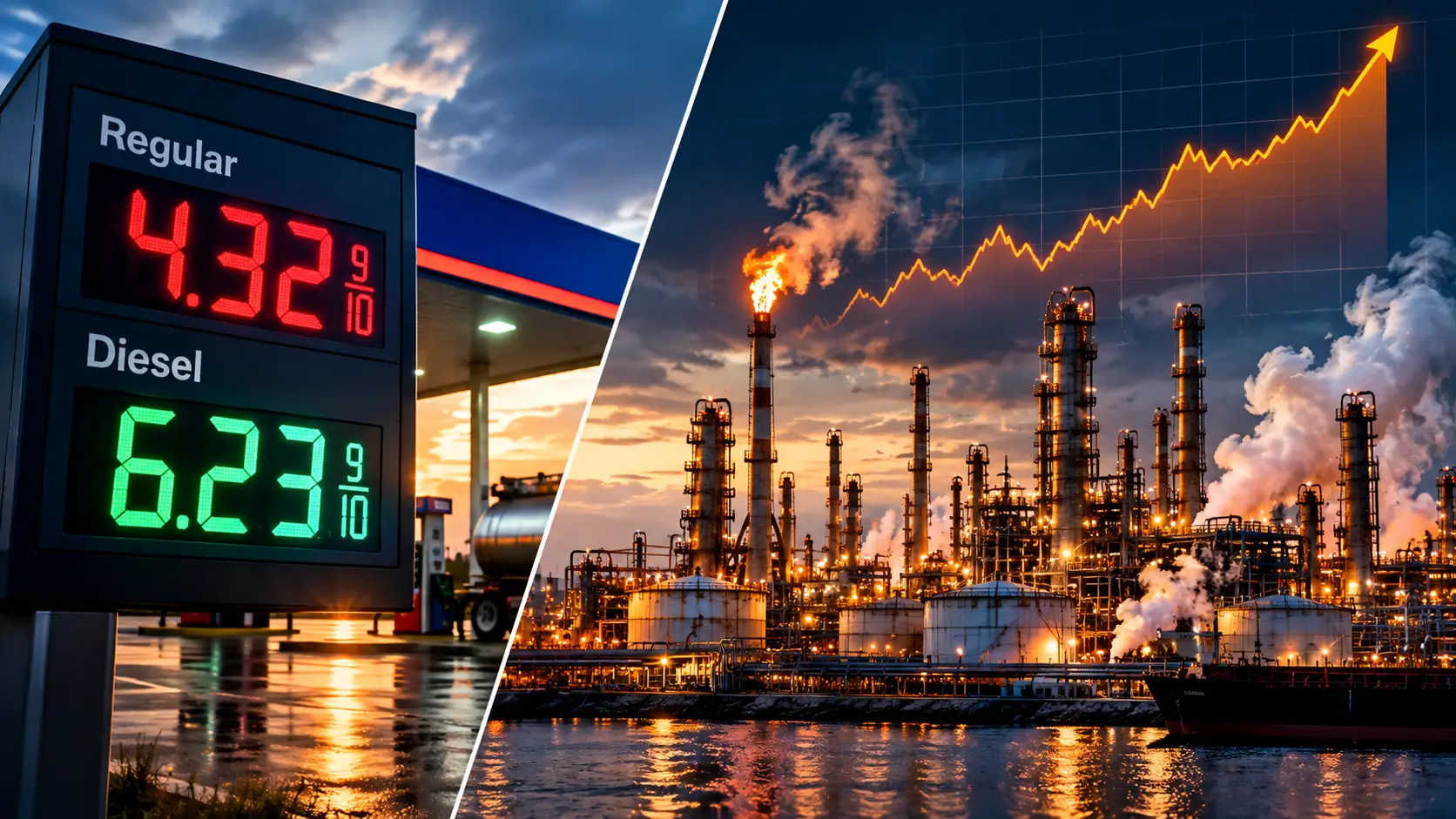
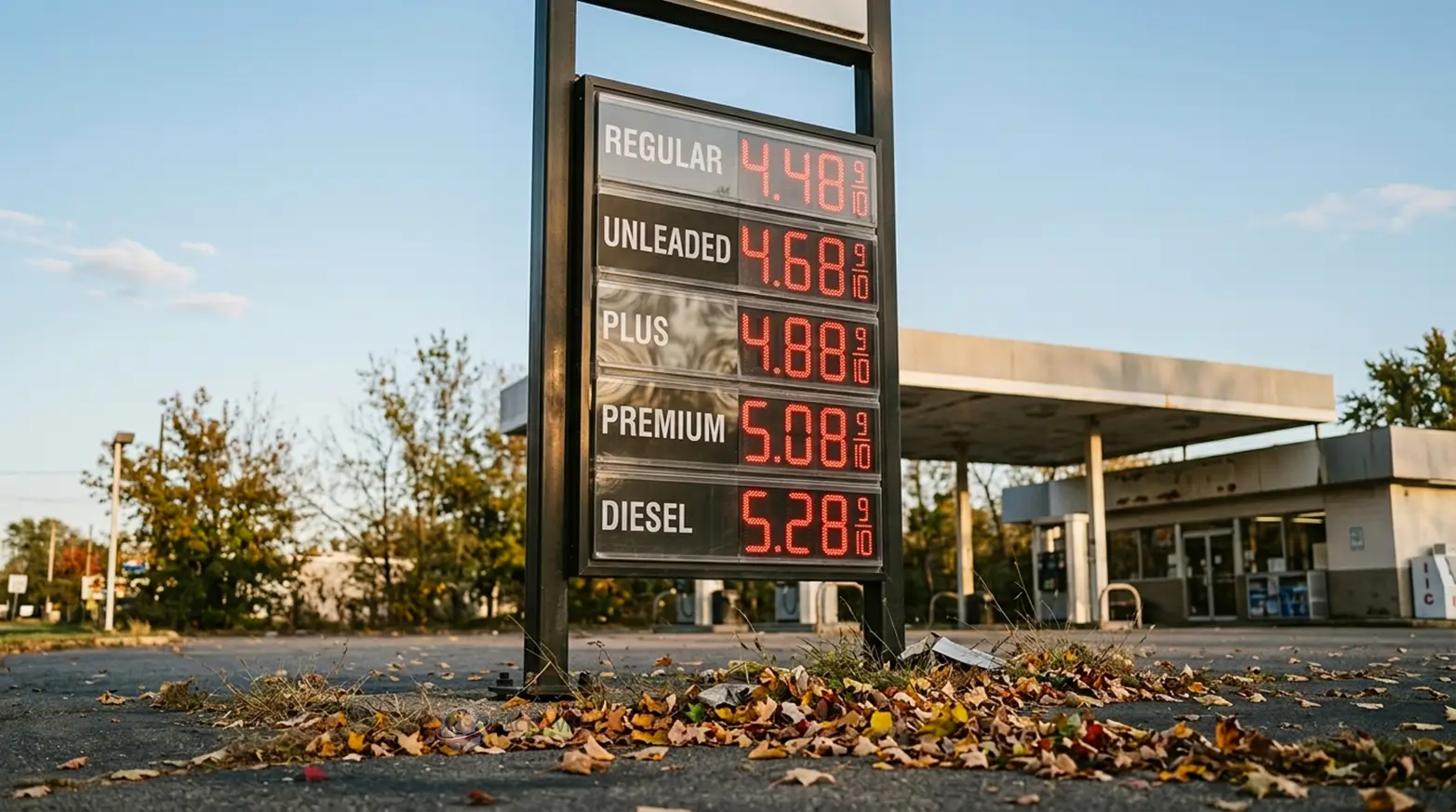
The national average price of gasoline hit $4.48 a gallon on September 24, according to AAA, the highest level ever recorded for this time of year. Autumn is normally when gas prices ease as summer driving season winds down. This year, they climbed nearly 5 cents in a single week instead.
That’s not a one-time spike. Gas has now touched $4.48 twice in 2026, once in May and again in September, an unusual round-trip that reflects a fuel market under sustained pressure from several directions at once, not a single passing event.
The Big Picture
Crude oil prices explain part of this story, but not most of it. Refinery capacity, global supply disruptions tied to the conflict involving Iran, and reduced Russian fuel exports are doing at least as much to keep pump prices elevated as the price of crude itself.
What Happened
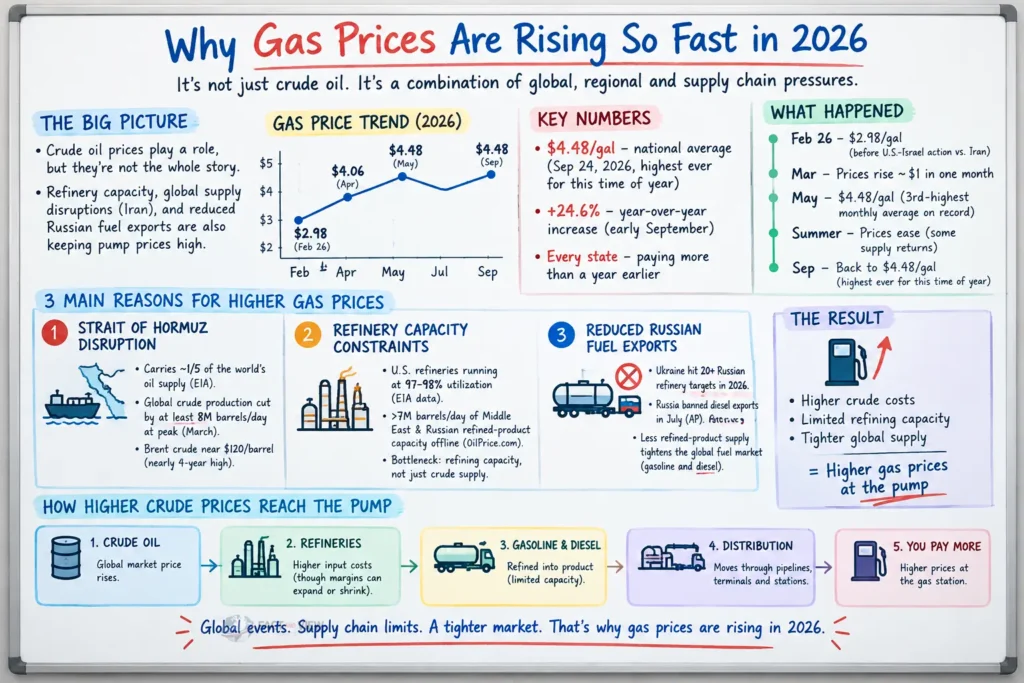
Gas prices have moved in a distinct pattern through 2026. The national average stood at just $2.98 a gallon on February 26, according to AAA data, before the U.S. and Israel launched military action against Iran on February 28. Prices then rose roughly $1 in a single month, reaching $4.06 by early April, according to AAA’s own reporting at the time, one of the sharpest one-month increases in the national average in recent memory.
By May, the national average hit $4.48 a gallon, the third-highest monthly average on record behind only June and July 2022, according to the U.S. Energy Information Administration. Prices eased somewhat over the summer as some disrupted crude production began returning to the market, before climbing back to that same $4.48 level in late September, a level AAA says is the highest ever recorded for this point in the fall season, surpassing the previous September record of $3.83 set in 2023. August 2026 alone averaged above $4.00 a gallon, tying July 2008 for one of the highest monthly averages since the EIA began tracking the data in 1992.
Year-over-year, the increase is stark: gasoline was running about 24.6% above year-ago levels as of early September, according to Consumer Price Index data. Every single state was paying more for gas than a year earlier as of that same period, according to an analysis of AAA data by LendingTree, meaning this isn’t a regional story playing out in a handful of states; it’s a nationwide pattern with only the magnitude varying by location.
“Why Diesel Prices Are Rising — and Trump Blames Ukraine” — deeper background on the Russian refinery strikes and export restrictions also affecting gasoline markets.
Why Gas Prices Are Rising So Fast
Three separate forces are compounding each other, and untangling them explains why this year’s price surge has been unusually persistent rather than a brief spike.
The Strait of Hormuz disruption. The Strait of Hormuz normally carries about one-fifth of the world’s oil supply, according to the EIA. Following the escalation of the conflict involving Iran, the International Energy Agency reported that global crude production was curtailed by at least 8 million barrels a day at the disruption’s peak in March, with sharp output drops from Iraq, Qatar, Kuwait, the UAE and Saudi Arabia. That single event pushed Brent crude toward $120 a barrel at the time, a nearly four-year high.
Refinery capacity, not just crude supply. U.S. refineries have been running close to full capacity for much of 2026, processing crude at roughly 97% to 98% utilization, according to EIA weekly data, leaving little room to increase gasoline output even when crude is available. Globally, more than 7 million barrels a day of Middle Eastern and Russian refined-product capacity has been offline at various points this year, according to market data reviewed by OilPrice.com, meaning the bottleneck often isn’t crude oil itself but the refining capacity needed to turn it into finished gasoline and diesel.
Reduced Russian fuel exports. Ukraine has struck more than 20 Russian refinery targets in 2026, prompting Moscow to ban diesel exports in July, according to the Associated Press, removing meaningful refined-product supply from an already tight global market. While that campaign targets diesel specifically, refineries typically produce both gasoline and diesel from the same crude runs, so reduced Russian refining activity tightens the broader global fuel market that gasoline prices are also priced against.
“U.S. Fuel Crisis Deepens as Gasoline Hits Record Highs” — related coverage of the refining capacity constraints discussed here.
How Higher Crude Prices Actually Reach the Pump
It helps to walk through the mechanism step by step, since “oil prices went up” alone doesn’t explain why a specific price shows up at a specific gas station.
Crude oil is the raw input refiners buy on global markets. When crude prices rise, refiners’ costs rise with them, though not always by the same percentage, since refining margins (the difference between what a refiner pays for crude and what it earns selling finished fuel, sometimes called the crack spread) can expand or shrink independently based on how much refining capacity is available relative to demand. When refining capacity is scarce, as it has been for much of 2026, refiners can charge more per barrel processed even if crude costs stay flat, because there’s more demand for their limited processing capacity than they can supply.
Refiners then sell finished gasoline to wholesalers at a price reflecting both the crude cost and their own margin. Wholesale prices flow to individual gas stations within days, since gasoline is one of the most quickly repriced consumer goods in the economy; stations generally adjust pump prices based on the replacement cost of their next fuel delivery, not the price they originally paid for the gas currently in their tanks. That’s part of why gas prices can jump overnight even before a station has sold through its existing, cheaper inventory.
“Why Americans Still Feel Poor Even When Inflation Falls” — related look at how costs like gasoline factor into overall household financial strain.
This is why gas prices can rise even faster than crude oil prices during a supply squeeze: it’s not just crude that got more expensive, it’s the refining margin on top of it, and 2026 has seen both move higher at the same time. Diesel crack spreads specifically reached record levels above $90 a barrel in mid-August, according to market data reviewed by Investing.com, and while that figure applies most directly to diesel, it reflects the same underlying refining capacity squeeze pushing up gasoline margins as well.
Why Prices Vary So Much by State
Gasoline prices aren’t uniform across the country, and the gap between the cheapest and most expensive states has been unusually wide this year. As of early September, California had the nation’s highest average at $5.87 a gallon, followed by Washington at $5.51 and Hawaii at $5.39, according to AAA data. Indiana had the lowest average in the country, and also recorded the smallest year-over-year increase of any state, largely because it temporarily suspended most of its state gasoline taxes during spring and summer 2026, according to LendingTree’s analysis.
State and local taxes, environmental regulations requiring specific fuel blends, and regional refining and distribution costs all contribute to these gaps, independent of what’s happening with crude oil or the Strait of Hormuz. A national average, while useful for tracking the overall trend, can obscure how differently this year’s price pressure has landed depending on where a household lives.
What This Means for American Households
The financial impact is direct and measurable, not speculative. Drivers nationwide spent an average of $139.45 a month at the pump in August 2026, at roughly $48.44 per transaction, according to Empower Personal Dashboard data. A year earlier, with gas running about a quarter cheaper, that same monthly driving pattern would have cost roughly $112, a difference of nearly $330 a year for the average driver, using the 24.6% year-over-year increase reported in CPI data.
- Commuters and rural households, who typically drive longer distances with fewer public transit alternatives, are absorbing a larger share of their budgets in gasoline costs than urban households with shorter commutes.
- Lower-income households feel gas price increases more acutely as a share of overall spending, since transportation costs make up a larger portion of their budgets compared with higher-income households.
- Trucking and delivery-dependent businesses face higher fuel costs that often get passed through to shipping rates and, eventually, the price of delivered goods, though this effect typically shows up with a lag of weeks rather than immediately.
- Households in high-tax states like California face a compounding effect, where elevated national crude and refining costs combine with state-specific taxes and fuel requirements to produce some of the highest prices in the country, currently near $5.87 a gallon.
- Households in states with lower fuel taxes, like Indiana, have been comparatively insulated, a reminder that state-level tax policy can meaningfully offset, though not eliminate, the impact of national supply pressures.
- Airlines and other fuel-intensive industries face related cost pressure through jet fuel, which is refined from the same crude oil and has also seen price increases tied to the same global supply disruptions.
None of this suggests a nationwide economic emergency; unemployment has remained relatively stable through 2026, and the price increases described here, while significant, represent a specific, traceable cost pressure rather than a broader collapse in household finances.
What to Watch Next
- EIA’s Weekly Petroleum Status Report, released every Wednesday, particularly gasoline inventory levels and refinery utilization rates.
- Developments in the Iran conflict and Strait of Hormuz shipping, since continued disruption there remains the single largest swing factor in global crude supply.
- Russian refinery strikes and Moscow’s export policy, given the direct link between reduced Russian fuel exports and tighter global refined-product markets.
- U.S. refinery utilization rates, since any further outages would tighten an already constrained domestic refining system.
- AAA’s daily national and state gas price averages, for the most immediate read on where prices are heading week to week.
- Crude oil benchmark prices (Brent and WTI), which remain the base input even though refining capacity has driven much of this year’s added pressure on top of crude costs.
The Bottom Line
Gas prices are rising so fast in 2026 because of a specific, traceable combination of forces: a major supply disruption tied to the conflict involving Iran and the Strait of Hormuz, U.S. and global refining capacity running close to its limits, and reduced Russian fuel exports following Ukrainian strikes on Russian refineries. None of these factors alone would likely have produced a fall record; together, they’ve kept pump prices elevated well beyond the usual seasonal pattern.
What’s clear from the data: the national average has now hit $4.48 a gallon twice this year, a level historically associated with summer driving season rather than autumn. What remains genuinely uncertain is how quickly Hormuz shipping normalizes, whether global refining capacity comes back online as expected, and how Russian export policy evolves, all of which will shape whether prices ease heading into winter or remain elevated. For now, the most useful takeaway is that this year’s gas prices reflect a convergence of specific, identifiable supply-side pressures rather than a single cause, and each of those pressures is still actively in motion.
Recommended External Sources
- AAA — Daily National and State Gas Price Averages
- U.S. Energy Information Administration — Weekly Petroleum Status Report
- U.S. Energy Information Administration — Short-Term Energy Outlook
- U.S. Bureau of Labor Statistics — Consumer Price Index News Release
- International Energy Agency — Oil Market Report