

Diesel just topped $6 a gallon for the first time ever. President Trump says Ukraine’s drone strikes are the reason. The energy data tells a bigger, messier story.
President Trump on Sunday urged Ukrainian President Volodymyr Zelenskyy to stop Ukrainian drone strikes on Russian oil refineries, arguing the attacks are driving a global diesel shortage and pushing U.S. prices to record highs.
Diesel really is at record levels. But the explanation is much bigger than Ukrainian drones.
Why it matters: U.S. diesel prices sit at the intersection of a five-front energy story: crude oil markets, global refining capacity, the Iran war, the Strait of Hormuz, and the Russia-Ukraine conflict. Trump’s public framing puts almost all the weight on one of those fronts.
The real question isn’t whether Ukraine’s strikes matter. It’s how much they matter next to everything else pushing prices up.
Why It Matters
Diesel isn’t a niche commodity. It moves nearly everything Americans buy.
- Trucks, trains and ships that haul freight run on it.
- Farm equipment runs on it, and harvest season is diesel’s biggest annual demand spike.
- Home heating oil in the Northeast is a distillate product, chemically close to diesel.
When diesel gets more expensive, the cost of moving goods rises. That pressure works its way into producer prices, and eventually into what consumers pay at the store, months before most people connect the dots back to a fuel receipt.
Driving the News
Speaking to reporters Sunday on the sidelines of a golf event in Ireland, Trump said Ukraine needs to stop hitting Russian diesel infrastructure specifically, even as the wider war continues.
“He has to stop knocking out diesel fuel in Russia,” Trump said, according to Al Jazeera and Bloomberg. “There are plenty of other targets. Don’t hit diesel fuel. That’s hurting the world.”
Trump explicitly rejected a connection to the Iran war in the same remarks. Diesel’s price surge, he said, “is done by what’s happening with Russia and Ukraine,” not the Middle East, according to Al Jazeera.
Notably, Trump did not use the same remarks to call on Vladimir Putin to end the war, or to stop Russian strikes on Ukraine’s own energy grid, which continued over the same weekend, per PBS NewsHour and the AP. That’s a factual asymmetry in emphasis, not a claim about Trump’s motives.
The Trump administration has separately pressed Ukraine to limit strikes on other energy targets, including Caspian Pipeline Consortium facilities and non-Russian tankers in the Black Sea, according to Bloomberg.
Zelenskyy has defended the refinery campaign as a legitimate response to Russian attacks. “Our warriors continue responding justly to Russian strikes on Ukraine,” he wrote on X after a September 7 strike.
By the Numbers
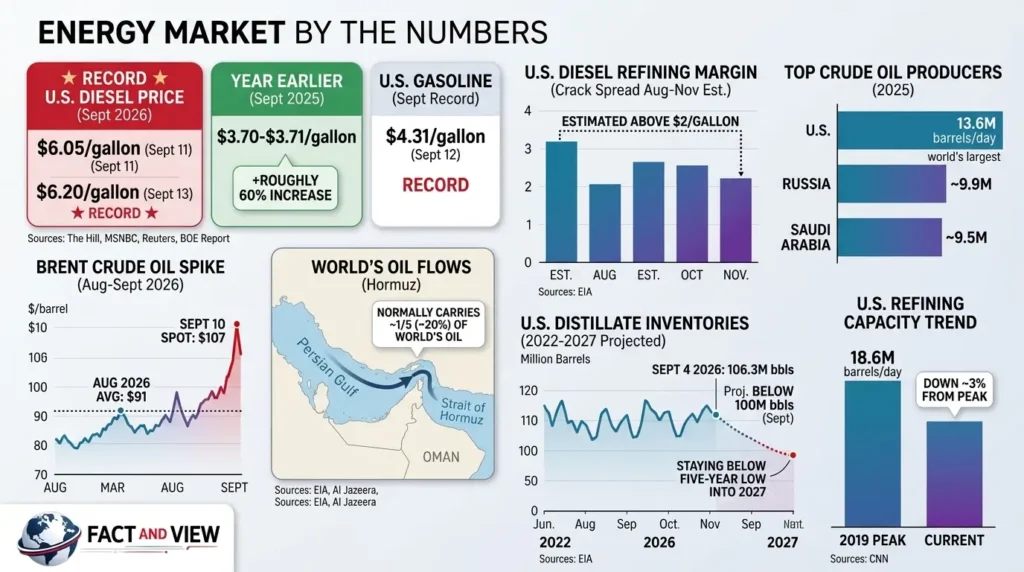
- U.S. diesel price: Topped $6.05 a gallon on Friday, September 11, then $6.20 by Sunday, per AAA data cited by The Hill and MSNBC, the highest on record.
- A year earlier: About $3.70-$3.71 a gallon, per the same reporting, a roughly 60% increase.
- U.S. gasoline: $4.31 a gallon Saturday, the highest price on record for September, per AAA data cited by CNN.
- Brent crude: Averaged $91 a barrel in August 2026, per the EIA’s September Short-Term Energy Outlook; spot prices touched $107 on September 10, per Reuters data via BOE Report.
- U.S. distillate (diesel/heating oil) inventories: 106.3 million barrels as of September 4, per EIA data, forecast to fall below 100 million barrels this month and stay below the five-year low into 2027.
- U.S. diesel crack spread (the refining margin on diesel): Estimated above $2 a gallon from August through November, per the EIA.
- Strait of Hormuz: Normally carries about one-fifth of the world’s oil, per the EIA and Al Jazeera.
- 2025 crude production: U.S., 13.6 million barrels a day (world’s largest); Russia, roughly 9.9 million; Saudi Arabia, roughly 9.5 million, per EIA international data.
- U.S. refining capacity: Down about 3% from its 2019 peak of 18.6 million barrels a day, per EIA data cited by CNN.
What’s Actually Driving Diesel Prices?
No single actor sets the price of diesel. It’s the product of several markets stacked on top of each other.
Crude oil is the base input; when Brent and WTI rise, refined fuels generally follow, though not always in lockstep.
Refining capacity matters separately from crude supply. Valero estimated that the wars in Iran and Ukraine together have knocked roughly 5 million barrels a day of global refining capacity offline, according to CNBC, meaning even ample crude can’t fully translate into cheap diesel if refineries can’t process it.
Global refined-product supply is the market that actually prices diesel, not just U.S. production. Tight global distillate supply has pulled U.S. diesel exports to five-year highs every month since February 2026, per the EIA, which paradoxically pulls supply away from the domestic market and toward higher-paying foreign buyers.
U.S. inventories are historically low, which the EIA says raises the risk of sharp price swings from any new disruption.
Seasonal demand adds pressure every autumn as harvest season and pre-winter heating oil buying both draw on the same distillate pool.
The Strait of Hormuz, discussed in depth below, remains the single largest geopolitical swing factor in the entire chain.
The Russia Factor
Russia is one of the world’s three largest crude producers and a major diesel exporter. That changed sharply in 2026.
Ukraine has struck more than 20 Russian refinery targets this year, according to MSNBC/MS NOW, including recent strikes on the Nizhnekamsk refinery cluster in Tatarstan and a refinery in Slavyansk-on-Kuban near Crimea. A Ukrainian strike also hit a refinery in Siberia in the days before Trump’s remarks, per The Hill.
The damage prompted Moscow to ban diesel exports in July 2026, according to the AP, removing supply from an already tight global market. The International Energy Agency has said disruptions to Russia’s refining system and a near-halt in product exports “have compounded” existing supply losses, per Al Jazeera. Putin himself has acknowledged the strikes have caused Russia economic pain, per MS NOW.
Can Ukrainian strikes affect global diesel prices? Yes, measurably. Russia’s export ban and reduced refining output are real supply losses in a tight global market. But “Ukraine is contributing to the supply squeeze” and “Ukraine is responsible for America’s diesel prices” are different claims, and the available data supports only the first one.
The Ukraine Factor
Ukraine’s rationale for targeting Russian refineries is straightforward and openly stated: Russia’s oil exports fund its war effort, and its refineries and fuel depots support Russian military logistics directly. Kyiv considers that infrastructure a legitimate wartime target, a position it has held consistently even as it faces continued Russian strikes on its own power grid.
The economic effect is real: reduced Russian refining capacity tightens a global product market that was already stretched thin by the Iran war. But nothing in the available EIA, IEA or Reuters reporting supports the claim that Ukraine’s campaign, on its own, is the primary driver of the U.S. price spike.
The Iran and Strait of Hormuz Factor
The U.S. and Israel launched military action against Iran on February 28, 2026, disrupting oil flows from the Gulf. The IEA reported that global crude production was curtailed by at least 8 million barrels a day in March, with sharp drops from Iraq, Qatar, Kuwait, the UAE and Saudi Arabia, sending Brent toward $120 a barrel, a nearly four-year high, according to Investing News Network.
The Strait of Hormuz normally carries about 20% of the world’s oil supply. Even partial, intermittent disruption to that corridor removes far more oil from global markets than any refinery strike campaign can, simply because of its scale. The EIA’s own September outlook explicitly ties elevated diesel crack spreads through November to the expectation of continued volatility in Hormuz shipping, easing only if flows normalize and Saudi and Kuwaiti refineries can resume higher distillate exports.
Trump’s claim that the diesel spike “isn’t done by the Middle East” is difficult to square with the EIA’s own modeling, which treats Hormuz-related disruption as a primary driver of the current distillate crunch, not a secondary one.
How Much Oil Does Everyone Actually Produce?
Production volume alone doesn’t determine what Americans pay at the pump. The U.S. produces more crude than any other country, 13.6 million barrels a day in 2025, well ahead of Russia (9.9 million) and Saudi Arabia (9.5 million). But crude oil and refined products trade in global markets, and the U.S. still imports and exports heavily depending on grade and location.
The more relevant bottleneck right now isn’t production, it’s refining capacity and the availability of specific refined products like diesel. A country can pump enormous volumes of crude and still face high pump prices if refineries can’t process enough of it into finished fuel, which is exactly the disconnect Exxon CEO Darren Woods described to CNBC this summer.
Why Is Trump Focusing on Ukraine?
Several factors, all independently verifiable, help explain the emphasis, without establishing Trump’s underlying motive as settled fact.
Affordability and gas prices are hanging directly over the November midterms, according to CNBC and the Washington Times, giving the administration a clear political incentive to identify an actionable, external cause.
The administration has simultaneously pushed to expand U.S. refining capacity, and a White House official credited Trump with “reversing the Biden administration’s disastrous energy policies,” per the Washington Times, a message aimed as much at domestic politics as at the war itself.
Blaming Ukraine’s specific, narrow tactic, refinery strikes, is also a more actionable ask than addressing Iran-related Hormuz disruption, which the U.S. itself is a direct party to, or Russian aggression, which Trump has generally avoided condemning directly throughout his renewed diplomatic engagement with both Putin and Zelenskyy.
Whether this framing is consistent with the underlying energy data is a separate question from why it might be politically convenient, and on the data, the framing is only partially supported.
The Biden Blame
The Trump administration has repeatedly attributed today’s tight refining capacity to policies from the Biden era. The evidence for that specific causal claim is thinner than the rhetoric suggests.
EIA data shows U.S. refining capacity is down only about 3% from its 2019 peak, a modest, long-running decline spanning multiple administrations rather than a sharp Biden-era collapse. Independent fact-checking of Biden-era diesel prices found that the 2021-2022 surge was driven mainly by post-pandemic demand recovery and Russia’s 2022 invasion of Ukraine, global forces largely outside any president’s short-term control.
It’s also worth noting the pattern isn’t new. Biden faced similar criticism for blaming external actors, Russia, OPEC, oil companies, for gas prices during his own term rather than domestic policy choices. Assigning blame to outside forces during a fuel price spike appears to be a recurring feature of American politics, not a tactic unique to either party.
What the Data Shows
Weighing the available evidence produces a rough hierarchy, not a precise breakdown:
Primary factors: Iran-related disruption to Gulf oil flows and the Strait of Hormuz; a genuinely tight global distillate market; historically low U.S. diesel inventories.
Secondary factors: Russian refinery strikes and Moscow’s resulting export ban; strong seasonal demand; record U.S. diesel exports drawing supply away from the domestic market.
Political factors: Trump’s public framing, which emphasizes Russia-Ukraine while explicitly downplaying Iran; election-year pressure ahead of the midterms; a broader pattern of blaming the prior administration for structural energy issues with limited direct evidence.
The Bigger Picture
The U.S. cannot fully insulate its diesel prices from global markets simply by being the world’s largest crude producer. Refining capacity, global product supply, shipping routes and chokepoints like Hormuz all shape the price independently of how much oil comes out of the ground in Texas or North Dakota.
That’s why the political argument over “who caused this” can mislead more than it clarifies. The more useful question is which specific forces are removing supply from the global market right now, and roughly how large each one is, a question the EIA’s own modeling answers more precisely than any single politician’s framing does.
What to Watch
- Whether Strait of Hormuz shipping normalizes, which the EIA treats as the key swing factor for diesel crack spreads through 2027.
- U.S. distillate inventory levels heading into winter heating season.
- Whether Russia lifts or extends its diesel export ban.
- Continued Ukrainian strikes on Russian refineries, and Russia’s retaliatory strikes on Ukraine’s grid.
- EIA Short-Term Energy Outlook updates, released monthly.
- Whether the Trump administration’s refinery-expansion push produces any near-term commitments, which most industry analysts currently doubt.
Related Reading
- How Tariffs Actually Raise Prices — A Simple Breakdown — a related look at how federal policy shifts pass through into consumer costs.
- Ukraine-Russia War Enters a New, Riskier Phase — deeper background on the conflict driving the refinery strikes discussed here.
- Iran’s Alleged Plot to Kill Trump Sparks New Fears — context on the US-Iran conflict shaping the Strait of Hormuz disruption.
- US Debt Has Passed $40 Trillion: How Close Is America to a Debt Crisis? — relevant background on the broader economic pressures facing American households alongside rising fuel costs.
Disclaimer: This article distinguishes verified facts, direct quotations, and economic analysis from political claims and reasonable inference throughout. It does not endorse any political position and is for informational purposes only.