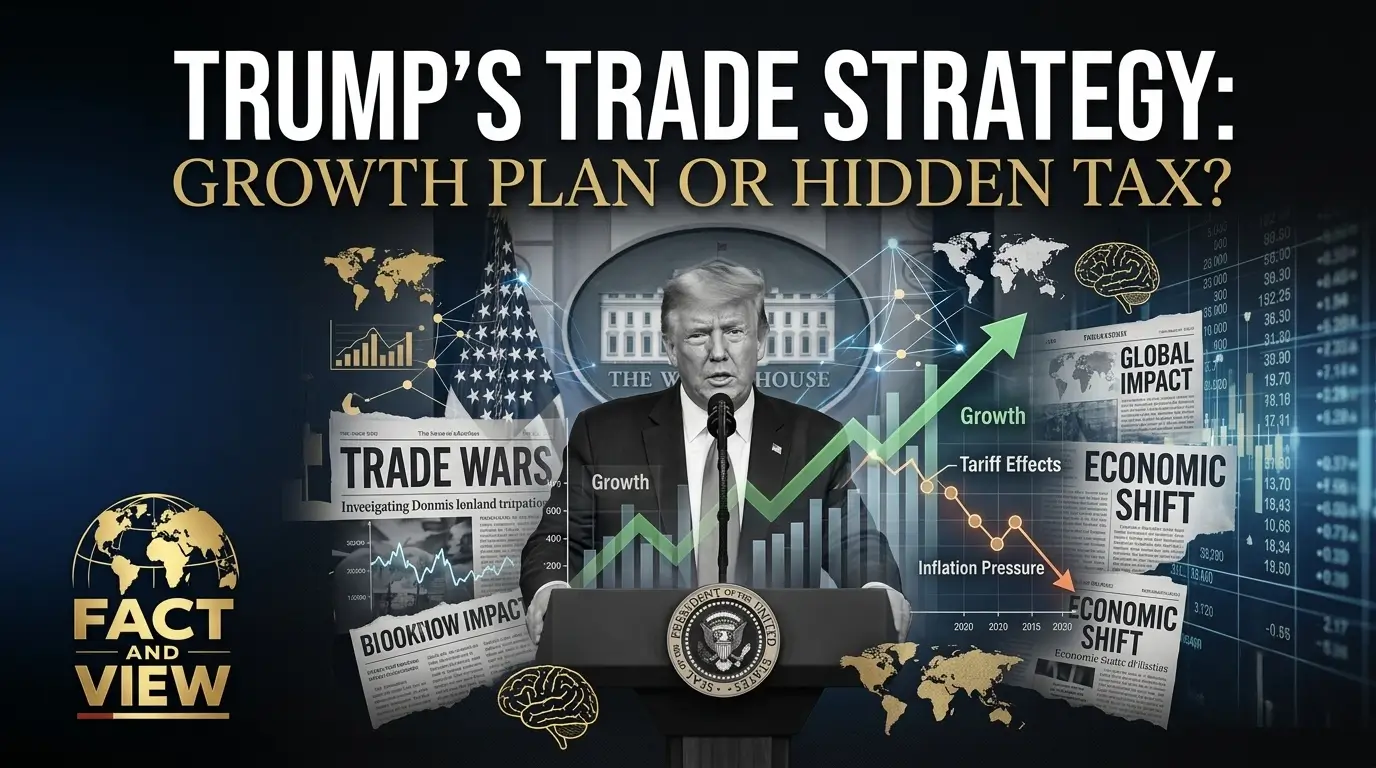
The Trump administration’s economic strategy rests on a two-pillar framework: cut income taxes through the One Big Beautiful Bill Act, and raise tariff revenue to partially offset those cuts. On paper, the combination is designed to deliver net economic growth — lower tax burdens for producers, higher trade barriers for competitors, and a manufacturing renaissance as the reward.
On the ground, the math is more complicated. In 2026, three major independent economic institutions — the Congressional Budget Office, the Tax Foundation, and the Penn Wharton Budget Model — have all modeled what this combination actually produces. Their findings are not identical. In several cases, they diverge significantly. But all three share one conclusion: the effects are not distributed equally across the income spectrum.
As the USMCA review opens in July 2026 and midterm elections approach in November, the question of whether Trump’s trade strategy is a growth engine or a regressive fiscal mechanism has moved from academic debate to kitchen-table politics.
The View from the Right: A Pro-Growth Package, Read Correctly
The conservative economic case for the tariff-plus-tax-cut combination begins with a premise: the OBBBA and the tariffs are not competing policies. They are complementary instruments of the same supply-side strategy.
The Tax Foundation’s analysis, published February 25, 2026, supports a net positive economic conclusion — with careful qualifications. OBBBA tax provisions raise long-run GDP by 0.7%. Current Section 232 tariffs reduce long-run GDP by 0.2%. The net result, on Tax Foundation’s model, is a modestly positive combined effect on the economy in the long run.
The USTR’s April 2026 congressional testimony adds the leverage argument. Since the introduction of the reciprocal trade program in April 2025 through February 2026, the U.S. goods trade deficit fell by 24% year-over-year. Capital goods orders exceeded $4 billion per month in Q4 2025 — levels not seen since before China’s WTO entry. Q1 2026 delivered the first positive manufacturing job growth in three years.
The Hoover Institution’s evenhanded assessment provides historical context. During Trump’s first term, tax cuts combined with business investment incentives produced real GDP growth of 3% measured Q4 to Q4 in 2017 — above the pre-term baseline. When tariffs were then added in mid-2018, they “undercut business confidence and materially slowed growth of business investment.” The conservative lesson drawn: the sequencing and calibration of tariffs matters enormously for the growth outcome.
On revenue, the current Section 232 and Section 122 tariffs — after the SCOTUS ruling struck down IEEPA tariffs in February 2026 — are projected to raise $668 billion over a decade, per the Tax Foundation’s updated post-IEEPA-ruling estimates. This revenue reduces the OBBBA’s $3.3 trillion net deficit increase, though it does not eliminate it.
The Right’s synthesis: the combination produces net growth in the long run, generates substantial revenue, and corrects decades of structural trade imbalance with China. The short-term volatility is the cost of structural correction.
The View from the Left: A Regressive Combination, Measured Precisely
Progressive economists and institutions accept the Tax Foundation’s arithmetic while drawing opposite conclusions about what it means for people.
The CEPR’s analysis by Clausing and Obstfeld — published in 2025 and updated for 2026 — identifies the distributional mechanism precisely: tariffs are a more regressive tax than income taxes because lower-income households save very little of their income, meaning a larger share of their consumption is subject to tariff-driven price increases. When tariffs are combined with OBBBA tax cuts that deliver proportionally larger benefits to higher-income households, the combination produces a net tax increase for most Americans below the top income decile.
The Tax Foundation itself — in its distributional analysis — confirms this finding with its own model: “The tariffs offset a larger portion of the tax cuts for lower- and middle-income taxpayers than for higher-income taxpayers.” More specifically, the bottom quintile will see a net reduction in after-tax income by 2034 under the OBBBA even on a conventional basis — a result that is “exacerbated by the tariffs if they remain in place.”
Fact: Tariff revenue in 2025 reached approximately $30 billion per month by August, per CEPR’s tracking — a real and substantial revenue stream. But CEPR projects that pass-through to consumers increases over time as companies raise prices more when tariffs prove long-lasting.
The Penn Wharton Budget Model’s April 2025 analysis — covering the full scope of tariffs before the SCOTUS IEEPA ruling — projected a 6% long-run GDP reduction and a 5% wage reduction. PWBM specifically compared the tariffs to alternative revenue instruments, finding that tariffs “reduce GDP and wages by more than twice as much” as a revenue-equivalent corporate tax increase from 21% to 36% — itself considered a highly distorting tax.
The Left’s synthesis: tariffs as a fiscal instrument are the most economically distorting and distributional regressive tax available. Combining them with an income tax cut that favors upper-income households amplifies inequality while generating insufficient revenue to offset the deficit created.
The Economic Arithmetic: Four Models, Four Numbers
The most useful way to navigate the competing claims is to examine what each model actually measures — and what each excludes.
| Model | Long-Run GDP Effect | Key Assumption |
|---|---|---|
| Tax Foundation (Feb 2026) | OBBBA +0.7%, tariffs -0.2%, net +0.5% | Uses General Equilibrium; excludes policy uncertainty impact |
| CBO (2026) | Tariffs reduce GDP growth rate by 0.06pp/year | Models tariffs as permanent; includes household purchasing power reduction |
| Yale Budget Lab | All 2025 tariffs: GDP persistently -0.6% lower long-run | Accounts for retaliation; values at $160B/year in 2024 dollars |
| Penn Wharton (Apr 2025) | Tariffs reduce long-run GDP by 6%, wages by 5% | Full April 2 tariff scope; includes dynamic investment suppression |
The variation is not methodological inconsistency — it reflects different tariff scopes and time horizons modeled. Tax Foundation uses the post-SCOTUS-ruling tariff baseline. Penn Wharton modeled the full April 2 Liberation Day scope before legal curtailment.
The consensus zone: The combination of OBBBA and current post-IEEPA tariffs is net positive on GDP in the long run — modestly. In the short run, the uncertainty from constantly changing trade policy “may reduce investment even if it ultimately collects no revenue,” per Tax Foundation’s own caveat. The $160 billion annual GDP cost estimated by Yale Budget Lab (for the full 2025 tariff scope) would represent roughly 0.6% of current GDP — a permanent drag, not a temporary adjustment.
The Household Dimension: Who Actually Pays
The macro numbers translate into household-level outcomes that are specific and verifiable.
In 2025: Trump tariffs averaged a $1,000 household tax increase, per Tax Foundation’s tracker.
In 2026: That figure rose to $1,500 per household on average, accounting for Section 232 and Section 122 tariffs.
The middle-income lifetime cost: Penn Wharton’s model — based on the full April 2025 tariff scope — projected a $22,000 lifetime loss for a middle-income household from the tariff regime alone. This figure assumes tariffs remain in place permanently and compounds through wage suppression and reduced investment.
The regressivity measurement: CEPR’s analysis confirms that for all but the top income decile, the after-tax income effect of the tariff-OBBBA combination is negative — meaning the tariff tax increase exceeds the income tax cut for households in the bottom 90% of the income distribution. The OBBBA spending cuts (Medicaid, SNAP, education) compound this finding for households in the bottom three income deciles.
For young Americans specifically: The trade strategy’s growth promise assumes a manufacturing renaissance that generates middle-wage factory jobs accessible to workers without college degrees. The counter-evidence: manufacturing employment fell 89,000 net from April 2025 to February 2026 before the Q1 2026 recovery — and the announced reshoring investments in semiconductors (Nvidia, TSMC) primarily require engineering credentials, not assembly-line skills. For the generation navigating student debt and a housing affordability crisis simultaneously, the tariffs add to living costs without yet delivering the job market transformation that justifies them.
Related reading: Why Millennials Can’t Afford Homes — how tariff-driven cost increases layer onto the affordability barriers already locking a generation out of homeownership.
The Deficit Question: Revenue Without Solvency
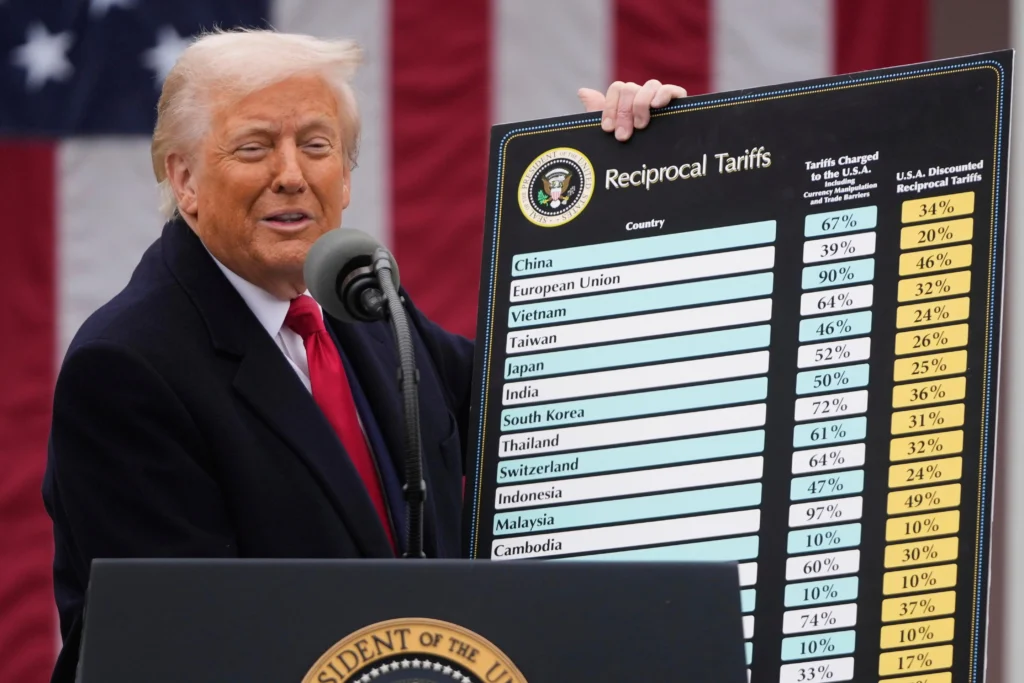
The administration frames tariff revenue as a contribution to fiscal consolidation. The numbers challenge that framing.
Fact: Current post-IEEPA tariffs are projected to raise $668 billion over a decade (Tax Foundation, 2026 update). The OBBBA increased the 10-year deficit by approximately $3.3 trillion on a dynamic basis. Tariff revenue covers approximately 20% of that deficit increase — not a rounding error, but far short of the “tariffs pay for the tax cuts” claim.
Fact: The Tax Foundation’s distributional model concludes that tariffs “offset a little less than one-third of the long-run economic effect of the OBBBA while paying for less than half its cost.” The combination produces net tax cuts — but the cuts are asymmetrically distributed upward and the costs are asymmetrically distributed downward.
Fact: CBO’s full analysis of the original Liberation Day tariff scope (before IEEPA ruling) found a $2.8 trillion deficit reduction over ten years — but simultaneously a reduction in household purchasing power and a shrinking economy. Deficit reduction through tariffs, by CBO’s measurement, comes at a higher economic cost per dollar raised than through alternative fiscal instruments.
Related reading: What Happens If US Debt Keeps Rising? — the full fiscal trajectory showing how $668 billion in tariff revenue compares to $39 trillion in national debt.
A Strategy With Real Trade-offs, Unevenly Distributed
Trump’s trade strategy in 2026 is neither a transformational growth engine nor a straightforward economic catastrophe. It is a policy combination with measurable outcomes across multiple models — outcomes that are net positive at the aggregate level in long-run models, net negative for most households in distributional models, and genuinely uncertain in the short run due to the investment-suppressing effect of policy volatility.
Three conclusions are supported by the consensus of independent economic analysis:
- The OBBBA-tariff combination is a net tax cut on average — but the cuts flow disproportionately to higher-income households while the costs fall disproportionately on lower- and middle-income ones
- Tariff revenue is substantial but insufficient — $668 billion over a decade covers less than a quarter of the OBBBA’s deficit expansion
- Long-run GDP effects are modestly positive in equilibrium models — but those models explicitly exclude the business uncertainty premium from constantly shifting tariff policy, which may be the most significant short-run economic cost
Whether this constitutes a “growth plan” or a “hidden tax” depends on which part of the income distribution you occupy — and over what time horizon you measure the outcome.
Continue reading from Fact and View:
- Trump Tariffs: Protecting America or a New Tax on Families? — the household cost companion: $1,700 average annual increase and who pays
- New US Laws in 2026: What They Mean for Americans — the full OBBBA analysis: which tax cuts you actually receive and which spending cuts affect you
FAQ
Do Trump’s tariffs offset the OBBBA tax cuts?
Only partially — and unevenly. The Tax Foundation’s February 2026 analysis finds that tariffs offset approximately one-third of the long-run economic benefit of the OBBBA while covering less than half its fiscal cost. For lower- and middle-income taxpayers, the tariff offset is proportionally larger — meaning the net income gain from the OBBBA is substantially smaller for them than for high earners. For the bottom income quintile, the Tax Foundation projects a net reduction in after-tax income by 2034 on a conventional basis. Track the full distributional analysis at taxfoundation.org/research/all/federal/trump-tariffs-trade-war.
What does the CBO say about Trump’s trade strategy and economic growth?
CBO’s analysis of the full tariff scope (before the IEEPA ruling) found a $2.8 trillion deficit reduction over ten years — alongside a reduction in household purchasing power, a shrinking economy, and an increase in the average annual inflation rate of 0.4 percentage points in 2025 and 2026. CBO’s model projects tariffs reduce the GDP growth rate by 0.06 percentage points per year on average. The analysis treats the tariffs as permanent — an assumption that has since been partially invalidated by the Supreme Court’s February 2026 ruling striking down IEEPA tariffs.
What does the Penn Wharton Budget Model project for household wealth?
Penn Wharton’s April 2025 analysis — based on the full Liberation Day tariff scope — projects that Trump’s tariffs reduce long-run GDP by approximately 6% and wages by 5%. A middle-income household faces a $22,000 lifetime wealth loss under this projection. PWBM notes this represents more than twice the harm per dollar of revenue raised compared to a revenue-equivalent corporate tax increase from 21% to 36%. The full analysis is at budgetmodel.wharton.upenn.edu. These figures assume the original Liberation Day tariff scope — which was partially struck down by SCOTUS in February 2026.
How much revenue do Trump’s tariffs raise in 2026?
Current post-IEEPA-ruling tariffs — primarily Section 232 (steel, aluminum, autos) and Section 122 (10% baseline) — are projected to raise $668 billion over the decade on a dynamic basis, per Tax Foundation’s 2026 update. Before the SCOTUS ruling, total projected tariff revenue over 10 years was approximately $2 trillion. Monthly tariff collections reached approximately $30 billion by August 2025 per CEPR tracking. This revenue is real and substantial — but covers less than 25% of the OBBBA’s $3.3 trillion 10-year deficit increase.
Are tariffs more or less regressive than income taxes?
More regressive, per CEPR’s analysis by Clausing and Obstfeld. Because lower-income households save a smaller share of their income and spend proportionally more on goods subject to tariff-driven price increases, tariffs function as a consumption tax with a higher effective rate on lower incomes. The CEPR analysis finds that for all but the top income decile, the net effect of the tariff-OBBBA combination is negative — meaning the tariff increase exceeds the income tax cut. The 2025 OBBBA spending cuts (Medicaid, SNAP) further reduce after-tax income for households in the bottom three income deciles, compounding the regressivity finding.
Where can I compare different economic models of Trump’s trade strategy?
The primary independent modeling sources, each with different methodological assumptions:
- Tax Foundation — Tariff Tracker 2026 — updated post-IEEPA ruling; General Equilibrium model; distributional tables
- Yale Budget Lab — Fiscal and Distributional Effects — GDP level effects, export impacts, retaliation accounting
- Penn Wharton Budget Model — long-run GDP and wage effects; household lifetime cost
- CBO — Tariff Distributional Analysis — official nonpartisan Congressional projections
- CEPR — Tariffs as Fiscal Policy — distributional and efficiency cost analysis
- Hoover Institution — Evenhanded Analysis — first and second term comparison with historical context
Sources: Tax Foundation — Tariffs Threaten to Offset OBBBA, March 3, 2026 · Tax Foundation — State of the Union 2026: Tariffs and Tax Cuts, February 25, 2026 · Tax Foundation — Trump Tariffs Tracker, April 2026 · Penn Wharton Budget Model — Economic Effects of Trump’s Tariffs, April 10, 2025 · Yale Budget Lab — Fiscal Effects of All 2025 Tariffs · CBO — Trump Tariffs Deficit and GDP Analysis · CEPR — Trump’s Tariffs as Fiscal Folly · Hoover Institution — Evenhanded Analysis of Trump’s Economic Policies
© Fact and View, 2026. This article presents analysis from multiple independent economic institutions. It does not represent an editorial endorsement of any policy position.