
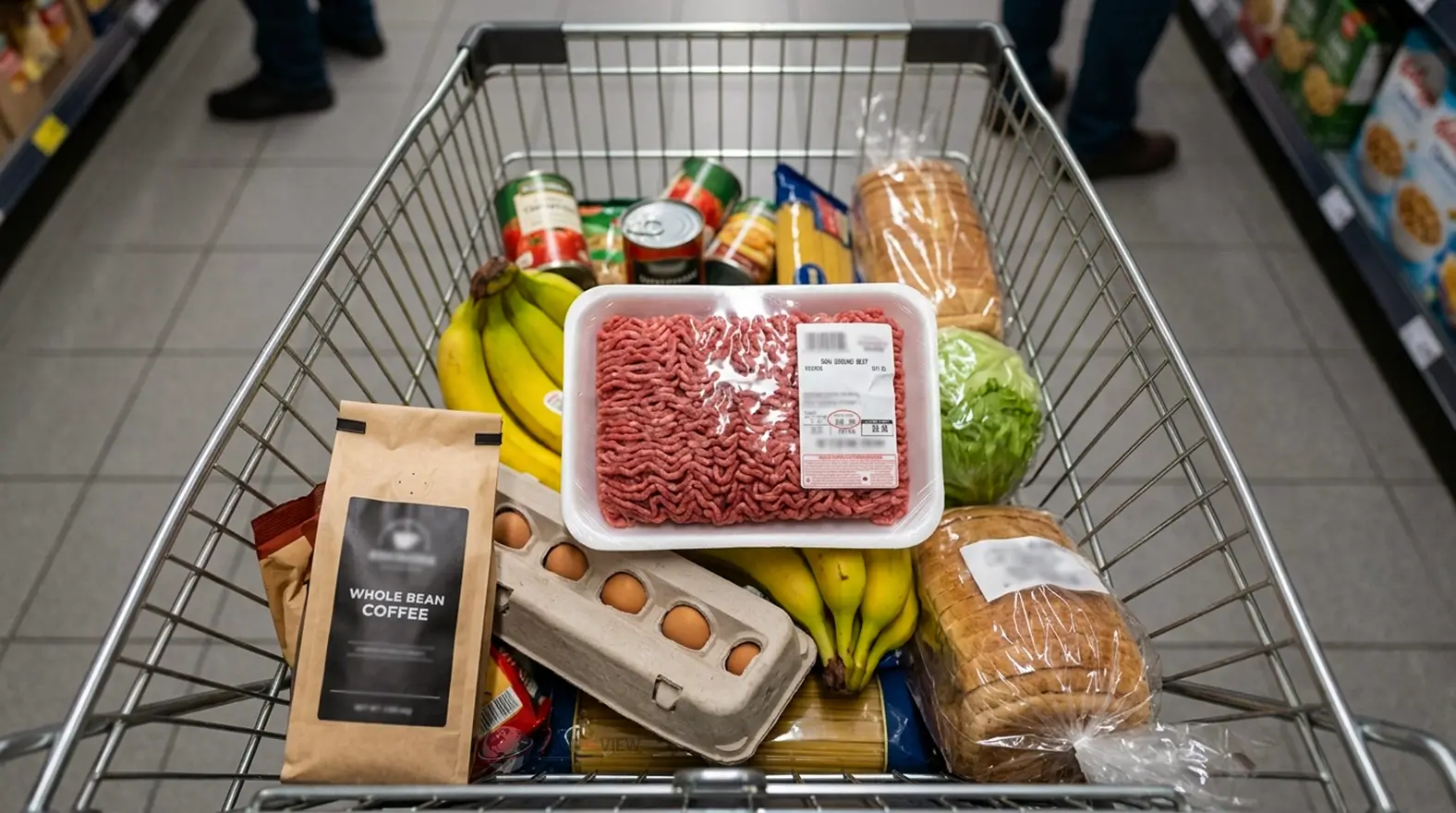
Grocery store inflation has actually cooled. Food-at-home prices rose just 2.2% over the twelve months ending in August 2026, according to the U.S. Department of Agriculture, below the 20-year historical average rate of increase. Ask anyone shopping for ground beef, though, and “cooled” isn’t the word they’d choose.
That’s because a single average conceals wildly different stories happening inside the same grocery cart. Beef prices are near record highs and expected to stay elevated for years. Coffee costs have jumped well above general inflation. Eggs, meanwhile, have actually gotten cheaper, recovering from a supply crisis the year before. Understanding why groceries still feel expensive requires looking inside the basket, not just at the average.
The Big Picture
The overall grocery inflation rate and what a specific household actually pays each week can diverge sharply, because a handful of categories, especially beef, are being driven by structural supply problems that have almost nothing to do with the broader inflation trend and won’t resolve quickly just because the average improves.
What the Data Actually Shows
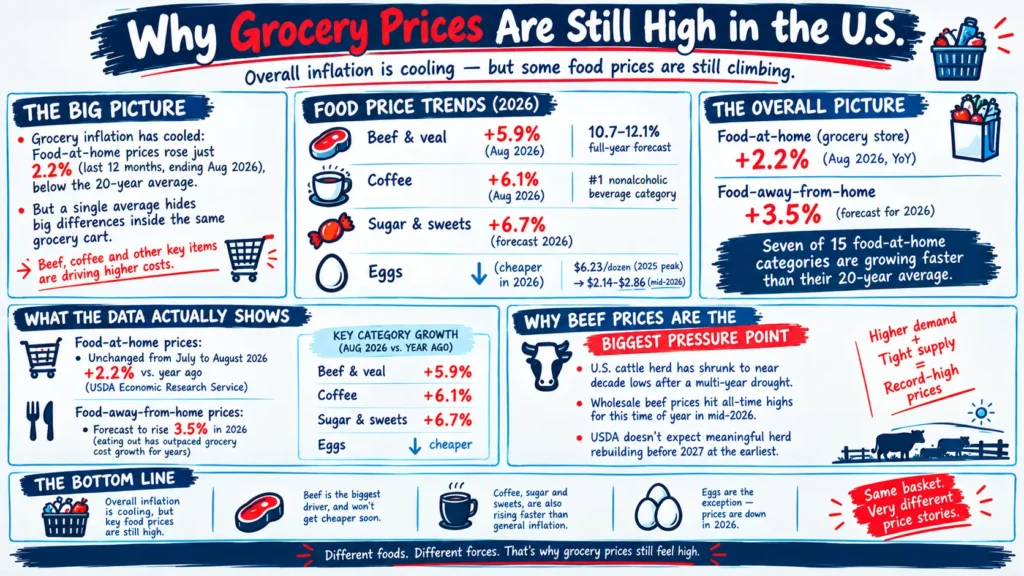
Food-at-home prices, the USDA’s term for grocery store and supermarket purchases, were unchanged from July to August 2026 and stood 2.2% above year-ago levels, according to the agency’s Economic Research Service. Food-away-from-home prices, meaning restaurant and takeout meals, are forecast to rise 3.5% for all of 2026, continuing a pattern where eating out has outpaced grocery shopping in cost growth for several years running.
Underneath those headline numbers, the USDA’s monthly Food Price Outlook shows sharp divergence across categories:
- Beef and veal retail prices were 5.9% higher in August 2026 than a year earlier, and the USDA’s full-year 2026 forecast for the category runs as high as 10.7% to 12.1% depending on the specific report and month, among the fastest-growing categories in the entire grocery basket.
- Coffee retail prices were 6.1% higher in August than a year earlier, outpacing every other nonalcoholic beverage category, according to USDA data.
- Sugar and sweets are forecast to rise 6.7% for 2026, another category running well above the overall grocery inflation rate.
- Eggs are the clear exception, with prices actually falling in 2026, a sharp reversal from 2025, when avian flu outbreaks pushed prices as high as $6.23 a dozen at their peak, according to price data compiled by USDA and industry trackers, before recovering to roughly $2.14 to $2.86 a dozen by mid-2026.
Seven of the fifteen food-at-home categories the USDA tracks are growing faster than their own 20-year historical average in 2026, while the others are growing more slowly, which is precisely why an improving overall average and a genuinely painful shopping trip can coexist.
Why Beef Prices Are the Biggest Pressure Point
Beef’s price surge isn’t primarily a monetary or inflation story; it’s a livestock supply story that plays out over years, not months. The U.S. cattle herd has shrunk to some of its lowest levels in decades, following an extended multi-year drought that reduced available grazing land and pushed many ranchers to shrink their herds rather than expand them, since drought-stressed pastures can’t support as many animals and hay and feed costs rise when grazing land is scarce.
Wholesale beef prices reached what USDA data described as all-time highs for this time of year in mid-2026, and the agency’s own economists don’t expect meaningful herd rebuilding before 2027 at the earliest. Food economist David Ortega, quoted in industry reporting on the trend, described the dynamic simply: strong consumer demand for beef running into a genuine supply shortage is exactly what produces record-high prices.
This matters because it means beef prices aren’t behaving like typical inflation, which tends to respond to interest rates, energy costs, or broader monetary conditions. Cattle take roughly two years from breeding decisions to slaughter-ready weight, so even if ranchers started expanding herds today in response to high prices, the additional supply wouldn’t reach grocery shelves for years. That lag is why USDA forecasts show elevated beef prices persisting well beyond 2026, and it’s also why interest rate changes or improving overall inflation trends have essentially no ability to bring beef prices down faster; the constraint is biological and agricultural, not financial.
It’s also worth noting wholesale beef prices have shown some month-to-month relief even within this broader trend, falling 4.1% from June to July and another 3.0% from July to August, according to USDA data, while still remaining above year-ago levels. That pattern, short-term fluctuations layered on top of a longer-term elevated baseline, is common in agricultural commodities and shouldn’t be mistaken for the underlying herd-size problem resolving itself.
Why Coffee and Sugar Are Also Running Hot
Coffee and sugar share a different problem: both are heavily import-dependent commodities grown almost entirely outside the United States, in countries like Brazil and Vietnam for coffee, making their U.S. retail prices sensitive to foreign weather, production conditions, and trade policy simultaneously.
Coffee prices in particular were affected by both production challenges in major growing regions and by tariff policy. A 50% tariff on Brazilian coffee imports was in effect before being lifted in November 2025, and the after-effects of that period, combined with ongoing production volatility in Vietnam and Brazil, have kept retail coffee prices elevated even as the specific tariff itself has since been removed. This illustrates a broader pattern worth understanding: tariffs and trade policy changes don’t affect retail prices instantly, and their effects can linger in the pricing pipeline well after the underlying policy changes.
How Egg Prices Show the Other Side of the Story
Eggs are worth examining specifically because they demonstrate that today’s high grocery prices aren’t a permanent, one-directional trend across every category. After avian flu outbreaks devastated egg-laying flocks in 2025, sending prices as high as $6.23 a dozen, producers rebuilt flock sizes over the following months, and supply gradually recovered. By 2026, prices had fallen back to a range of roughly $2.14 to $2.86 a dozen, according to USDA and Bureau of Labor Statistics data, with some 2026 forecasts projecting eggs could finish the year down close to 30% from 2025 levels, among the sharpest reversals of any food category tracked.
The lesson from eggs applies to how to think about beef as well: supply-driven price shocks, whether from disease outbreaks or herd shortages, can and do reverse once the underlying supply problem is addressed. The difference is timing. Egg-laying hens reach production age in a matter of months, allowing flocks to be rebuilt and prices to normalize within roughly a year of a disease outbreak; cattle require roughly two years from breeding to market weight, which is why beef’s elevated prices are expected to persist much longer than eggs’ temporary spike did. Both cases involve the same underlying principle, prices eventually respond to supply recovering, but the biological timeline of the specific animal involved determines whether that recovery takes months or years.
What This Means for American Households
The practical effect on a grocery bill depends heavily on what a specific household buys, which is part of why national averages can feel disconnected from lived experience. Consider two hypothetical households spending the same $200 a week on groceries: one that builds meals around ground beef and steak, and one that relies more on chicken and eggs. Given beef’s roughly 6% to 12% price increases against essentially flat or falling prices for eggs and modest increases elsewhere, the beef-heavy household could easily be paying $15 to $25 more per week than a year ago, while the egg-and-chicken household might see costs barely move, even though both are shopping at the same store during the same month.
- Households that eat a lot of beef are absorbing meaningfully more cost pressure than the headline 2.2% grocery inflation figure suggests, given beef’s double-digit price increases.
- Coffee drinkers and households buying more sugar-containing products are seeing costs rise faster than the overall grocery average as well, a pattern likely to persist as long as import and weather-related pressures on those commodities continue.
- Households that rely heavily on eggs as an affordable protein source have genuinely benefited from this year’s price declines, a rare bright spot in an otherwise mixed picture, and a reminder that not every category is moving in the same direction.
- Lower-income households generally spend a larger share of their income on groceries overall, meaning any given percentage increase in food-at-home prices represents a proportionally larger budget impact than for higher-income households.
- Households eating out frequently face a double pressure, since food-away-from-home prices are rising faster (a forecast 3.5% for 2026) than grocery store prices, making cooking at home a relatively more attractive option on cost grounds than it was in prior years, even with beef’s elevated prices factored in.
None of this points to a broad food affordability crisis; overall grocery inflation running below its 20-year historical average is a genuine improvement. But it does mean that a shopping list heavy in beef, coffee, or sugar will feel considerably more expensive than one built around chicken, pork, or eggs, categories where prices are flat or falling.
What to Watch Next
- The USDA’s monthly Food Price Outlook, updated regularly by the Economic Research Service, for the most current category-by-category forecasts.
- Cattle inventory reports from the USDA, which will signal when herd rebuilding actually begins and how long elevated beef prices are likely to persist.
- Coffee and sugar commodity markets, along with any changes to tariff policy affecting food imports, since both categories remain sensitive to trade and weather developments abroad.
- Monthly CPI reports from the Bureau of Labor Statistics, which provide the official, broader inflation context these USDA figures sit within.
- Egg production and flock-size data, to confirm whether the current price relief in that category continues through the rest of 2026.
The Bottom Line
Grocery prices overall have genuinely moderated in 2026, rising more slowly than their own historical average, which makes “why groceries still feel expensive” a legitimate and slightly counterintuitive question rather than a contradiction. The answer lies in a small number of categories, especially beef, driven by structural supply problems that operate on multi-year timelines largely disconnected from the broader inflation rate, alongside import-sensitive commodities like coffee and sugar affected by weather and trade policy.
What’s clear from the data: beef prices are likely to stay elevated well into 2027 given how long cattle herd rebuilding takes, while eggs demonstrate that even sharp, painful price spikes can reverse once their specific underlying cause is resolved. What remains uncertain is how quickly coffee and sugar prices respond to any further trade policy changes, and whether cattle ranchers begin herd expansion sooner than USDA’s current timeline suggests. For now, the most useful takeaway for grocery shoppers is that the category matters far more than the national average when it comes to understanding your own bill.
Sources :
- U.S. Department of Agriculture, Economic Research Service — Food Price Outlook, Summary Findings
- U.S. Bureau of Labor Statistics — Consumer Price Index News Release
- U.S. Department of Agriculture, Economic Research Service — Livestock, Dairy, and Poultry Outlook
- U.S. Bureau of Labor Statistics — Average Retail Food and Energy Prices
- USDA Agricultural Marketing Service — Market News and Commodity Reports