The IMF’s April 2026 World Economic Outlook has a title that leaves no room for diplomatic ambiguity: “Global Economy in the Shadow of War.” It is the first time since the Cold War that the Fund has constructed its flagship annual report around three separate conflict escalation scenarios — not as tail risks buried in footnotes, but as the central organizing framework for understanding where the world economy is headed.
The reason is not rhetorical. The Strait of Hormuz is functionally impaired. The Ukraine war enters its fifth year. Geoeconomic confrontation — trade wars, export controls, sanctions, and industrial policy weaponization — tops the World Economic Forum’s Global Risks Report 2026 as the risk most likely to trigger a global crisis this year, selected by 18% of over 1,300 expert respondents. State-based armed conflict ranks second.
The question is no longer whether global conflict is affecting the economy. It clearly is. The question is: what happens if it gets worse — and exactly how does that travel from a military escalation thousands of miles away into your mortgage rate, your grocery bill, your retirement account, and your business’s cost structure?
The Big Picture: Three Simultaneous Shocks, One Fragile Economy
The global economy entered 2026 with genuine momentum. The pre-conflict growth forecast was 3.4% — solid by post-pandemic standards, supported by AI-driven productivity, lower U.S. tariffs, and easing inflation. Then the Middle East war broke out.
Fact: The IMF’s reference forecast — which assumes a short-lived conflict and a moderate 19% rise in energy prices — puts global growth at only 3.1% in 2026 and global headline inflation at 4.4% — a sharp deviation from the global disinflation trend of recent years.
Fact: Risks are decisively on the downside. A prolonged conflict, deeper geopolitical fragmentation, disappointment over AI-driven productivity, or renewed trade tensions could significantly weaken growth and destabilize financial markets. High public debt and eroded policy buffers add vulnerability.
Fact: Geoeconomic confrontation tops the WEF Global Risks Report 2026 near-term rankings, with 18% of respondents viewing it as the risk most likely to trigger a global crisis in 2026. State-based armed conflict follows in 2nd position. Economic downturn and inflation risks both surged eight positions in the two-year outlook.
The economy absorbing these shocks is not in peak condition. Global public debt is at record levels. The Fed is frozen between fighting inflation and managing a softening labor market.
Central banks across the developing world have depleted the policy buffers they used to fight COVID. The IMF is explicit: today’s shock hits a more vulnerable global economy than the 2022 commodity surge did — and 2022 was already the worst inflation shock since the 1970s.
The View: Three simultaneous conflict fronts — the Middle East, Ukraine, and the slow-burning U.S.-China geoeconomic confrontation — are not independent risks.
They interact. Energy shocks from the Middle East raise input costs for European industry already weakened by Russia’s war.
China’s response to Western sanctions accelerates rare earth export controls that disrupt semiconductor supply chains across Asia. Trade war escalation compounds energy inflation. The compounding effect is what makes this moment structurally different from any single-conflict precedent in recent history.
Deep Dive: Five Economic Transmission Channels of Escalation
1. The Energy Price Spiral: Three Quantified Scenarios
The IMF has done the arithmetic that most market analysts have avoided. The results are sobering.
Fact: The IMF’s adverse scenario assumes oil and gas prices increase by 80% and 160% respectively from Q2 2026 levels, with inflation expectations rising 50–90 basis points in advanced and emerging economies, and corporate risk premiums rising 50–100 basis points. Under this scenario, global growth falls to 2.5% and inflation rises to 5.4%.
Fact: In the IMF’s severe scenario — where energy supply dislocations extend into 2027, inflation expectations become markedly less anchored, and financial conditions tighten sharply — global growth falls to 2% in both 2026 and 2027, while inflation exceeds 6%. The impact on emerging market and developing economies would be almost twice that on advanced economies.
The transmission from oil price to household wallet is not abstract:
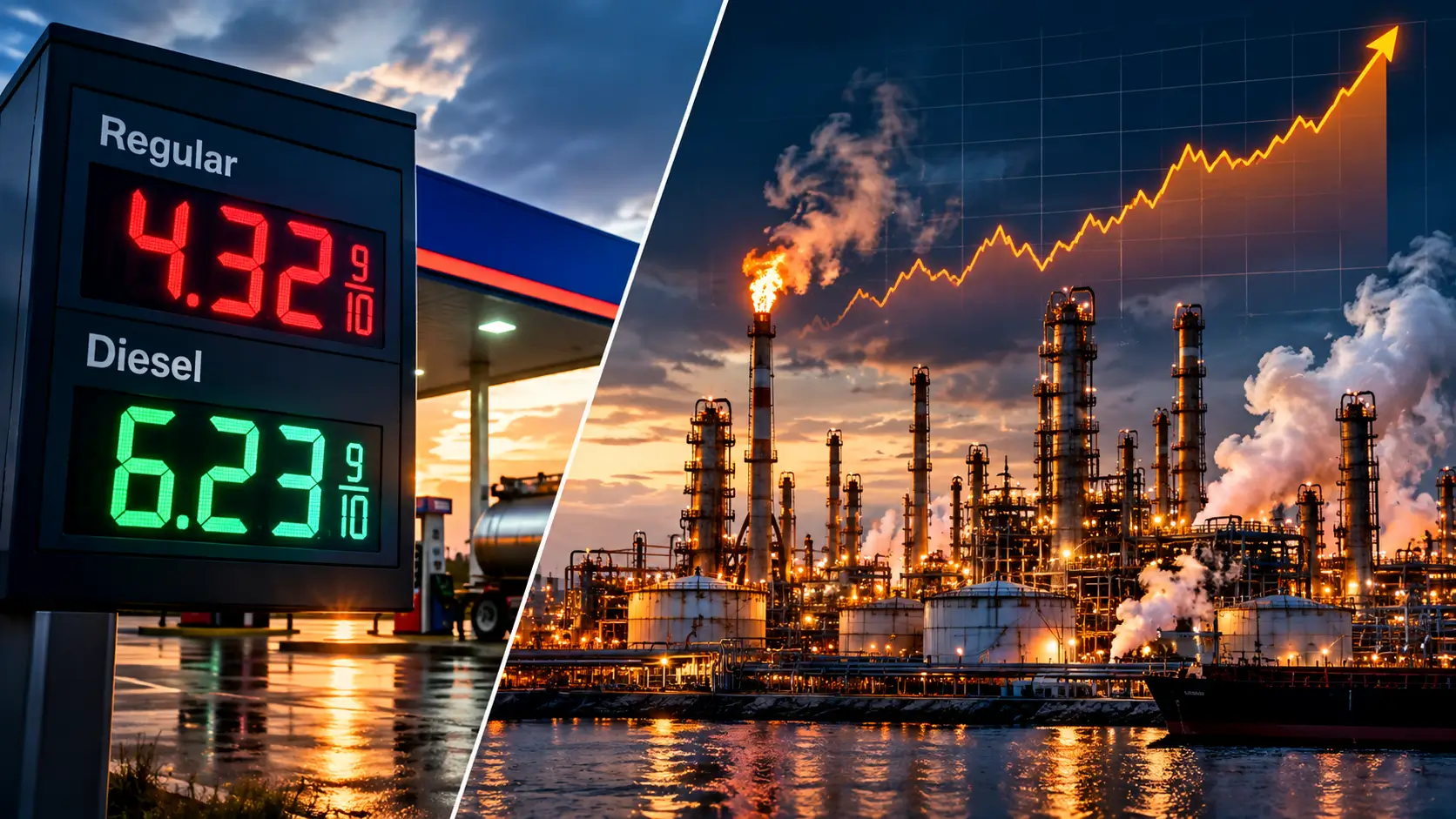
- A 19% energy price rise (reference scenario) adds approximately $0.40–$0.60 per gallon to U.S. fuel costs and pushes headline CPI toward 3.8–4%
- An 80% energy price surge (adverse scenario) is comparable to the 1973 oil embargo — the shock that triggered a decade of stagflation
- A 100%+ energy price shock (severe scenario) would be the largest peacetime energy crisis in modern history
Oil and gas prices have already increased sharply, and so have the prices of diesel and jet fuel, fertilizer, aluminum, and helium. Higher commodity prices are a textbook negative supply shock: raising prices and costs, disrupting supply chains, and eroding purchasing power.
2. Supply Chain Fracture: From Disruption to Decoupling
Supply chains are the invisible infrastructure of modern economic life. Conflict accelerates their fracture along geopolitical fault lines — and 2026 has made those fault lines newly visible.
Fact: The Strait of Hormuz remains a critical global chokepoint where disruption threatens not just oil shipments but also fertilizer access and high-tech supply chains. Asymmetric economic shocks disproportionately burden import-dependent Asian economies and vulnerable nations facing high inflation and debt.
Fact: Armed disputes can cause major disruptions in global logistics, raw material access, and energy supply. Manufacturers face production shutdowns, shipping delays, and input cost spikes when regional conflicts escalate. China’s export controls on rare earth materials — critical inputs for automotive and electronics manufacturers — caused Ford to shut down plants for weeks in 2025 due to magnet shortages.
The supply chain risk map in 2026 has four distinct pressure points:
- Hormuz disruption: 20 million barrels/day of crude oil and one-fifth of global LNG trade routed through a strait that is currently “functionally impaired” per WEF analysis
- Taiwan Strait: Any escalation in China-Taiwan tensions would disrupt 92% of the world’s advanced semiconductor production — a supply chain failure with no short-term substitute
- Black Sea routes: The Ukraine war has permanently redirected 30% of global wheat exports through higher-cost land corridors, embedding a structural food inflation premium
- Rare earth export controls: China supplies 60%+ of global rare earth processing — the foundation of EV batteries, wind turbines, defense systems, and consumer electronics
The View: Supply chain decoupling — the deliberate separation of Western and Chinese/Russian supply networks — was already underway before 2026. Escalation accelerates it. The short-run cost of decoupling is real: more expensive inputs, longer lead times, redundant inventory. The long-run benefit is also real: reduced single-point-of-failure risk. Companies that began building diversified supply chains in 2022–2023 are structurally better positioned for 2026 escalation risks than those that waited.
3. Financial Markets: The Risk Premium Cascade
Military escalation doesn’t just disrupt physical commodity flows. It reprices financial assets — and that repricing travels through every portfolio and balance sheet in the global economy.
Fact: In the IMF’s scenarios, corporate risk premiums rise by 100–200 basis points in advanced economies and emerging markets respectively in 2026–27, while sovereign spreads increase by 100 basis points in emerging markets excluding China. These tighter financial conditions dampen aggregate demand and lower asset valuations globally.
The financial channel operates through three mechanisms:
- Risk premium expansion: When geopolitical uncertainty rises, investors demand higher returns on all risk assets — equities, corporate bonds, emerging market debt — simultaneously. That means lower prices across the board before any earnings impact materializes
- Capital flight to safety: Money moves into U.S. Treasuries, Swiss francs, and gold — strengthening the dollar and tightening financial conditions for every country that holds dollar-denominated debt
- Dollar appreciation: A stronger dollar makes imports cheaper for U.S. consumers but raises borrowing costs for emerging markets that owe debt in dollars, triggering sovereign stress in the most vulnerable economies
The View: The financial channel is the fastest-moving transmission mechanism — it operates in hours, not months. When a military escalation headline breaks overnight, equity futures fall, oil futures spike, gold rallies, and Treasury yields move — all before any physical supply has changed. This front-running dynamic means that the market’s response to escalation risk is often larger and faster than the underlying economic disruption warrants. That creates both danger and opportunity: investors who can distinguish temporary risk-premium expansion from genuine structural damage have a timing edge.
4. Inflation Resurgence: The Stagflationary Trap
The IMF draws an explicit parallel between 2026 and 1973 — and notes the critical difference: today’s central banks have less room to maneuver.
Fact: Today’s shock echoes the 2022 commodity price surge following Russia’s invasion of Ukraine, which helped push global inflation to the highest since the 1970s. In 2022, the subsequent synchronized tightening and disinflation without a recession is widely seen as a major policy success. There are reasons to doubt the same outcome is achievable now. In 2022, inflation pressures were already elevated coming from post-pandemic supply-demand imbalances, tight labor markets, and abundant liquidity.
The stagflationary trap works like this: escalation pushes energy and food prices higher, which raises headline inflation, which forces central banks to hold or raise rates, which slows growth, which creates unemployment, which is politically intolerable — creating pressure to cut rates before inflation is tamed, which reignites inflation. There is no clean exit from this loop once it begins.
The war is already complicating monetary policy decision-making, as economists in countries as far from the battlefield as Chile and Poland scale back expectations for rate cuts — as oil prices rise and uncertainty deepens.
The Fed’s April 29 vote — 8-to-4 to hold rates, the most divided in 34 years — is the first visible evidence that this trap is closing around U.S. monetary policy.
5. Defense Spending Surge: Short-Term Stimulus, Long-Term Debt
Every major conflict triggers a defense spending surge. The IMF has quantified what that surge typically costs — and the numbers should give fiscal hawks pause.
Fact: In a typical defense spending boom, defense outlays increase by about 2.7 percentage points of GDP over two-and-a-half years, with roughly two-thirds financed through deficit. Fiscal deficits worsen by about 2.6 percentage points of GDP, public debt increases by about 7 percentage points within three years, and external balances deteriorate. Wartime booms are especially costly, with public debt jumping by about 14 percentage points and social spending falling.
Military outlays are rising by an average of 2.7 percentage points of GDP across affected economies, largely deficit-financed, contributing to “fiscal dominance” — a condition where rising debt service costs begin to constrain central bank independence and crowd out civilian spending.
The View: Defense spending is economic stimulus with an asterisk. In the short run, it creates manufacturing jobs, boosts industrial output, and supports GDP. In the medium run, it crowds out social spending, widens fiscal deficits, and raises public debt to levels that take decades to reduce. The WEF’s finding that fiscal dominance risk is rising across multiple economies simultaneously — not just in war-proximate countries — signals that the fiscal cost of this era of conflict is not being priced into bond markets accurately.
Risks & Opportunities: The IMF’s Three Scenarios, Applied
Reference Scenario (~45% probability): Limited Conflict, Managed Disruption
Energy prices rise 19%. Global growth falls to 3.1%. Inflation ticks to 4.4%. Central banks hold rates. Hormuz disruption eases by mid-year. Supply chains reroute around the disruption.
What this means for you: Elevated fuel and grocery costs through Q3 2026. Mortgage rate relief delayed to 2027. Equity markets volatile but directionally positive once clarity emerges.
Adverse Scenario (~30% probability): Prolonged Disruption, Tighter Conditions
Oil up 80%, gas up 160%. Corporate risk premiums rise 100bps. Growth falls to 2.5%. Inflation hits 5.4%. Some central banks raise rates into a slowing economy. Emerging market sovereign stress materializes.
What this means for you: Mortgage rates return toward 7.5%–8%. Business borrowing contracts. Dollar surges, making imports cheaper for U.S. consumers but devastating for EM trading partners. Defensive assets — gold, short-duration Treasuries, TIPS — outperform significantly.
Severe Scenario (~25% probability): Energy Crisis, Inflation Spiral, Recession
Oil up 100%+. Inflation expectations become unanchored. Global growth at 2% — borderline recession. Inflation exceeds 6% and persists into 2027. Fiscal dominance constrains central bank responses. Sovereign debt crises in vulnerable emerging markets.
What this means for you: This is the 1973–1974 playbook: a commodity-driven stagflationary shock that central banks cannot cleanly resolve. Equity markets drawdown 25–35%. Consumer spending contracts as real wages fall. Gold and hard assets preserve value. Businesses with fixed-rate debt and domestic revenue streams are most resilient. Import-dependent businesses face existential margin pressure.
The Bottom Line
This is not only a regional crisis. It is a structural shock to the world economy, delivered at a moment of geoeconomic fragility. The longer it runs, the more lasting the damage becomes. First it hits oil, gas, shipping, and aviation; then inflation, industrial costs, and food security; and eventually trade routes, investment decisions, and political stability.
For consumers:
- Budget for energy and food costs remaining elevated through 2026 regardless of scenario — even the IMF’s most optimistic case assumes a 19% energy price rise persists for months
- Variable-rate debt is the highest-risk liability in an escalation scenario: HELOC rates, adjustable mortgages, and credit card balances all respond rapidly to the rate environment that conflict-driven inflation creates
- Physical gold (or gold ETFs: GLD, IAU) and I-Bonds provide meaningful purchasing power protection in all three scenarios — they don’t need a crisis to be useful; they need inflation, which all three scenarios produce
For investors:
- Defense sector allocation is structurally supported across all scenarios — demand for ammunition, air defense, drones, and logistics technology is inelastic to conflict duration
- In the adverse and severe scenarios, dollar appreciation makes unhedged international equity positions painful — consider currency-hedged international ETFs or reduce EM exposure in favor of domestic defensives
- Short-duration Treasuries and TIPS are not just defensive — they are actively attractive in a scenario where long-term rates move higher on inflation and fiscal stress
For businesses:
- Energy cost hedging is no longer optional for businesses with meaningful fuel or electricity exposure — forward contracts, supplier agreements with price caps, and operational efficiency investments all reduce scenario-specific vulnerability
- Supply chain audit for single-source dependencies in China, the Middle East, or conflict-proximate regions should be a Q2 2026 board-level priority, not a future planning exercise
- Build 90-day cash liquidity buffers: in the adverse and severe scenarios, credit conditions tighten and banking sector stress can emerge faster than most businesses plan for
In a world already weakened by rising rivalries, unstable supply chains, and prolonged conflicts at risk of regional spillover, such confrontation carries systemic, deliberate, and far-reaching global consequences, increasing state fragility.
The IMF has modeled the scenarios. The WEF has ranked the risks. The data is available and unambiguous. The only remaining question is whether households, businesses, and investors use it to prepare — or wait for the severe scenario to make the preparation obvious and far more expensive.
FAQ
What does “global conflict escalation” actually mean economically?
It means the simultaneous intensification of multiple armed conflicts and geopolitical confrontations that disrupt commodity markets, supply chains, financial conditions, and fiscal stability across multiple economies at once. In 2026, this includes the Middle East war and its Hormuz disruption, the ongoing Ukraine conflict and its energy market legacy, and the U.S.-China geoeconomic confrontation through tariffs and export controls. The WEF Global Risks Report 2026 ranked geoeconomic confrontation as the top risk most likely to trigger a global crisis in 2026, with state-based armed conflict second. The economic impact travels through four channels: commodity prices, supply chain disruption, financial conditions tightening, and inflation expectations becoming unanchored.
What does the IMF predict happens if conflict escalates severely?
In the IMF’s severe scenario — where energy supply dislocations extend into 2027 and inflation expectations become markedly less anchored — global growth falls to 2% in both 2026 and 2027, while inflation exceeds 6%. The impact on emerging market and developing economies would be almost twice that on advanced economies. For context: 2% global growth is the IMF’s historical definition of a global recession. It would be the worst economic performance since the 2009 financial crisis and 2020 pandemic year. Read the full IMF analysis at imf.org/weo-april-2026.
How does a Middle East conflict raise food prices in America?
Through three channels. First, oil price increases raise the cost of diesel that powers every tractor, truck, and ship in the agricultural supply chain. Second, natural gas — also disrupted by Hormuz closure — is the primary feedstock for nitrogen fertilizer production; higher gas prices mean higher fertilizer costs, which raise crop input costs globally. Third, the Strait of Hormuz carries not just oil but also fertilizer exports from Qatar and the UAE — disrupting the physical flow of agricultural inputs to major food-producing regions. Oil and gas prices have already increased sharply, and so have the prices of fertilizer, aluminum, and helium — the full commodity complex that feeds into food production costs.
Is this comparable to the 1970s oil shocks?
Structurally similar, but with important differences in both directions. The 1973 oil embargo caused a 300% oil price spike and pushed U.S. inflation above 12%. The adverse IMF scenario for 2026 assumes an 80% oil price increase — significant, but below 1973’s magnitude. However, there are reasons to doubt central banks can replicate their 2022 post-Ukraine success. In 2022, inflation pressures were already elevated coming from post-pandemic supply-demand imbalances, tight labor markets, and abundant liquidity — and central banks still achieved disinflation without recession. In 2026, they start from an already-elevated inflation baseline (3.3% CPI, 3.0% core PCE) with less room to tighten without causing recession.
What assets perform best in an escalation scenario?
Historical data across the three most comparable precedents (1973 oil crisis, 1990 Gulf War, 2022 Ukraine invasion) shows:
Underperformers: Airlines (fuel cost), consumer discretionary (purchasing power erosion), EM equities (dollar appreciation, sovereign stress), and long-duration growth stocks (rate sensitivity)
Gold: Outperforms in all three conflict escalation scenarios as a safe-haven and inflation hedge; track live prices at Kitco
Short-duration Treasuries (T-bills, 2-year notes): Benefit from flight-to-safety in the reference and adverse scenarios; TIPS protect against inflation in the severe scenario
Defense stocks: Structurally supported across all scenarios; RTX, LMT, NOC, Rheinmetall, BAE Systems have multi-year backlog visibility
Domestic energy producers: Higher oil prices directly benefit Permian Basin operators; partially cushioned by U.S. net exporter status
How does conflict escalation affect the Federal Reserve’s decisions?
It creates the stagflationary trap that the Fed has explicitly acknowledged. The adverse scenario assumes further disruption, leading to higher energy prices and inflation expectations and tighter financial conditions throughout the year, with growth falling to 2.5% and inflation rising to 5.4%. In that environment, the Fed faces simultaneous pressure to hold or raise rates (to fight 5.4% inflation) and cut rates (to support an economy growing at 2.5%). The April FOMC vote — 8-to-4 in favor of holding, the most divided since 1992 — already reflects this tension in real time. Monitor Fed rate expectations at CME FedWatch and inflation data at BLS.gov.
Where can I track global conflict economic risks in real time?
Primary sources, all free and updated regularly:
FRED — Geopolitical Risk Index — the St. Louis Fed’s quantitative geopolitical risk measure, updated monthly
IMF World Economic Outlook, April 2026 — the definitive three-scenario conflict impact framework
WEF Global Risks Report 2026 — annual expert survey of top global risks, ranked by likelihood and severity
World Bank Global Economic Prospects — quarterly GDP and growth forecasts by region
Kiel Institute Conflict Tracker — military and economic aid tracking across all active conflicts
EIA Weekly Energy Report — official U.S. energy supply, price, and inventory data
Sources: IMF World Economic Outlook, April 2026 — “Global Economy in the Shadow of War” · IMF WEO Chapter 1, April 2026 · IMF WEO Executive Summary, April 2026 · IMF Spring Meetings Press Briefing Transcript, April 14, 2026 · IMF Blog — War Darkens Global Economic Outlook, April 14, 2026 · WEF Global Risks Report 2026 · WEF — Global Price Tag of War in the Middle East, March 12, 2026 · WEF — Finance Stories April 2026 · World Bank Global Economic Prospects 2026 · Z2Data — 22 Critical Supply Chain Risks 2026
© Fact and View, 2026. For informational purposes only. Not investment advice.