
The Federal Reserve raised its benchmark interest rate on September 16, the first increase since 2023. The target range now runs from 3.75% to 4%. All twelve voting officials backed the move, and Chair Kevin Warsh said inflation has stayed above the Fed’s 2% goal for too long.
That decision reaches your mortgage, car loan, credit cards, savings account, job and retirement account. Each one reacts on its own schedule, and some reacted months before the Fed acted.
Higher rates raise the cost of borrowing and raise the pay on saving. The size of each change depends on the product you hold. This article explains how interest rates affect your everyday life by following the money from the Fed’s decision to your monthly statement.
The Big Picture
Interest is the fee you pay to use someone else’s money, or the fee a bank pays to use yours. The Fed controls one short-term rate and pushes on all the others. Banks add their own margins, and bond investors add their expectations about inflation.
If you owe money, higher rates raise your cost, sometimes within a month. If you hold cash, higher rates raise your earnings, though banks pass those gains along at a slower pace. Your household lands on one side or the other depending on how much debt and how much cash you carry.
The main rates after the September decision:
| Product | Current level | Source |
|---|---|---|
| Fed benchmark range | 3.75% to 4% | Federal Reserve |
| 30-year mortgage | 6.95% to 7.37% | Freddie Mac, Zillow |
| New-car loan (average) | 6.35% | Experian, Q2 2026 |
| Used-car loan (average) | 11.19% | Experian, Q2 2026 |
| Credit card (average) | Above 21% | Federal Reserve data |
| Savings account (national average) | 0.38% | FDIC |
| High-yield savings (best available) | 4.10% to 4.21% | Bankrate, NerdWallet |
The Fed’s September Decision
The federal funds rate is the rate banks charge each other for overnight loans. The September hike lifted the target range by a quarter of a percentage point. The Fed’s own projections put the median year-end rate near 4.1%, which leaves room for one more quarter-point increase before December.
The vote drew attention because the Fed held rates steady for most of 2026. President Donald Trump said after the August jobs report that the Fed should lower rates. Fed officials pointed to inflation.
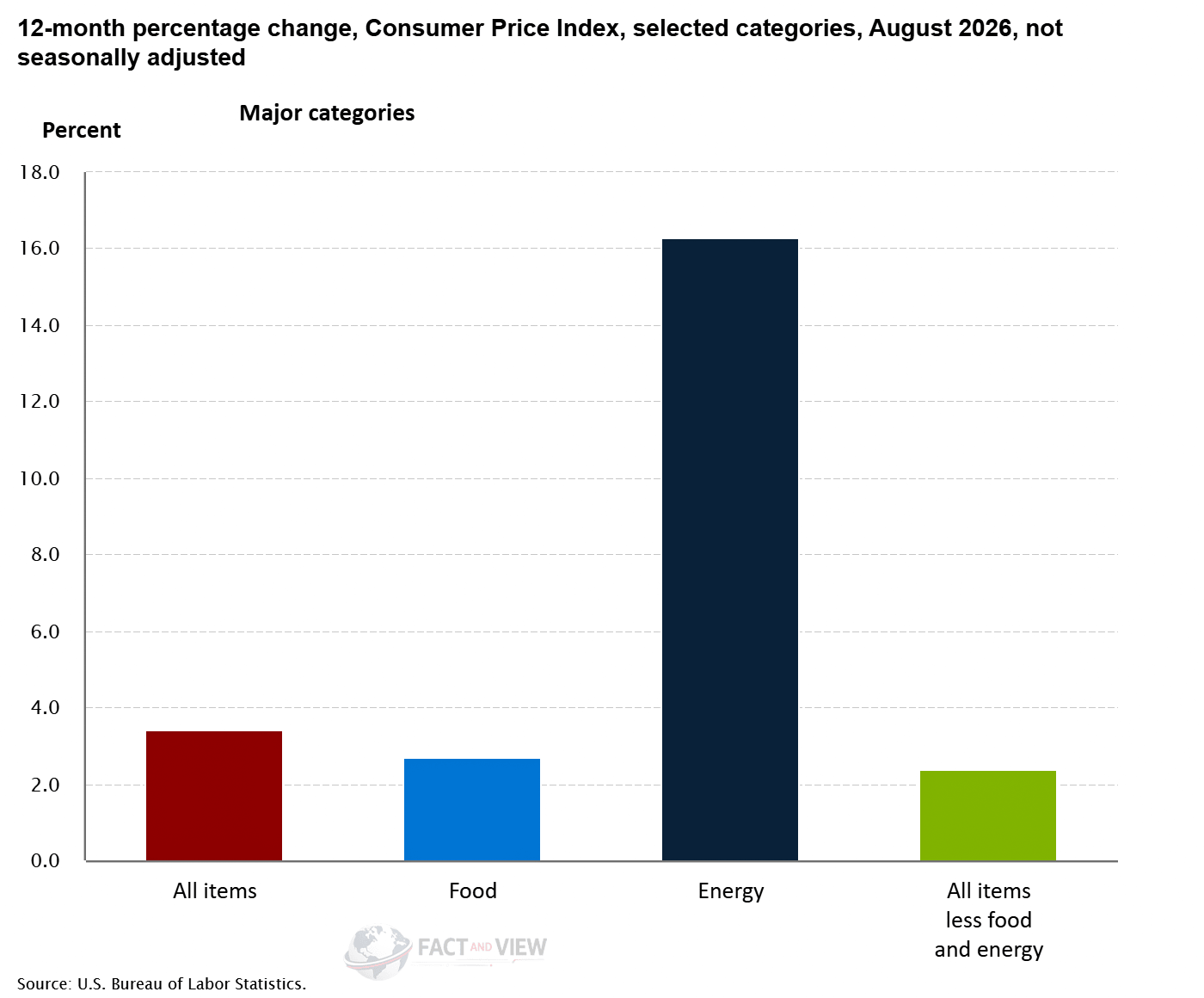
The Consumer Price Index rose 3.4% over the twelve months ending in August, according to the Bureau of Labor Statistics. Core prices, which exclude food and energy, rose 2.4%. Both readings sit above the 2% target.
“Why Mortgage Rates Are Still So High in 2026” for the full Treasury-to-mortgage chain.
The Forces Behind Higher Rates
Three developments sit behind the current rate environment:
- Energy costs. Crude oil traded above $100 a barrel in early September, according to Energy Information Administration spot prices, after the Iran conflict disrupted shipping through the Strait of Hormuz. Gasoline reached $4.48 a gallon on September 24, according to AAA.
- Steady hiring. Employers added 162,000 jobs in August, the strongest month since March, and unemployment held at 4.1%, according to the BLS. The agency revised June and July payrolls up by a combined 55,000.
- A restless bond market. The 10-year Treasury yield climbed toward 5%, its highest level since 2007, according to Mortgage News Daily, as investors demanded more pay for the risk that inflation erodes their returns.
Steady hiring gives the Fed room to fight inflation, because the Fed weighs stable prices against maximum employment. A job market that holds up lowers the risk that a rate hike triggers layoffs.
The Logic of a Rate Hike
The Fed raises rates to slow spending. Higher rates make loans more expensive, so households buy fewer cars and homes, and businesses delay expansion. Less spending eases demand for goods and services, and slower demand takes pressure off prices.
The approach works with a lag. Economists describe the delay between a rate change and its full effect on the economy as long and variable, which means the September hike will reach prices and hiring over many months.
The Chain From the Fed to Your Wallet
Follow one decision through five steps:
- The Fed sets the target range for the federal funds rate.
- Banks set the prime rate, their benchmark for their best customers, three percentage points above the top of that range. Prime stood at 6.75% in February, according to Trading Economics, so the September hike puts it at 7% by the same formula.
- Credit cards, home equity lines and many small business loans float off prime. Those rates change within one or two billing cycles.
- Mortgages follow the 10-year Treasury yield, which moves on investor expectations about the Fed and inflation. The 30-year rate climbed from 5.75% in early March to between 6.95% and 7.37% by the week of the meeting, according to Zillow and Freddie Mac surveys.
- Savings and CD rates rise last, and online banks move first.
Mortgage rates track expectations, so they rose months before the Fed acted. Credit card rates follow the decision, so they adjust after it.
How Interest Rates Affect Your Everyday Life, Bill by Bill
Your Mortgage
On a $400,000 loan over 30 years, the payment at 5.75% comes to $2,334 a month. At 7% it comes to $2,661. That $327 monthly gap adds up to about $117,700 in extra interest over the life of the loan, using standard amortization math.
Homeowners with rates near 3% or 4% face a different problem. Selling means trading that loan for one near 7%, so many stay in their homes, and fewer houses reach the market. Buyers then compete for a thin supply, which supports prices while borrowing costs climb.
Your Car Loan
Experian reports an average new-car loan rate of 6.35% and a used-car rate of 11.19% for the second quarter of 2026. Borrowers with top credit scores paid 4.41% on new cars, and borrowers with the weakest scores paid 16.11%.
Your credit score moves your rate more than the Fed does. On the average new-car loan of $43,610 over 69 months, a jump from 6.35% to 7% adds about $13 a month and $930 over the loan. The 11.7-point gap between the best and worst credit tiers dwarfs that.
Americans owe $1.713 trillion on auto loans, more than the $1.651 trillion they owe on student loans, according to the New York Fed.
Your Credit Cards
Average credit card rates run above 21%, according to Federal Reserve data. The average cardholder with a balance carries $6,595, according to Capital One data. At 21%, that balance generates about $115 in interest each month, or $1,385 a year.
The quarter-point increase adds about $16 a year to that balance. The 21% starting rate costs you $1,385. Card debt across the country totals about $1.28 trillion, according to the New York Fed, so a small change in the rate multiplies across millions of households.
Your Savings
The national average savings account pays 0.38%, according to the FDIC. The best high-yield accounts pay 4.10% to 4.21%, according to Bankrate and NerdWallet surveys. On $10,000, that gap means $38 in a year versus $410.
One-year CDs pay less than the top savings accounts. Bankrate’s national average for a 12-month CD stood at 1.71%, while Curinos reported an average near 2.53% on larger deposits, and the gap comes from different survey methods.
Banks raise deposit rates later than loan rates, and in smaller steps. Online banks move first, and large branch-based banks may hold their rates for months. With inflation at 3.4%, a 4.1% account beats price increases by 0.7 percentage points, and a 0.38% account falls behind by more than three.
Your Student Loans
Lenders fix the rate on a federal student loan at origination, so the September hike changes nothing on the federal loans you hold. Private loans with variable rates move with market benchmarks, and those borrowers should expect higher payments.
Your Job and Your Employer
Business loans track the prime rate. Higher borrowing costs lead some owners to delay equipment purchases, expansion and hiring. The Fed wants some of that slowdown, because it lowers price pressure. The risk is that the slowdown spreads to payrolls.
The labor market held through August. Average hourly earnings rose 0.3% to $37.75 in August, according to the BLS. Small businesses face the sharpest pinch, because they borrow on prime-linked loans and lack the cash reserves of large firms.
Your Retirement Account
Bond prices fall when yields rise. If you own a bond fund, its price drops first, and its income rises later as the fund buys higher-paying bonds. Stocks follow no fixed pattern. Higher rates raise borrowing costs for companies and make safe bonds more attractive, but strong earnings can offset both effects. No formula tells you how your account will react.
Two Households, One Rate Hike
Take two households and run the numbers from this article.
The first household owes $400,000 on a mortgage, $43,610 on a car and $6,595 on a credit card. If its rates moved as described above, it pays $327 more a month on the mortgage, $13 more on the car and about $1.40 more on the card. That adds up to about $341 a month, or $4,100 a year.
The second household holds $10,000 in a high-yield savings account at 4.1% and owes nothing. It earns $410 a year, and each additional $10,000 adds another $410. A rate hike helps this household and leaves its costs unchanged.
Most families sit between those two, which makes your own mix of debt and cash the number that matters. Add up what you owe at variable rates, subtract what you hold in high-yield accounts, and you can see which side of the hike you stand on.
Four Numbers to Check on Your Own Statements
Your household has its own version of the table above. Four lookups take about ten minutes:
- Your credit card APR. Your statement lists it, along with the index it follows. A variable rate tied to prime rose with the September hike.
- Your mortgage type. A fixed-rate loan keeps its payment. An adjustable-rate loan resets on a schedule in your loan documents.
- Your savings yield. Compare the APY on your statement with the 4.10% to 4.21% the best accounts pay.
- Your auto loan rate. Compare it with the Experian averages for your credit tier, from 4.41% for top scores to 16.11% for the weakest.
What to Watch Next
- The Fed’s two remaining 2026 meetings. The central bank’s projections point toward one more quarter-point hike.
- The September jobs report, due October 2 from the BLS.
- The next Consumer Price Index report, which shows whether inflation moves toward the 2% target.
- The 10-year Treasury yield, the best daily gauge for mortgage rates.
- Freddie Mac’s weekly mortgage survey, which the agency publishes each Thursday.
- Deposit rates at online banks, which reveal how fast savers see the hike.
The Bottom Line
The Fed raised its benchmark rate to a range of 3.75% to 4% because inflation runs at 3.4%, above the 2% target, while hiring stays strong. That decision now pulls on most of your borrowing and saving choices.
Mortgage rates sit near 7%, credit cards charge above 21%, and the best savings accounts pay above 4%. A buyer with a $400,000 mortgage pays $327 more each month than at March rates. A saver in a high-yield account earns about ten times what the average account pays.
The unknowns are the pace of future hikes, the speed of inflation’s decline, and the delay before higher rates show up in hiring. The data to follow are the monthly inflation report, the jobs report and the 10-year Treasury yield.
Continue reading from Fact and View:
- “How Inflation Affects Your Savings” for the savings side of the story.
- “Why Prices Are Still Rising in 2026 Even as Inflation Cools” for the inflation data behind the Fed’s decision.
- “Why Americans Still Feel Poor Even When Inflation Falls” for the debt burden behind the card and auto loan figures.