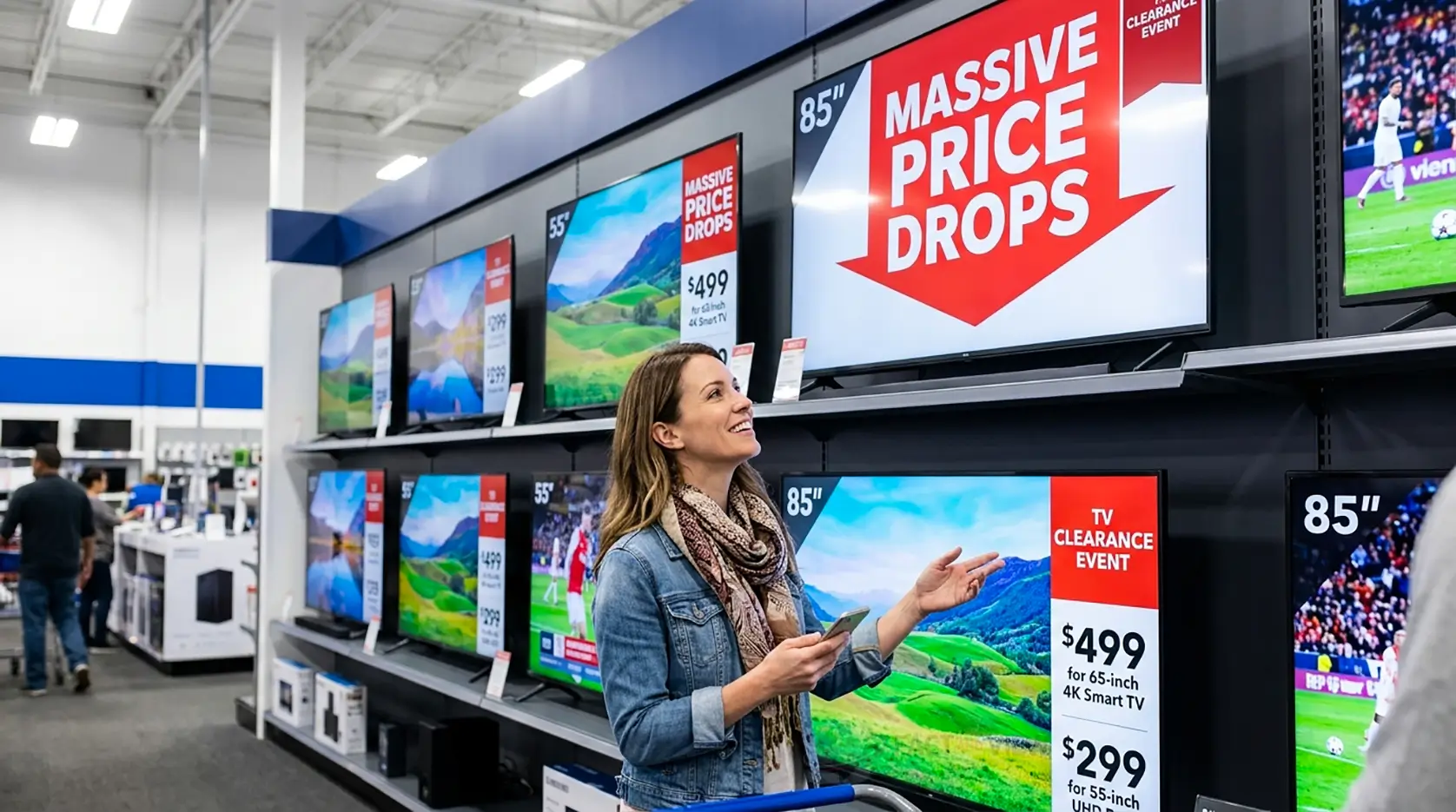
Televisions got cheaper again this year. The Bureau of Labor Statistics (BLS) measured TV prices 1.0% lower in August than a year earlier, while prices across the economy rose 3.4%. Over the long run the gap widens: BLS found its price index for TVs fell 94% between December 1997 and August 2015.
The decline has slowed. TV prices rose in June, July and August on a seasonally adjusted basis, about 3.2% combined, as memory chips and display panels cost more to buy. Black Friday lands on November 27, eight weeks from now.
This article explains why TV prices keep falling, which costs have started pushing them up, and what to weigh before you buy.
The Big Picture
Makers build TVs in huge volumes, compete on price and fit better technology into each model for less money. Those forces cut prices for decades. In 2026, memory chip costs, display panel costs and thinner room for holiday discounts push the other way, according to market analysts. The long decline holds in the data, and the latest months show it flattening.
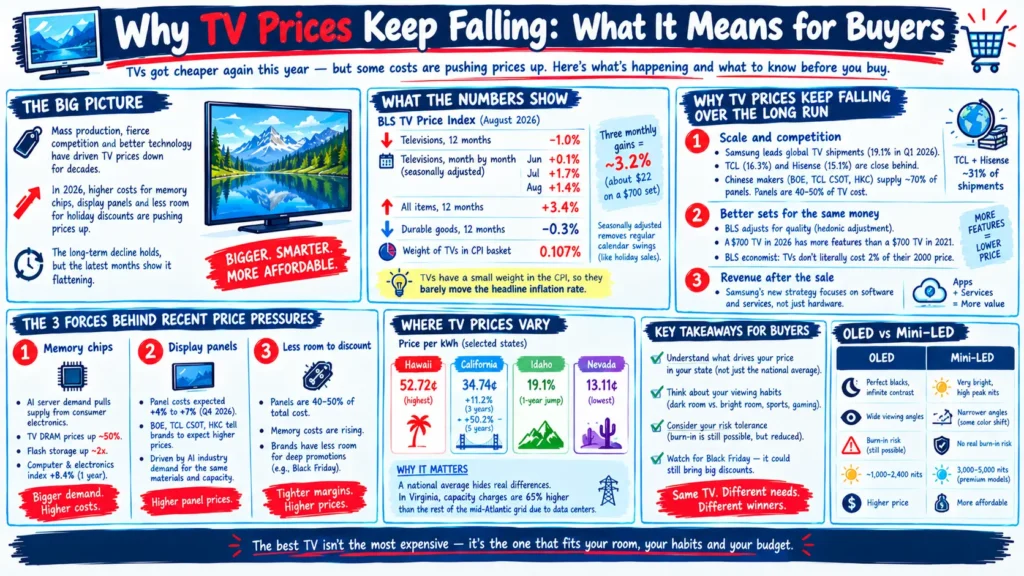
What the Numbers Show
BLS publishes a TV price index inside the Consumer Price Index (CPI), its monthly measure of what consumers pay. The August 2026 report, released September 11, shows:
- Televisions, 12 months: down 1.0%.
- Televisions, month by month (seasonally adjusted): up 0.1% in June, 1.7% in July and 1.4% in August.
- All items, 12 months: up 3.4%.
- Durable goods, 12 months: down 0.3%. Durables are products built to last three years or more.
- Weight of TVs in the CPI basket: 0.107%, about one-tenth of one percent.
Seasonal adjustment strips out regular calendar swings, such as holiday sales, so one month compares fairly with the next.
Compound the three monthly gains and you get about 3.2%. On a $700 set, that adds about $22.
The small weight explains why TV prices barely move the headline inflation rate. Most households buy a TV once every several years, so BLS gives the category a thin slice of the basket.
Why TV Prices Keep Falling Over the Long Run
Three forces account for most of the decline.
Scale and competition
Samsung has led global TV shipments for 20 straight years. In the first quarter of 2026 it held 19.1% of shipments, TCL held 16.3% and Hisense held 15.1%, according to a Tech Times analysis of industry data. TCL and Hisense together ship about 31% of the world’s sets.
The Chinese display makers BOE, TCL CSOT and HKC supply about 70% of global TV panels, according to TrendForce, a market research firm. Panels make up 40% to 50% of the cost of building a TV, per the same Tech Times analysis.
Panel suppliers that add capacity faster than demand grows push panel prices down. Brands that fight for the same shoppers pass much of that saving along, because a rival will if they don’t. That reasoning is analysis, and the price data above fits it.
Better sets for the same money
BLS adjusts its TV index for quality. Suppose a $700 TV in 2026 has a bigger, sharper, smarter screen than a $700 TV in 2021. BLS counts the improvement as a price cut. The Bureau calls this a hedonic quality adjustment, and it applies to goods whose features change often.
BLS economist Steve Reed told Sherwood News in 2024 that TVs do not literally cost 2% of their year-2000 price, and he named quality adjustment as a major reason the index fell so far. A flat sticker price can register as a decline in the CPI because the same dollars buy more TV.
Revenue after the sale
A Q1 2026 market outlook said Samsung’s visual display division, after naming a new head in May, would steer toward platforms such as software and services, not hardware alone. When a maker expects to earn from apps and services during a set’s life, it can sell the hardware on thinner margins.
No public source puts a dollar figure on that income, so treat this as informed inference.
What Changed in 2026
Three cost pressures arrived at the same time.
Memory chips
AI server demand pulls memory chip supply away from consumer electronics, according to Tech Times. Trade coverage citing the research firm Omdia put TV-specific DRAM prices up about 50% and flash storage prices up about two-fold. A smart TV needs both to run its apps and software.
The same BLS release shows a similar squeeze elsewhere in electronics. Its index for computers, peripherals and smart home assistants rose 8.4% over the year, and 3.8% in August alone. Memory costs are one plausible cause, though BLS does not name a reason.
Display panels
TrendForce expects TV panel costs to rise 4% to 7% from quarter to quarter during the fourth quarter of 2026, according to eCoustics reporting. BOE, TCL CSOT and HKC have told Samsung, LG and Sony to expect higher panel prices starting in September or in the fourth quarter. TrendForce ties the increase to AI-industry demand for the same upstream materials and factory capacity that display makers use.
Less room to discount
Tech Times argues that with panels at 40% to 50% of cost and memory’s share rising, brands lose the room to run the deep promotions that historically drive second-half sales. That is one analyst’s reading. Black Friday could still deliver large markdowns, and the next section covers how to track them.
Fewer independent brands
Sony and TCL signed a binding agreement on March 31, 2026 to form Bravia, Inc. TCL will hold 51% and Sony 49%. The venture takes over Sony’s TV business when it begins operating in April 2027, pending regulatory approvals.
Shared manufacturing can cut costs. Fewer independent brands can also mean less price competition. Analysts disagree about which effect wins, and the venture has no sales record yet.
How a Cost Increase Reaches the Price Tag
Follow one cost from a chip factory to your receipt:
- AI data centers buy memory chips and compete for display-making capacity.
- Suppliers raise prices to TV makers.
- A TV maker’s cost per set rises, and panels alone carry 40% to 50% of that cost.
- The maker raises list prices or trims promotions.
- Retailers pass the change to shoppers, and BLS records it in the CPI.
Delays sit between each step, because retailers sell stock they bought at older prices. BLS data show TV prices turning up over the summer. Trade policy can add to this chain. A tariff on imported components or finished sets raises a maker’s cost by the same logic our tariff explainer lays out.
What It Means for Buyers
This section offers general information, not personal financial advice.
- Timing. Black Friday falls on November 27. Retail price trackers have long put the deepest TV discounts around that date, and one analysis says component costs may limit this year’s markdowns. The summer increase adds about $22 to a $700 set, so a single day’s sale can erase it.
- Room and use. Brightness, burn-in risk and screen size change the price by hundreds of dollars. Our comparison of OLED and Mini-LED sets puts 65-inch Mini-LED models at $700 to $2,000 and OLED models at $1,200 to $3,000 or more, according to retailer surveys.
- The cost of watching. A cheaper TV does not make TV cheaper. BLS’s index for cable, satellite and live streaming TV service rose 3.0% over the year, and its smaller-sample index for video and video game subscriptions rose 14.7%. A $60 monthly streaming bundle at that growth rate adds about $8.82 a month, or about $106 a year. That is an illustration from an index, because your own bill depends on your services.
- Sony shoppers. Sony’s current sets come from its existing business. The TCL-led venture takes over in April 2027.
TV prices carry little weight in overall inflation, so the effect on a household budget is small and arrives only when you replace a set.
What to Watch Next
- BLS September CPI report, due October 14, for the next TV price reading.
- TrendForce and Omdia updates on panel and memory prices.
- Black Friday promotions on November 27, compared with last year’s discount depth.
- Memory chip supply, since AI demand sets the pace for DRAM and flash prices.
- Bravia, Inc., which begins operating in April 2027.
- Trade policy changes affecting imported TVs and components.
The Bottom Line
TV prices fell for decades because makers built sets at huge scale, panel suppliers added capacity and brands competed for the same shoppers. BLS measures the drop at 94% from 1997 to 2015, and the index still sits 1.0% lower than a year ago, even as overall prices rose 3.4%.
The recent trend has turned. TV prices rose about 3.2% over June, July and August, and reports point to higher memory and panel costs through the fourth quarter. A smaller discount budget at the brands could follow, though no one can measure that yet.
Unknowns remain: how long AI demand keeps memory chips scarce, how deep Black Friday discounts run, and what the Sony and TCL venture does to competition. The September CPI report and the November sales season will show which trend is winning.
Continue reading from Fact and View:
- “OLED vs Mini-LED: What’s the Difference?” for the panel types and price ranges referenced above.
- “How Tariffs Actually Raise Prices” for the cost chain behind imported electronics.
- “Why Prices Are Still Rising in 2026 Even as Inflation Cools” for the broader price picture.
- “Why Americans Still Feel Poor Even When Inflation Falls” for how big purchases fit household budgets.
Sources :
- U.S. Bureau of Labor Statistics, Consumer Price Index News Release, August 2026
- U.S. Bureau of Labor Statistics, Long-term price trends for computers, TVs, and related items
- U.S. Bureau of Labor Statistics, CPI Quality Adjustment Questions and Answers
- Sherwood News, TVs don’t actually cost 98% less than they used to
- Tech Times, Global TV Market Share Q1 2026
- eCoustics, LCD TV Prices Could Rise Before Black Friday (citing TrendForce)