

Most Americans never swap dollars for euros or yen. The dollar still shapes what you pay for gas, groceries, a new phone and a flight to Rome. Understanding why the U.S. dollar matters starts with one fact: almost everything that crosses a border has a price that moves with the exchange rate.
That link is in the news now. The U.S. Dollar Index (DXY) stood near 102 on Oct. 6, up about 3.5% over 12 months and at its highest level since April 2025. The Federal Reserve raised interest rates on Sept. 16 for the first time since 2023, to a range of 3.75% to 4%. August consumer prices rose 3.4% from a year earlier, and the energy index jumped 16.3%.
A stronger currency usually stretches your purchasing power abroad, yet your gas and grocery bills tell a more complicated story. Exchange rates are one force among several, and this year other forces are louder. This guide explains how currency value moves everyday spending, who gains, who loses, and what to watch before your next big purchase.
Understanding the Basics: What Drives the Greenback?
An exchange rate is the price of one currency in another. Banks, companies and investors set that price in the foreign exchange market, which trades around the clock. A “strong” dollar buys more euros, yen or pesos than it did before. A “weak” dollar buys fewer. The dollar’s purchasing strength abroad rises and falls with that gap.
Most headlines track the U.S. Dollar Index, or DXY. The index compares the dollar with six currencies, and the euro carries 57.6% of the weight, followed by the yen (13.6%), the pound (11.9%), the Canadian dollar (9.1%), the Swedish krona (4.2%) and the Swiss franc (3.6%). The index works like a thermometer for the global currency market. It does not set prices in stores.
Three forces move the dollar most:
- Interest rates. Higher yields on Treasury bonds attract foreign investors, who must buy dollars first. Analysts at National Australia Bank said in late September that the dollar was tracking 10-year Treasury yields more closely than it tracked rate expectations.
- Fear and growth. Investors often buy dollars in a crisis, which makes the dollar a safe-haven asset. The pattern can break. The index fell 10.8% in the first half of 2025, its worst first half since 1973, as analysts pointed to trade policy, fiscal concerns and slower growth.
- Trouble elsewhere. The euro slid on Oct. 5 amid fresh political uncertainty in Spain and instability in France, which pushed the dollar index higher.
Because oil, metals and many other goods trade in dollars, the currency also plays a role in international trade that no other money matches. A move in the dollar can ripple into prices far from any currency counter. Economists also watch a trade-weighted index that the Fed publishes, which covers more currencies, including the Chinese yuan and the Mexican peso. The two gauges usually move together over time, but they can diverge when the yuan or the peso moves on its own.
The Bright Side: How a Strong Dollar Helps Your Wallet
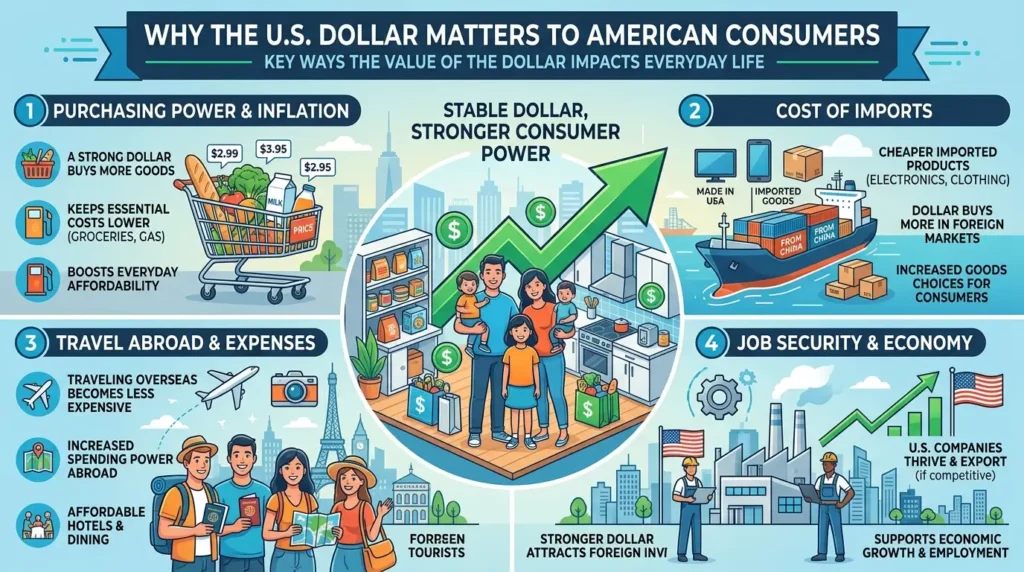
When the dollar gains, foreign goods and foreign trips get cheaper for Americans. The effect arrives slowly and unevenly. Imported products fill a typical American home, from phones to cookware, so the exchange rate reaches nearly every household.
Cheaper Imported Goods
A Japanese camera maker or a German carmaker earns yen or euros. If the dollar rises, each dollar a U.S. importer spends buys more of those currencies, so the same product costs less to bring in. Global supply chains stretch that effect across cheaper electronics, clothing, furniture, auto parts and machinery.
Retailers do not pass savings along overnight. They buy inventory months ahead, hedge currency swings and weigh freight, labor and rent. A stronger dollar tends to restrain domestic prices at the margin. It does not guarantee a lower sticker price. Consumers see the effect most clearly in categories where competition is fierce and margins are thin, such as consumer electronics, where a few cents on the exchange rate can decide a promotion.
The latest import data shows why. Nonfuel import prices rose 5.5% from August 2025 to August 2026, the largest 12-month increase since 2022. The dollar sank in 2025 and has regained only part of it, and shipping and material costs moved. The Bureau of Labor Statistics data cannot split those causes apart, so treat any single explanation with caution.
Affordable International Travel
An overseas vacation shows the exchange rate most clearly. On Oct. 1, the euro bought about $1.13 and a dollar bought about 158 yen. The dollar index sat roughly 3.5% higher than a year ago, so a week in European travel destinations or Japan costs a little less in dollar terms than it did last fall.
Local inflation, airfare and hotel demand still decide the final bill. Jet fuel costs follow crude oil, and oil has climbed this year. A better exchange rate softens the total. It does not erase it. Cards that charge a foreign transaction fee can wipe out a small gain from a stronger dollar, so check the fee before you leave.
The Flip Side: When a Weak Dollar Pushes Prices Up
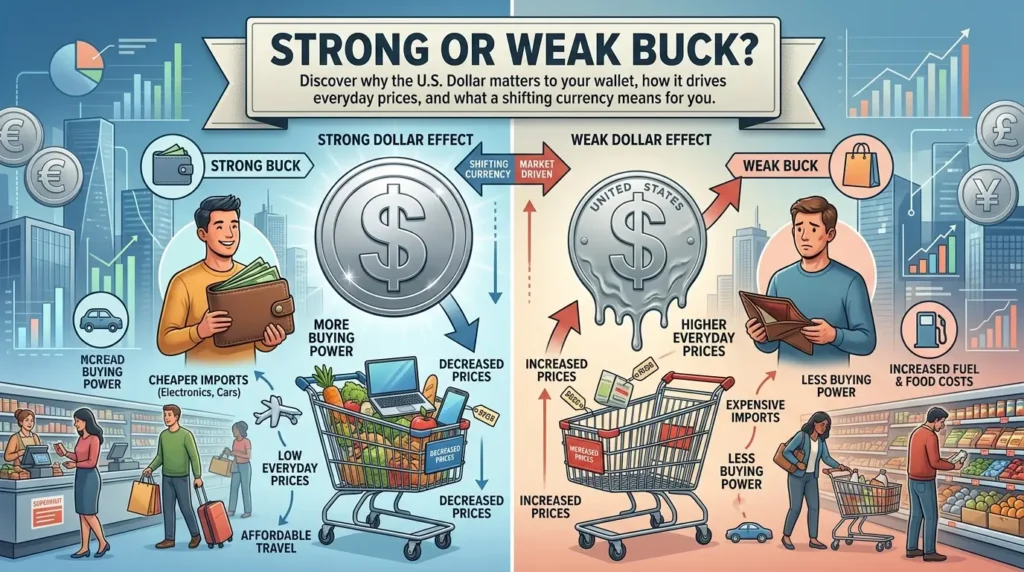
A falling dollar works in reverse. Each dollar buys less foreign currency, so importers pay more, and some of that cost reaches domestic prices.
Rising Costs at the Grocery Store
Nearly all the coffee Americans drink grows abroad. So do bananas, cocoa, olive oil and a large share of winter produce. When the dollar weakens, importers pay more for those items, and grocery bills eventually reflect it.
The link stays modest. Commodity costs make up only part of a shelf price, and labor, packaging, refrigeration and trucking cover the rest. The food at home index rose 2.2% over the 12 months ending in August, a slower pace than overall inflation rates, even after the dollar’s 2025 slide. Weather, tariffs and local wages move food prices too. A weak dollar would add to that mix, but it would arrive months after the exchange rate moves, which makes it hard to blame for any single trip to the store.
The Energy Effect: Gas and Oil Prices
Oil trades in dollars worldwide. A weaker dollar makes crude cheaper for buyers who hold euros or yen, which can lift demand and push the dollar price up. A stronger dollar can do the opposite. Economists call the relationship loose, because supply shocks often overwhelm it.
This year shows the point. The dollar has strengthened, yet gas prices set records for the season. The national average reached $4.41 on Oct. 1, and the September average of $4.33 beat the previous September record of $3.83 set in 2023. AAA cited crude averaging about $100 per barrel in mid-September amid continued volatility in the Strait of Hormuz. Import fuel prices rose 26.8% over the 12 months ending in August.
The chain from crude oil to your wallet runs like this. Crude prices set the cost of a refinery’s raw material. Refiners sell gasoline and diesel wholesale. Station owners add delivery and margin, and gas station pumps show the result. Drivers in California, where the average topped $6.40, feel the squeeze hardest. Diesel fuels trucks and trains, so energy costs spread into the price of almost everything on a shelf. That path explains much of today’s cost of living pressure, and the dollar appears to play a minor part.
The Hidden Risk: The Impact on American Jobs and Savings
A strong dollar helps shoppers and squeezes sellers. American exporters price goods in dollars or compete with foreign rivals. When the dollar rises, their products cost more abroad, and buyers may switch to cheaper suppliers.
That pressure reaches domestic manufacturing first: farm equipment, machinery, chemicals and aircraft. Firms facing weaker overseas orders may trim hours, delay hiring or cut investment. Employment rates in export-heavy regions can feel it, though economists disagree on the size of the effect, and it builds slowly. No single exchange-rate move reliably predicts layoffs. Weak overseas demand, tariffs abroad and the strength of the domestic economy can matter as much as the currency.
Large companies feel a second effect. S&P Dow Jones Indices found that 47.8% of S&P 500 sales came from outside the United States in 2014, and the share stood near 43% in 2018, with technology the most exposed sector. Those figures are dated, but the pattern holds. A multinational that earns euros and reports in dollars sees lower corporate earnings when the dollar rises, because those euros convert into fewer dollars. Aircraft makers such as Boeing sell mostly in dollars, so a strong dollar can hurt them through customers’ costs and foreign competition, not through conversion.
Your savings feel the dollar through three channels:
- Retirement accounts. A weaker dollar raises the dollar value of foreign stocks in an international fund. A stronger dollar trims it.
- Interest rates. The Fed raised rates to fight inflation, and higher rates generally lift savings yields while raising borrowing costs on cards, auto loans and mortgages. The median Fed projection points to one more quarter-point hike in 2026.
- Stock earnings. Multinational profits sit inside most index funds, so currency swings reach 401(k) balances through corporate results.
The Fed sits at the center of the story. It sets the short-term rate, and higher rates tend to lift the dollar. Learn how it works in How the Federal Reserve Works, and see how rate moves reach your debt in Why Mortgage Rates Stay High.
Conclusion: What Should Consumers Do?
The dollar is not a switch that turns prices up or down. In the consumer wallet, it works as one line among many. It is one input beside oil, tariffs, wages, shipping and weather. Today it is rising while energy costs also rise, and the energy shock is winning the fight for your budget.
Some general points can sharpen financial planning. This is education, not personal financial advice.
- Big imported purchases. Electronics, appliances and cars from abroad carry currency costs in their price. A strong dollar can help, but retailers adjust slowly, so smart shopping means comparing prices over weeks instead of chasing one week’s exchange rate. Our guide on what inflation is and how it is measured explains why sticker prices lag.
- Travel. Check the current exchange rates before you book, and compare what a card charges for foreign transactions. A favorable rate helps, but nobody forecasts currencies reliably, so waiting for a better one can backfire. Compare card quotes in dollars and in local currency before you pay.
- Budgeting. Build room for gas and groceries, since energy is driving the largest swings in your cost of living right now. Our explainer on how oil prices reach the gas pump shows what to watch.
- Long-term savings. Keep currency in perspective. Retirement portfolios rarely hinge on one exchange rate, and diversification across assets and regions spreads the risk.
Several signals matter in the weeks ahead. Watch the dollar index, the Fed’s next moves, new import price and CPI reports from the Bureau of Labor Statistics, and crude oil prices. If the Strait of Hormuz calms, fuel costs could ease even with a strong dollar. If the Fed keeps raising rates, the dollar may rise further, which would help importers and shoppers but pressure exporters.
Strong or weak, the currency matters because it connects your wallet to the world economy. A shopper in Ohio, a retiree in Arizona and a small-business owner in Texas all feel it at different times and through different doors. Tracking a few economic trends will make your budgeting decisions better informed and protect your financial health against surprises. Data in this article is current as of Oct. 8, 2026.