The average American now pays about $2,240 a year for full-coverage car insurance, according to mid-2026 data from Insurify. That figure sits on top of two of the steepest annual increases American drivers have ever seen: premiums rose roughly 24% in 2023 and another 22% in 2024, the fastest pace since the 1970s.
Then, oddly, prices fell. The average premium dropped about 6% to 9% in 2025. In 2026, they’ve started climbing again, but only by about 1% nationally, and not everywhere. Twenty-seven states saw rates rise in the first half of 2026; the rest held steady or fell.
That back-and-forth is the real story. Car insurance in America isn’t expensive for one reason, and it isn’t getting more expensive at the same pace in every state. Here’s what’s actually driving the cost, and why your own bill depends heavily on where you live.
What’s Actually Driving the Cost Up
Four forces show up in nearly every analysis of rising premiums.
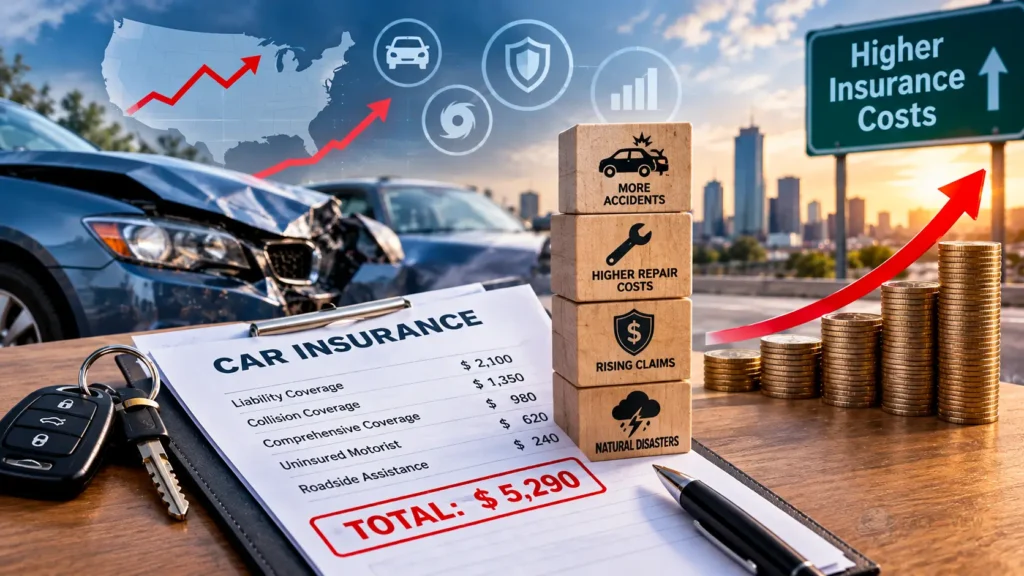
Vehicles got more expensive to fix. New cars now pack in cameras, radar sensors, and driver-assist systems that double as safety features and expensive-to-replace hardware. The Bureau of Labor Statistics recorded motor vehicle repair prices up nearly 13% year-over-year in mid-2023, and repair cost inflation has stayed elevated since, still running around 10% year-over-year as of late 2025 according to Swiss Re.
Vehicles got more expensive to replace, too. The average new vehicle price rose about 19% between 2020 and 2022, according to industry data cited by multiple insurers, before cooling to roughly 4% growth over the following two years. Insurers price that risk into every physical damage claim.
Claims got costlier to settle. Data from LexisNexis shows total claims costs climbed 35% for liability claims and 40% for collision claims since 2019, driven by a mix of more severe accidents, higher medical costs, and a greater share of claims involving an attorney.
Litigation costs kept rising faster than general inflation, a pattern the industry calls social inflation. Bankrate’s chief financial analyst Greg McBride has pointed out that litigation costs keep climbing even in years when broader economic inflation cools, since they’re driven by legal and social trends rather than supply and demand.
None of this is unique to car insurance. Home insurance costs have risen for overlapping reasons, and the two track each other more closely than most drivers realize.
The Industry’s Own Boom-and-Bust Cycle
Here’s the part most coverage skips: insurers didn’t just react to rising costs. For a few years, they badly underpriced them, then spent two years making up the difference.
In 2022, private passenger auto insurers as a group lost money. The industry’s combined ratio, the share of every premium dollar paid out in claims and expenses, hit roughly 112, meaning insurers paid out $1.12 for every dollar they collected. That’s an underwriting loss, not a rounding error.
Regulators in most states only let insurers raise rates with some delay and review, so insurers spent 2023 and 2024 pushing through the steep increases needed to catch up, the same years drivers felt the sharpest pain. It worked. By 2025, the private auto combined ratio had fallen to the high 80s, and AM Best called it the industry’s best underwriting result in a decade.
That profitability is exactly why premiums fell in 2025. Flush with profit, insurers competed harder for new customers and cut rates in many states.
It’s also why the relief didn’t last. Repair and medical cost inflation never stopped. Once insurers finished catching up and pricing stabilized, those underlying costs started pushing rates back up again in 2026, just more gradually than the 2023–2024 shock.
Why Your State Matters as Much as the National Average
National averages hide enormous variation, and the data does not support the idea that premiums are climbing everywhere at once.
Washington, D.C. has the highest average full-coverage premium in the country, around $3,880 a year as of mid-2026, nearly double the national figure. Regulators there point to a collision claim frequency roughly double the national average and a vehicle theft rate about four times the median state, according to NAIC and National Insurance Crime Bureau data.
Some states moved sharply in one direction. New Jersey’s average premium rose about 20% heading into 2026. Earlier in the national rate spike, S&P data showed Nevada premiums up 38% between January 2023 and February 2024, while North Carolina drivers saw just a 5.5% increase over that same stretch.
Heading into the back half of 2026, Insurify projects premiums will fall in roughly 15 to 18 states, including Louisiana, Texas, Oklahoma, and Colorado, even as 32 states see increases. That split matters: a national average obscures a market that is currently moving in two directions at once.
Part of the reason is regulatory. States run their own insurance systems, and two structural choices shape how fast premiums can move:
- Prior-approval versus file-and-use states. In prior-approval states like California, insurers must get regulators to sign off on rate changes before using them, which can slow both increases and decreases. Other states let insurers file and use new rates with lighter review, which tends to let prices adjust faster in both directions.
- No-fault versus tort states. States like Florida, New York, and Michigan require drivers to carry personal injury protection and limit lawsuits over smaller injury claims. Most other states, including California, run a pure tort system, where an injured driver can sue the at-fault driver directly, a structure that tends to produce higher litigation costs and larger claim payouts.
Neither system is simply better or worse for drivers. Each trades off differently between predictability, lawsuit exposure, and how quickly rates reflect real costs.
Repair Costs: Fixing a Modern Car Costs More Than It Used To
The repair-cost story deserves its own look, because it’s less about inflation and more about what cars have become.
A bumper replacement today often means recalibrating a camera or radar sensor mounted behind it, a step that didn’t exist a decade ago. Windshield replacements frequently require resetting a driver-assist camera. Manufacturers increasingly design body panels as large, integrated units rather than smaller replaceable parts, so a repair that once meant swapping a bracket now sometimes means replacing an entire assembly.
Labor adds to the squeeze. The auto repair industry has faced a persistent shortage of certified technicians, and wages for the technicians available have risen accordingly. Rental car costs during repairs have climbed too, adding to what insurers pay out on a typical claim.
The effect compounds with accident severity. Insurers have reported that a growing share of collision claims, roughly a quarter in recent years, result in payouts exceeding the value of the underlying claim reserve, a sign that repair costs are consistently outrunning what insurers initially expect to pay.
Medical Costs and the Litigation Factor
The other major driver rarely gets explained clearly: a growing share of every premium dollar goes toward bodily injury claims, not vehicle damage.
When a crash causes injury, insurers pay for medical treatment, lost wages, and pain and suffering, costs that rise with the broader health care system. As treatment costs climb nationally, so does the average injury claim.
Layered on top is what the industry calls social inflation: a documented rise in claims that involve an attorney, larger jury verdicts in the cases that go to trial, and the growth of litigation funding, where outside investors finance lawsuits in exchange for a share of the settlement. Insurers argue this pushes up the cost of even routine claims, since the threat of a larger court award shapes settlement negotiations long before any case reaches trial.
This is a genuine point of disagreement. Insurers and tort-reform advocates argue litigation costs are a major, avoidable driver of premiums. Trial attorneys and consumer advocates generally counter that larger verdicts reflect insurers underpaying legitimate claims for years, and that genuinely severe injuries deserve the compensation a jury awards. Both positions appear regularly in state regulatory hearings, and the data doesn’t fully settle the dispute either way.
How This Hits Household Budgets
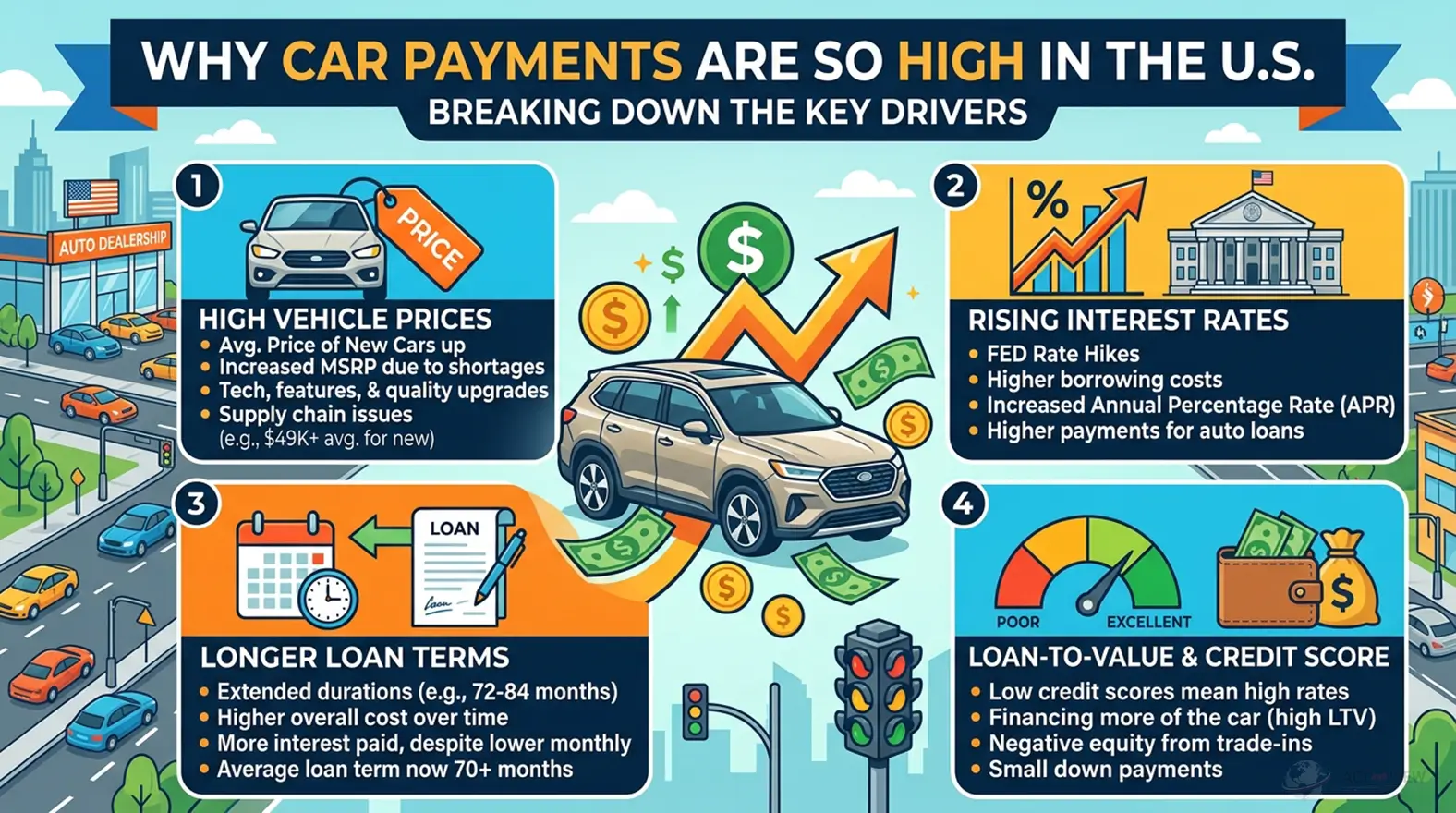
For a household already managing higher car payments and a stretched budget, a几 insurance bill that’s 20% to 40% higher than it was three years ago is not a small line item.
Car insurance is also mandatory in nearly every state, unlike many other discretionary expenses households can cut when money is tight. That makes it a particularly visible and resented cost, even in states where the recent increases have been modest.
The squeeze compounds for drivers already dealing with the broader gap between falling inflation and financial strain. A driver with an imperfect credit history, a recent claim, or coverage in a high-theft ZIP code can see a bill well above even their state’s rising average.
What Could Bring Rates Down, and What Could Push Them Back Up
If 2025 is any guide, continued insurer profitability could extend some relief into 2027, particularly in states where claims costs stay contained.
But the underlying pressures, repair-cost inflation, medical-cost inflation, and litigation costs, haven’t reversed. If they keep rising faster than general inflation, insurers will eventually need to raise rates again to stay profitable, regardless of how competitive the market feels in any given year.
A few long-term factors could shift the picture further out. Advanced driver-assist systems may gradually reduce how often accidents happen, even as they raise the cost of each repair when one does occur. Some regulators and lawmakers have also pushed tort reform or stricter litigation-funding disclosure rules in response to social inflation, though these remain contested and vary significantly by state.
What to Watch
A few sources will show where rates are actually heading, state by state, well before it shows up in a renewal notice:
- State insurance department rate filings, which show approved increases or decreases before they take effect.
- NAIC’s annual Auto Insurance Database Report, the closest thing to an authoritative national and state-by-state benchmark.
- AM Best and Moody’s underwriting reports, which track whether insurers are still profitable enough to keep cutting rates or need to raise them again.
- Quarterly rate trackers from Insurify and S&P Global, which pick up shifts faster than annual government data.
The Bottom Line
Car insurance got dramatically more expensive in 2023 and 2024 because insurers had underpriced real cost increases, in repairs, vehicle prices, medical care, and litigation, and needed steep rate hikes to recover. That catch-up phase mostly ended by 2025, which is why premiums briefly fell.
What happens next depends on whether repair and medical cost inflation stays ahead of or behind general inflation, a balance that’s shifted twice in the past three years and could shift again. It also depends heavily on which state a driver lives in, since state-level regulation and legal systems shape how fast those underlying costs translate into an actual bill.
The honest answer to “why is my car insurance so expensive” is rarely one factor. It’s usually some combination of a more expensive vehicle to fix, a state with slower or faster rate regulation, and an industry still working through a cost cycle that hasn’t fully settled.
Sources:
- Insurify — Car Insurance Cost Report, Mid-2026
- S&P Global Market Intelligence — state-level auto insurance rate data (via CNN reporting)
- LexisNexis Risk Solutions — 2023 U.S. Auto Insurance Trends Report
- AM Best — U.S. P/C Industry Underwriting Report, 2025 Results
- Moody’s — P&C Insurer Earnings Analysis, 2025
- Swiss Re Institute — 2026 P&C Outlook
- National Association of Insurance Commissioners (NAIC) — Auto Insurance Database Report
- National Insurance Crime Bureau — vehicle theft data
- U.S. Bureau of Labor Statistics — Consumer Price Index, motor vehicle maintenance and repair