Ask most founders why their fundraising got harder, and they’ll talk about their pitch, their traction, their market timing. Ask the venture capitalists writing the checks, and a very different explanation usually surfaces first: the price of money itself.
Tech startup funding has always looked like a story about visionary founders and bold bets on the future. Increasingly, it’s also a story about interest rates — a variable that sits quietly behind nearly every valuation spreadsheet, every term sheet negotiation, and every decision about whether a startup gets funded at all. When the U.S. Federal Reserve moves its benchmark rate, the effects don’t stop at mortgages and credit cards. They travel directly into Silicon Valley, reshaping which startups get funded, how much they’re worth on paper, and how long they have before running out of cash.
This is the mechanism behind that connection — and why it matters more today than it has in a generation.
Why Interest Rates Matter for Tech Startups
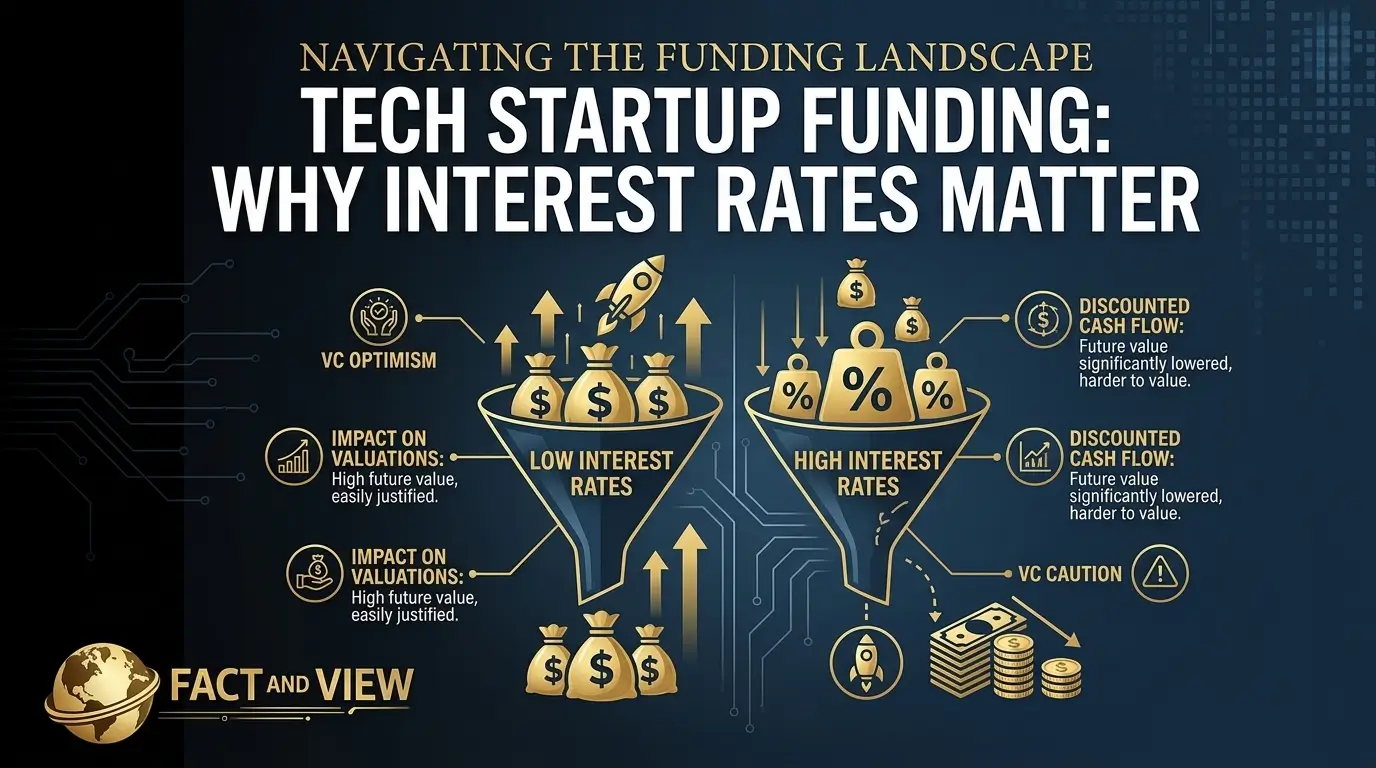
Startups are, in financial terms, bets on cash flow that doesn’t exist yet. A profitable, established company generates real earnings today. A pre-revenue or early-revenue startup asks investors to believe in earnings that might materialize five, seven, or ten years from now — and that time gap is exactly where interest rates do their damage.
Fact: Every startup valuation, whether built through a formal discounted cash flow model or a simpler comparable-multiples approach, relies on a discount rate to translate future cash flows into a present-day dollar figure. Bain & Company’s analysis found that a 200-basis-point increase in discount rates can reduce justified growth equity valuations by more than 30%, even when the underlying revenue growth assumptions remain completely unchanged.
Fact: The U.S. 10-year Treasury yield — a foundational input into discount rate calculations across the entire economy — rose from an average of 1.45% in 2021 to 2.95% in 2022, then stabilized in the 4%–5% range through the following several years, according to Federal Reserve Economic Data (FRED). That single shift reset the mathematics of valuation for every long-duration venture cash flow in the market.
The View: The intuitive version of this concept is simple: money promised further in the future is worth less when the “safe” alternative — a government bond — pays more. What makes this especially brutal for startups specifically is duration. A mature, profitable company generates meaningful cash flow within a year or two. A venture-backed startup often isn’t expected to generate serious profit for the better part of a decade. That gap between now and profitability is precisely where higher rates compound most severely, which is why tech startup funding reacts to Fed policy more violently than almost any other corner of the investment world.
Related reading: What the Federal Reserve Really Does — the full mechanics of how the Fed sets rates and why they ripple through every corner of the economy.
How Higher Rates Affect Venture Capital
Interest rates don’t just change how startups are valued — they change where venture capital itself decides to go in the first place.
Fact: By offering more attractive yields, higher interest rates make alternative investments such as government and corporate bonds more competitive with venture capital, directly affecting how institutional investors — pension funds, endowments, sovereign wealth funds — allocate capital across asset classes. When a low-risk bond pays a meaningfully higher yield, the risk premium venture capital must offer to attract the same dollar grows correspondingly larger.
Fact: Sovereign wealth funds and large institutional allocators responded to the higher-rate environment of the early 2020s by redirecting capital away from early-stage funds and toward late-stage rounds, secondary transactions, and continuation vehicles — structures generally seen as lower-risk than fresh early-stage bets. Target net internal rates of return for venture funds reset from roughly 30% expectations down to the low twenties, with tighter loss tolerance across the board.
Fact: The exit environment — IPOs and acquisitions, the mechanism through which venture investors actually realize returns — is also directly rate-sensitive. KPMG Private Enterprise’s global head, Conor Moore, described how rate-driven market uncertainty in one recent quarter was “throwing a bit of a wrench into things, especially on the IPO front,” after earlier expectations for a steady stream of public listings failed to materialize.
The View: This is the part of the interest rate story that rarely makes it into startup-focused media coverage: venture capital doesn’t exist in a sealed ecosystem. It competes for the same pool of institutional capital as bonds, public equities, private credit, and real estate. When rates rise, venture capital isn’t just facing higher discount rates on its own portfolio — it’s simultaneously facing tougher competition for the capital it needs to keep investing in the first place. That’s a double bind that pure equity-market analysis often misses.
Related reading: Where Smart Money Is Moving Right Now — how institutional investors are currently reallocating capital across asset classes, venture capital included.
Why Startup Funding Slows During Tight Monetary Policy
The historical data on this relationship isn’t subtle — it’s one of the clearest cause-and-effect patterns in modern startup finance.
Fact: Global venture capital funding peaked around $357 billion during the ultra-low-rate environment of the early 2020s, then fell to approximately $214 billion the following year — a roughly 40% year-over-year decline — as rising interest rates, inflation concerns, and tightening monetary policy took hold simultaneously, according to venture capital industry benchmarking data.
Fact: The slowdown wasn’t limited to total dollars invested. Deal counts, average round sizes, and time between funding rounds all contracted during the tightening period, as investors demanded clearer paths to profitability and longer runway assumptions before committing capital — a materially higher bar than during the preceding low-rate cycle.
Fact: Even during subsequent funding rebounds driven by enthusiasm for artificial intelligence, the underlying tightness has persisted in a specific, measurable way: seed-stage deal counts have fallen sharply year-over-year even as total seed dollars invested rose, because the increase has been driven entirely by a smaller number of unusually large rounds rather than broader-based investment activity.
The View: The mechanism connecting tight monetary policy to slower startup funding runs through investor psychology as much as pure math. Higher rates don’t just make the arithmetic of valuation less favorable — they raise the bar for what counts as an acceptable risk in the first place. In a zero-rate world, a venture investor has little reason not to bet on unproven, pre-revenue ideas, since the opportunity cost of that capital sitting elsewhere is negligible. In a 4%–5% rate world, that same capital has a credible, boring alternative, and unproven ideas suddenly have to clear a much higher bar to justify the risk.
The Federal Reserve’s Role in Startup Investment
The Federal Reserve doesn’t set startup valuations directly, and it has never mentioned venture capital in a policy statement — but its decisions are arguably the single most important external variable in the entire startup funding ecosystem.
Fact: The Fed’s benchmark federal funds rate directly influences the entire yield curve, including the Treasury yields that anchor discount rate calculations across every asset class. When the Fed raises or holds rates, that decision propagates within days into venture fund models, startup cap tables, and term sheet negotiations happening in conference rooms with no direct connection to the Fed whatsoever.
Fact: Beyond valuation math, Fed policy affects venture debt — an increasingly common financing tool that lets startups extend their operating runway between equity rounds without triggering a new valuation event. Venture debt interest rates typically move in tandem with the broader rate environment, priced as a floating benchmark rate (such as SOFR) plus a spread of roughly six to nine percentage points, meaning founders relying on this tool feel Fed policy changes directly and immediately in their monthly interest expense.
Fact: Market consensus forecasts, including those from major financial institutions, have repeatedly tied expectations for renewed startup funding momentum directly to anticipated Fed rate cuts — with analysts explicitly noting that easier monetary policy “should support valuations and improve exit conditions” for the venture ecosystem broadly.
The View: Founders who treat Fed policy as background noise irrelevant to their fundraising strategy are making a costly mistake. A rate-cutting cycle genuinely changes what’s fundable — the kinds of growth stories, timelines to profitability, and burn rates that investors will tolerate expand meaningfully when the cost of capital falls. Understanding where the Fed is in its cycle isn’t optional macro trivia for a founder planning a raise. It’s directly relevant to timing, valuation expectations, and which investors are likely to be aggressive versus defensive in the coming quarters.
Related reading: Fed Rate Hikes: Fighting Inflation or Slowing Growth? — the current debate inside the Fed over where rates go next, and what it signals for risk assets broadly.
Which Startups Are Most Vulnerable?
Rising rates don’t hit every startup equally. The damage concentrates predictably around a few specific characteristics.
Long-duration, pre-revenue startups absorb the most direct valuation damage, since their entire worth is built on cash flows furthest out on the timeline — precisely the cash flows that discount rate increases punish most severely.
Startups with short cash runway face a second, compounding problem: if they need to raise again soon and market conditions have tightened, they’re forced to either accept a lower valuation than their prior round (a “down round”) or turn to more expensive venture debt to buy time.
Non-AI startups in the current cycle face a uniquely difficult environment. Even as headline venture totals have hit record highs, funding to non-AI startups has actually declined — falling roughly 10% year-over-year in one recent measurement period — while capital reallocates almost entirely toward artificial intelligence.
Seed-stage companies broadly have seen deal counts fall sharply — by roughly 30% to 44% year-over-year across different markets in recent periods — even as total seed dollars invested increased, because a shrinking number of unusually large rounds are absorbing capital that would previously have been distributed across many smaller deals.
The View: The startups most exposed to rate-driven funding stress share a common trait: they’re asking investors to wait the longest for a return, with the least certainty about the destination. That’s always been true to some degree, but the current cycle has sharpened it into something closer to a hard filter than a soft preference.
How AI Startups Are Adapting
Artificial intelligence startups have, so far, proven to be the clearest exception to the broader rate-driven funding slowdown — though not for the reasons casual observers often assume.
Fact: AI’s share of global venture capital more than doubled from roughly 30% in 2022 to 61% in 2025, before reaching approximately 80% to 86% of total U.S. venture dollars in the first half of one recent year, according to Crunchbase data. A handful of frontier AI labs absorbed the majority of that capital in a small number of enormous individual rounds.
Fact: Seed-stage AI startups have commanded valuations roughly 42% higher than non-AI peers, reflecting investor conviction that AI represents a genuine platform shift large enough to justify premium pricing even in a higher-rate environment.
Fact: Despite the funding abundance at the top of the AI market, investors are applying sharper scrutiny than during the earlier AI hype cycle. Venture capitalists broadly expect the market to weed out young AI startups carrying thin margins or inefficient capital use, even as headline totals for the sector remain at record levels.
The View: AI startups aren’t immune to interest-rate-driven valuation discipline — they’re simply benefiting from a competing force strong enough to override it: genuine conviction among investors that they’re witnessing a platform-level technological shift, the kind of narrative that has historically justified premium valuations even against a difficult rate backdrop. That’s a real distinction, not a contradiction of the broader interest rate story — but it also means the AI funding boom is concentrated in a way that leaves most other startups, AI-adjacent or not, competing for a shrinking share of available capital.
Related reading: Is It Too Late to Invest in AI Stocks? — the public-market counterpart to this private funding story, including where the AI infrastructure buildout is concentrated.
What Investors and Founders Should Watch Next
For anyone navigating tech startup funding — whether writing checks or trying to raise them — a handful of signals offer the clearest forward-looking read on where the environment is heading.
- Fed rate decisions and forward guidance, since even the expectation of future cuts tends to move venture sentiment before any actual policy change takes effect.
- 10-year Treasury yield trends, the direct input into most formal startup valuation models, available in real time through FRED.
- The gap between AI and non-AI funding totals, a useful gauge of how concentrated — and therefore how fragile — the current funding environment actually is beneath the reassuring headline numbers.
- Venture debt pricing and volume, since rising reliance on debt financing over fresh equity rounds often signals that founders are trying to avoid down-round valuations in a tightening market.
- IPO and M&A exit activity, the ultimate release valve for venture capital — a healthy exit market allows funds to return capital to their own investors and redeploy it into new startup investments.
The Bottom Line
Tech startup funding has never operated independently of the broader cost of capital, but the connection has rarely been as visible or as consequential as it is now. A 200-basis-point shift in discount rates can erase 30% of a startup’s justified valuation without a single change to its actual business. Fed policy shifts ripple into venture fund allocation decisions, term sheet negotiations, and exit timing within weeks, not years.
For founders, the practical takeaway is to treat interest rate trends as material information for fundraising strategy, not background noise — timing a raise, setting valuation expectations, and choosing between equity and venture debt all shift meaningfully depending on where the rate cycle stands. For investors, the current environment rewards a sharper distinction between startups with genuine near-term revenue durability and those asking for a longer leap of faith, a distinction that matters far more when the cost of waiting has a real, rising price attached to it.
Sources: Startup Stash — Venture Capital and Technology in 2026 · International Banker — Record Funding Levels Mask Venture Capital’s Bifurcated Landscape · ValAdvisor — Startup Valuation in 2026 · SeedScope — Startup Funding Trends in 2026 · Growth Equity Interview Guide — Venture Capital Statistics · Bhagat — Why Do Venture Capitalists Use Such High Discount Rates? (JRF) · Qubit Capital — AI Startup Funding Trends 2026 · CRV — AI Startup Funding: What Investors Look For in 2026 · Crunchbase News — Global Startup Investment Hit Record $510B in H1 2026 · Crunchbase News — Q1 2026 Shatters Venture Funding Records · Tech Insider — Q1 2026 Venture Capital Hits $297B, AI Captures 81% · TechTimes — European Startup Funding Hits Six-Year Deal-Count Low · VentureDebtHub — Venture Debt Interest Rates 2026 · FRED — 10-Year Treasury Constant Maturity Rate
© Fact and View. For informational purposes only.