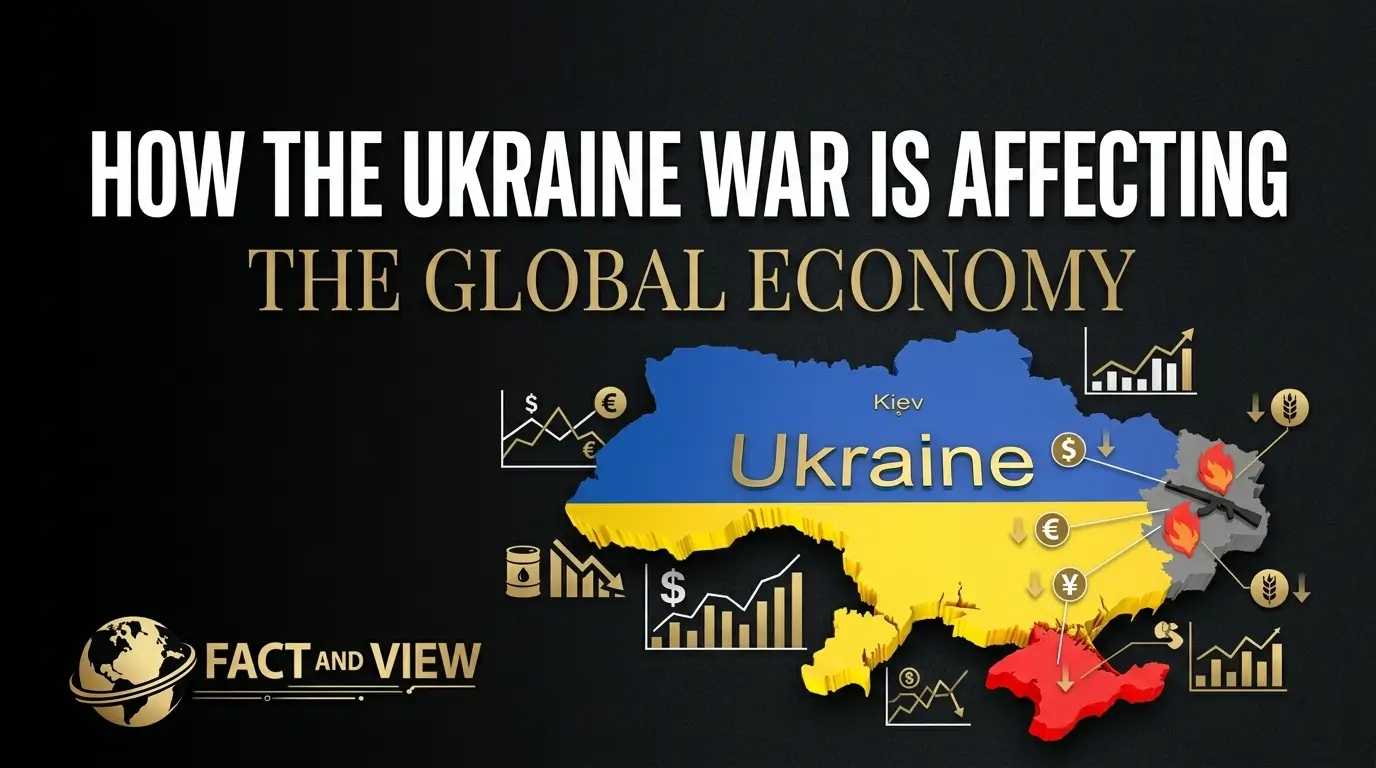
Russia’s war against Ukraine entered its fifth year in February 2026. Four years of full-scale conflict have cost Ukraine $172 million per day — every single day of 2025. Its economy sits roughly 20% below pre-war GDP levels. Its reconstruction bill has just been estimated at $588 billion — nearly three times the country’s entire annual economic output. And yet Ukraine’s military factories are now exporting weapons to Europe.
This is not a frozen conflict. It is an active economic shock that is reshaping energy markets, European defense budgets, global food supply chains, and the fiscal architecture of the Western alliance. The war’s economic reverberations reach every American household and every business in the global supply chain — through energy prices, defense spending, interest rates, and the restructuring of trade routes that seemed permanent three years ago.
Here is the full picture — facts separated from analysis, with precise implications for your finances and your business in 2026.
The Big Picture: Four Years of Compounding Economic Damage
The economic story of this war operates on three distinct levels simultaneously: Ukraine’s internal destruction, the cost to supporting Western nations, and the structural reshaping of global markets.
The longer the conflict continues, the more economists worry that geopolitical instability, elevated energy prices, and rising government debt could eventually trigger wider economic consequences far beyond Eastern Europe. Read our full analysis on whether the U.S. economy could face a major slowdown or financial crisis in 2026.
All three are accelerating in 2026 — not stabilizing.
Fact: As of December 31, 2025, the total cost of reconstruction and recovery in Ukraine is estimated at almost $588 billion over the next decade — nearly three times Ukraine’s estimated nominal GDP for 2025, per the joint Rapid Damage and Needs Assessment (RDNA5) released by the World Bank Group, the European Commission, the United Nations, and the Government of Ukraine on February 23, 2026.
Fact: The war cost Ukraine an average of $172 million per day in 2025 — up sharply from $140 million per day in 2024, a 23% increase. Ukraine requires approximately $5 billion per month to cover military salaries, ammunition, logistics, and advanced defense technologies.
Fact: Ukraine’s real GDP in 2025 is estimated to be about 20% below pre-war levels, per the IMF’s February 2026 Country Report. In Q1 2026, Ukraine’s real GDP fell 0.5% year-on-year — its first contraction since 2024 — driven directly by Russian attacks on energy infrastructure.
Fact: The EU and its 27 member states have made available over $223 billion in financial, military, humanitarian, and refugee assistance since the start of the war, as of April 22, 2026, per the European External Action Service.
The View: The war’s economic cost is not linear. It is compounding. Each month of conflict adds to the reconstruction bill, extends the fiscal strain on Western donors, and deepens the structural damage to Ukraine’s productive capacity. The $588 billion reconstruction estimate is not a fixed ceiling — it is a floor. Every additional week of bombing adds to it. And the international community is being asked to finance a recovery effort while simultaneously funding an ongoing military campaign costing $5 billion per month.
Deep Dive: Five Economic Shockwaves Hitting the World Right Now
1. Ukraine’s Economy: Surviving, Not Recovering
Ukraine’s economy has proved more resilient than most analysts predicted in February 2022. But resilience is not recovery — and the gap between the two matters enormously for the global capital flows being directed toward Kyiv.
Fact: IMF growth projections for Ukraine put real GDP growth at 2% for 2025 and 4.5% for 2026. Inflation is projected at 12.6% for 2025 and 7.6% for 2026. Ukraine’s unemployment rate is estimated at 10.2% for 2026, and the IMF puts Ukraine’s financing gap for 2026–2029 at $65 billion.
What’s keeping the economy alive:
- Foreign aid dependency: In 2025, foreign assistance covered 56% of Ukraine’s budget’s additional needs, down from 73% in 2024. All domestic budget revenue goes to defense, which consumes around half the national budget. Every civil function — teachers, doctors, pensions — is funded by international transfers.
- ERA programme: Ukraine received $5.1 billion in 2026 under the ERA programme, financed from proceeds generated by frozen Russian assets.
- EU loan lifeline: In 2026, financing from the European Union under a large €90 billion loan will be crucial for Ukraine.
- Defense exports: In late 2025, Ukraine tentatively opened arms sales abroad. Ten export centers are planned across Europe by end of 2026, with drone production lines already operating in Germany. The export potential for 2026 is estimated at “several billion dollars.”
The View: The emergence of Ukraine as a defense exporter is one of the war’s most economically significant developments — and one of its most underreported. A country that spent 2022 begging for weapons is now selling battlefield-tested drone technology to NATO members. This is not a rounding error in Ukraine’s trade balance. It is the beginning of a defense industrial ecosystem that will shape European security economics for decades.
2. European Energy: Permanently Restructured
The energy disruption from this war is not a temporary crisis. It is a completed structural transformation of the European energy market — one that carries lasting costs for European households and competitiveness.
Fact: Since 2020, the European economy has experienced multiple shocks: Brexit, the pandemic, and a sharp rise in energy prices following the start of the war in Ukraine. The eurozone grew by just 0.9% year-on-year in 2024 and is projected to grow 1.2% in 2025. Germany — Europe’s largest economy — contracted 0.2% in 2024 and is forecast to grow just 1.2% in 2026.
The war’s energy legacy operates through four channels:
- LNG pivot: Europe replaced Russian pipeline gas with liquefied natural gas from the U.S., Qatar, and Norway — at significantly higher cost, with global LNG prices elevated by the simultaneous Middle East conflict
- Electricity grid damage: The World Bank RDNA5 report highlights a 21% increase in damaged or destroyed energy assets over the past year, directly linked to intensified Russian strikes during winter. Ukraine’s energy system — once a net exporter — now requires $67.78 billion in recovery investment for the energy sector alone
- Industrial cost pressure: Germany’s automotive and chemical sectors — built on cheap Russian gas — have permanently lost their energy cost advantage; factory closures in energy-intensive industries have accelerated
- Defense energy demand: Increased European defense production is itself energy-intensive, adding pressure on electricity grids already strained by decarbonization targets
The View: Europe’s energy transformation is irreversible. No diplomatic resolution restores Russian gas flows at pre-war prices or volumes. European industry has already begun restructuring around permanently higher energy costs — which means either higher prices for European exports, lower margins, or offshoring of energy-intensive production. For American businesses competing with European manufacturers, this is a subtle but real competitive advantage. For consumers who buy European goods, it’s an inflation driver that has nothing to do with the Fed.
3. Global Food Supply: The Grain Corridor Legacy
Ukraine and Russia together produced roughly 30% of the world’s wheat exports before the war. The disruption of Black Sea trade routes, the mining of Ukrainian agricultural land, and the weaponization of grain access created the first acute global food crisis since 2011.
Fact: Price shocks from the war have had worldwide impact, especially on poor households for whom food and fuel constitute a higher proportion of expenses. The IMF identified the conflict as creating “an adverse shock to both inflation and activity” across multiple economies simultaneously.
In 2026, the direct food market disruption has moderated — alternative sourcing from Australia, Canada, and South America partially filled the gap — but the structural legacy remains:
- Land mine contamination affects an estimated 174,000 square kilometers of Ukrainian agricultural land, with full demining expected to take decades
- Agricultural export infrastructure along the Danube has partially replaced Black Sea routes but at higher logistics cost
- Ukrainian grain now primarily moves through European land corridors rather than sea routes, adding $15–$25 per tonne in transport costs that ultimately reach consumers
4. The Western Defense Spending Surge: Economic Stimulus or Fiscal Strain?
The war has triggered the largest European defense spending increase since the Cold War. That spending is both an economic stimulus and a fiscal pressure — and the distinction matters for investors.
Fact: More than 30% of Ukraine’s GDP is currently allocated to military spending. By comparison, NATO members in peacetime are expected to spend at least 2% of GDP on defense.
Fact: The U.S.-NATO PURL agreement from July 2025 provides a mechanism for European countries to purchase U.S. equipment to send to Ukraine. Subsequent commitments have added up to more than $4.8 billion, with Ukraine requesting $15 billion of equipment for 2026.
Fact: The EU and G7 partners agreed collectively to provide loans of $50 billion to support Ukraine’s budgetary, military, and reconstruction needs, financed by extraordinary revenues from immobilized Russian sovereign assets.
The defense investment surge has clear sector winners:
- Defense contractors: Rheinmetall, BAE Systems, Leonardo, and U.S. primes (RTX, LMT, NOC) are operating at multi-year production backlogs
- Ammunition manufacturers: 155mm artillery shell production in NATO countries has increased 5x since 2022 and remains the binding constraint on Ukrainian battlefield capability
- Drone technology: Ukraine’s war has demonstrated that low-cost drones can challenge conventional armor — accelerating defense procurement globally
- Critical minerals: Titanium (30% of global reserves in Ukraine), lithium, and rare earths in Ukrainian-controlled territory carry long-term reconstruction investment value
The View: European defense spending increases are structural, not temporary. Germany’s constitutional debt brake amendment, Poland’s 4% of GDP defense target, and the UK’s commitment to 2.5% of GDP — all announced since 2022 — represent a multi-decade shift in European fiscal priorities. For defense sector investors, this is a generational demand cycle. For European taxpayers already facing energy cost increases and post-pandemic fiscal consolidation, it is a direct competitor for social spending budgets.
5. The Reconstruction Opportunity: $588 Billion in Future Investment
The destruction is unprecedented in modern European history. So is the reconstruction opportunity.
Fact: Direct physical damage alone has surged past $195 billion. Housing, transport, and energy infrastructure bear the brunt, with 14% of all housing in Ukraine damaged or destroyed, displacing over three million households.
Fact: International institutions are laying the groundwork to ensure reconstruction modernizes rather than merely replaces. The EU Commissioner for Enlargement reaffirmed Brussels’ commitment: “we will rebuild Ukraine as a strong, modern EU country.”
Where the $588 billion goes — and who benefits:
- Energy infrastructure: $67.78 billion in electricity grid, gas storage, and renewable capacity — targeting 75% private sector funding
- Housing: 14% of national housing stock requires repair or replacement
- Transport: Roads, rail, ports, and bridges connecting western Ukraine to EU corridors
- Digital infrastructure: Ukraine’s wartime digitization — government apps, digital ID, drone logistics — creates a technology-forward reconstruction template
- Agriculture: Demining, irrigation, and rural logistics restoration
Risks & Opportunities: Three Scenarios
Base Case (~45% probability): Frozen Conflict by 2027, Slow Reconstruction
The war transitions to a frozen conflict by mid-to-late 2027. Active frontlines stabilize. International reconstruction financing begins flowing at scale — led by the €90 billion EU loan and ERA programme proceeds. Ukraine’s GDP growth accelerates toward 4–5% annually from 2027 as reconstruction multipliers kick in.
What this means for you: Construction materials, engineering services, and EU-connected logistics companies benefit from reconstruction contracts. The energy market stabilizes — but European gas prices remain structurally above pre-war levels permanently.
Upside Scenario (~25% probability): Peace Agreement, Reconstruction Boom
A negotiated settlement in 2026–2027 unlocks private sector investment at scale. The $588 billion reconstruction becomes a $700+ billion investment cycle as confidence returns. EU accession path accelerates. Ukraine’s digital and defense industries become globally significant export sectors.
What this means for you: European equity markets re-rate upward on geopolitical risk relief. Construction, energy, and infrastructure companies in the EU and UK capture reconstruction contract flows. Defense stocks continue compounding on the structural NATO spending increase.
Downside Scenario (~30% probability): Escalation and Aid Fatigue
Western political support fractures. The U.S. significantly reduces aid. European defense spending cannot compensate. Russian forces gain territorial momentum. Energy infrastructure damage intensifies. Ukraine’s economy contracts 3–5%, requiring emergency IMF intervention beyond the existing $65 billion financing gap.
What this means for you: European energy prices spike again. Global food markets face renewed disruption. Defense stocks remain elevated but geopolitical risk premium hits all European equities. Gold and safe-haven assets benefit. The structural damage to global supply chain confidence compounds.
The Bottom Line
The Ukraine war’s economic impact in 2026 is no longer primarily about commodity price spikes. Those were 2022’s story. Today, the war is reshaping three things that matter to every investor, business, and household in the global economy:
1. European fiscal architecture. Defense spending has permanently crowded into budgets previously allocated to social programs and fiscal consolidation. That means higher European debt, structural upward pressure on EU bond yields, and reduced competitiveness in energy-intensive industries.
2. Global defense investment. The war has demonstrated, at enormous human cost, that drone warfare, AI-enabled targeting, and logistics technology are decisive. That lesson is now driving defense procurement decisions in 40+ countries simultaneously — creating a multi-decade demand cycle for defense technology companies.
3. The reconstruction trade. $588 billion in verified reconstruction needs, backed by multilateral financing guarantees and EU accession incentives, represents the largest infrastructure investment opportunity in Europe since the Marshall Plan. The private sector — construction, energy, technology, logistics — is being explicitly targeted to provide 75% of the financing in key sectors.
Practical guidance:
- For investors: Defense sector allocations remain well-supported by structural demand. European infrastructure and construction companies with Ukrainian exposure offer asymmetric upside if a settlement occurs. Track reconstruction contract flows via the World Bank Ukraine Recovery Platform.
- For businesses: If your supply chain touches European energy-intensive manufacturing, model permanently higher input costs. Alternative sourcing from non-European suppliers — built during the 2022–2023 disruption — should be maintained, not wound down.
- For consumers: The energy price legacy of this war is baked into European manufacturing costs and therefore into the price of imported goods from Europe. That structural inflation layer doesn’t resolve with a ceasefire.
The war is not over. Its economic consequences have already permanently arrived.
FAQ
How much has the Ukraine war cost the global economy overall?
Quantifying the full global cost is methodologically complex, but several anchors exist. Federal Reserve research estimated the initial geopolitical risk surge produced a drag on world GDP of around 1.7% cumulatively through 2022, while boosting global inflation by 1.3 percentage points. Ukraine’s own economic output remains 20% below pre-war levels after four years. Western nations have committed over $267 billion in total aid (Kiel Institute tracking through 2025), and the EU alone has provided over $223 billion. The reconstruction bill for Ukraine alone now stands at $588 billion. The cumulative global cost — including energy market restructuring, food price inflation, defense spending increases, and refugee-related costs — exceeds $1.5 trillion by most comprehensive estimates.
How has the Ukraine war affected energy prices and food prices in the US?
The direct U.S. impact was most acute in 2022–2023, when the war’s disruption of global LNG markets pushed U.S. natural gas prices to multi-year highs and global food commodity prices surged. By 2026, those acute effects have moderated but structural legacies remain. The U.S. became Europe’s largest LNG supplier during the war — a trade relationship that persists and keeps U.S. gas prices at levels above the 2019–2021 average. Food commodity prices are higher than pre-war baselines due to persistent Ukrainian agricultural output disruption and land mine contamination affecting 174,000 square kilometers of farmland.
What does Ukraine’s reconstruction mean for investors?
It represents the largest verified infrastructure investment opportunity in Europe since the Marshall Plan. The total reconstruction cost is estimated at $588 billion over the next decade, backed by the World Bank, European Commission, and United Nations. Private sector investment is explicitly targeted to cover 75% of energy sector needs and significant portions of housing, transport, and digital infrastructure. The EU’s Ukraine Facility provides up to $54 billion through 2027 as a de-risking anchor for private capital. Track investment opportunities via the Ukraine Recovery Platform and the EBRD’s Ukraine country program.
How has the war changed European defense spending?
Dramatically and permanently. Multiple European NATO members have committed to defense spending above 2% of GDP for the first time in decades, with Poland targeting 4% and Germany amending its constitutional debt brake to fund defense. The U.S.-NATO PURL agreement from July 2025 creates a mechanism for European countries to purchase U.S. equipment to send to Ukraine, with commitments already exceeding $4.8 billion. The structural demand surge for ammunition, air defense systems, drones, and logistics technology is a multi-decade investment cycle for defense sector companies. Follow European defense procurement at NATO’s official budget tracker.
How is Russia’s economy holding up under sanctions?
Better than initial Western forecasts predicted — but with deepening structural damage. The World Bank revised its 2022 Russia GDP contraction estimate from 11% down to 4.5%, and the IMF’s estimate was similarly lower than forecast. Russia has redirected trade through China, India, and Central Asian intermediaries, and elevated energy prices — partly caused by the war itself — have partially offset sanction-related revenue losses. However, military spending has consumed an estimated $211 billion (U.S. DoD figures) through 2025, roughly 10% of GDP. Inflation, labor shortages from military mobilization, and accelerating capital flight are imposing cumulative structural costs that official GDP figures understate. Track Russian economic indicators at the IMF’s Russia data page.
Where can I track the war’s economic impact in real time?
The most reliable primary sources:
EEAS EU Assistance Tracker — official EU aid figures updated monthly
World Bank Ukraine Recovery and Reconstruction — official damage and reconstruction needs assessments
IMF Ukraine Country Reports — quarterly macro updates including GDP, inflation, and financing gap data
Centre for Economic Strategy Ukraine Tracker — weekly economic indicators updated in real time
Kiel Institute Ukraine Support Tracker — tracks aid commitments from all donor countries
CSIS Russia-Ukraine War Analysis — battlefield and economic analysis with verified data
Sources: World Bank RDNA5, February 23, 2026 · IMF Ukraine Country Report No. 26/58, February 2026 · IMF Ukraine Growth Forecast, Kyiv Post, October 2025 · EEAS EU Assistance to Ukraine, April 22, 2026 · Euronews — Four Years On, February 24, 2026 · CSIS — Russia-Ukraine War in 10 Charts, March 13, 2026 · Euromaidanpress — Ukraine Economy Four Years, February 24, 2026 · CES Ukraine Economy Tracker, May 2026 · Federal Reserve — Effect of Ukraine War on Global Activity · Brookings — Ukraine Energy Sector · GMK Center — Global Economy 2026 · Social Europe — Cost of Ukraine War
© Fact and View, 2026. For informational purposes only. Not investment advice.