Home prices have nearly doubled over the past decade. Mortgage rates are at 6.47%. The average monthly payment on a new car just hit an all-time record. And middle-income buyers can afford just 21% of homes currently for sale — down from 50% before the pandemic. The American housing market is not in a crisis. It’s in a slow-motion affordability collapse. And 2026 is the year the reset begins — not with a crash, but with something that will feel, for millions of Americans, almost equally disorienting: nothing much happening at all.
Will housing prices drop in 2026? The short answer is: nationally, no. Regionally, yes — in more places than most people expect. And whether prices go up 1% or down 3% matters far less than the structural forces now reshaping who can buy, where, and at what cost.
The Big Picture: Why 2026 Is a Transition Year
The U.S. housing market has been governed for three years by a single dominant force: the mortgage rate lock-in effect. Homeowners who locked in 2.75%–3.5% rates in 2020–2021 have had no incentive to sell and trade into a 6.5% mortgage. That frozen supply, combined with persistent demand from millennials reaching peak homebuying age, has kept prices elevated despite collapsing affordability.
In 2026, that dynamic is beginning — very gradually — to change.
Fact: Inventory is rising. Realtor.com and Bright MLS both forecast approximately a 10% increase in available homes for sale in 2026 compared to 2025, driven by a combination of new listings and homes sitting on the market longer. “Life-changing events are making more people list their property to move on to their next home,” according to NAR’s January 2026 real estate outlook podcast.
Fact: Home prices have risen 27%–80% across different U.S. markets over the past five years, per data presented at the NAR’s recent summit. The median resale home price is now actually more expensive than the median price of a newly built home — a dynamic that has occurred only two or three times in the past several decades.
Fact: Mortgage delinquency rates remain at historically low levels. Most current homeowners have significant equity, low fixed rates, and good credit — meaning forced selling is unlikely to materialize at scale. There is no foreclosure avalanche coming. The 36,766 foreclosure filings recorded in October 2025 — a 19% year-over-year increase — remain well below the 3.1 million seen during the 2008 crash, per Ramsey Solutions’ March 2026 housing forecast.
The View: The housing market in 2026 is best understood as a pressure vessel: enormous pent-up demand meeting slowly expanding supply, in an environment of elevated mortgage rates that constrain who can actually transact. The result is not a crash. It is stagnation punctuated by widening regional divergence. That is a different kind of problem — one that doesn’t resolve quickly, and one that will keep homeownership out of reach for a generation of younger buyers even as the headline numbers look relatively calm.
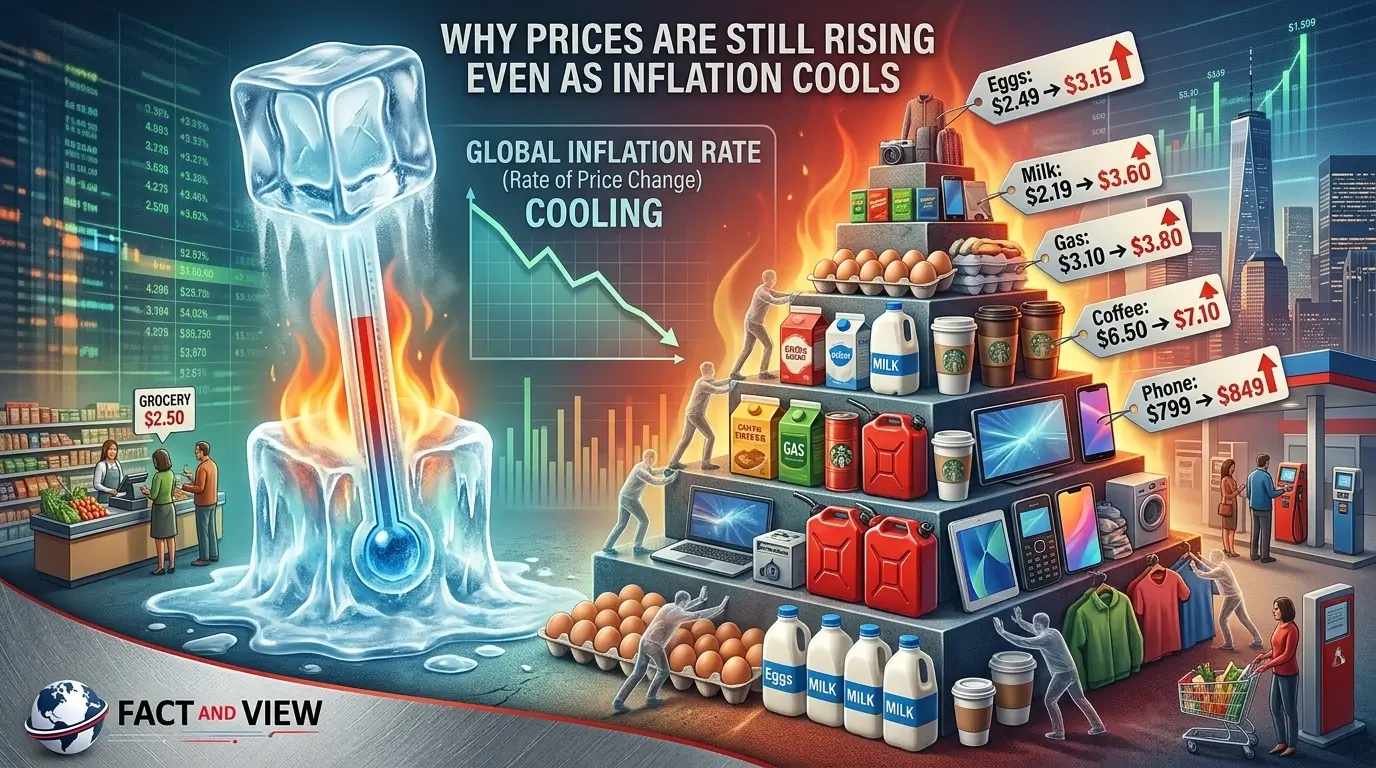
The affordability crisis in housing is also part of a much broader economic problem tied to inflation, elevated borrowing costs, and rising living expenses across the United States. To understand why prices remain stubbornly high in 2026 — from housing to groceries and everyday essentials — read our full breakdown of why inflation is still affecting American households and what it means for the economy going forward.
Deep Dive: Five Forces Shaping Housing in 2026
1. What Every Major Forecaster Is Saying About Prices
The professional consensus on national home price growth in 2026 is unusually tight — and unusually modest:
- J.P. Morgan Global Research: 0% national price growth in 2026. “Lower adjustable-rate mortgage rates and builder buydowns could be enough, along with a rising wealth effect, to shift demand higher while supply increases subside. Consequently, we expect home prices to stall at 0% nationally in 2026,” said John Sim, Head of Securitized Products Research at J.P. Morgan.
- Redfin: +1% median home sale price year-over-year in 2026.
- Realtor.com: +2.2% nominal price growth; real prices decline when adjusted for income growth.
- Bright MLS: +0.9% — the most conservative among major forecasters.
- Fannie Mae: +2.1%–3% for 2026 and 2027.
- NAR Chief Economist Lawrence Yun: +4%, with home sales rising 14% year-over-year.
Fact: Translated into dollar terms, using the median home sales price of $410,800 in Q2 2025, a 2.1%–4% increase places the 2026 median in the $419,000–$427,000 range — approximately $9,000–$16,000 higher than 2025, per Ramsey Solutions’ analysis of Fannie Mae data. That is not a price drop. But it is the slowest growth trajectory in years.
The View: The consensus range of 0%–4% national price growth is itself a signal. When J.P. Morgan says 0% and NAR says 4%, the disagreement isn’t about the data — it’s about regional weightings and assumptions about rate movement. The honest read is: national prices are unlikely to fall, but the growth tailwind is gone. For sellers who bought at 2020–2021 prices, this means the era of effortless appreciation is over. For buyers, it means the affordability calculus still doesn’t work — just marginally less badly than in 2023 or 2024.
2. The Regional Split: Where Prices Are Actually Falling
The national average conceals a story that is far more interesting — and far more actionable.
Fact: Realtor.com’s 2026 forecast projects home price declines in 22 of the 100 largest U.S. cities. Most are concentrated in the Southeast and West — areas that experienced the sharpest pandemic-era price surges and the most aggressive new construction. J.P. Morgan’s John Sim specifically identifies the West Coast and Sun Belt: “House prices are falling the most along the West Coast and Sun Belt, where there remains a glut of new homes following the pandemic-era construction boom.”
Markets likely to see price pressure downward in 2026:
- Austin, TX — excess new construction has inverted the supply-demand balance
- Phoenix, AZ — inventory back above 2019 levels; buyers regaining leverage
- Tampa, FL — insurance cost explosion has crushed demand, added motivated sellers
- Sacramento, CA — affordability gap drove buyers to remote work-friendly alternatives
- Denver, CO — overbuilt in the mid-price range; listings sitting longer
Markets likely to see continued price strength:
- Northeast metros (Boston, New York, Washington D.C.) — severely supply-constrained
- Chicago, IL — relative affordability still attracting Midwest buyers
- Midwest mid-size cities — Columbus, Indianapolis, Kansas City remain under-inventoried
The View: The regional divergence in 2026 is the housing story. It’s not about whether the national number is +1% or +3%. It’s about the fact that buyers in Tampa are in a fundamentally different market from buyers in Boston. In supply-constrained Northeast markets, prices remain sticky because zoning, construction costs, and land scarcity impose structural floors. In Sun Belt markets where builders overshot, prices face genuine gravitational pull. A national forecast is essentially useless for actual purchase decisions.
3. Mortgage Rates: The Variable That Controls Everything
No single factor shapes housing affordability more than the 30-year mortgage rate — and no single factor is more hostage to events outside the housing market.
Fact: The current 30-year fixed mortgage APR is 6.54%, per Bankrate’s May 7, 2026 survey. The Fed held its benchmark rate at 3.5%–3.75% on April 29, with futures markets pricing in zero cuts for the rest of 2026. Freddie Mac’s weekly survey shows a 6.30% average. Rates briefly dipped below 6% in early May on Iran ceasefire hopes — then reversed as geopolitical uncertainty persisted.
Fact: A one-percentage-point drop in mortgage rates can expand the pool of qualifying buyers by approximately 5.5 million households nationwide, including 1.6 million renters who could become first-time buyers, per NAR economist analysis. At 6.3%, the current rate is meaningfully better than the 6.8% average in spring 2025 — but still far above the 3% rates of 2021.
Fact: The Middle East conflict has introduced a new variable. Every escalation that pushes oil prices higher also pushes inflation expectations higher — which pushes 10-year Treasury yields higher — which pushes mortgage rates higher. The Iran ceasefire discussion in early May was enough to briefly push rates below 6%. A permanent resolution would be the most powerful single catalyst for housing affordability that doesn’t involve Fed action.
The View: Mortgage rates in 2026 are a geopolitical hostage. The Fed, the Treasury market, and the energy price environment all interact to determine the 30-year rate — and right now, all three are pointing in the same direction: elevated. The 6.3% rate scenario many forecasters built their 2026 projections around already looks optimistic given the April–May rate trajectory. Buyers waiting for sub-6% rates in 2026 are likely to be disappointed.
4. The Lock-In Effect: Slowly Thawing, Not Breaking
The lock-in effect — the phenomenon of homeowners refusing to sell their 3% mortgage into a 6.5% replacement — has been the defining supply constraint of 2022–2025. In 2026, it is beginning to dissolve, slowly.
Fact: Redfin identifies three categories of sellers who are breaking through the lock-in barrier in 2026: divorce proceedings, job relocations, and estate sales from aging Baby Boomers. These “life-event sellers” are immune to the rate calculus because they must sell regardless of mortgage economics. Baby Boomers — who collectively hold $17+ trillion in home equity — are driving the upper end of the market more than any other demographic.
Fact: New home sales are projected to rise 5% in 2026, per NAR’s forecast. Homebuilders are actively undercutting the lock-in effect by offering rate buydowns — paying upfront sums to lower the buyer’s mortgage rate by 1.5–2.0 percentage points on new construction. This tactic has kept new home sales competitive with resales and partially explains why newly built homes are now cheaper than the median resale home.
The View: The lock-in effect created an artificial supply floor that prevented the price correction affordability fundamentals would otherwise have demanded. As that floor gradually dissolves — through life events, builder competition, and rising inventory — the underlying affordability math will exert more gravitational pull on prices. The process takes years, not quarters. But 2026 is the year the direction changes, even if the magnitude is small.
5. Affordability: Still Broken, Marginally Less So
The numbers here are stark. And they matter more than any price forecast.
Fact: Middle-income buyers can currently afford just 21% of homes for sale in the United States. Before the pandemic, they could afford approximately 50%. That collapse in effective purchasing power — driven by a combination of price appreciation and rate increases — represents the worst affordability environment in modern housing history, per NAR economists cited in their January 2026 podcast.
Fact: Realtor.com chief economist Danielle Hale forecasts a 2.2% nominal price increase — but with income growth projected at 3.6% and inflation at 3%, real affordability is expected to improve slightly in 2026. “Those monthly payments will actually drop as we move into 2026,” Hale told Money.com. Redfin’s forecast echoes this: incomes rising faster than home prices for a sustained period is the core of the “Great Housing Reset” thesis.
The View: Marginal affordability improvement through income growth — not price declines or rate cuts — is the mechanism by which the housing market “recovers” in 2026. That is an extremely slow and uneven process. Gen Z and younger millennials face a structural disadvantage that a 1% decline in real home prices does not meaningfully address. The affordability crisis is not resolving in 2026. It is stabilizing. That is a very different thing.
Risks & Opportunities: Three Scenarios
Base Case (~50% probability): Slow Reset, Prices Up 1%–2%
Mortgage rates hold between 6.0%–6.5%. Inventory rises 10%. National prices grow 1%–2% — below inflation, meaning real prices decline slightly. Sales volume rises 5%–10%. Regional divergence continues: Northeast and supply-constrained markets firm; Sun Belt and overbuilt metros softer.
What this means for you: Sellers retain their equity but face longer selling timelines and less competitive offer environments. Buyers gain modestly more negotiating power in certain markets. First-time buyers remain largely priced out in coastal markets.
Upside Scenario (~25% probability): Rate Drop Unlocks Demand
Iran de-escalation accelerates. Middle East conflict eases. Oil drops. Inflation expectations fall. 10-year Treasury yields retreat. Mortgage rates reach 5.5%–5.75% by Q3. New buyer pool expands by 2–3 million households. National prices rise 4%–6%. Sales surge 15%.
What this means for you: If you’re waiting to buy, rate movement is your buy signal — not calendar month. Track Freddie Mac’s weekly survey at freddiemac.com/pmms. A move from 6.5% to 5.75% saves approximately $180/month on a $400,000 mortgage.
Downside Scenario (~25% probability): Stagflation Freezes the Market
Middle East conflict escalates. Oil stays above $115. Inflation spikes. Rates climb to 7%+. Buyer pool contracts further. Transaction volume collapses. Prices fall 2%–5% nationally as motivated sellers — divorce, relocation, estate — cannot find buyers at current prices.
What this means for you: A 5% national price decline on a $420,000 median home is $21,000 in lost paper equity. For recent buyers with minimal down payments, that erodes equity cushions quickly. More significantly, frozen transaction volume means job mobility decreases — people can’t move for opportunities they can’t finance.
The Bottom Line
Will housing prices drop in 2026? Not nationally. Not materially. But the question misses the more important point: the housing market is undergoing a structural reset that will play out over 3–5 years, not one calendar year.
For buyers:
- The best markets to buy in 2026 are Sun Belt metros with rising inventory — Austin, Phoenix, Tampa — where seller leverage has evaporated and price reductions are occurring
- Get pre-approved now. Know your number at 6.5% and model what a refinance looks like at 5.5% in 2027–2028
- Never buy based on a national price forecast. Your ZIP code is the market that matters. Use Redfin’s market tracker and Realtor.com’s local forecast tool to understand your specific conditions
For sellers:
- List in Q2 before summer inventory surge further shifts leverage to buyers
- Price competitively from day one. Overpriced homes in 2026 sit — and sitting homes invite low offers
- In Sun Belt markets with rising inventory, price reductions of 3%–7% are increasingly common and expected by buyers
For investors:
- Rental demand is rising. Redfin projects rents to increase 2%–3% nationally in 2026, with stronger gains in supply-constrained metros as apartment construction slows from its 2021–2022 peak
- Single-family rental properties in Midwest markets — where prices are lower, cap rates are higher, and affordability keeps renters renting longer — offer the most compelling risk-adjusted returns
- The lock-in effect means institutional buyers of existing homes face less competition from traditional move-up buyers, creating acquisition opportunities in markets with motivated sellers
The housing market’s verdict for 2026: not a crash, not a boom. A long-overdue rebalancing — uneven, regionally specific, and driven by forces that have very little to do with the monthly price index and everything to do with mortgage rates, income growth, and the slow dissolution of a three-year supply freeze.
FAQ
Will US home prices crash in 2026?
No credible forecast projects a national housing crash in 2026. The structural conditions for a crash — mass foreclosures, speculative over-leverage, collapsing demand — are absent. Mortgage delinquency rates are at historical lows. Most homeowners have substantial equity and fixed low-rate loans. J.P. Morgan forecasts 0% national price growth; NAR forecasts 4%; the consensus range is 0%–4%. What’s more likely than a crash: regional price declines of 3%–8% in overbuilt Sun Belt and West Coast markets, combined with continued strength in supply-constrained Northeast metros.
Where will home prices fall most in 2026?
Realtor.com projects price declines in 22 of the 100 largest U.S. cities in 2026, with most located in the Southeast and West. Markets most exposed to price pressure include Austin, TX (inventory glut from overbuilding), Tampa, FL (insurance cost explosion driving seller urgency), Phoenix, AZ (inventory back above 2019 levels), Sacramento, CA, and Denver, CO. These are markets that saw the largest pandemic-era price surges and the most aggressive new construction — the supply correction is now arriving.
When will mortgage rates come down in 2026?
The Fed held its rate at 3.5%–3.75% at its April 29 meeting, and markets are pricing in zero cuts for the rest of 2026. Most forecasters expect the 30-year mortgage rate to hold in the 6.0%–6.5% range through 2026. Rates could dip temporarily on geopolitical de-escalation in the Middle East. A sustained move below 6% is unlikely without a significant shift in inflation data. Track weekly rate movements at Freddie Mac’s Primary Mortgage Market Survey and daily changes at Bankrate.
Is 2026 a good time to buy a house?
It depends entirely on your local market, your financial position, and your time horizon. Nationally, buyer leverage is improving — more inventory, longer time-on-market, more price reductions. In Sun Belt markets with rising inventory, buyers have more negotiating power than at any point since 2019. Chris Reis, a broker with Compass in Seattle, calls 2026 “a transitional year — there won’t be a crash or a boom, just the market finding its footing after years of extraordinary disruption. Buyers will have more selection and negotiating power than at any time since the pandemic.” The financial rule remains: only buy if you plan to stay at least 5–7 years and the monthly payment at current rates is sustainable on your income without assuming rate relief.
Should I wait for home prices to drop before buying?
Redfin does not expect prices to fall nationally in 2026 because sellers will pull back too — most would-be sellers have enough equity to wait for the market to recover rather than accept lower prices. Waiting for a national price correction that is unlikely to materialize means continuing to pay rent while missing equity accumulation. The more productive question: is there a specific local market where inventory is rising and prices are softening? If yes, buying in that market now — at 6.5% with a plan to refinance — is likely superior to waiting indefinitely for rates that may not arrive until 2027–2028.
Will rents go up or down in 2026?
Up — in most markets. Redfin projects rents to rise about 2%–3% year-over-year by end of 2026, roughly matching the pace of inflation, as apartment construction slows from its 2021–2022 surge and competition for each available unit increases. The markets with the sharpest rent increases will be supply-constrained Northeast and Midwest metros where affordability keeps more households renting longer. Sun Belt markets with heavy apartment construction will see softer rent growth or modest declines.
Where can I track the US housing market in real time?
The most reliable primary sources:
J.P. Morgan US Housing Market Outlook — institutional research on national trends and securitized market dynamics
Redfin Housing Market Tracker — weekly data on median prices, days on market, sale-to-list ratios
Realtor.com Housing Market Forecast — monthly updates with local market breakdowns
Freddie Mac PMMS — the definitive weekly 30-year mortgage rate benchmark
NAR Existing Home Sales — monthly official transaction volume data
Case-Shiller Home Price Index via FRED — the gold standard for long-run price trend analysis
CFPB Mortgage Calculator — model your specific monthly payment at current and projected rates
Sources: J.P. Morgan US Housing Market Outlook 2026 · Redfin Housing Predictions 2026 · NAR 2026 Real Estate Outlook · NAR Housing Market Comeback 2026 · Money.com — Will Home Prices Fall 2026 · CBS News — 22 Cities Where Prices May Fall · Ramsey Solutions Housing Forecast · Norada Real Estate — Mortgage Rates May–July 2026 · CNBC — 10 Cities Where Prices May Fall · Bankrate Mortgage Rates, May 7, 2026
© Fact and View, 2026. For informational purposes only. Not investment advice.