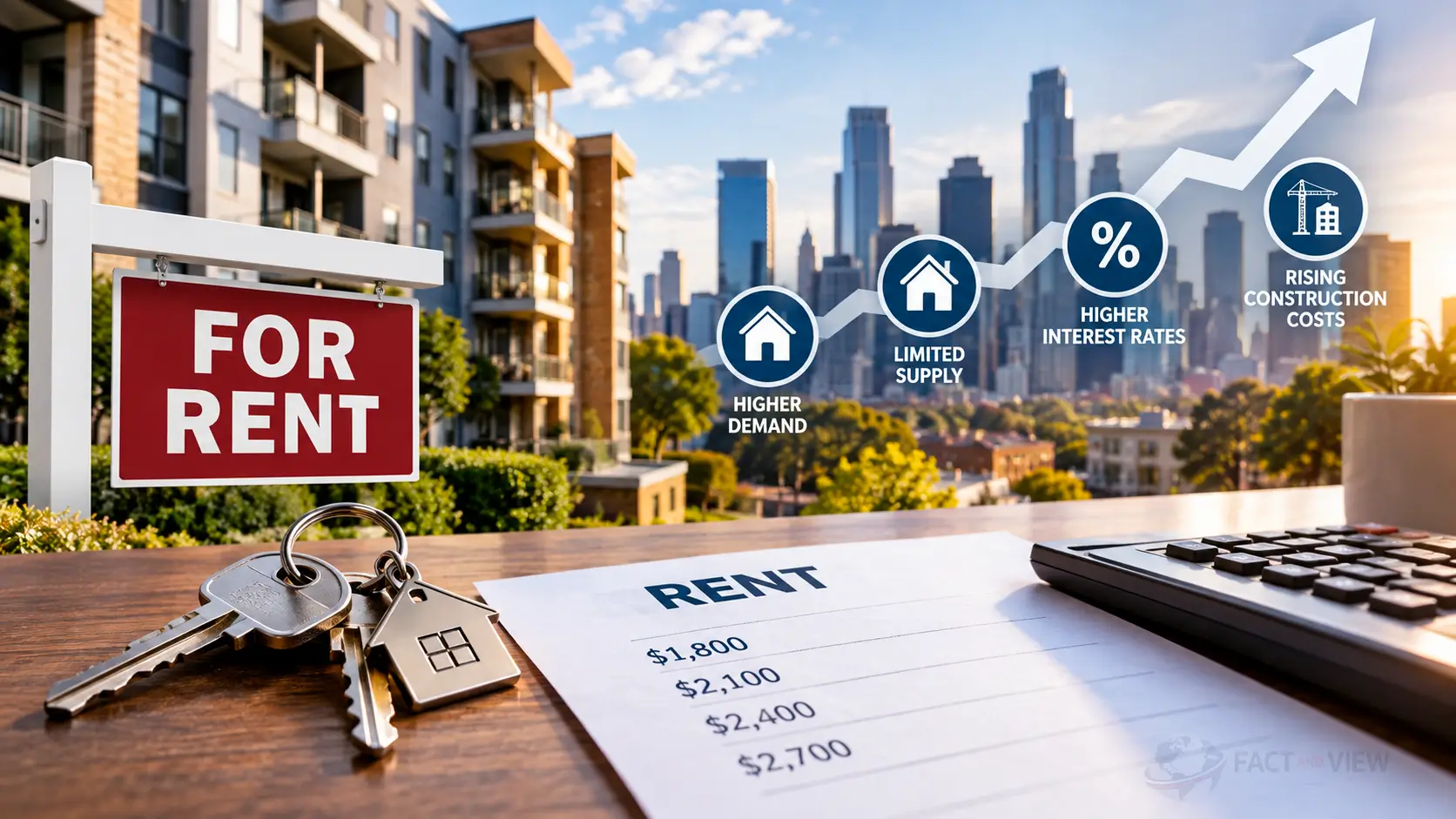
Rent prices have stopped climbing at the pace many Americans experienced during the pandemic housing boom. Yet for millions of households, finding an affordable apartment remains a serious financial challenge.
The reason is straightforward: slower rent growth does not reverse the increases that have already happened. A household paying hundreds of dollars more each month than it did several years ago still faces that higher bill, even when the market begins to cool.
The latest data show a rental market moving in two directions. Some cities have more apartments available and landlords are offering incentives to attract tenants. At the same time, lower-income households continue to struggle with housing costs, and many renters have little money left after paying for a place to live.
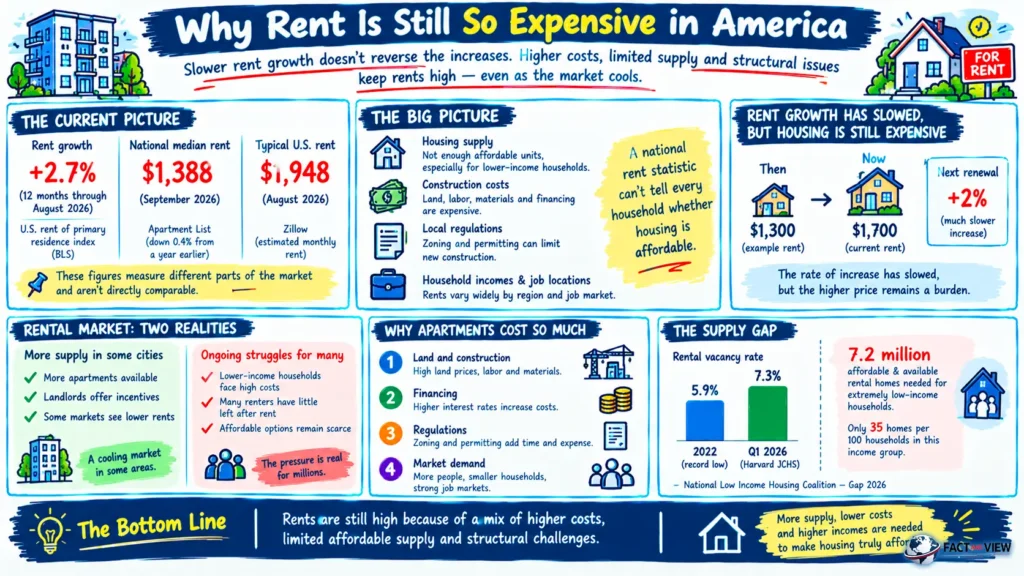
According to the U.S. Bureau of Labor Statistics, the rent of primary residence index rose 2.7% over the 12 months through August 2026. Meanwhile, Apartment List reported that its national median rent measure stood at $1,388 in September, down 0.4% from a year earlier. These figures measure different parts of the market and should not be treated as directly comparable estimates of the same rent.
Understanding why rent is still so expensive in America requires looking beyond monthly price changes. Housing supply, construction costs, local regulations, household incomes, and the location of job opportunities all influence what renters pay.
Rent Growth Has Slowed, but Housing Is Still Expensive
The first distinction is between the price of rent and the rate at which rent changes.
Suppose an apartment rented for $1,300 a month several years ago and now costs $1,700. If the landlord raises the price by just 2% at the next renewal, the rent increase has slowed considerably. But the tenant still pays $1,700 before the next increase.
That difference explains why economic reports can describe a cooling rental market while renters continue to experience financial pressure.
The pandemic accelerated the problem. Changes in household formation, moving patterns, and demand for housing contributed to a sharp increase in rents in many markets. The subsequent wave of apartment construction has helped moderate prices in some areas, but it has not returned rents to their earlier levels everywhere.
Recent reports illustrate this shift.
Zillow’s August 2026 analysis put typical U.S. rent at $1,948 a month and found that the cost of renting remained substantially below the estimated monthly cost of buying a home. Apartment List, using a different dataset and methodology, reported a September national median rent of $1,388. The figures should be read within each provider’s methodology rather than compared as though they describe identical properties.
The broader lesson is that a national rent statistic cannot tell every household whether housing is affordable. A renter in a market with abundant new apartments may have negotiating power, while someone searching for a modest apartment near a major employment center may face a very different situation.
The U.S. Has More Rental Housing, but Affordable Options Remain Scarce
One reason the problem persists is that adding apartments does not automatically create enough apartments at prices that lower-income households can afford.
The Harvard Joint Center for Housing Studies found that rental vacancy rates rose from a record low of 5.9% in 2022 to 7.3% in the first quarter of 2026 as construction increased. The U.S. Census Bureau subsequently reported a national rental vacancy rate of 7.3% in the second quarter of 2026. These figures suggest that the market has gained some breathing room after years of unusually tight conditions.
However, the number of available apartments is only part of the story. Their price, location, size, and condition matter just as much.
Developers generally need enough rental income to cover land, construction, financing, maintenance, and operating expenses. When those costs are high, a newly constructed building may require rents that are out of reach for households with modest incomes.
The Harvard center found that over the previous decade, growth in the rental housing stock had been concentrated in higher-rent units. The number of units renting for less than $1,000 a month had declined by 7 million, either because the units were lost or were converted to higher-rent housing.
This helps explain why a city can build thousands of apartments and still have a shortage of inexpensive places to live.
The National Low Income Housing Coalition’s Gap 2026 report estimated a shortage of 7.2 million rental homes that were both affordable and available to extremely low-income households. Nationally, only 35 such homes existed for every 100 households in that income group.
This is a targeted measure of the shortage facing the lowest-income renters, not a claim that the country lacks 7.2 million rental units of every price category. That distinction matters because a home that exists but costs far beyond a household’s budget does little to solve that household’s housing problem.
Why Building New Apartments Costs So Much
The economics of rental construction help explain why supply takes time to improve affordability.
Land is a major expense, especially in cities with strong job markets and limited space near transit, universities, hospitals, and business districts. Developers must also pay for materials, labor, permitting, infrastructure, and financing before an apartment can earn any rental income.
Local rules can add another barrier. Zoning restrictions may limit building heights, prevent multifamily housing in certain neighborhoods, or restrict the number of homes that can be built on a parcel. Lengthy approval processes and development fees can further increase the cost and risk of a project.
Research from Brookings has highlighted how land-use regulations and development barriers can constrain housing supply, particularly in locations where demand is strong. Local conditions matter: an expensive coastal city with limited construction opportunities is not the same as a metropolitan area where developers have recently added large numbers of apartments.
Financing adds another complication. Developers frequently borrow money to acquire land and construct buildings. When financing becomes more expensive, some projects no longer make financial sense. Developers may postpone construction, reduce the number of units, or seek higher expected rents to compensate for the additional costs.
Operating expenses matter after a building opens, too. Property insurance, repairs, taxes, utilities, and maintenance can add to the cost of running a rental property. These expenses do not translate into identical rent increases everywhere: a landlord’s ability to raise prices also depends on local demand, competition, leases, and tenant protections.
None of these costs alone explains America’s rental problem. Together, however, they help explain why additional construction can take years to deliver meaningful relief, particularly in markets where affordable housing is already scarce.
Why Rent Is Highest Where People Need to Live
Housing demand is not evenly distributed across the country.
People move toward places with employment opportunities, higher wages, universities, transport links, and access to services. When many households want to live in the same area but housing construction does not keep pace, landlords face less pressure to reduce asking prices.
This is especially difficult for workers who cannot easily move farther away. A lower rent in a distant suburb may come with additional spending on fuel, public transportation, childcare, or commuting time. For someone who must be close to a hospital, school, office, or industrial site, moving to a cheaper market may not be practical.
Supply differences can produce very different results from one city to another. Harvard’s housing research found that apartment vacancy rates had increased by five percentage points in the Austin metropolitan area since 2021, where construction had been substantial. In the Chicago area, where apartment construction had been more subdued, the increase was only half a percentage point.
These figures illustrate why national averages can conceal local pressure. New supply can give renters more choices, but the effect depends on how many apartments become available, where they are located, and which price ranges they serve.
How Interest Rates Affect Rent
Interest rates influence the rental market in several ways, even though landlords do not automatically increase rent whenever the Federal Reserve changes its policy rate.
First, borrowing costs affect the economics of building and financing rental properties. More expensive credit can discourage developers from starting projects, limiting the supply of new apartments in the years ahead.
Second, high mortgage rates can make buying a home harder to afford. Some households that would otherwise purchase a home remain renters for longer, sustaining demand in the rental market.
Third, interest rates affect landlords differently depending on how their properties are financed. An owner with a fixed-rate loan faces different immediate pressures from an owner who must refinance at a higher rate.
Higher interest rates therefore do not guarantee higher rents, just as lower rates do not guarantee cheaper apartments. The outcome depends on local supply, tenant demand, operating costs, and how quickly construction responds.
The important point is that housing supply reacts slowly. A change in financing conditions today may affect the number of apartments available years later, long after the original economic circumstances have changed.
The Income Problem: Rent Takes Too Much of the Paycheck
Even when rent increases slow, households can remain under pressure if their incomes are too low to cover housing and other necessities comfortably.
Housing researchers commonly describe a household as cost-burdened when it spends more than 30% of its income on housing and utilities. Spending more than 50% is considered a severe cost burden.
Harvard’s 2026 housing report found that, based on the latest available household data for 2024, 83% of renters earning less than $30,000 a year spent more than 30% of their incomes on housing. Two-thirds spent more than half their incomes on housing.
The pressure extends beyond the rent payment itself. Tenants may also have to pay for electricity, water, internet, renter’s insurance, parking, laundry, and other expenses that vary by property and lease. Moving can require a security deposit, an application fee, and the first month’s rent before a household has fully settled in.
These costs reduce the money available for groceries, transportation, medical expenses, childcare, debt payments, and savings. A tenant may technically qualify for an apartment but still struggle to afford it without relying on credit or reducing other essential spending.
The same squeeze affects the ability to build financial security. When housing consumes a large share of take-home pay, renters have less capacity to handle a car repair, a medical bill, reduced working hours, or a period of unemployment.
Why Lower Asking Rents Do Not Help Everyone Immediately
A cooling market can create opportunities for renters, but the benefits are not evenly distributed.
Someone signing a new lease may be able to negotiate a lower price, choose a unit in a building offering move-in concessions, or find more options than were available a year earlier. A tenant renewing an existing lease may not receive the same benefit, particularly when local rents remain high or housing demand is strong.
The distinction between new lease prices and the rents paid by existing tenants also matters for inflation statistics. Market listings reflect the prices landlords are currently asking for available units. The Bureau of Labor Statistics’ rent index measures rents across the housing stock, which means changes in advertised rents may not show up immediately or in the same proportion in the official measure.
That is one reason national rent data can appear contradictory. One index may show new rental offers becoming cheaper while another continues to register annual increases in the rent households pay.
The price level also remains important. A 1% decline from an elevated starting point will not restore affordability for a household whose income has failed to keep up with earlier rent increases.
The wider cost-of-living picture matters here, too. When groceries, insurance, and other essentials take more of a paycheck, a rent payment that was once manageable can become difficult even if the rent itself barely changes.
What Could Make Rent More Affordable?
There is no single policy that can solve America’s rental affordability problem. The most useful approaches address both the supply of homes and the gap between housing costs and household incomes.
Building more housing in high-demand areas can give renters more choices and reduce competition for available apartments. Allowing a wider range of housing types, simplifying appropriate permitting processes, and making better use of land near jobs and transportation can help projects move forward. The impact depends on how much housing is built and whether it is located where people need it.
Preserving existing lower-cost housing also matters. If older apartments are demolished, converted to higher-rent units, or become too expensive to maintain, the supply of affordable housing can shrink even as the overall number of homes increases. Renovation and preservation policies can help keep some existing units available at lower prices.
Supporting households with the lowest incomes addresses a different problem. Market-rate construction alone may not provide housing at prices that the poorest households can afford. Housing vouchers and other targeted assistance can help eligible families bridge the gap between their incomes and the cost of a suitable home.
Finally, renters can compare neighborhoods, negotiate where conditions allow, and evaluate the full cost of an apartment rather than the advertised rent alone. These steps may help individual households, but they cannot substitute for broader changes in housing supply and affordability.
The direction of the market will depend on construction, local demand, income growth, financing conditions, and public policy. The national vacancy rate has moved away from its pandemic-era low, but the shortage of homes affordable to the lowest-income households remains severe.
The Bottom Line
Rent remains so expensive in America because the affordability problem is deeper than the latest monthly change in asking prices. Earlier increases left rents at a higher level, incomes have not kept pace for many households, and the country still lacks enough homes that the lowest-income renters can afford.
There are signs of improvement in some markets. More apartment construction and higher vacancy rates have given some renters greater choice and leverage. But a national cooling trend does not guarantee relief in every city or every price range.
The most important indicator to watch is not simply whether rent growth slows. It is whether the supply of suitable, affordable housing expands enough for households to spend less of their income on shelter and still cover the rest of their lives.
For renters, that is the difference between a market that is getting less expensive at the margin and one that is genuinely becoming affordable.
Sources:
The article uses current data and research from the following sources:
- bls.gov — measures rent inflation and housing costs.
- census.gov — provides rental vacancy data.
- jchs.harvard.edu — analyzes housing supply, rental affordability, and household cost burdens.
- nlihc.org — estimates shortages of affordable homes for extremely low-income renters.
- apartmentlist.com — tracks monthly rental-market conditions.
- zillow.com — examines rent levels, affordability, and rent-versus-buy costs.
- brookings.edu — explains the role of land use, supply constraints, and local housing markets.
See also :
- Why Americans Still Feel Poor Even When Inflation Falls
- How Interest Rates Affect Your Everyday Life
- Why Home Insurance Costs Are Rising Across the U.S. Even in a Quiet Storm Year
- Why Americans Are Spending More Even When Money Feels Tight
FAQ
Why is rent so expensive in America?
Rent remains expensive because earlier rent increases raised the price baseline, housing supply is limited in many high-demand areas, and affordable units are scarce relative to the needs of lower-income households.
Will rent prices go down in the United States?
Rent declines are possible in markets where apartment supply grows faster than demand. National trends do not guarantee lower rents in every city or price range.
Why are rents high even when inflation slows?
Lower inflation means prices are increasing more slowly; it does not mean that rents return to previous levels. Rent can remain high even after the annual rate of increase declines.
What percentage of income should go toward rent?
A common housing-affordability benchmark is 30% of household income for housing and utilities. It is a useful guideline, not a universal rule that accounts for every household’s taxes, debts, or other expenses.