

Every summer, a strange annual ritual plays out across retirement planning circles: independent analysts start publishing monthly guesses about a number the government won’t officially confirm until October. For the roughly 75 million Americans who receive Social Security or Supplemental Security Income, that number — the annual cost-of-living adjustment, or COLA — determines whether next year’s checks keep pace with rising grocery bills, or quietly fall further behind them.
The 2027 Social Security COLA is currently projected in a range of roughly 3.6% to 3.8%, based on the latest available inflation data. That estimate has already moved meaningfully over the past several months — spiking as high as 4.7% in one forecaster’s model before cooling back down — and it will keep shifting until the Social Security Administration locks in the final figure using September inflation data.
Here’s exactly how that number gets built, why it keeps changing, and what it will actually mean for a typical retiree’s monthly check.
What Is the 2027 Social Security COLA?
The cost-of-living adjustment is Social Security’s built-in mechanism for protecting benefits from inflation. Each year, the Social Security Administration (SSA) adjusts monthly payments up — never down — based on how much consumer prices rose over the preceding year, using a specific government inflation measure rather than a political or budgetary decision.
Fact: The COLA is not optional or discretionary. It has been an automatic feature of Social Security since a 1972 law made annual adjustments permanent, ensuring benefits would rise without requiring a separate act of Congress each time.
Fact: The 2027 COLA specifically refers to the increase that will take effect for benefit payments beginning in January 2027, calculated using inflation data collected during the third quarter (July, August, and September) of 2026.

The View: The COLA is best understood not as a raise, in the traditional sense, but as a preservation mechanism. It exists to keep a retiree’s purchasing power roughly constant over time — not to grow it. That distinction matters enormously for expectations: even a COLA that sounds generous in percentage terms is, by design, simply meant to offset the inflation retirees already experienced, not provide them additional real income.
Related reading: What Happens If Social Security Runs Out? — the broader solvency picture behind the program issuing this annual adjustment.
How Is the COLA Calculated?
The methodology behind the COLA is precise, publicly documented, and has remained essentially unchanged for decades — which is exactly what allows outside analysts to forecast it with reasonable accuracy months before the official announcement.
Fact: The Social Security Administration calculates the COLA using the Consumer Price Index for Urban Wage Earners and Clerical Workers, known as the CPI-W — a specific inflation index tracking a defined basket of goods and services purchased by hourly and clerical workers, distinct from the more commonly cited headline CPI.
Fact: The formula compares the average CPI-W reading for the third quarter of the current year (July, August, and September) against the average CPI-W reading from the third quarter of the last year in which a COLA took effect. The percentage increase between those two figures, rounded to the nearest tenth of a percentage point, becomes the official COLA.
Fact: Because the calculation relies entirely on third-quarter data, the first six months of any given year’s inflation numbers — no matter how dramatic — technically play no direct role in the formula itself. They matter only insofar as they help forecasters estimate where third-quarter numbers are likely to land.
Fact: The Social Security Administration officially announces the confirmed COLA each October, immediately following the release of the September CPI-W report — for the 2027 adjustment, that release is scheduled for October 14, 2026.
The View: The CPI-W’s central role in this calculation is also its most persistent controversy. Critics, including many advocacy groups for older Americans, have long argued that CPI-W poorly reflects actual retiree spending patterns, since it’s built around a working-age household basket rather than one weighted toward the healthcare and housing costs that consume a disproportionate share of a typical retiree’s budget. Proposals to switch to the CPI-E (Consumer Price Index for the Elderly) — a lesser-known index specifically designed to track spending patterns among Americans 62 and older — have circulated in Congress for years without gaining sufficient traction to become law.
Why Inflation Matters for the 2027 COLA
Because the COLA formula is mechanical rather than discretionary, the entire forecasting exercise around it comes down to a single question: where is inflation heading through the end of the third quarter?
Fact: The CPI-W rose 3.5% year-over-year in June, according to Bureau of Labor Statistics data released in July — a reading that came in notably cooler than the sharp increases recorded earlier in the spring, when April data showed the same index up 3.9% year-over-year.
Fact: That spring-to-summer volatility produced dramatic swings in independent forecasts. Policy analyst Mary Johnson’s projection jumped from 3.2% in March to as high as 4.7% by June — driven by what she described as “sharply rising” gasoline, energy, and fresh produce prices — before dropping back down to 3.7% just one month later as June’s cooler reading came in. Johnson called the June deceleration “a significant drop in inflation, and one that we’ve rarely seen in the June CPI data over the past five years.”
Fact: Energy and gasoline prices have been specifically identified as an outsized driver of the recent forecast volatility, since the CPI-W basket weights transportation and energy costs relatively heavily compared to some broader inflation measures.
The View: This volatility is the clearest illustration of why COLA forecasts published in the spring should be treated with real caution. A single category of spending — energy prices, which can swing sharply based on geopolitical events entirely disconnected from underlying domestic economic conditions — has been enough to move the projected COLA by more than a full percentage point within a matter of weeks. Retirees building financial plans around an early-year forecast are, in effect, building around a number with a real chance of shifting meaningfully before it’s finalized.
Related reading: Middle East Tensions Explained: What It Means for Oil Prices — the kind of energy market shock capable of moving CPI-W, and therefore the COLA, with little warning.
Current 2027 COLA Projections
As of the most recent data available, independent forecasters have converged on a relatively narrow — though not identical — range for the 2027 COLA.
Fact: The Senior Citizens League (TSCL), a nonpartisan advocacy organization that has tracked COLA projections for years, has held its estimate at 3.8% for two consecutive monthly updates, unchanged from June and down only slightly from an earlier 3.9% reading in April.
Fact: AARP’s most recent projection, based on the same June inflation data, forecasts a 3.6% increase — modestly below TSCL’s estimate, reflecting a marginally different modeling approach applied to the same underlying CPI-W trend.
Fact: Mary Johnson’s independent estimate currently sits at 3.7%, after the sharp downward revision from her earlier 4.7% projection.
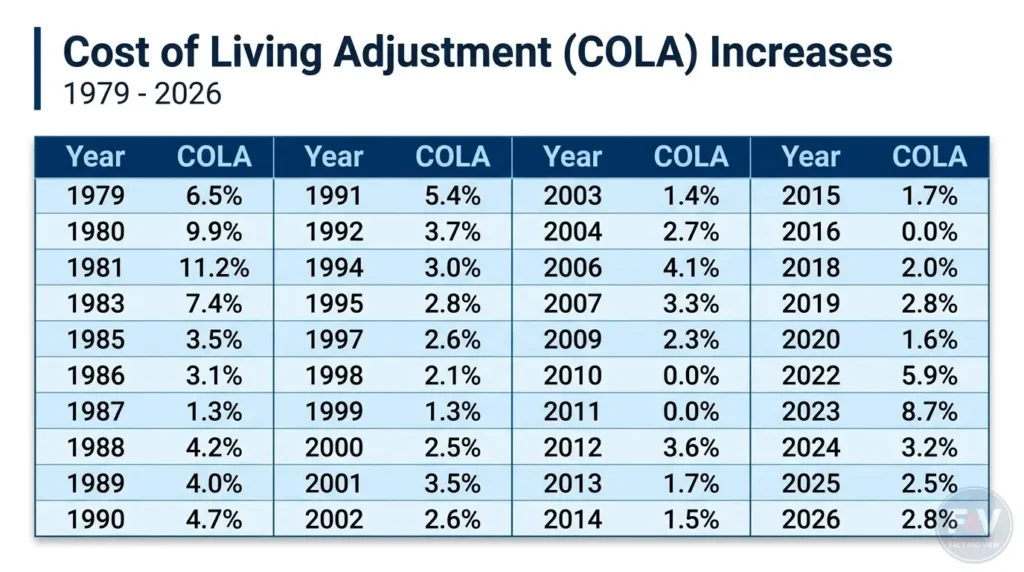
Fact: Combined, these estimates place the current expected range at approximately 3.6% to 3.8% — a meaningfully more moderate outlook than the elevated projections circulating earlier in the year, though still above the 10-year historical average COLA of roughly 3.1%, according to Social Security Administration data.
The View: The fact that three independently operating forecasters — using the same public CPI-W data but different modeling assumptions — have converged within two-tenths of a percentage point of each other is a meaningful signal in itself. It suggests the July-through-September inflation trajectory would need a genuinely significant shift, rather than routine month-to-month noise, to push the final 2027 COLA meaningfully outside this 3.6%–3.8% band.
How Much Could Social Security Benefits Increase?
Translating a percentage projection into an actual dollar figure is where these forecasts become concretely useful for retirement budgeting.
Fact: If the 2027 COLA lands at approximately 3.8%, TSCL’s modeling projects the average monthly benefit for a retired worker would rise by roughly $73.62 to $79.14, depending on the specific baseline benefit figure used, pushing the average check from the current range of approximately $1,937 to $2,083 up to somewhere between $2,011 and $2,162.
Fact: Critically, a meaningful share of that gain would likely be absorbed before it ever reaches a retiree’s bank account. According to the 2025 Medicare Trustees Report, the standard Medicare Part B premium — which is deducted directly from most retirees’ Social Security checks — is projected to rise to approximately $218.60 in 2027, up from $202.90 in 2026, an increase of roughly $15.70 per month.
Fact: Applied against a hypothetical $73.62 COLA increase, that Part B premium hike alone would absorb roughly 21% of the gross COLA gain, leaving a net increase closer to $58 per month for a typical Medicare-enrolled beneficiary. Retirees subject to Income-Related Monthly Adjustment Amount (IRMAA) surcharges — which apply to higher-income beneficiaries — would see an even steeper reduction in their effective net gain.
The View: This is the calculation that headline COLA percentages routinely obscure, and it’s arguably more important to a retiree’s actual budget than the topline number itself. A 3.8% COLA sounds like meaningful relief in isolation. Net of the Medicare Part B premium increase that arrives simultaneously, the real purchasing power gain is closer to 2.8%–3.0% for most Medicare-enrolled retirees — a distinction that rarely makes it into news headlines but belongs in every retiree’s actual financial planning.
Related reading: Best Investments During Inflation — strategies for protecting purchasing power when COLA increases don’t fully offset real-world cost growth.
What Could Change Before the Official Announcement?
Three full months of additional inflation data — the entirety of the third quarter — remain uncollected as of the most recent forecasts, leaving genuine room for the final number to shift.
Fact: Only the CPI-W readings for July, August, and September 2026 will actually enter the final COLA calculation. Every projection published before the September data release is, by definition, an estimate built on incomplete information, however well-informed.
Fact: Energy prices remain the single most-cited swing factor across current forecasts, given their historical tendency to move sharply and unpredictably based on geopolitical developments, refinery disruptions, or seasonal demand shifts — any of which could push the final CPI-W reading meaningfully above or below current projections.
Fact: Legislative developments could also reshape the broader context, if not the COLA formula itself. Congress has reintroduced the Social Security 2100 Act, legislation aimed at providing longer-term relief for beneficiaries who have lost purchasing power to persistent inflation — though such bills have a long history of stalling without passage, and would not retroactively alter the mechanical CPI-W-based formula used for the 2027 calculation regardless of its eventual fate.
The View: The single most important thing to understand about any pre-October COLA projection is that it is explicitly a planning estimate, not guaranteed income. Every reputable forecasting organization — TSCL, AARP, and independent analysts alike — attaches this caveat to their published numbers, and retirees making near-term financial decisions should weight that uncertainty accordingly, particularly for any spending commitment that depends on the increase landing at the higher end of the current range.
What Retirees Should Watch in the Coming Months
For retirees and near-retirees tracking this process, a handful of specific, publicly available data points offer the clearest ongoing signal before the official October announcement.
- The monthly CPI-W release from the Bureau of Labor Statistics, which updates the underlying inflation data feeding every independent forecast, typically published in the second week of each month.
- TSCL’s monthly COLA estimate updates, which have proven to track closely with eventual official figures in past years and are published shortly after each new CPI-W release.
- Energy and gasoline price trends specifically, given their outsized recent influence on CPI-W volatility relative to other basket components.
- The September CPI-W report itself, scheduled for release on October 14, 2026 — the single data point that completes the calculation and allows the SSA to announce the final, binding 2027 COLA.
- The 2027 Medicare Part B premium confirmation, since the net benefit increase that actually reaches a retiree’s account depends as much on this figure as on the COLA percentage itself.
The Bottom Line
The 2027 Social Security COLA, currently projected in the 3.6%–3.8% range, would represent a moderate increase compared to the historic 8.7% adjustment retirees received in 2023 during the height of post-pandemic inflation, and modestly above the 10-year average COLA of roughly 3.1%. But the percentage that dominates headlines each October tells only part of the story that matters for a retiree’s actual monthly budget.
The mechanical CPI-W formula behind the calculation is transparent and well-documented, which is precisely why independent forecasters can track it with reasonable accuracy months in advance — but “reasonable accuracy” still leaves real room for movement, as this year’s swing from a 3.2% estimate in March to as high as 4.7% in June and back down to under 3.8% by July has demonstrated. And whatever percentage the Social Security Administration ultimately announces in October, a meaningful share of that gain will likely be absorbed before it reaches a retiree’s account, given the Medicare Part B premium increase arriving on the same schedule.
For retirees planning around this number, the most useful approach is to treat every pre-October estimate as a moving target, monitor the monthly CPI-W releases as they arrive, and budget conservatively around the net increase — after Medicare premiums — rather than the gross percentage that makes the headlines.
Continue reading from Fact and View:
- What Happens If Social Security Runs Out? — the trust fund solvency timeline shaping the program issuing this annual adjustment
- Social Security 2027: Can America Afford Its Promises? — the broader legislative debate over the program’s long-term funding
- How to Protect Retirement Savings from Market Volatility — building a retirement plan resilient to inflation and COLA uncertainty alike
Sources: Fox Business — Social Security 2027 COLA Projected at 3.8% Amid Rising Inflation · AARP — Social Security COLA Preview: Will 2027 Benefits Go Up? · CNBC — Social Security COLA for 2027 May Be Higher as Inflation Rises · Kiplinger — Latest Inflation Data Keeps 2027 Social Security COLA Forecast Steady · GovtSchemes — 2027 Social Security COLA Forecast: Latest Estimate, Medicare Offset · Eciks — Social Security 2027 COLA Forecast at 3.8% as Inflation Cools · 401(k) Specialist — Next Social Security COLA Raise: 2027 Predictions & Historical Tracker · Freedom for All Americans — 2027 Social Security COLA Projected at 3.8% · Social Security Administration — Cost-of-Living Adjustment Methodology
© Fact and View. For informational purposes only. Not financial or retirement planning advice. Consult a qualified financial advisor for guidance specific to your situation.