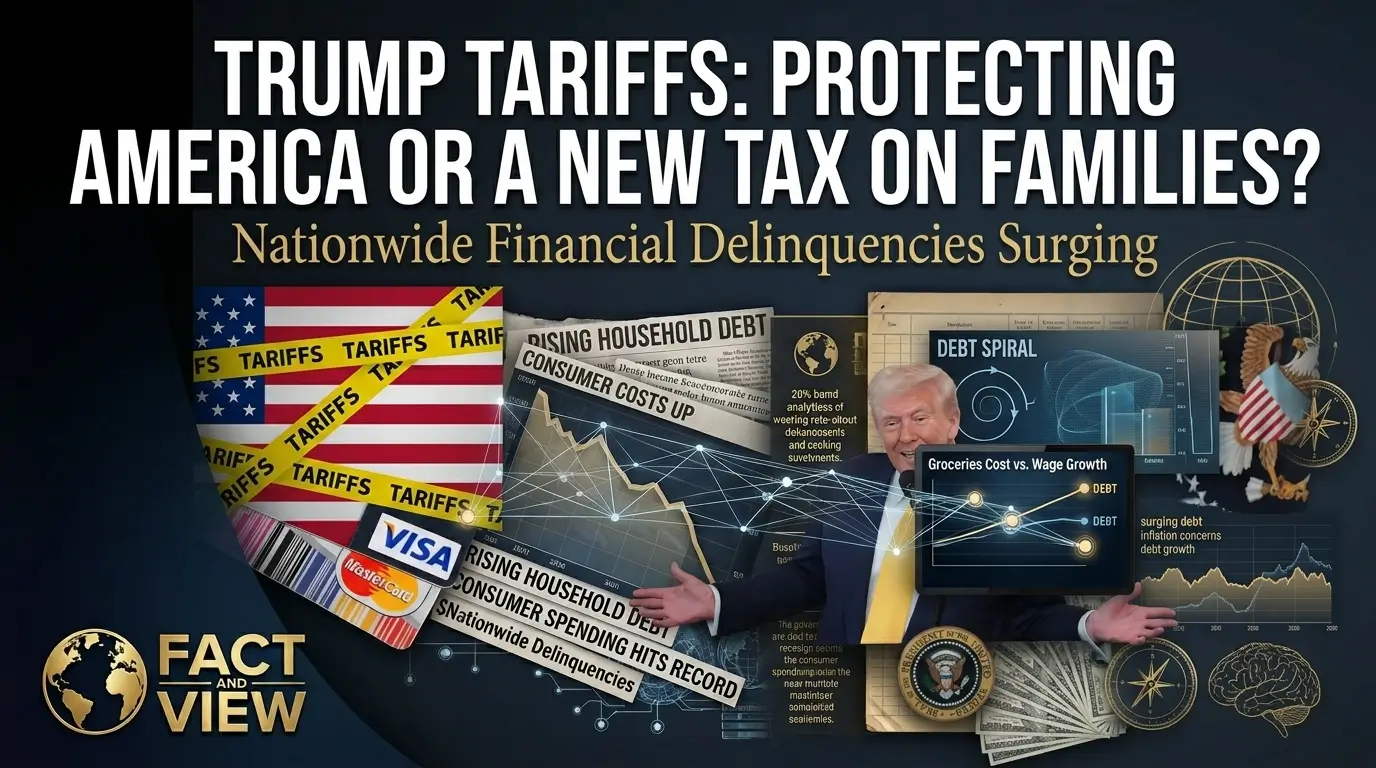
In April 2025, President Trump signed what the White House called “Liberation Day” — a sweeping executive order imposing tariffs on goods from virtually every major trading partner. The average effective tariff rate reached its highest level since 1947. One year later, the tariffs remain in modified form, and the debate over their consequences has become one of the most consequential economic arguments ahead of the November 2026 midterm elections.
For the broader fiscal context in which the tariffs operate, see US National Debt Explained: Should You Be Worried? — tariff revenue of $956 billion over a decade is projected against a backdrop of $39 trillion in existing debt.
The core question is not whether the tariffs are popular. It is whether they are working — and for whom. The answer depends entirely on which data you examine, which time horizon you accept, and whether the cost being paid today is justified by the industrial rebuilding promised for tomorrow.
This article examines both sides of that argument with verified data from independent economic sources, administration documents, and polling conducted in 2025 and 2026.
The View from the Right: Sovereignty, Jobs, and Strategic Industry
Conservative and pro-administration voices frame the tariffs as a long-overdue correction to decades of trade policy that prioritized cheap imports over domestic production capacity.
The White House’s April 22, 2026 release cites tangible outcomes:
- The manufacturing sector capped off Q1 2026 with the first positive manufacturing job growth in three years
- Apple committed $600 billion over four years to U.S. manufacturing, generating 20,000 new jobs. Nvidia is committing $500 billion to produce AI chips on American soil, with next-generation production already underway in Arizona
- U.S. Steel restarted its Gary Tin Mill in Indiana — creating 225 jobs after the mill was shuttered in 2022 when cheap foreign imports flooded the market
The AI infrastructure investment surge is explored in depth in Is It Too Late to Invest in AI Stocks? — where reshoring and domestic chip production form a central part of the investment thesis.
The conservative argument rests on national security as much as economics. Steel, semiconductors, and pharmaceuticals are not just products — they are strategic assets. A country that cannot produce them domestically is, in this view, strategically vulnerable. The tariffs are the price of reducing that vulnerability.
On trade math, the administration points to a reduction in Chinese imports: imports from China declined by $135 billion last year relative to 2024, a reduction of about 10 percent — a concrete shift in sourcing away from a geopolitical competitor.
Polling among Republican voters shows strong base support: 71% of Republicans and Republican-leaning independents support the tariffs, versus 28% who disapprove. Core CPAC conservatives remain the most enthusiastic supporters as the midterms approach.
The Right’s framing: short-term price adjustments are a necessary investment in long-term industrial self-sufficiency. Forty years of trade deficits with China and offshored factory work cannot be corrected without transitional costs.
The View from the Left: A Regressive Tax on Working Families
Progressive and Democratic voices reframe the tariffs not as strategic policy but as a tax — one that falls disproportionately on middle- and lower-income households who spend a higher share of their incomes on goods.
The data supporting this view is specific and verified:
- The Trump tariffs are the largest US tax increase as a percent of GDP since 1993 and amount to an average tax increase per US household of $1,500 in 2026
- From February 2025 to January 2026, the average household paid an additional $1,700 due to tariffs, according to a Council on Foreign Relations calculation
- Harvard Business School’s Pricing Lab found that the price of imported goods rose approximately 4.0% between March and September 2025, while domestic goods rose 2.0%, accounting for an added 0.7-percentage-point increase in CPI as of August 2025
This cost compounds existing household financial stress analyzed in Why Credit Card Debt Is Exploding in America — where $1.3 trillion in revolving debt at 21% APR reflects families already stretched thin before tariff costs arrived.
On jobs, independent analysis contradicts the administration’s reshoring narrative. Trump’s tariffs “didn’t seem to drive significant near-term increases in reshoring or reduce America’s total import dependence,” according to a report from Kearney, a global management consulting firm. More strikingly, manufacturing employment fell by 89,000 from April 2025 to February 2026 — a net loss, not a gain, in the period of peak tariff implementation.
Manufacturing workers themselves are divided. A Washington Post poll of over 500 manufacturing workers found 52% oppose the tariffs, believing they are bad for their livelihoods and the country. Some 57% said tariffs would hurt their jobs, and 59% said tariffs would hurt the companies they work for. Even among Trump voters, only 44% said they believed tariffs would help them.
The Left’s framing: the tariffs function as a consumption tax with a progressive-rate problem — they cost every household roughly the same in dollar terms, but that $1,500–$1,700 represents a far larger share of income for a family earning $45,000 than for one earning $250,000.
The Economic Dimension: What the Numbers Actually Say
Setting aside political framing, the macroeconomic data presents a genuinely mixed picture that neither side fully acknowledges.
On inflation: The Federal Reserve Bank of St. Louis found that from June to August 2025, tariffs explained roughly 0.5 percentage points of headline PCE annualized inflation out of a total of 2.85 percent. The contribution is real but not dominant — other factors including the Middle East energy shock and supply chain pressures account for the majority of current CPI at 3.3%.
On GDP: The permanent Section 232 tariffs are projected to reduce long-run US GDP by 0.3% before foreign retaliation. Accounting for retaliatory tariffs affecting $223 billion of U.S. exports, the combined GDP drag reaches 0.5%. These are not catastrophic numbers — but they represent a measurable, permanent reduction in economic output.
On revenue: The tariffs are projected to raise $956 billion in revenue from 2026 to 2035 on a conventional basis — falling to $697 billion after accounting for negative economic effects. This revenue is real and significant, but it comes entirely from higher prices paid by American importers and consumers.
On the worst-case fears: Many Americans expected tariffs to push inflation much higher. In May 2025, consumers surveyed by the University of Michigan predicted prices would rise 6.6% over the next year. Businesses surveyed by the Federal Reserve Bank of Philadelphia predicted 4.7%. Those predictions did not materialize. The measured inflation impact, while real, has been considerably smaller than initial fear-driven forecasts.
On who bears the cost: A Center Square Voters’ Voice Poll of 2,659 respondents in March 2026 found that 42% of voters say American consumers primarily pay the cost of tariffs, 38% believe the burden is shared by all parties, 12% think foreign countries pay, and 8% say American businesses absorb the costs. Only 12% of voters — across partisan lines — believe the administration’s central claim that foreign countries bear the tariff burden.
The Household Reality: Five Categories of Daily Life
The tariff debate is often abstract. The cost impact is concrete:
Groceries: From February 2025 to January 2026, grocery price inflation accelerated, with retailers having loaded tariff costs onto products with inelastic demand — meaning staples like canned goods, packaged foods, and household products absorbed disproportionate increases.
Utilities and energy: Electricity prices increased by 2.5 times more than the annual inflation rate in 2025 — the highest annual increase since December 2014. Natural gas wholesale spot prices increased 56% in 2025 from the 2024 annual average. The tariff-energy-inflation overlap is creating compounding household cost pressure.
Healthcare: Some marketplace insurers raised rates to account for tariff impacts on the industry. As a result, 1.4 million fewer Americans selected marketplace health insurance plans in 2026 — a direct reduction in coverage driven partly by tariff-induced cost increases.
Utilities (long-term): Millions of residents across 49 states will face higher utility bills or proposals for increased rates by 2027 — costing consumers more than $92 billion by 2028.
Technology and AI goods: Tariffs on Chinese semiconductors and components feed directly into the cost of consumer electronics. For a generation navigating AI-linked job market disruption, the irony is not lost: the tariffs raise the cost of the devices and tools that workers need to compete in an AI-accelerated economy.
The Midterm Dimension: Voter Sentiment in 2026
The tariff debate is not just economic — it is electoral. With the November midterms approaching and affordability emerging as the dominant voter concern, both parties are calculating how tariff sentiment will translate at the ballot box.
A March 2026 Harris Poll found that 64% of Republicans, 77% of Democrats, and 67% of independents believe Trump’s tariffs contributed to rising prices. The bipartisan acknowledgment that tariffs are inflationary — even among Republican voters — is a notable finding.
The Brookings Institution’s May 2026 analysis found that Black unemployment peaked at 8.2% in November 2025 before falling to 7.3% in April 2026, with tariff-linked layoffs concentrated in manufacturing, private education, and health services — sectors employing significant numbers of minority voters in swing states.
American Thinker and other conservative outlets frame Q1 2026 manufacturing job growth as proof that the policy is working, while Democratic strategists point to the $1,700 average household cost increase and 89,000 net manufacturing job losses in the prior 10-month period as evidence that the gains are smaller than claimed and the costs are larger.
The Trump tariffs of 2025–2026 are neither the industrial salvation described by the White House nor the economic catastrophe forecast by the most alarmist critics.
What they demonstrably are:
- The largest US tax increase as a share of GDP since 1993
- A $1,500–$1,700 average annual household cost increase, concentrated in goods spending
- A measurable but not dominant driver of current inflation — accounting for approximately 0.5–0.7 percentage points of price growth
- A policy that has shifted some import sourcing away from China without yet delivering the manufacturing employment gains promised as justification
- A strategic bet that short-term consumer costs will be offset by long-term industrial capacity, supply chain resilience, and leverage in trade negotiations
Whether that bet pays off depends on a time horizon that extends well beyond November 2026. The reshoring investments announced by Apple and Nvidia are real, though independent analysts note they appear to be happening alongside the tariffs rather than because of them. The manufacturing job growth in Q1 2026 is the first in three years — but it follows a 10-month period of net losses.
For American voters heading to the polls in November, the empirical question translates into a personal one: is the $1,700 in higher costs this year a reasonable price to pay for a more self-sufficient industrial economy in 2030 or 2035? Or is it a tax on working families whose incomes have not kept pace with the living costs those same tariffs helped inflate?
Neither side has a monopoly on the correct answer. They have different estimates of how long the transition takes, how painful the costs are, and whether the promised industrial future is achievable. Those are legitimate disagreements over real uncertainty.
The tariff debate will be decided not by economists but by voters in Ohio, Michigan, Pennsylvania, and Nevada — states where manufacturing memories run deep and grocery receipts run long.
Sources: Tax Foundation — Trump Tariffs Tracker, April 2026 · Center for American Progress — Liberation Day Anniversary, March 17, 2026 · White House — Manufacturing Roaring Back, April 22, 2026 · Reason — Kearney Reshoring Report, April 29, 2026 · Center for American Progress — Affordability Review, February 2026 · Center Square Voters’ Voice Poll, March 2–5, 2026 · Brookings Institution — Black and Latino Voters, May 2026 · Washington Post / Yahoo Finance — Manufacturing Workers Poll · Harvard Business School Pricing Lab, September 2025 · USA Today — Tariff Inflation Reality Check, December 2025
© Fact and View, 2026. This article presents documented perspectives from multiple political viewpoints. It does not represent an editorial endorsement of any policy position.