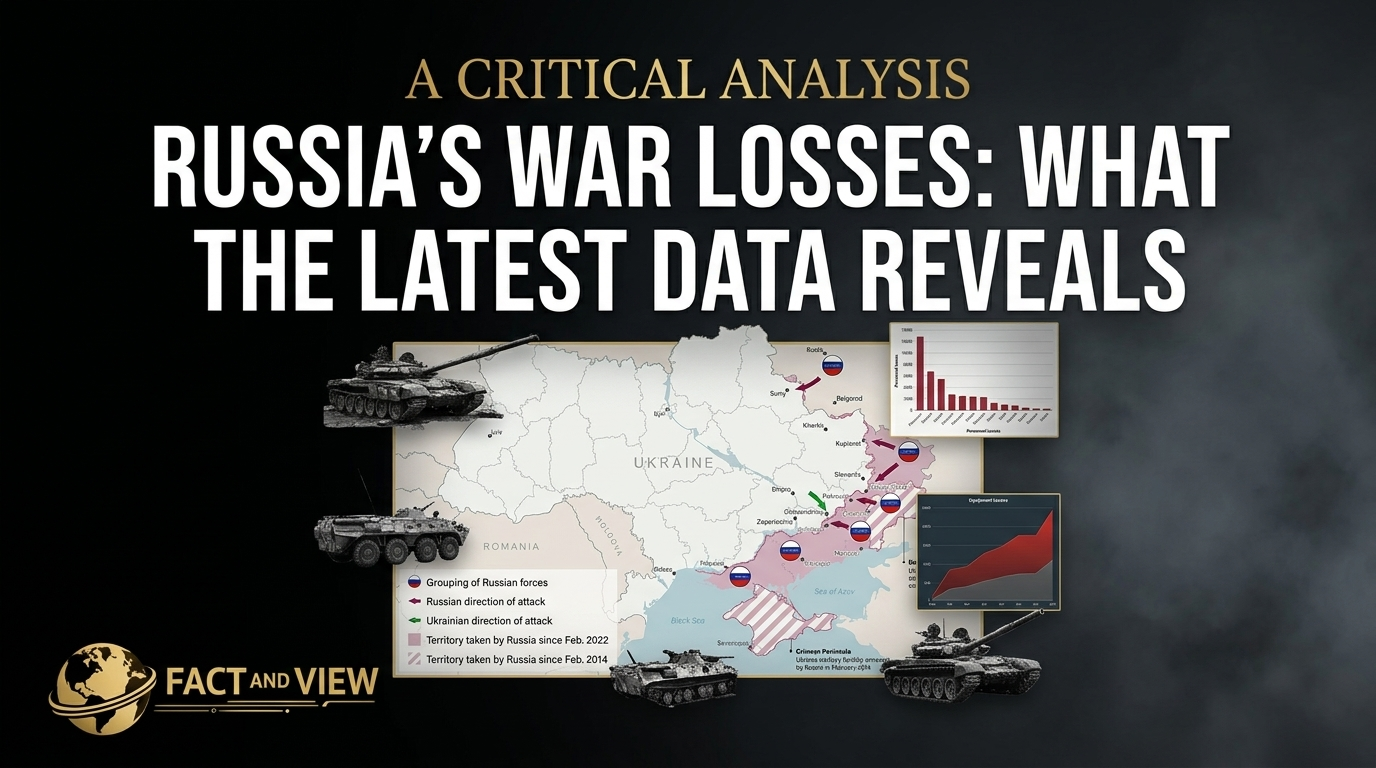
In May 2026, Vladimir Putin quietly did something no Russian leader had done in decades: he scaled back the country’s most sacred military tradition. The annual Victory Day parade in Moscow — a showcase of Russian military might dating back to World War II — was trimmed and subdued, a direct concession to the threat of Ukrainian long-range drones. For a man who launched his war with the promise of a swift, triumphant campaign, the optics were devastating.
That moment of quiet retreat tells a bigger story — one that new data from the Center for Strategic and International Studies (CSIS) now quantifies in stark detail. Russia is not winning this war. By nearly every measurable indicator, it is losing ground, losing men, and losing momentum.
A Casualty Toll Without Modern Precedent
The headline number is almost incomprehensible: according to CSIS estimates, the Russian military has suffered 1.4 million battlefield casualties and as many as 450,000 deaths since its February 2022 full-scale invasion.
To put that in perspective, Russian fatalities in Ukraine are more than four times greater than all U.S. fatalities in all wars combined since World War II, and more than nine times greater than all Soviet and Russian fatalities in all wars combined since World War II.That includes Korea, Vietnam, Afghanistan, and Chechnya — all of them, combined, multiplied by nine.
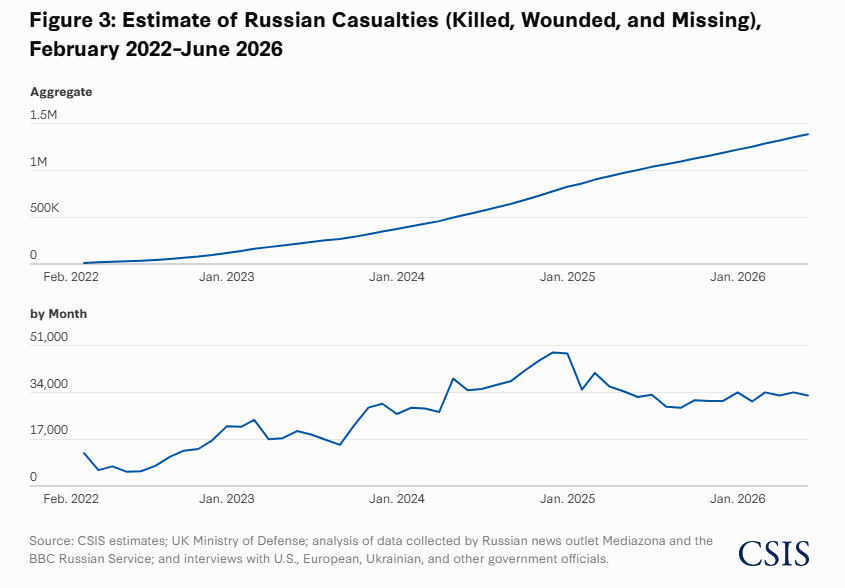
The human cost is compounding faster than Russia can replace it.Russia's monthly casualty rates of over 30,000 per month in 2026 have likely exceeded Russia's recruitment rates of roughly 27,000 new recruits per month.Moscow is now burning through soldiers faster than it can enlist them — a demographic trap that no army can sustain indefinitely.
Drones Are Doing the Killing
How has a smaller, outgunned military inflicted casualties of this scale on a nuclear superpower? The answer, increasingly, is drones.
According to some estimates, over 90 percent of Russian casualties are from drone attacks rather than a result of human-to-human engagements.The eastern front line has effectively become a drone kill zone stretching 20 to 40 kilometers wide, where any movement — vehicle or infantry — risks instant detection and strike. Russian commanders have adapted by sending small infiltration squads rather than massed assault formations, but the results are the same: soldiers walk into the kill zone and are destroyed, one small group at a time.
Ukraine has also dramatically taken the war to Russian soil itself.Ukraine has orchestrated a series of short-, medium-, and long-range strikes to disrupt and destroy Russian logistics and supplies — targeting oil refineries, rail lines, munitions depots, radar systems, and air defense installations. Strikes have reached St. Petersburg, Moscow, and even Ukrainka Air Base in Siberia, over 6,000 kilometers from Kyiv.
A new weapon is accelerating this campaign. Ukraine has deployed the Hornet, a one-way, autonomous attack drone that costs roughly $6,000 and has a range of up to 150 kilometers.The Hornet uses onboard AI to analyze live video, identify and classify targets, detect Russian decoys by their geometry and thermal signature, and strike — all without relying on satellite connections that Russian electronic warfare can jam. It represents a new class of threat: cheap, smart, and essentially immune to Russia’s primary countermeasures.
The Ground War: Moving at World War I Speeds
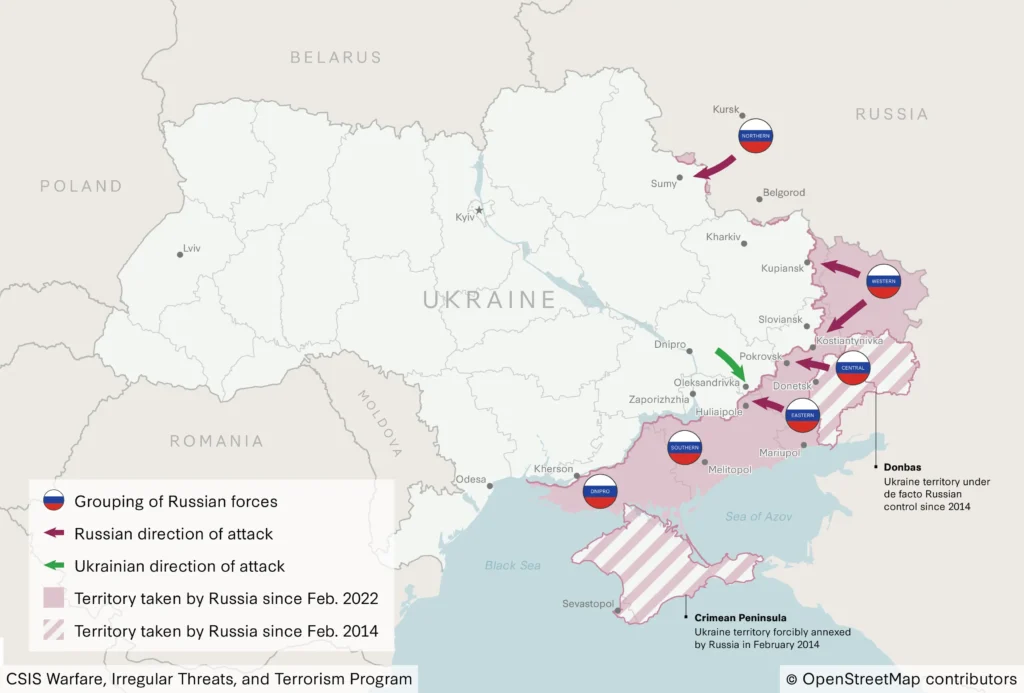
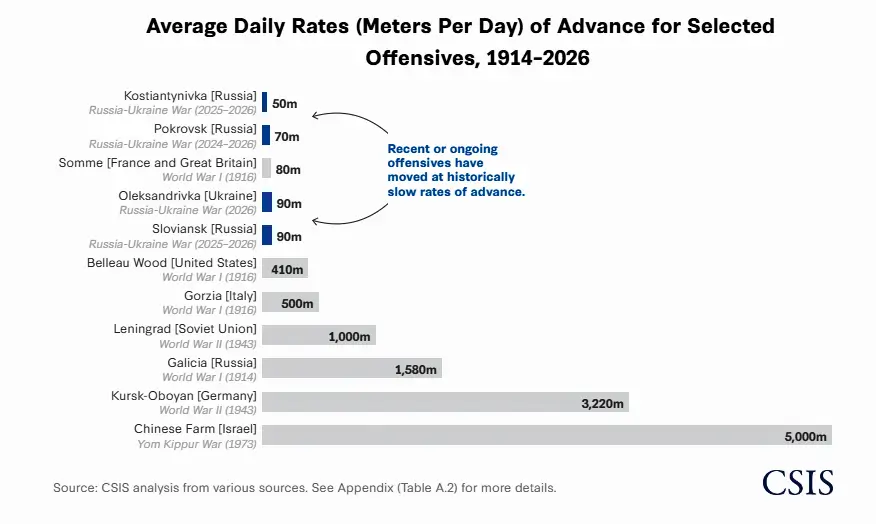
Russia’s ground offensive, meanwhile, has become a monument to futility. Russian forces advanced at an average rate of approximately 50 meters per day around Kostiantynivka, 70 meters per day around Pokrovsk, and 90 meters per day around Sloviansk.
Those numbers require context to fully absorb. These are among the slowest rates of advance in any war over the last century.The current Russian offensive is advancing at roughly the same pace as the Battle of the Somme in 1916 — one of the most catastrophically grinding engagements in human history. By contrast, modern combined-arms offensives historically move at thousands of meters per day.
The reason for this paralysis is the same drone saturation that is killing Russian soldiers at such alarming rates. Dense minefields and fortifications, combined with drone coverage across a zone more than 20 kilometers wide on each side of the front, make any large-scale armor concentration suicidal. Russia cannot mass its forces without becoming a target.
Pokrovsk — a key logistics hub in Donetsk Oblast — fell to Russian forces in late January 2026, but only after nearly two years of fighting, advancing approximately 50 kilometers at an average rate of about 70 meters per day.Two years. Fifty kilometers. That is the return on investment for Russia’s most significant recent territorial gain.
Russia Is Now Losing Territory
Then came the spring of 2026 — and Russia’s first net territorial losses in nearly two years. Russia's territorial control in Ukraine shrank in the spring of 2026, with a net loss of roughly 400 square kilometers in April and May.
Russian forces currently control approximately 118,000 square kilometers of Ukraine — about 20 percent of the country, an area roughly the size of Pennsylvania. But that footprint, which had relentlessly expanded since 2022, stopped growing and began to shrink. Ukrainian counterattacks along the Oleksandrivka axis in the south, as well as pressure across Kharkiv, Donetsk, and Zaporizhzhia Oblasts, drove Russia back.
These are not vast territorial swings. Both sides are maneuvering at historically slow rates, constrained by the same defensive landscape. But the direction of movement has reversed — and in a war where psychological momentum matters as much as geography, that reversal carries weight.
Continue reading from Fact and View:
- What Happens If US Debt Keeps Rising? — how dollar reserve erosion directly affects the financing of the $39 trillion national debt
- Fed Rate Hikes: Fighting Inflation or Slowing Growth? — the Fed independence questions intersecting with dollar policy debates
- Where Smart Money Is Moving Right Now (2026 Update) — the institutional gold-buying trend directly connected to dollar diversification
Putin’s Calculus: Pain Without End
None of this has stopped Russia from fighting. Despite high losses, Russia continues to fight — a decision that rests firmly with Putin, who has given no public indication he intends to slow down even as the war's costs grow harder to hide from a Russian public showing some signs of fatigue.
The grim arithmetic is that Russia retains enormous manpower reserves and a war economy that, while visibly strained, has not yet broken. Everyday Russians are absorbing tax increases, internet restrictions, grocery price spikes, and an increasingly repressive political climate — all to sustain a war that is killing their sons and brothers at a rate unseen in Russian history. Yet protest remains suppressed, and the Kremlin’s information architecture keeps most Russians from understanding the true scale of the losses.
The bitter irony of the Ukraine war is that despite Russia's battlefield challenges and economic vulnerabilities, the United States and Europe have failed to fully wield economic or military pressure.The tools exist — tighter sanctions on Russia’s oil shadow fleet, expanded military aid, more air defense systems for Ukraine — but they have been deployed inconsistently and often too slowly.
What the Numbers Are Really Saying
Step back from the individual statistics and a coherent picture emerges. Russia launched this war expecting a quick, decisive victory. Instead, it has fought for more than four years, suffered casualties that dwarf its entire modern military history, advanced at the pace of trench warfare, lost territory it had held for years, and watched its most prestigious military parade get quietly downsized because of drone threats.
Ukraine, for its part, has not won. It controls less territory than it did in February 2022. Its own casualty toll — estimated at 525,000 to 625,000 total casualties and up to 150,000 fatalities — is devastating for a smaller nation. The defensive advantages that have checked Russian advances also constrain Ukrainian counteroffensives. Rapid, sweeping territorial recovery remains out of reach.
The war in Ukraine heavily favors the defender, a dynamic that has frustrated Russian offensives but also constrained Ukrainian counterattacks.The most likely path to ending this war runs not through a decisive battlefield breakthrough by either side, but through a negotiated ceasefire reached when one side’s costs become politically unbearable.
Based on the data, that threshold is approaching faster for Moscow than for Kyiv.
The Lesson for America
For U.S. policymakers and military planners, this conflict is a live laboratory unlike anything available in recent decades. It demonstrates that cheap, mass-produced autonomous systems can impose strategic costs on a major conventional military. It shows that air superiority — once the exclusive domain of expensive fighter aircraft — can be contested by a nation with drone factories and software engineers. And it proves that sustained international support, even when uneven and politically contentious, can make the difference between a nation surviving and collapsing.
The question is whether the United States and its allies are drawing the right conclusions — and acting on them fast enough.