In April 2025, Ford shut down several of its manufacturing plants for weeks. The cause was not a labor strike, a parts shortage, or a demand collapse. It was magnets — specifically, the neodymium-iron-boron permanent magnets inside electric motors, sourced almost entirely from China, which had just imposed export controls on seven categories of medium and heavy rare earth elements. The shutdown cost Ford hundreds of millions of dollars and affected tens of thousands of workers.
That is what rare earth dependency looks like in practice.
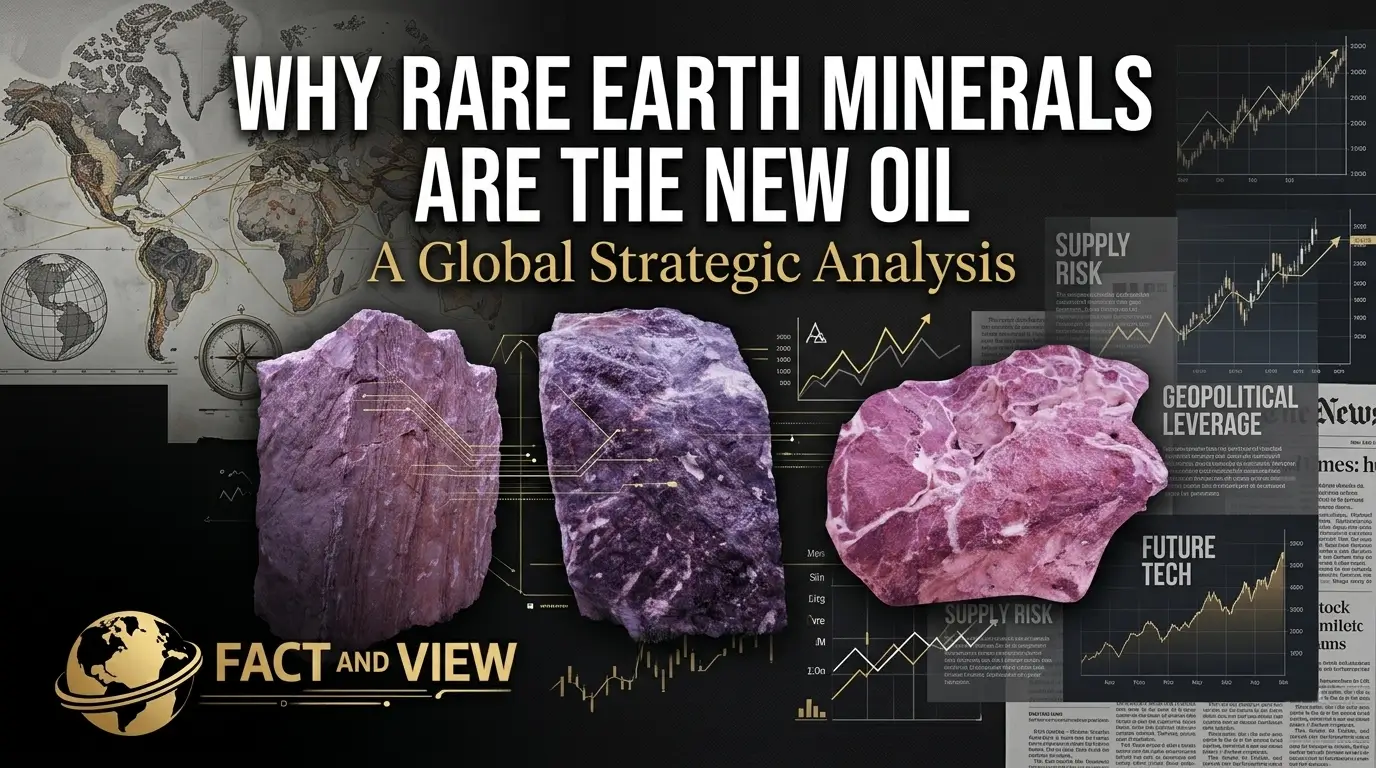
Rare earth elements — a group of 17 metals with names like neodymium, dysprosium, terbium, and yttrium — are invisible to most people because they never appear as a line item on any product they buy. They are embedded inside the EV battery, the smartphone screen, the F-35 fighter jet, the wind turbine, the MRI machine. Without them, the modern technology economy does not function. And as of 2026, one country controls approximately 80% of the world’s supply of the most critical ones. That country is China — and it has already demonstrated its willingness to use that control as geopolitical leverage.
The Big Picture: How Rare Earths Became a Weapon
The parallel to oil is not rhetorical. It is structural.
In 1973, the Arab oil embargo demonstrated that a small group of countries controlling a critical industrial input could bring Western economies to their knees by turning off supply. Oil’s strategic importance was visible for decades. No one saw the embargo coming as a political event until it happened. The rare earth situation in 2026 follows the same pattern: strategic dependency built over decades, now weaponized.
Fact: As of 2026, China maintains its grip across key segments of the rare earth value chain, particularly processing and refining. By 2035, China is projected to supply approximately 80% of battery-grade graphite and rare earth elements, over 60% of refined lithium and cobalt, and approximately 70% of battery-grade manganese, per ODI’s Critical Minerals Geopolitics in 2026 report.
Fact: China has progressively escalated its export controls architecture from 2023 through 2026. The timeline is precise and deliberate:
- December 2024: China banned exports of gallium and germanium to the U.S. — semiconductors and fiber optics immediately affected
- April 4, 2025: Export controls imposed on seven categories of medium and heavy rare earths including samarium, gadolinium, terbium, dysprosium, lutetium, scandium, and yttrium
- October 9, 2025: China introduced its most comprehensive restrictions to date — any foreign-made product containing 0.1% or more of Chinese-origin rare earths, or manufactured using Chinese processing technologies, now requires a license, extending Chinese regulatory authority across global supply chains
- January 1, 2026: Updated Export Licensing Catalogue added controls on rare-earth compounds including samarium, gadolinium, and lutetium
Fact: China and the U.S. reached a temporary mutual stand-down at the APEC summit in Busan (October 30, 2025), suspending the most aggressive October 9 measures until November 2026. China’s May 20, 2026 Ministry of Commerce statement described ongoing assessment of “civilian applications” — which STRASAM analysts interpret not as softening, but as “a selective opening of the door that will maintain controlled access,” per their May 2026 analysis.
The View: China’s export control architecture is not reactive. It is a deliberate, legally codified strategic instrument — as demonstrated by State Council Order No. 834, promulgated March 31, 2026, which created China’s first dedicated supply-chain security framework integrating export controls, investment screening, and data security obligations under a unified national security mandate. This is the rare earth equivalent of OPEC gaining the legal authority to embargo oil and control downstream refining simultaneously. The question is not whether China will use this leverage again. It is when and under what conditions.
Related reading: What Happens If a Global Conflict Escalates? Economic Impact — how rare earth supply shocks fit into the IMF’s framework for simultaneous geopolitical disruptions.
Deep Dive: Five Reasons Rare Earths Are the New Oil
1. They Are Irreplaceable in the Technologies That Define the Future
Oil powered the 20th century’s industrial economy. Rare earth elements power the 21st century’s technology economy — and there is currently no substitute for most applications.
The applications that cannot function without rare earths:
- Electric vehicles: Each EV motor contains approximately 1–2 kg of rare earth magnets (primarily neodymium and dysprosium). Global EV production is projected to exceed 40 million units annually by 2030.
- Defense systems: F-35 fighter jets require approximately 920 pounds of rare earth materials per aircraft. Virginia-class submarines contain over 9,200 pounds. Patriot missile systems, Tomahawk cruise missiles, and Javelin anti-tank systems all depend on rare earth components.
- Wind turbines: Each direct-drive offshore wind turbine requires approximately 600 kg of neodymium-iron-boron magnets. Global wind capacity additions require thousands of tonnes annually.
- Consumer electronics: Smartphones contain up to 17 different rare earth elements across screens, speakers, cameras, and vibration motors.
- MRI machines: Gadolinium-based contrast agents are essential for medical imaging — there is no clinically approved substitute.
Fact: Demand for neodymium, praseodymium, dysprosium, and terbium — the rare earths used in permanent magnets — is expected to rise by more than 30% by 2030, per IEA projections cited in STRASAM’s analysis. The critical minerals market is projected to reach $325 billion by 2030 — from approximately $200 billion today. Supply is constrained; demand is accelerating.
2. Supply Concentration Is Structurally Extreme
Oil’s strategic risk came from geographic concentration in the Middle East. Rare earth risk comes from geographic concentration in China — but it is more severe because it spans not just extraction but processing.
Fact: Diversification in the rare earths market has been limited by several factors. In the upstream segment, only a handful of mines outside China and Myanmar are operating at scale. Newly announced mining projects typically have lead times averaging around eight years. Refining development is even more nascent, with only a few industrial-scale processing facilities operating outside China — in Malaysia, the United States (MP Materials’ Mountain Pass facility), and Estonia.
Fact: Separation and refining processes are technically complex, and many rare earth ores for magnets contain radioactive elements such as uranium and thorium, with few countries having the infrastructure or regulatory framework to process them safely, per IEA analysis.
The View: The eight-year lead time for new rare earth mines is the single most important fact in this entire supply chain discussion. Even if the U.S., Australia, Canada, and the EU dramatically accelerate permitting and investment today, the first new supply capacity does not reach industrial scale until 2033–2034 at the earliest. China knows this arithmetic better than anyone. The temporary stand-down on export controls is not generosity — it is confidence that the dependency cannot be unwound within any politically relevant timeframe.
3. The Defense Dependency Is a National Security Crisis
For commercial applications, rare earth dependency is an economic problem. For defense applications, it is a national security crisis.
Fact: China’s most stringent rare earth and magnet export controls restrict products with even trace Chinese content — including any foreign-made product containing 0.1% or more of Chinese-origin material. This means a Japanese manufacturer using Chinese-processed rare earths to make magnets for a U.S. defense contractor technically falls under Chinese licensing authority, per CSIS analysis from October 2025.
U.S. defense vulnerability by platform:
- F-35 Lightning II: 920 lbs of rare earth materials per aircraft; no domestic alternative supply chain exists at scale
- DDG-51 Arleigh Burke-class destroyers: Multiple rare earth-dependent systems including sonar, propulsion motors, and guidance systems
- Guided missile systems: Samarium-cobalt magnets in precision guidance systems have no current domestic alternative
- Night vision equipment: Lanthanum-based lenses with no commercially viable substitute
The View: The export control architecture that China constructed between 2023 and 2026 is more surgical than the Ford plant shutdown headline suggests. China is not trying to destroy U.S. manufacturing. It is demonstrating, with precise and deniable calibration, that it could do so — and that any U.S. military or technological escalation carries a materials supply cost that will land in American factories, defense budgets, and ultimately consumer prices. This is the rare earth deterrent: not a declaration of war, but a permanent background leverage that reshapes every bilateral negotiation.
Related reading: How the Ukraine War Is Wrecking the Global Economy — the parallel to Russian energy leverage over Europe before the war.
4. The Ukraine Angle: $588 Billion in Rare Earth Opportunity
Ukraine holds approximately 30% of the world’s titanium reserves — and sits on confirmed deposits of lithium, cobalt, manganese, and graphite that have attracted strategic interest from the U.S., EU, and private capital simultaneously.
Fact: The total reconstruction cost estimate for Ukraine is $588 billion over the next decade, per the World Bank’s RDNA5 report from February 2026. The EU has explicitly committed to rebuilding Ukraine as “a strong, modern EU country.” A U.S.-Ukraine minerals agreement signed in early 2026 grants American companies priority access to Ukrainian critical mineral development as part of the broader security relationship.
Fact: The U.S.-Ukraine minerals deal represents Washington’s most concrete strategic move toward rare earth diversification since the war began. Ukraine’s lithium deposits alone, if developed, could supply a meaningful fraction of Europe’s battery production requirements — reducing dependency on both Chinese processing and Middle Eastern energy simultaneously.
The View: The Ukraine minerals angle transforms what looks like a geopolitical burden — billions in military and reconstruction aid — into a strategic investment in supply chain diversification. Whether that investment pays off depends on whether Ukraine’s territory is secure enough for mining development, which in turn depends on the war’s outcome. The rare earth calculus is one reason Washington views Ukrainian territorial integrity as a economic security issue, not just a humanitarian one.
5. The Investment Landscape: From Niche to Necessary
Three years ago, rare earth investment was a niche pursued by specialists. In 2026, it is entering mainstream institutional portfolios — driven by the same supply concentration risk that has driven gold allocations for generations.
The investable rare earth value chain:
- Mining: MP Materials (MP) — operator of Mountain Pass, California, the only active rare earth mine in the U.S.; direct beneficiary of Chinese export controls
- Processing: Lynas Rare Earths (LYSCF) — the largest rare earth processor outside China; processing facilities in Malaysia and Australia; building a Texas processing plant with U.S. DoD funding
- Magnets: Vacuumschmelze (VAC), TDK Corporation — rare earth magnet manufacturers with non-Chinese supply chains
- Diversified critical minerals: The Sprott Uranium Miners ETF (URNM) and VanEck Rare Earth/Strategic Metals ETF (REMX) offer basket exposure across the critical minerals complex
Fact: The U.S. government has provided direct funding to Lynas Rare Earths for its Texas processing facility — a rare example of the Defense Department treating a foreign mining company as a national security asset. This signals where government-directed capital is flowing in the critical minerals space.
Risks & Opportunities: Three Scenarios
Base Case (~45% probability): Managed Tension, Gradual Diversification
The U.S.-China stand-down on export controls holds through November 2026. New Western rare earth projects break ground but don’t reach production before 2033. China maintains its processing dominance. Prices for neodymium and dysprosium remain elevated, embedding a structural cost premium in EVs, defense systems, and electronics.
What this means for you: EV prices remain structurally higher than ICE alternatives for longer than analysts predicted. Defense procurement costs rise. Companies with vertically integrated rare earth supply chains — MP Materials, Lynas — outperform broader materials indices.
Upside Scenario (~25% probability): Western Supply Chain Success
Accelerated permitting, government funding, and private capital deliver new rare earth processing capacity ahead of schedule. Australia, Canada, and Greenland open new mining operations by 2029. Ukraine’s lithium and cobalt deposits begin early-stage development. Chinese leverage is partially offset.
What this means for you: EV battery costs fall faster than consensus. Defense procurement costs stabilize. REMX and REMX-adjacent ETFs deliver strong returns as Western processing capacity is valued at a premium above Chinese alternatives.
Downside Scenario (~30% probability): Export Controls Reimposed, Supply Shock
The November 2026 stand-down deadline arrives and China reinstates full October 2025 controls. Ford-type plant shutdowns occur across multiple U.S. manufacturers simultaneously. Defense procurement delays affect F-35 and guided weapons production. Antimony and dysprosium prices spike to new records.
What this means for you: Manufacturing cost inflation in EVs, electronics, and defense contracts passes through to consumer prices and government budgets. This is the scenario where rare earth exposure in a portfolio — through REMX, MP Materials, or Lynas — provides the strongest relative performance, as supply shocks directly increase prices for domestically sourced materials.
Related reading: Best Investments During Inflation (2026 Guide) — how critical minerals fit into the real asset inflation hedge framework alongside gold and energy.
The Bottom Line
Rare earth minerals are the new oil not because they are chemically similar to petroleum, but because they share the same structural characteristic that made oil so geopolitically explosive: they are non-substitutable critical inputs that a small number of producers control, in a world of accelerating demand.
Oil’s strategic era lasted from the 1973 embargo to the U.S. shale revolution of the 2010s — roughly 40 years. The rare earth strategic era is beginning now, and the equivalent of the shale revolution — sufficient Western processing and refining capacity to break Chinese leverage — is at minimum 8–10 years away.
For investors:
- REMX (VanEck Rare Earth/Strategic Metals ETF) provides diversified exposure to the rare earth supply chain, including mining, processing, and magnet manufacturers
- MP Materials (MP) is the only integrated rare earth producer in the U.S. — direct leverage to any export control escalation
- Lynas Rare Earths (LYSCF) is the largest non-Chinese processor globally, with U.S. DoD-funded capacity expansion in Texas
- Critical minerals exposure belongs in the same portfolio bucket as gold and energy — real assets that appreciate when geopolitical risk reprices supply chain vulnerability
For businesses:
- Any company using neodymium, dysprosium, or samarium magnets in its products — from EV motors to industrial automation to defense subcontracting — should audit its supply chain for Chinese-origin content exposure immediately
- The November 2026 stand-down expiration is the next binary risk event — build 6-month raw material inventory before October if operationally feasible
- Explore U.S. Department of Commerce and DoD critical minerals financing programs, which are actively funding domestic alternatives to Chinese processing
For consumers:
- The rare earth supply squeeze embeds a structural cost premium into EVs, electronics, and any technology with precision motors — expect prices to remain elevated regardless of what inflation does elsewhere
- If you are in the market for an EV, the current price represents the “constrained supply” price, not a distortion — it is unlikely to fall significantly faster than rare earth supply chains diversify
The race to secure rare earths is the defining geoeconomic competition of the coming decade. It will determine the cost of your next car, the capability of your country’s defense systems, and the energy transition’s pace and price. China understands this. The West is catching up — slowly.
FAQ
What are rare earth minerals and why do they matter?
Rare earth elements (REEs) are a group of 17 metallic elements including neodymium, dysprosium, terbium, yttrium, lanthanum, and cerium. Despite the name, most are not geologically rare — but they are extraordinarily concentrated in mineable deposits, which are predominantly in China. They are essential for permanent magnets in EV motors and wind turbines, semiconductors, defense guidance systems, consumer electronics screens and speakers, and medical imaging equipment. Demand is projected to rise 30%+ by 2030 as EV adoption, renewable energy, and defense spending all accelerate simultaneously. There are no commercially viable substitutes for the most critical applications.
Why does China control so much of the rare earth supply?
China’s dominance reflects decades of deliberate industrial policy investment — not just mining, but the technically complex and environmentally intensive refining and processing infrastructure that turns raw ore into usable materials. China processes approximately 80% of global rare earth elements. Outside China, only a handful of facilities in Malaysia (Lynas), the U.S. (Mountain Pass), and Estonia operate at industrial scale. Newly announced mining projects take an average of eight years from announcement to production. China’s dominance is not primarily about geology — it is about the sustained investment in downstream processing that other countries are only beginning to replicate.
What export controls has China placed on rare earths in 2026?
China has progressively escalated its rare earth export control architecture from 2023 through 2026. As of 2026, the key active measures include: export controls on seven categories of medium and heavy rare earths including samarium, gadolinium, terbium, dysprosium, lutetium, scandium, and yttrium (since April 2025); a temporary suspension of the most sweeping October 2025 measures until November 2026; and the January 1, 2026 expansion of the Export Licensing Catalogue to include additional rare-earth compounds. State Council Order No. 834 (March 31, 2026) created China’s first dedicated supply-chain security framework that integrates export controls with investment screening under a unified national security mandate.
How do rare earth export controls affect American consumers?
The most immediate consumer impact is through EVs and electronics. Rare earth export controls raise the cost of neodymium-iron-boron magnets — used in every EV motor — and reduce the availability of heavy rare earth elements used in electronics. Ford’s manufacturing shutdown from Chinese magnet supply disruption illustrates the direct transmission from rare earth control to manufacturing cost. For consumers, this embeds a structural cost premium in EVs, smartphones, and precision electronics that persists until Western supply chains develop sufficient non-Chinese capacity — which the IEA estimates will not happen before the early 2030s.
How do I invest in rare earth minerals?
Several vehicles provide exposure to the rare earth supply chain:
- VanEck Rare Earth/Strategic Metals ETF (REMX) — the most widely held rare earth basket ETF, holding miners and processors globally
- MP Materials (MP) — the only integrated U.S. rare earth miner and processor; Mountain Pass, California; direct beneficiary of any Chinese export control escalation
- Lynas Rare Earths (LYSCF) — Australia-based, largest rare earth processor outside China; building DoD-funded Texas processing facility
- Sprott Physical Uranium Trust (SRUUF) — uranium is not a rare earth, but it shares the same critical minerals investment thesis as demand for nuclear power grows alongside AI data center load
For most investors, REMX provides the broadest, most liquid exposure without single-stock concentration risk. Track rare earth pricing and supply data at the USGS Mineral Resources Program.
What is the US doing to reduce dependence on Chinese rare earths?
Several parallel initiatives are underway in 2026:
- MP Materials domestic supply chain: The U.S. government has contracted with MP Materials to supply rare earth magnets for defense applications from Mountain Pass, California
- Lynas Texas processing facility: Funded partly by DoD contracts to create non-Chinese heavy rare earth processing capacity in the U.S.
- U.S.-Ukraine minerals agreement: Grants American companies priority access to Ukrainian critical mineral reserves — lithium, cobalt, titanium — as a long-term supply diversification strategy
- DoE critical minerals loan program: Financing for domestic mining and processing projects under the Inflation Reduction Act’s critical minerals provisions (not yet reversed by the OBBBA)
- Permitting reform: The OBBBA includes provisions to streamline federal mining permits, though full effect is 3–5 years away
None of these initiatives produces industrial-scale output before 2030 at the earliest. The IEA’s eight-year project lead time is the binding constraint regardless of political will or capital availability.
Where can I track rare earth prices and supply chain developments?
Primary sources for monitoring this market:
- USGS Mineral Resources Program — official U.S. government mineral production and pricing data, updated annually
- IEA Critical Minerals Tracker — demand and supply projections for all energy transition minerals
- CSIS Critical Minerals Security Program — policy analysis and export control tracking
- ODI Critical Minerals Geopolitics — 2026 supply chain risk analysis
- Benchmark Mineral Intelligence — real-time pricing for lithium, cobalt, rare earths, and battery materials
- Visual Capitalist — Critical Minerals Charts — visual supply chain concentration data
Sources: ODI — Critical Minerals Geopolitics 2026 · Clark Hill — China Rare Earth Export Controls, May 2026 · CSIS — China Rare Earth Restrictions, October 2025 · IEA — Export Controls Supply Concentration · STRASAM — New Politics of Oil, May 2026 · Andersen Institute — China Export Control Architecture, May 2026 · Global Policy Watch — Heavy Rare Earths, February 2026 · Critical Minerals Journal — US-China Tariff Tangle · World Bank RDNA5, February 2026
© Fact and View, 2026. For informational purposes only. Not investment advice.