Every year, the Pentagon and America’s intelligence agencies publish a report that most Americans never read — and every year, it says roughly the same unsettling thing: China is building the military capability to take Taiwan by force, even if it hasn’t decided to use it. The Pentagon’s most recent assessment says the People’s Liberation Army is aligning its forces to give Xi Jinping “credible military options” for a decisive victory over Taiwan by 2027. America’s own intelligence community, releasing its own report just weeks later, offered a more measured read: Beijing does not currently plan to invade in 2027, and has no fixed timeline at all.
Both statements are true. Both come from the U.S. government. And the gap between them is exactly why “what happens if China invades Taiwan” has become one of the most consequential hypothetical questions in the world economy — not because war is imminent, but because the answer touches your phone, your car, your retirement account, and the global economic order in ways almost no other single event could.
This is the clearest, most evidence-based answer available.
The Big Picture: Why This Question Won’t Go Away
Taiwan sits at the center of a strategic triangle that didn’t exist thirty years ago. It is a self-governing democracy of 23 million people that China considers a breakaway province. It is defended, ambiguously, by the United States under a 1979 law that promises to help Taiwan defend itself without explicitly promising to fight for it. And it manufactures the overwhelming majority of the world’s most advanced computer chips — the ones inside your iPhone, your car’s safety systems, and every major AI data center on Earth.
Fact: Taiwan Semiconductor Manufacturing Company (TSMC) accounts for roughly 70% of global foundry revenue and produces the vast majority of the world’s most advanced logic chips. The combined market capitalization of TSMC’s top customers — including Apple, Nvidia, and Qualcomm — approaches $14 trillion.
Fact: In December 2025, the U.S. Department of Commerce and National Security Council convened Apple, Nvidia, AMD, and Qualcomm for a closed-door briefing on 2027 Taiwan supply chain risk. Officials shared internal simulations showing that a complete cutoff of Taiwanese chip supply could contract U.S. GDP by as much as 11% — a shock exceeding the Great Depression and roughly double the 2007–2009 financial crisis.
Fact: The U.S. intelligence community’s March 2026 Annual Threat Assessment concluded that Chinese leaders “do not currently plan to execute an invasion of Taiwan in 2027, nor do they have a fixed timeline for achieving unification.” That assessment softened the alarm sounded by then-INDOPACOM commander Admiral Phil Davidson in 2021, when he told Congress China wanted to be ready to invade by 2027 — a warning now known simply as the “Davidson Window.”
The View: The most useful way to think about Taiwan risk isn’t as a prediction of when war happens — nobody, including Chinese leadership itself, may have decided that yet. It’s as a standing structural risk that global markets, supply chains, and pension funds have priced far too casually for far too long, precisely because it hasn’t happened yet. The 2026 intelligence assessment lowering the near-term alarm doesn’t eliminate the risk; it just moves the clock, not the stakes.
Related reading: What Happens If a Global Conflict Escalates? Economic Impact — the IMF’s broader framework for how simultaneous geopolitical shocks compound across the global economy.
The Economic Shock: What $10 Trillion Actually Means
Bloomberg Economics has run the most detailed modeling publicly available, examining five scenarios ranging from a full Chinese invasion to peaceful rapprochement. The invasion scenario is the one worth understanding in detail.
Fact: Bloomberg Economics estimates a full-scale war triggered by a Chinese invasion of Taiwan, drawing in the United States, would cost the global economy approximately $10.6 trillion in the first year alone — roughly 9.6% of global GDP. For comparison, the 2008 financial crisis shrank global GDP by about 5%.
Fact: Under Bloomberg’s modeling, the economic damage would not be distributed evenly:
- Taiwan’s own economy would contract by approximately 40%, based on comparable historical conflicts, with its coastal population and industrial base absorbing direct war damage
- China’s GDP would fall by roughly 16.7%, driven by Western sanctions cutting off trade and technology access
- U.S. GDP would decline by approximately 6.7%, driven primarily by the loss of Taiwanese semiconductors and disruption to Apple’s Asian supply chain
- The broader world economy would contract by roughly 10.2%, with South Korea, Japan, and other East Asian economies hit hardest after the direct combatants
Fact: A separate, less catastrophic scenario — a Chinese naval blockade of Taiwan rather than a full invasion — would still halt semiconductor exports within days, according to Rhodium Group analysis. Taiwan is the world’s 16th-largest trading economy, moving $922 billion in goods and services annually; nearly all of it would freeze in a blockade.
The View: The reason economists keep returning to the same eye-watering figures isn’t dramatization — it’s that no other single flashpoint on Earth combines this much military risk with this much economic concentration in one place. There is no OPEC-style spare capacity for advanced semiconductors. When Middle East oil supply is disrupted, alternative producers and strategic reserves cushion the blow within weeks. When Taiwan’s chip fabs go offline, there is, in the words of one industry analysis, “no other global production capability that could replace TSMC in the short or medium term.” That single fact is what separates the Taiwan scenario from every other regional conflict currently being modeled by Western economists.
Related reading: Is It Too Late to Invest in AI Stocks? — how concentrated the current AI investment boom already is in companies directly exposed to Taiwanese chip production.
The Military Reality: Invasion vs. Blockade
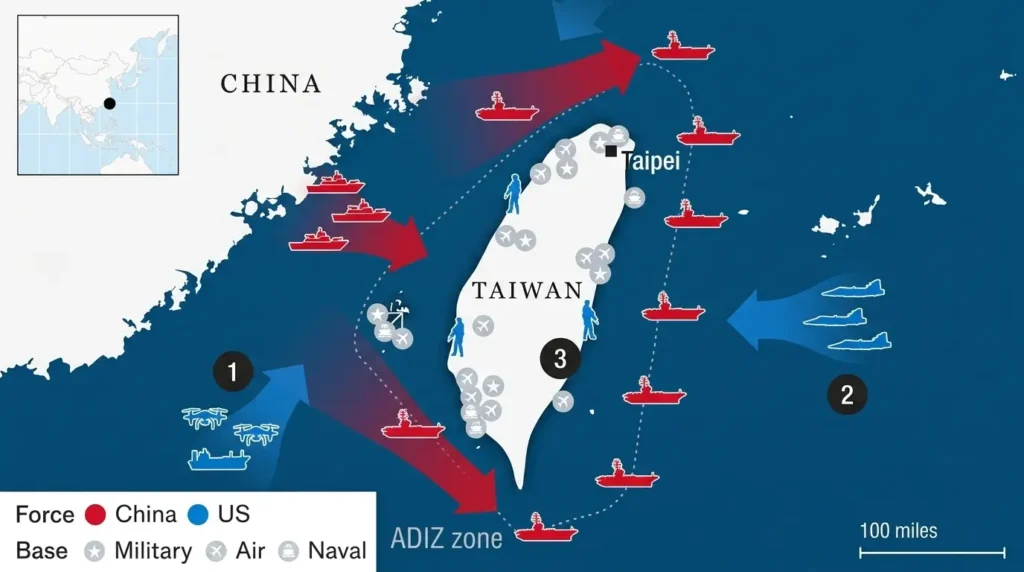
Not every Taiwan scenario looks like a full amphibious assault, and the distinction matters enormously for how the crisis would actually unfold.
Fact: A Center for Strategic and International Studies wargaming exercise, cited by the American Enterprise Institute, modeled a Chinese invasion prompting direct U.S. military intervention, with Japan and Australia joining the defense of Taiwan while most other nations offered only diplomatic support or economic sanctions. The exercise projected the conflict would last one to three weeks of intense naval and air combat in the Western Pacific.
Fact: Many defense analysts consider a full-scale amphibious invasion the least likely near-term scenario specifically because of the military obstacles involved. Taiwan’s mountainous terrain and narrow invasion beaches favor defenders. A late-2024 poll found two-thirds of Taiwanese citizens said they would personally fight to defend the island.
Fact: A blockade — closing Taiwan’s ports and air corridors without a direct assault — is viewed by many analysts as a more plausible pressure tactic, since it carries substantially lower military risk for Beijing while still inflicting the semiconductor and trade shock that alarms Washington.
Fact: Taiwan increased its defense budget by approximately 7.5% from 2024 to 2025 and has run large-scale “rapid response” military exercises explicitly designed around a 2027 invasion contingency, according to Taiwan’s Ministry of National Defense.
The View: The invasion-versus-blockade distinction is where most casual commentary on this topic goes wrong. A full invasion is the scenario that generates headlines, but a blockade is the scenario military planners increasingly treat as the more realistic pressure point — cheaper for Beijing, harder for Washington to justify a full military response to, and almost as economically devastating to the world’s chip supply. Whether the United States would treat a blockade as a red line requiring military intervention, the same way it likely would an invasion, remains one of the most consequential open questions in American foreign policy.
Would the United States Actually Get Involved?
Fact: Under the Taiwan Relations Act of 1979, the U.S. is legally obligated to make available to Taiwan the defense articles and services necessary for it to maintain sufficient self-defense capability. The law does not explicitly commit U.S. forces to fight on Taiwan’s behalf — a deliberate ambiguity that has shaped U.S. policy for over four decades, often described as “strategic ambiguity.”
Fact: The Bloomberg Economics modeling explicitly assumes U.S. military involvement in its invasion scenario, along with successful U.S. efforts to enlist allies in coordinated, severe economic sanctions against China — an assumption Bloomberg’s own analysts flag as uncertain, noting that sustained sanctions require political will that is not guaranteed in advance.
The View: Strategic ambiguity has kept the peace across the Taiwan Strait for over 40 years precisely because it leaves Beijing uncertain about the cost of aggression while avoiding a formal commitment that might encourage Taiwanese independence moves Beijing would find intolerable. Whether that ambiguity holds under an administration signaling different priorities on any given week is a live policy debate — and one reason Taiwan’s own government has accelerated its defense spending rather than relying solely on American guarantees.
Risks & Opportunities: Three Scenarios
Base Case (~55% probability): Continued Coercion, No Invasion
China continues “gray-zone” pressure — military drills, air incursions, economic coercion, and political interference in Taiwanese elections — without crossing into direct military action. This matches the current U.S. intelligence assessment. Markets continue mispricing the tail risk, and semiconductor supply chains remain concentrated in Taiwan by default.
What this means for you: No immediate disruption, but the underlying concentration risk in your investment portfolio — particularly in any fund heavy in Apple, Nvidia, or broad tech indices — remains unaddressed.
Upside Scenario (~20% probability): Diversification Accelerates Peacefully
Rising awareness of Taiwan risk accelerates Western investment in alternative chip manufacturing — TSMC’s own Arizona facilities, Samsung’s U.S. expansion, and new fabs under the CHIPS Act framework — reducing global dependence on a single geography without requiring a crisis to force the change.
What this means for you: A gradual, less dramatic version of the reshoring trend already visible in rare earth minerals and critical supply chains, reducing long-term portfolio concentration risk.
Downside Scenario (~25% probability): Blockade or Invasion Occurs
Either a blockade or full invasion materializes within the next several years, triggering the Bloomberg-modeled economic shock: global GDP down roughly 10%, U.S. GDP down roughly 6.7%, and a semiconductor supply freeze with no short-term substitute.
What this means for you: This is the scenario in which diversification — across geography, sector, and asset class — stops being theoretical portfolio advice and becomes the difference between manageable and catastrophic personal financial exposure.
The Bottom Line
The honest answer to “what happens if China invades Taiwan” is that nobody — not Bloomberg, not the Pentagon, not Beijing’s own military planners — knows with certainty, because so much depends on choices that haven’t been made yet: whether China invades or blockades, whether the U.S. and its allies intervene militarily, and whether sanctions hold together under economic pressure.
What is not uncertain is the exposure. A meaningful share of the S&P 500’s market capitalization now sits inside companies that depend, directly or indirectly, on a 110-mile strait that Chinese and American warships already patrol. That concentration didn’t happen because investors ignored the risk — it happened because the underlying companies are genuinely excellent, and diversifying away from them has a real opportunity cost.
For ordinary Americans, the practical takeaway isn’t to panic-sell technology stocks. It’s to understand, clearly, why this specific geopolitical fault line commands more sustained attention from economists, the Pentagon, and Wall Street than almost any other, and to factor that concentration honestly into long-term financial planning rather than discovering it during a crisis.
Continue reading from Fact and View:
- What Happens If a Global Conflict Escalates? Economic Impact — the IMF’s formal scenarios for how simultaneous global conflicts compound economic damage
- Why Rare Earth Minerals Are the New Oil — the broader race to reduce Western dependence on concentrated Asian supply chains
- Where Smart Money Is Moving Right Now (2026 Update) — how institutional investors are hedging geopolitical concentration risk right now
FAQ
How likely is China to invade Taiwan?
No credible near-term consensus exists. The U.S. intelligence community’s March 2026 Annual Threat Assessment concluded Chinese leaders “do not currently plan to execute an invasion of Taiwan in 2027, nor do they have a fixed timeline for achieving unification.” The Pentagon’s own report, released separately, said the PLA is building the capability for a “decisive victory” by 2027 — a capability goal, not a confirmed invasion plan. Most analysts treat 2027 as a readiness benchmark set by Xi Jinping, not a scheduled invasion date.
How would a China-Taiwan war affect the U.S. economy?
Bloomberg Economics projects a roughly 6.7% contraction in U.S. GDP in the first year of a full conflict, driven mainly by the loss of Taiwanese semiconductors and disruption to Apple’s Asian supply chain. A separate U.S. government simulation shared with major tech firms found a complete chip cutoff could shrink U.S. GDP by up to 11% — a shock exceeding the Great Depression.
Why does Taiwan matter so much to the global economy?
Taiwan Semiconductor Manufacturing Company (TSMC) produces roughly 70% of the world’s foundry chip output and the overwhelming majority of the most advanced logic chips used in smartphones, cars, and AI systems. No alternative manufacturer can currently replace that capacity in the short or medium term, making Taiwan a single point of failure for the global technology economy.
Would the United States militarily defend Taiwan?
The Taiwan Relations Act of 1979 requires the U.S. to help Taiwan maintain its own defense capability, but does not explicitly commit American forces to fight for the island — a deliberate policy of “strategic ambiguity” maintained by successive administrations for over four decades. Economic models of a Taiwan conflict generally assume U.S. involvement, but that assumption is not a guarantee.
What’s the difference between a Chinese invasion and a blockade of Taiwan?
An invasion involves a direct amphibious assault, which many analysts view as the less likely near-term scenario due to Taiwan’s defensible terrain and determined resistance. A blockade — closing ports and air corridors without a direct assault — is considered a lower-risk pressure tactic for Beijing that could still halt semiconductor exports within days, producing much of the same economic shock with a lower military cost.
Sources: USNI News — China Not Committed to 2027 Taiwan Invasion, March 2026 · AEI — China & Taiwan Update, March 27, 2026 · CNN — US Re-Evaluating Taiwan Threat, March 2026 · Reuters — US Assesses China Not Planning 2027 Invasion · NY Post — Pentagon Report on China War Readiness · Insurance Journal / Bloomberg Economics — The $10 Trillion Fight, February 2026 · Insurance Journal — $10 Trillion Global Cost Analysis · AEI — How Disruptive Would a Chinese Invasion of Taiwan Be? · Rhodium Group — Blockade Scenario Analysis · Congress.gov — Taiwan: Defense and Military Issues, CRS Report · TradeBrains — Semiconductor Industry Impact Analysis · TradingView — $10 Trillion Reckoning Market Analysis
© Fact and View, 2026. For informational purposes only.