
Regional bank stocks are trading near 52-week highs. Also true: the United States has now recorded fifteen bank failures since 2020, with the most recent closing its doors on July 10. Both of those facts are accurate at the same time, and reconciling them is the real story for anyone trying to understand where regional banks stand in mid-2026. This isn’t a repeat of the sudden, headline-grabbing collapse of Silicon Valley Bank in 2023. It’s something slower and, in some ways, harder to read: a sector absorbing years of accumulated stress from commercial real estate, interest rates, and deposit competition, even as its stock prices tell a more optimistic story.
Here’s what the data actually shows, and what it means for anyone trying to separate signal from noise.
A Slow-Motion Crisis, Not a 2023 Repeat
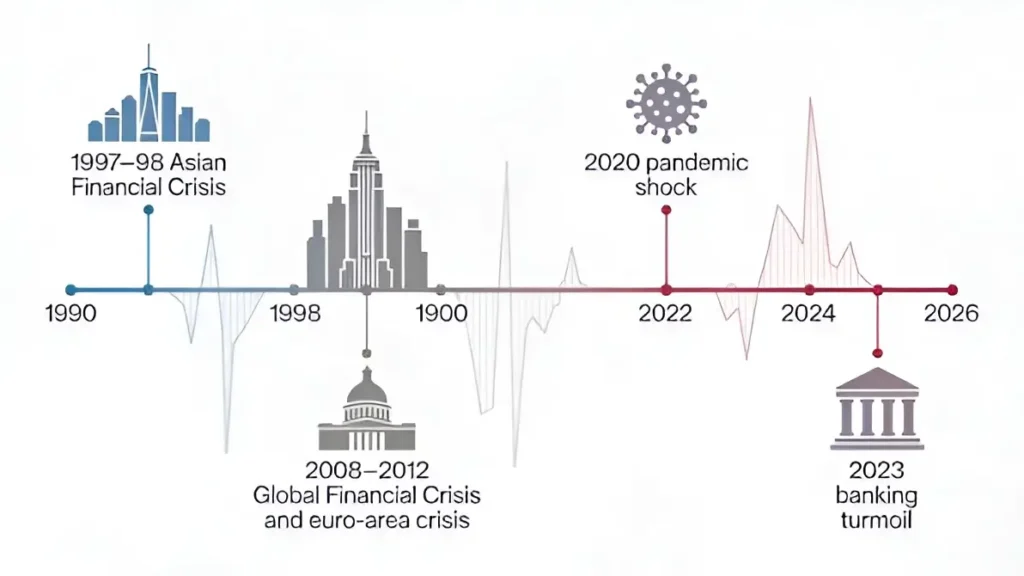
When people talk about a “regional banking crisis” in the US, they’re usually thinking of March 2023: Silicon Valley Bank collapsed in days, Signature Bank followed almost immediately, and First Republic went down two months later in the second-largest bank failure in American history. That episode was a classic bank run, supercharged by uninsured deposits that fled at digital speed once depositors lost confidence.
What’s unfolding now looks different. Since 2023, American Banker has tracked fifteen bank failures, but they’ve mostly been small, regional institutions with modest asset bases, resolved through orderly FDIC transactions rather than dramatic weekend rescues. The most recent, Kentland Federal Savings and Loan in Indiana, was the smallest standalone bank in the country. These aren’t SVB-style events. They’re a slower drip that analysts describe as evidence of persistent, structural stress rather than acute panic.
The Numbers Behind the Stress
Three data points capture the current state of the sector.
First, bond portfolio losses never fully healed. The American Enterprise Institute estimates that mark-to-market losses on bank bond holdings, caused by the Federal Reserve’s rate hikes earlier this decade, remain in the range of $600 billion system-wide. Those losses only become realized if a bank is forced to sell assets to meet deposit withdrawals, but they represent a persistent vulnerability sitting on balance sheets.
Second, commercial real estate remains the central risk. A National Bureau of Economic Research study cited by AEI estimated that if interest rates stay near current levels, a wave of commercial property loan defaults could push as many as 385 regional banks toward failure, a scenario researchers have compared to the savings-and-loan crisis of the 1980s. Office vacancies remain elevated as remote and hybrid work persist, and banks like New York Community Bancorp have already taken sizable earnings hits tied to souring commercial mortgage books.
Third, the stock market has, for now, shrugged much of this off. The SPDR S&P Regional Banking ETF (KRE), which tracks roughly 140 regional bank and thrift stocks, was trading around $75 in mid-July, near the top of its 52-week range of $57.55 to $76.84. That’s a notable recovery from March 2, 2026, when a single-day selloff wiped roughly 5% off both KRE and the broader SPDR S&P Bank ETF (KBE) amid fears of a “yield curve twist,” a scenario in which banks pay more to retain deposits while earning less on new long-term loans, squeezing profitability from both directions.
Why the Fed’s New Leadership Matters Here
Monetary policy sits at the center of almost every regional bank story, and 2026 brought a genuine changing of the guard. Kevin Warsh was confirmed as the 17th chair of the Federal Reserve in a narrow, historically divisive Senate vote and took over from Jerome Powell in May. His arrival came amid an unusually split Federal Open Market Committee, and at his first meeting as chair in June, the Fed held rates steady, citing elevated inflation driven partly by volatile energy prices.
For regional banks specifically, the interest rate path matters enormously. Higher-for-longer rates keep funding costs elevated for deposit-dependent lenders while continuing to pressure the value of CRE loans originated when rates were lower. Futures markets tracked by the CME’s FedWatch tool have shown investors pricing in few, if any, rate cuts through the rest of 2026, a very different picture than the two cuts many expected entering the year. That’s the backdrop against which any “regional banking crisis prediction” has to be read: relief in the form of lower funding costs hasn’t arrived yet, even if it’s still on the table for 2027.
US Regional Banking Crisis Predictions: The Bull Case and the Bear Case
Serious analysts are genuinely split, and it’s worth laying out both arguments rather than picking a winner.
The bear case, articulated by AEI and echoed by the International Monetary Fund and Fitch Ratings, centers on the CRE maturity wall: a large volume of commercial property loans originated at low rates that must be refinanced at today’s higher rates, potentially triggering defaults concentrated among smaller, less diversified lenders that lack the wealth management and investment banking revenue that cushions larger banks. Bankers themselves aren’t fully at ease either: an American Banker survey found a meaningful share of bankers worried about a possible recession and a volatile regulatory environment in 2026, with credit unions expressing the least confidence in their own institutions’ preparedness.
The bull case points to a different set of facts: economic growth projected around 2.2% for 2026 by industry groups like the American Bankers Association, inflation gradually moderating toward the Fed’s target on some measures, and a wave of deregulation under the current administration that bank executives argue frees up capital for lending rather than compliance. This deregulatory push has also fueled a pickup in bank mergers and acquisitions, with several regional players completing or announcing deals in recent months, consolidation that can strengthen balance sheets even as it shrinks the number of independent community banks.
Where both camps agree: this is not a monolithic, sector-wide crisis in the way 2008 was. It’s a bifurcated environment where well-capitalized banks with diversified loan books are likely to keep performing fine, while banks with concentrated CRE exposure or heavy reliance on uninsured deposits remain genuinely vulnerable.
Stock Analysis: How Investors Are Actually Positioning
For investors trying to get exposure to regional banks without betting on any single institution’s balance sheet, diversified vehicles like KRE remain the most common approach. Because the underlying index is equal-weighted rather than weighted by market capitalization, KRE gives roughly similar exposure to smaller, higher-risk names and larger, steadier ones like M&T Bank, Citizens Financial, and Truist, which somewhat offsets single-stock risk while still leaving the fund more volatile than broad market ETFs.
Individual regional bank stocks have shown a wide dispersion in performance, reflecting how differently the market is treating banks with strong versus weak CRE books. That dispersion is itself a signal: rather than treating “regional banks” as one trade, markets appear to be pricing individual balance sheet quality more carefully than they did in the immediate aftermath of the 2023 crisis, when fear briefly dragged down healthy and troubled banks alike.
It’s worth noting plainly that nothing here constitutes personalized investment advice. Individual bank fundamentals vary enormously, and any decision about specific stocks should involve independent research or a conversation with a licensed financial advisor, particularly given how sensitive this sector is to CRE exposure that isn’t always obvious from headline financial statements.
What This Means for Depositors, Not Just Investors
It’s easy to focus purely on stock performance and forget that regional banks also hold everyday Americans’ savings. The FDIC insures deposits up to $250,000 per depositor, per bank, and every failure tracked by American Banker since 2023 has been resolved with insured depositors made whole, typically through an acquiring bank absorbing the failed institution’s accounts within days. The more persistent risk, according to industry analysts, involves deposits above that threshold, which is why treasury management firms increasingly advise businesses and high-net-worth individuals to diversify large cash balances across multiple institutions rather than concentrate them at a single regional bank.
The Bottom Line
The US regional banking crisis of 2026 isn’t a single dramatic event; it’s an ongoing, uneven adjustment to higher-for-longer interest rates and a commercial real estate market still working through its own reset. Stock prices near 52-week highs reflect real strength at well-run institutions and genuine optimism about deregulation and eventual rate relief. Persistent bond losses, a real CRE maturity wall, and continued small-bank failures reflect the parts of the story that haven’t resolved. Both are true simultaneously, and both are worth watching heading into the back half of 2026, particularly as the Fed’s new leadership settles in and the next wave of commercial property loans comes due for refinancing.
Related Reading
- What Is Stagflation? Why Economists Fear It Again — the same combination of inflation and slower growth putting pressure on the Fed is a direct driver of the rate environment squeezing regional bank margins.
- How the US Treasury Prints and Borrows Money — for readers wanting the fundamentals of how Fed policy and Treasury yields, both discussed here, actually work.
Sources
- American Banker — “15 most recent bank failures”
- R&T Deposit Solutions — “Addressing Banking Stress After the Latest Bank Failure of 2026”
- American Enterprise Institute — “The Regional Bank Crisis Is Not Over”
- Morningstar — “Is There a Credit Storm Brewing for US Banks?”
- Arlingclose — “Should You Worry About the First US Bank Failure of 2026?” (arlingclose.com)
- American Banker — “Exclusive research: Bankers fear recession in 2026”
- FinancialContent / MarketMinute — “The 2026 Banking Twist: Why Regional and Diversified Lenders Are Plunging Toward Support”
- Investing.com — KRE ETF price and performance data
- IndexBox — “Regional Banking ETF (KRE) Volatility and Outlook in 2026” (indexbox.io)
- Tickeron — “Why SPDR S&P Regional Banking ETF (KRE) Could Outperform in 2026” (tickeron.com)
- Brookings Institution — “Who has to leave the Federal Reserve next?” (brookings.edu)
- Chase — “Kevin Warsh Is the New Chair of the Federal Reserve” (chase.com)
- Kiplinger — “June Fed Meeting: Updates and Commentary” (kiplinger.com)
- Congress.gov / Congressional Research Service — “Federal Reserve Board: Current and Historical Membership”
Disclaimer: This article is for informational and educational purposes only and does not constitute financial or investment advice. Bank stock performance and sector conditions change quickly; readers should verify current data and consult a licensed financial advisor before making investment decisions.