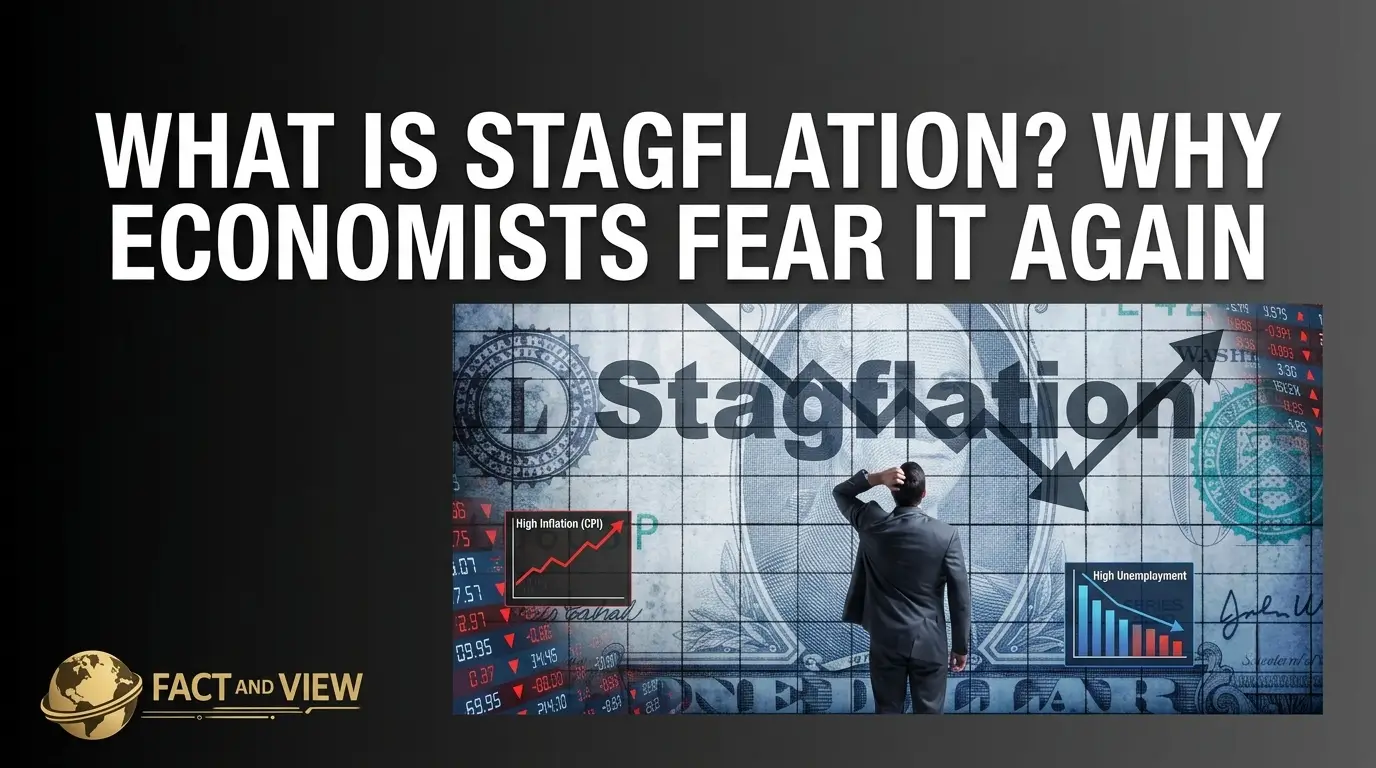
If you’ve turned on the news in 2026, you’ve probably heard the word “stagflation” more than once. Rising gas prices, stubborn inflation, and a cooling job market have brought back a term most Americans hadn’t heard since their parents talked about the 1970s. Understanding stagflation matters because it touches almost everything: what you pay at the grocery store, how easy it is to find a job, what your savings are worth, and what the Federal Reserve decides to do with interest rates. This guide breaks it down in plain English, with no economics degree required.
What Is Stagflation?
Stagflation is a combination of two economic problems that normally don’t happen at the same time: high inflation and a weak, slow-growing economy (often paired with rising unemployment).
To understand why that’s unusual, think about how the economy normally behaves. When the economy is booming, businesses hire more workers, people spend more money, and prices tend to rise because demand is strong. When the economy slows down, the opposite usually happens: businesses cut back, unemployment rises, and prices stay flat or even fall because people are spending less.
Stagflation breaks that pattern. Prices keep climbing even though the economy is stalling and jobs are harder to find. It’s like a car with the gas pedal and the brake pressed down at the same time.
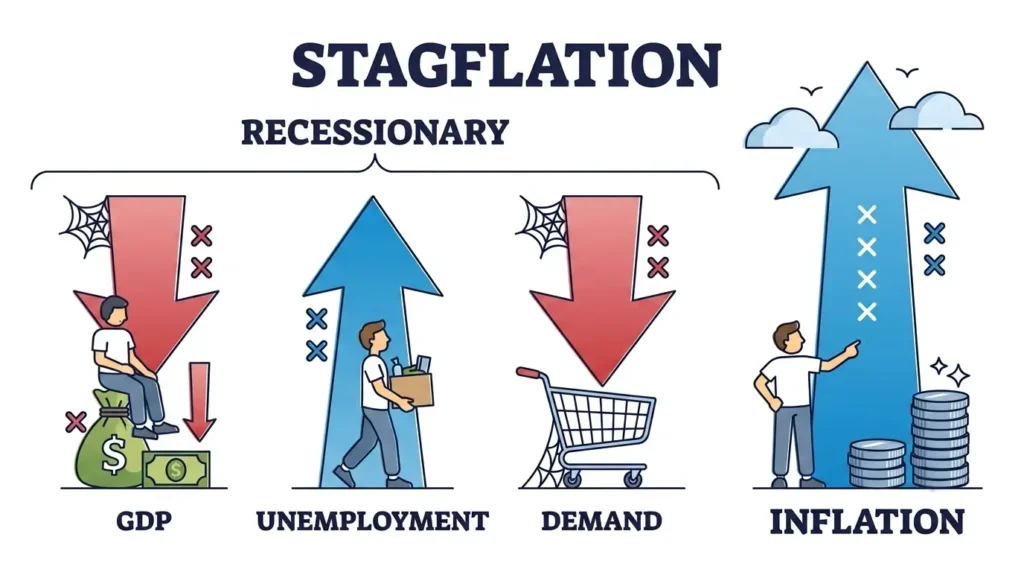
Real-world example: The most famous case happened in the United States during the 1970s. An oil embargo caused energy prices to spike, which pushed up the cost of nearly everything, from gasoline to groceries. At the same time, economic growth stalled and unemployment rose. Inflation and joblessness climbed together, something most economists at the time thought was nearly impossible.
Related reading: What Happens If US Debt Keeps Rising? — the fiscal context that shapes long-run Treasury market dynamics.
How Does Stagflation Work?
Stagflation usually develops through a chain reaction. Here’s a simplified, step-by-step look at how it can happen.
Step 1: A supply shock hits the economy
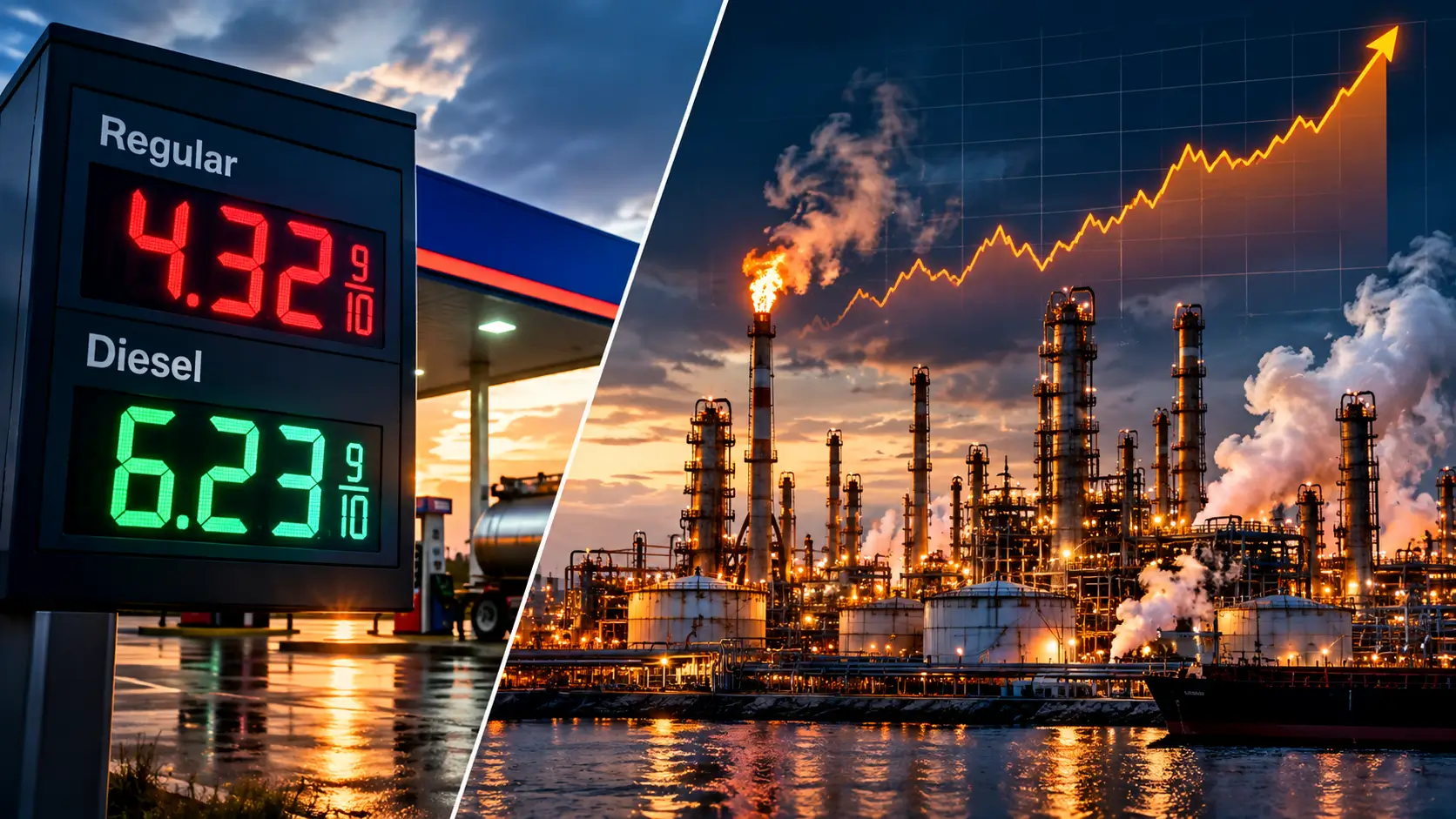
Something disrupts the supply of a key resource, most commonly oil or energy. This could be a war, a natural disaster, a trade dispute, or new tariffs (taxes on imported goods). When the cost of energy or imported materials rises, it becomes more expensive for businesses to make and ship products.
Step 2: Businesses raise prices
Companies pass along their higher costs to customers. This pushes up prices across the economy, which is what economists call inflation, a general increase in the price of goods and services over time.
Step 3: Growth slows down
As things become more expensive, people have less money left to spend on other goods and services. Consumer spending, which drives a large share of the U.S. economy, weakens. Businesses may also delay hiring or investment because costs are unpredictable.
Step 4: The job market weakens
As spending and business investment slow, companies may freeze hiring or lay off workers. Unemployment can rise even while prices keep climbing.
Step 5: Policymakers get stuck
This is the hardest part. The Federal Reserve, the U.S. central bank, normally fights inflation by raising interest rates, which makes borrowing more expensive and cools down spending. But raising rates during a weak economy risks pushing unemployment even higher. Lowering rates to help the job market, on the other hand, risks making inflation worse. There’s no easy fix, which is why stagflation is considered one of the toughest economic puzzles for policymakers.
Related reading: New US Laws in 2026: What They Mean for Americans — the full OBBBA provisions affecting Medicaid, SNAP, and healthcare simultaneously.
Why Does Stagflation Matter to Everyday Americans?
Stagflation isn’t just a headline for economists. It affects nearly everyone.
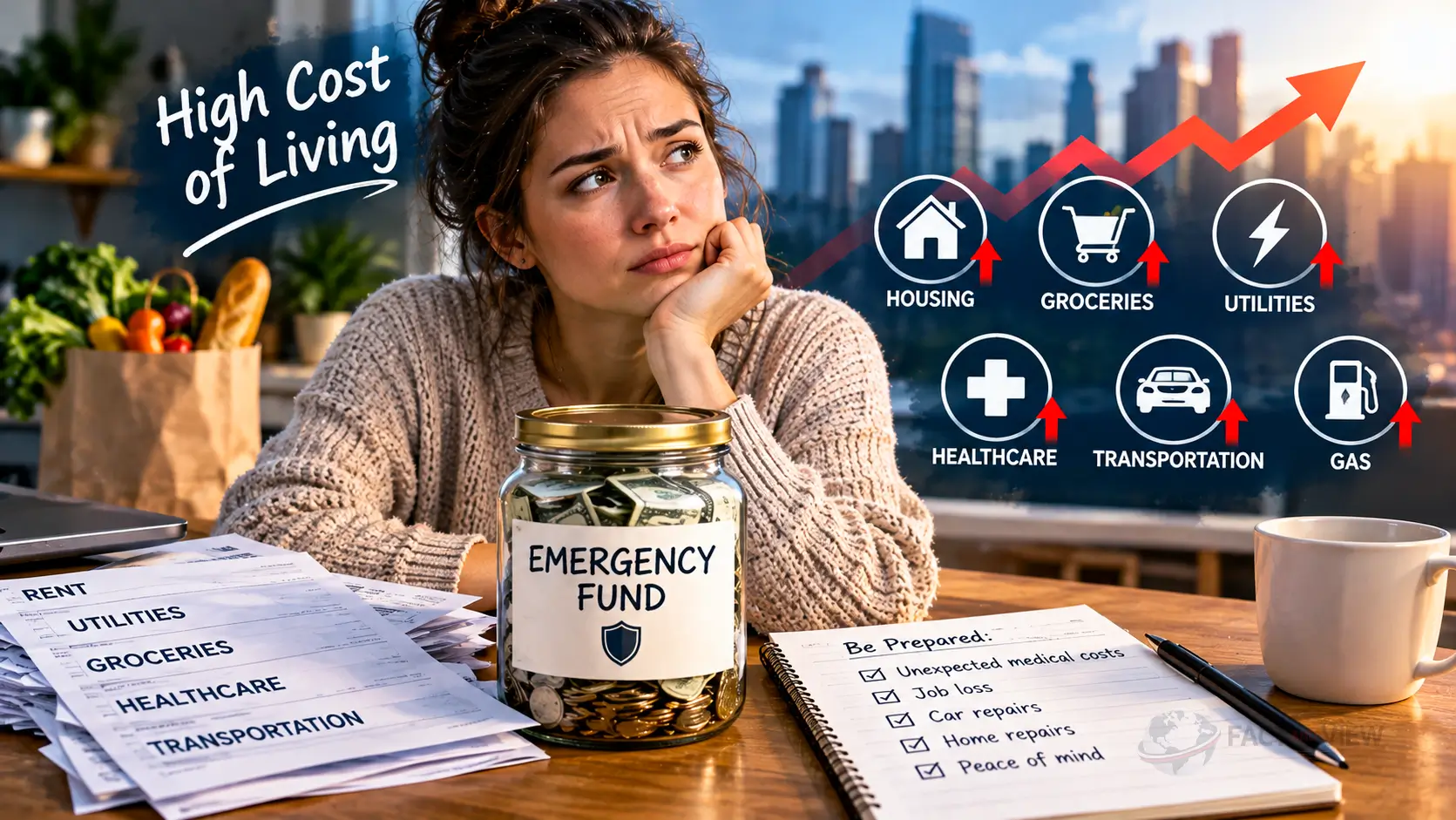
- Families and consumers feel the squeeze of paying more for groceries, gas, and housing while their paychecks may not stretch as far.
- Workers may face slower hiring, fewer raises, or job insecurity even as their cost of living rises.
- Businesses deal with higher costs for materials and labor while facing softer customer demand.
- Investors often see more market volatility, since stagflation makes it harder to predict company profits or interest rate decisions.
- Retirees and savers may find that inflation erodes the purchasing power of fixed incomes, pensions, or savings accounts.
- Taxpayers can be affected if the government spends more to cushion the economy, which can influence future tax policy or deficits.
In short, stagflation raises the cost of living while making it harder to get ahead through income growth, a frustrating combination for household budgets.
Why Are Economists Talking About Stagflation in 2026?
Concerns about stagflation resurfaced in 2026 for a few overlapping reasons. Inflation has stayed above the Federal Reserve’s long-standing 2% target for an extended stretch. At the same time, the labor market has shown signs of cooling, with hiring slowing and unemployment ticking up from the historic lows seen in prior years. Rising tariffs on imported goods have added to production and consumer costs, while a geopolitical conflict involving Iran pushed oil prices sharply higher for a period, echoing the type of energy shock that triggered stagflation in the 1970s.
These pressures have put the Federal Reserve in a familiar bind: inflation argues for higher interest rates, while a softening job market argues for lower ones. Economists are divided on how serious the risk is. Some believe current conditions are uncomfortable but manageable, a milder version sometimes called “stagflation lite.” Others warn that if energy prices or tariff-related costs stay elevated for a long time, the risk of a more serious and prolonged stagflation episode increases. As of mid-2026, most forecasters agree the outcome remains genuinely uncertain and will depend heavily on how energy markets, trade policy, and the labor market evolve over the coming months.
Related reading: US National Debt Explained: Should You Be Worried? — how the $39 trillion national debt and $1 trillion annual interest bill connect directly to Treasury market dynamics.
Potential Benefits (or Silver Linings) Related to Stagflation Awareness
Stagflation itself has no upside, but understanding the risk can help people prepare. Some practical advantages of awareness include:
- Better financial planning. Recognizing the signs early allows households to build emergency savings or reduce high-interest debt before conditions worsen.
- Diversification opportunities. Some investments, such as Treasury Inflation-Protected Securities (TIPS), which are government bonds that adjust with inflation, are specifically designed to help protect purchasing power.
- Policy attention. Rising concern about stagflation often pushes policymakers and the Federal Reserve to communicate more clearly about their plans, which can reduce uncertainty for businesses and consumers.
Risks and Criticism
Economists broadly agree that stagflation is difficult to manage and carries real risks:
- No easy policy fix. Traditional tools for fighting inflation (raising interest rates) can worsen unemployment, while tools for boosting jobs (lowering interest rates) can worsen inflation.
- Prolonged pain for households. Because wages often don’t keep pace with rising prices during stagflation, the cost-of-living squeeze can last for years, as it did in the 1970s.
- Market uncertainty. Stagflation tends to create volatile stock and bond markets, since investors struggle to predict corporate earnings or interest rate direction.
- Disagreement over causes. Economists don’t always agree on what’s driving current price pressures, such as tariffs, energy shocks, or government spending, which makes solutions politically and economically contentious.
Some economists caution against overusing the term “stagflation,” arguing that the U.S. would need much higher and more persistent inflation and unemployment, closer to 1970s levels, before the label truly applies. Others argue that even a mild version of the pattern deserves serious attention before it worsens.
Common Misunderstandings
Myth: Stagflation means the economy is in a full-blown recession. Reality: Stagflation refers to a mix of high inflation and weak growth or rising unemployment. It doesn’t always mean the economy is officially shrinking, though a recession can occur alongside it.
Myth: Stagflation only happened once, in the 1970s. Reality: While the 1970s remains the clearest historical example, milder stagflation-like conditions can occur at other times, including in periods of supply disruptions or energy shocks.
Myth: The Federal Reserve can easily fix stagflation. Reality: Stagflation is uniquely difficult because the usual tools for fighting inflation and unemployment work against each other.
Myth: Stagflation affects only investors or Wall Street. Reality: Because it raises everyday costs while threatening job security, stagflation affects nearly every household, not just financial markets.
FAQ
Is stagflation good or bad for the economy?
Stagflation is generally considered harmful. It combines the pain of rising prices with the stress of a weak job market, making it one of the more damaging economic conditions for households and businesses alike.
Who is most affected by stagflation?
Lower- and middle-income households tend to feel it most, since they spend a larger share of their income on essentials like food, gas, and housing. Retirees on fixed incomes and workers in industries sensitive to hiring slowdowns are also heavily affected.
Does stagflation affect me if I don’t invest in the stock market?
Yes. Even without investments, stagflation affects your cost of living, job security, and the interest rates on loans, credit cards, and mortgages.
Is stagflation permanent once it starts?
No, but it can be difficult to reverse quickly. Historically, ending stagflation has required a combination of time, changing energy or supply conditions, and consistent monetary policy.
Can stagflation be prevented?
Economists disagree on this. Some argue that early, decisive policy action can prevent it from taking hold, while others believe global shocks, like wars or supply disruptions, are largely outside a government’s control.
Is the U.S. currently in stagflation?
As of mid-2026, most economists say the U.S. is showing warning signs, elevated inflation alongside a cooling labor market, but not the severe, prolonged conditions seen in the 1970s. Views vary on how serious the risk is going forward.
How can I protect my finances if stagflation worsens?
Common strategies include maintaining an emergency fund, avoiding high-interest debt, and diversifying investments. Consulting a licensed financial advisor is recommended for personalized guidance, since individual circumstances vary widely.
The Bottom Line
Stagflation describes a rare and uncomfortable mix of high inflation and a weak or slowing economy, a combination that leaves policymakers with few good options and leaves households squeezed from both directions. In 2026, a combination of tariffs, energy price shocks, and a cooling job market has brought the term back into everyday conversation.
What readers should remember is that stagflation exists on a spectrum. Mild warning signs don’t necessarily mean a repeat of the 1970s, but they’re worth watching closely. Economists broadly agree on what stagflation is and why it’s hard to fix; where they disagree is on how likely a severe version is right now and what’s driving today’s pressures. Because inflation, jobs, and Federal Reserve policy remain closely watched and frequently changing, stagflation is likely to stay part of the economic conversation for the foreseeable future.
Sources: Stanford Institute for Economic Policy Research (SIEPR) — “The U.S. economy in 2026: What to watch for” · CNBC — “Some economists are warning about ‘stagflation.’ What it could mean for your money” — cnbc.com (March 2026) · CNBC — “Nearly 40% chances of stagflation by end of 2026, traders say” — cnbc.com (May 2026) · Unleashed Financial — “Feeling the Squeeze? Stagflation Explained 2026” · USA News Independent — “US Economy Forecast 2026: Recession or Growth? Navigating the ‘Stagflation’ Scare”
© Fact and View, 2026. For informational purposes only. Not investment advice. Always consult a qualified financial advisor before making investment decisions.