
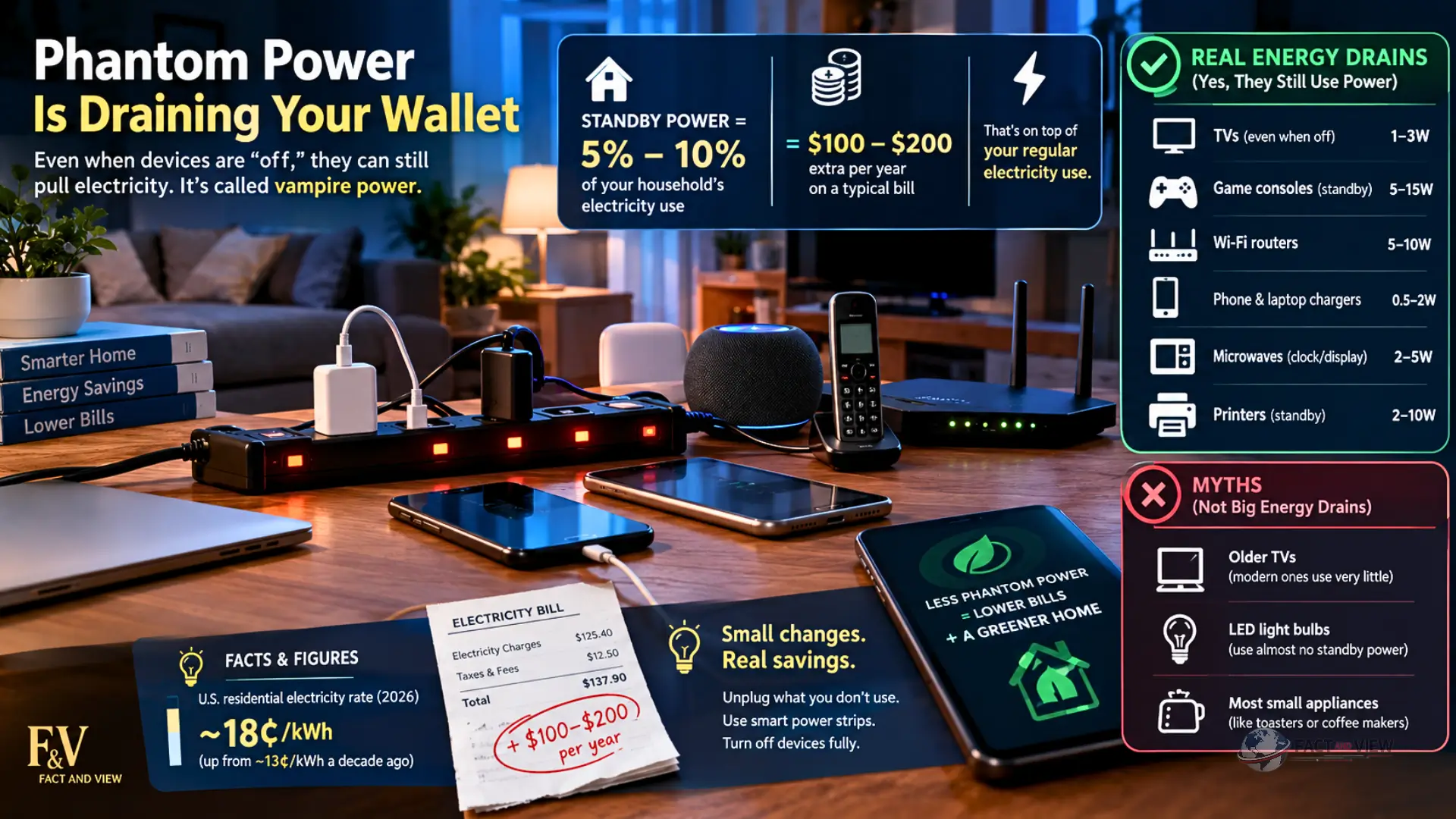
Somewhere in your house, devices that are technically “off” are still pulling electricity around the clock. The Department of Energy estimates this standby power, often called vampire power or phantom load, accounts for 5% to 10% of the average American household’s electricity use, adding roughly $100 to $200 a year to a typical bill depending on which devices and estimates are used.
That’s not a dramatic number on its own. But it’s also not nothing, especially with the average U.S. residential electricity rate running around 18 cents per kilowatt-hour in 2026, up from closer to 13 cents less than a decade ago. Here’s what’s actually drawing that power, and which of the usual suspects turn out to be a myth.
What “Vampire Power” Actually Is
Standby power is electricity a device uses while switched off, asleep, or otherwise not actively doing anything you asked it to do. A TV waiting for a remote signal, a DVR recording a show while you’re at work, a microwave keeping its clock running, all of it draws current continuously, just in small amounts.
Much of what’s known about which devices draw the most comes from Lawrence Berkeley National Laboratory’s long-running Standby Power research, a federal research program that has measured idle power draw across thousands of consumer devices.
The Worst Offenders in a Typical Home
Cable and satellite set-top boxes. DOE testing has consistently found these among the biggest standby draws in an average home, with many models pulling over 20 to 40 watts even while “off,” largely because they’re built to keep recording and updating program guides around the clock.
Older televisions. A TV bought before roughly 2015, before Energy Star’s standby requirements tightened, can draw enough idle power to cost $8 to $30 a year on its own. A modern Energy Star-certified TV, by contrast, typically draws under a dollar’s worth of standby power annually.
Game consoles left in instant-on mode. This is a setting problem as much as a device problem. A newer console in a low-power instant-on mode might draw around 10 watts, but an older console left in a full “rest mode” can pull 70 to 90 watts, comparable to leaving a light bulb on permanently, depending on the model and settings.
Desktop computers and monitors in sleep mode. Sleep mode is far better than leaving a machine fully running, but it’s not zero. A desktop and monitor combination left asleep rather than shut down can add up over a full year of continuous standby.
Appliances with digital clocks. Microwaves, coffee makers, and range ovens with built-in clocks draw a small, continuous trickle, often just a couple of watts each. No single one matters much, but a kitchen full of them adds up.
Stereo receivers and soundbars. Home audio equipment with a standby mode designed for instant power-on tends to run several watts continuously, one of the quieter but more persistent draws in an entertainment setup.
Wi-Fi routers and modems, technically, but with an important caveat covered below.
The Myth That Refuses to Die: Phone Chargers
Phone and laptop chargers get blamed constantly, and it’s mostly undeserved. A modern phone charger left plugged in but not charging anything typically draws between 0.1 and 0.5 watts, costing well under a dollar a year. Compare that to a single old-model game console in rest mode, which can cost 40 times more by itself.
The same logic applies to a Wi-Fi router or modem: yes, it draws power continuously, but unplugging it isn’t realistic for most households since it needs to stay on to actually work. Chasing chargers and routers while ignoring a cable box or an old TV is solving the wrong problem.
Why This Adds Up More Than It Used To
Two trends are quietly raising the stakes on standby power. First, electricity prices themselves have been climbing, so the same wasted kilowatt-hour costs more than it did five years ago. Second, the average home simply has more always-on devices than it used to, streaming boxes, smart speakers, gaming consoles, smart thermostats, doorbell cameras, each one adding its own small, continuous draw.
Neither trend is dramatic by itself. Together, they mean a phantom-load problem that was a rounding error a decade ago is a more real line item now, particularly for households already feeling the broader squeeze of rising day-to-day costs.
How Much You Can Realistically Save
The honest math favors targeting a handful of devices rather than unplugging everything in the house.
- Swapping an old cable box habit for a streaming-only setup, where practical, removes one of the single biggest offenders
- Changing a game console’s power settings from “instant-on” or “rest mode” to a true power-off takes 30 seconds and can cut that device’s standby cost dramatically
- A smart power strip for an entertainment center lets you cut power to several devices, TV, soundbar, DVD player, with one switch, rather than unplugging each individually
- Replacing a pre-2015 TV eventually pays back part of its cost through standby savings alone, though it’s rarely worth replacing a working TV for this reason alone
Doing all of this won’t transform a monthly bill. For a household with an old cable box and an older console left in rest mode, it can plausibly save somewhere in the range of $50 to $100 a year, real money for roughly an hour of effort, just not a dramatic one.
Quick Action Checklist
- Check your game console’s power settings tonight; this is the single highest-value, lowest-effort fix on this list
- Put your entertainment center on one smart power strip
- Skip unplugging phone chargers and routers; the payoff isn’t there
- When your next TV or set-top box needs replacing, check for the Energy Star label
The Bottom Line
Vampire power is real, well-documented by DOE and federal lab research, and worth a modest amount of attention, not panic. The actual savings sit mostly in a handful of specific devices, old cable boxes, older TVs, and consoles left in power-hungry standby modes, not in the chargers and routers that get the most attention online.
What’s uncertain is exactly how much any individual household will save, since it depends entirely on which devices they own and how old they are. What’s clear is that as electricity prices keep climbing, the gap between a quick settings change and continuing to pay for standby power you don’t need keeps getting a little more expensive to ignore.
Sources
- U.S. Department of Energy — standby power estimates (5%–10% of residential electricity use)
- Lawrence Berkeley National Laboratory — Standby Power research project, device-level wattage measurements
- U.S. Energy Information Administration — average residential electricity price, 2026
- ENERGY STAR — standby power standards and certified product data