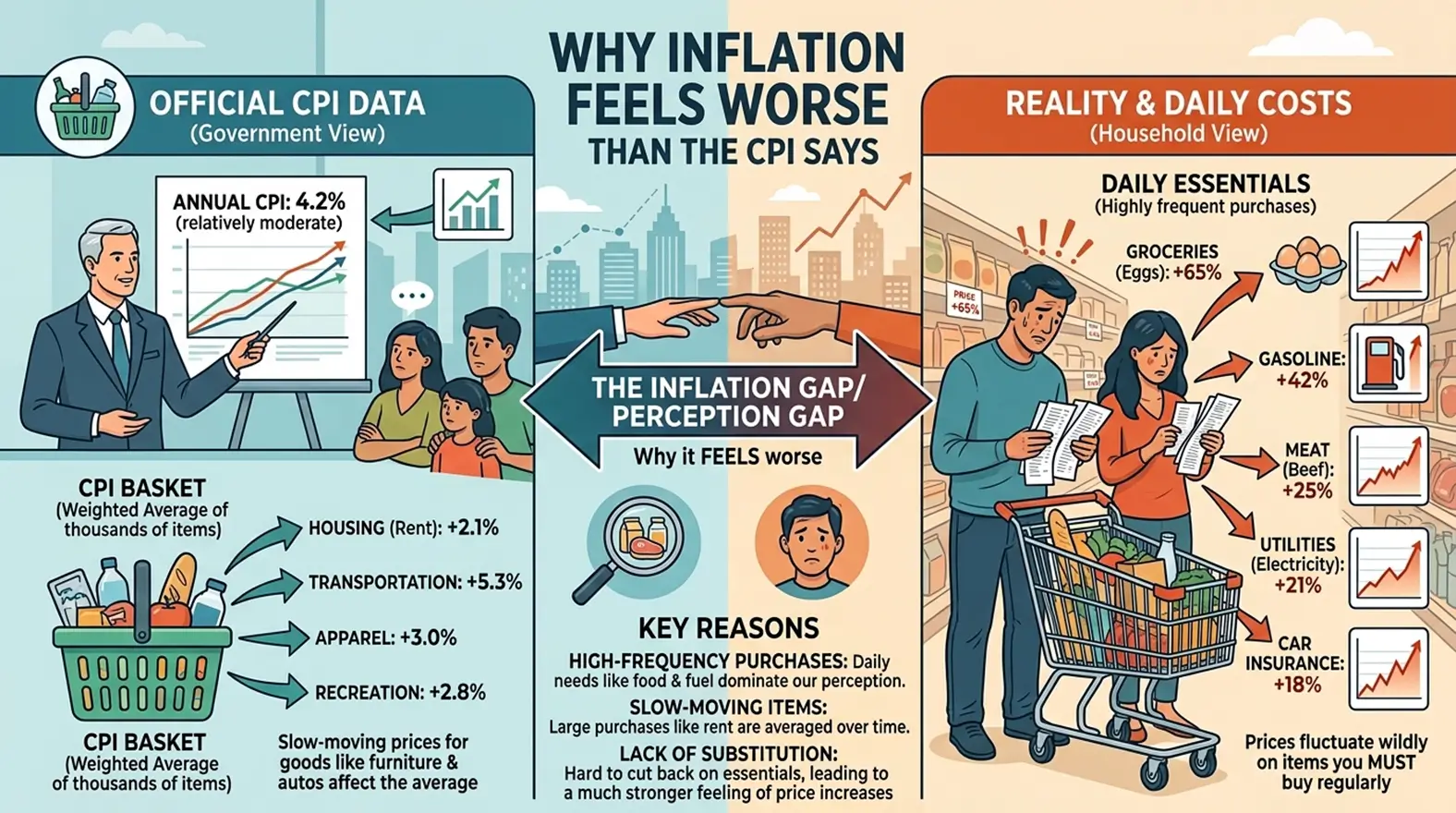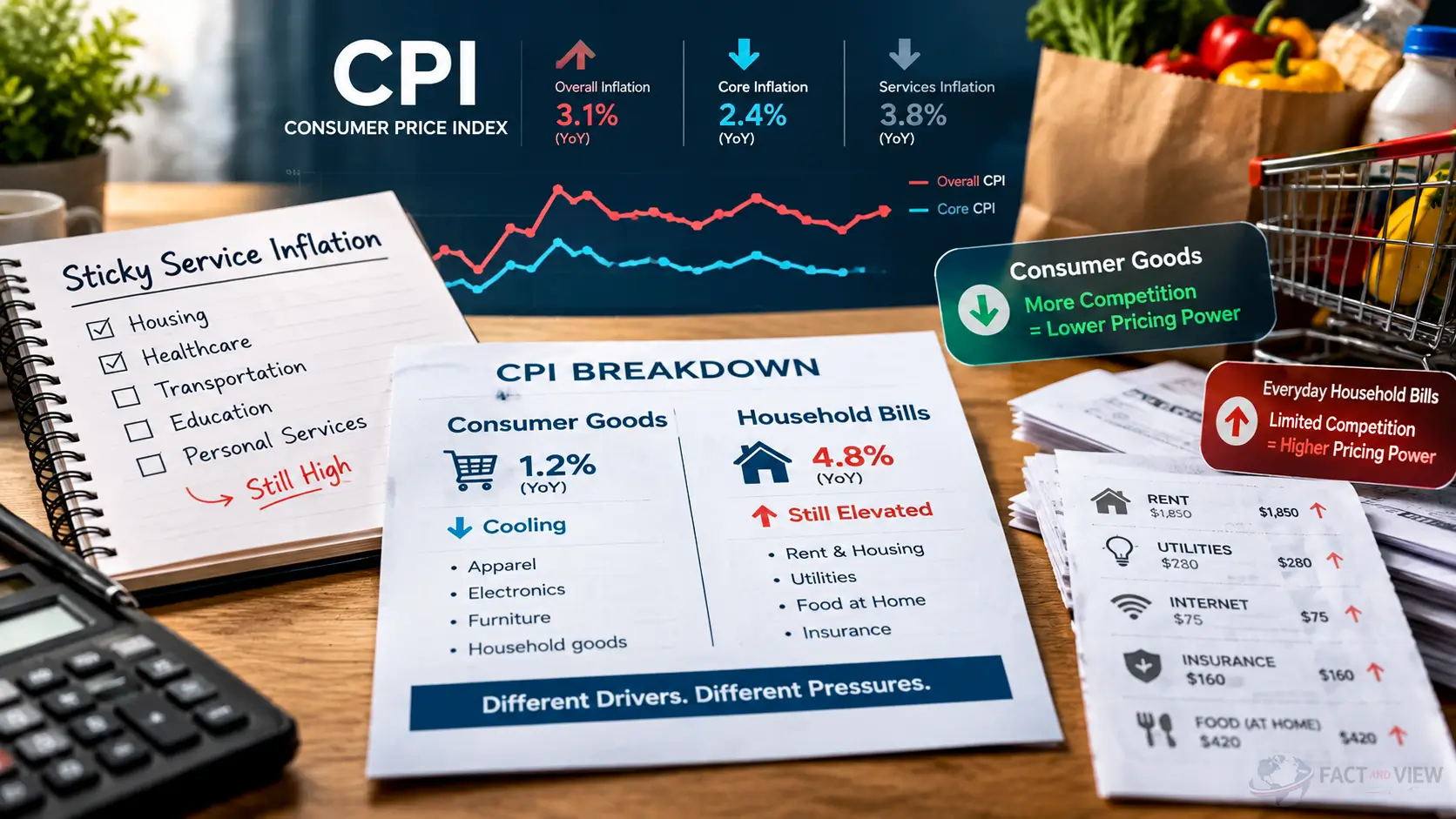
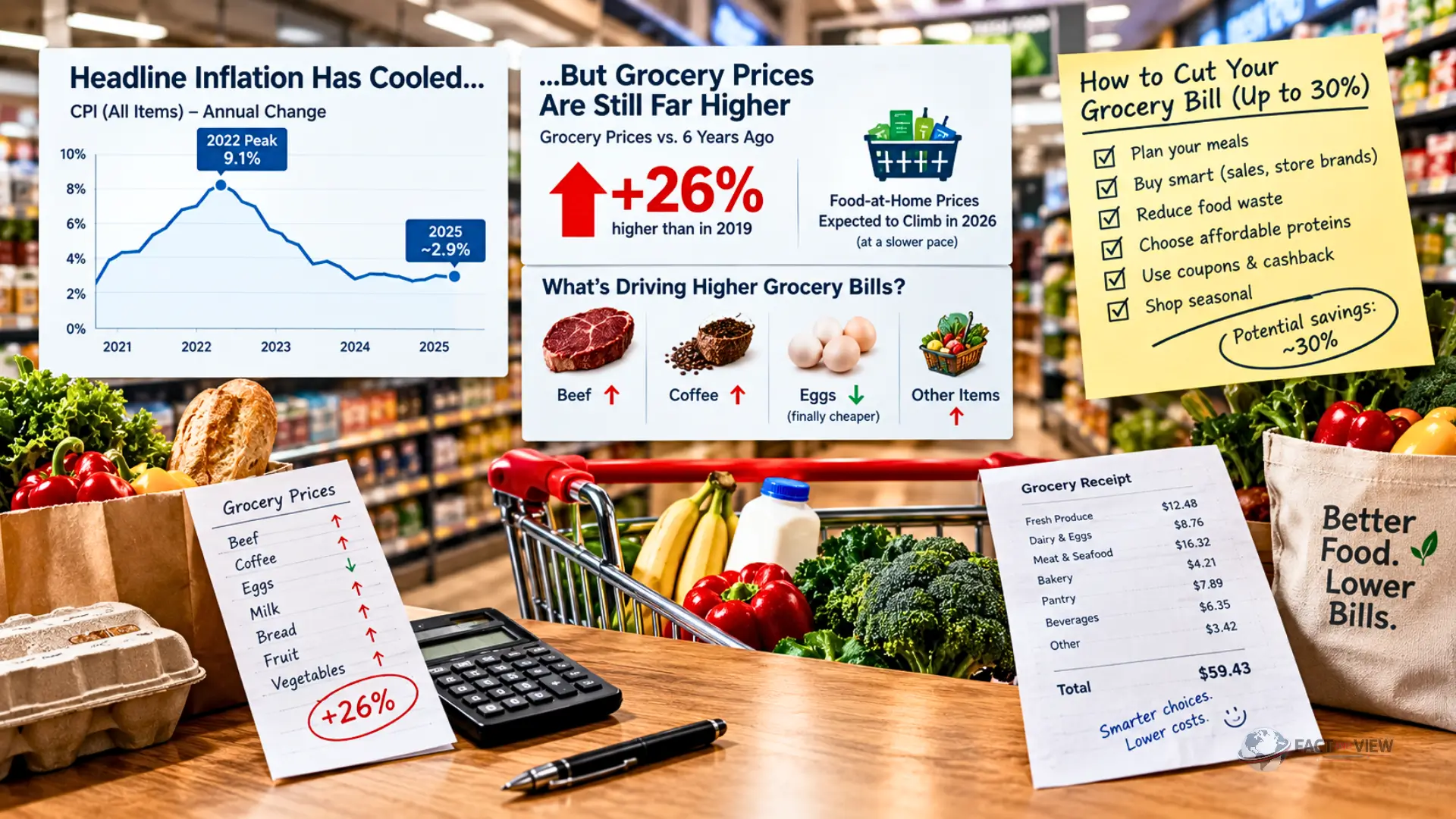
Headline inflation has cooled substantially from its 2022 peak. Grocery prices haven’t gotten that memo. According to federal data, grocery prices remain roughly 26% higher than they were six years ago, and the U.S. Department of Agriculture still expects food-at-home prices to climb further in 2026, just at a slower pace than during the worst of the post-pandemic spike.
Some of that is simple math: a slower rate of increase still means prices going up, not down. Some of it is specific, like beef and coffee prices climbing even as other items, eggs among them, have finally gotten cheaper. This piece breaks down exactly what’s driving your bill higher, and lays out a realistic, math-based path to cutting it, potentially by close to 30%, depending on where your household starts.
Why “Inflation Slowing” Doesn’t Mean Prices Are Falling
This is the single most misunderstood part of the grocery story, and FACT AND VIEW has explained the broader version of this gap elsewhere: a lower inflation rate describes how fast prices are rising, not whether they’re falling.
The USDA’s Economic Research Service projected food-at-home prices to rise roughly 2.3% in 2026. That’s a much calmer number than the double-digit grocery inflation Americans saw in 2022. But it’s still an increase, stacked on top of several years of already-elevated prices.
As Ricky Volpe, a professor of agribusiness at Cal Poly San Luis Obispo, has put it, any new inflation now lands on top of prices that were already very high, and shoppers notice that cumulative weight more than they notice this month’s specific percentage.
The Specific Items Driving Your Bill Higher
Not everything in the cart is moving the same direction, which is part of why the “groceries are expensive” story can feel confusing.
- Beef is the clearest case. Ground beef hit a record $6.69 a pound in December 2025, up from $5.61 a year earlier, driven by a cattle herd that’s been shrinking for roughly five years because of drought. That kind of supply problem doesn’t reverse quickly; rebuilding a cattle herd takes years, not months.
- Coffee has climbed for a mix of reasons: adverse weather in major growing regions like Brazil, combined with tariffs on imports. Coffee prices were still running about 44% above their level from two years earlier as of this fall, even after some relief measures.
- Eggs, by contrast, have fallen sharply after their own historic spike, a reminder that “grocery inflation” isn’t one uniform story but several different supply stories happening at once.
The overall pattern: categories tied to a slow-to-fix supply problem, cattle herds, coffee-growing weather, stay expensive far longer than categories where supply can recover quickly.
Why Tariffs Show Up at the Checkout Line
Tariffs are a real, documented piece of this puzzle, separate from weather and herd sizes. The mechanics of how tariffs raise consumer prices apply directly to groceries, since the U.S. imports a large share of items like coffee, bananas, and other produce that can’t be grown domestically at scale.
Brazil supplies roughly 35% of the world’s coffee, and tariffs on Brazilian imports pushed coffee costs higher through 2025. The administration removed those specific tariffs in November 2025 in an effort to ease prices, one of several rollbacks aimed at consumer staples; it also cut tariffs on some beef imports for the same stated reason. Packaging costs add a quieter layer on top: tariffs on imported steel and aluminum have raised the cost of producing cans, pushing up prices on canned goods independent of what’s inside them.
The rollbacks illustrate a genuine policy tension. Tariffs are generally framed by supporters as protecting domestic producers and leverage in trade negotiations; critics argue they raise costs for consumers on goods the U.S. doesn’t produce domestically in sufficient volume, coffee being the clearest example. Both points have shown up directly in grocery store pricing over the past year.
Why Grocery Bills Rarely “Come Back Down”
Even when a specific input cost eases, the retail price rarely falls back to where it started. Retailers, distributors, and manufacturers are generally far quicker to raise prices than to lower them, since margins compressed during the high-cost period get defended once costs ease rather than passed back to shoppers.
This mirrors a broader pattern across household bills generally: costs that are driven by labor, logistics, and long supply chains tend to ratchet upward and stay there, rather than tracking input costs symmetrically in both directions.
How to Actually Cut Your Bill, Not Just Cope With It
Here’s the part worth being precise about: a 30% reduction is realistic for a household currently doing little to no optimization, not a guarantee for everyone. The number comes from adding up several well-documented savings levers, not a single trick.
Start with waste. A peer-reviewed study in the American Journal of Agricultural Economics, using USDA purchase data, found the average household wastes close to 32% of the food it buys, worth nearly $1,900 a year. Cutting that waste by even half is the single largest lever most households have, and it costs nothing to start.
Switch staples to store brands. Flour, pasta, canned goods, and other basics typically cost 15% to 30% less as a store brand with little to no quality difference, according to retail pricing analyses.
Shop around what’s on sale, rather than planning meals first and shopping second. Loss-leader discounts, items stores price low to get shoppers in the door, are genuine savings, not marketing tricks.
Stack cashback apps on top of sales. Apps like Ibotta, Fetch, and Rakuten add a few more percentage points back on purchases you’re already making.
| Strategy | Realistic savings |
|---|---|
| Cutting food waste in half | 10%–15% of total bill |
| Store brands on staples | 5%–10% of total bill |
| Sales timing + cashback stacking | 5%–10% of total bill |
Stacked together, a household starting from an unoptimized baseline, buying mostly name brands, wasting close to a third of its food, never checking sales flyers, can realistically approach a 25% to 30% reduction. A household already doing some of this will see smaller, incremental gains layered on top.
What Could Bring Real Relief
Some relief is plausible but slow. Cattle herds take years to rebuild, so beef prices are unlikely to ease meaningfully before 2027 or later, according to USDA projections. Coffee prices depend heavily on weather in growing regions that the U.S. doesn’t control, making that forecast genuinely uncertain. Further tariff rollbacks on specific food categories remain possible, following the pattern already set with coffee and beef, though analysts disagree on how much additional relief that alone would deliver.
What to Watch
- USDA’s Food Price Outlook, updated regularly, for category-by-category forecasts
- BLS’s monthly CPI report, specifically the food-at-home component
- USDA cattle inventory reports, the clearest leading indicator for where beef prices head next
The Bottom Line
Grocery bills are still high in 2026 because slower inflation is not the same thing as falling prices, and because a handful of specific categories, beef most of all, are stuck behind supply problems that take years to fix. Tariffs have added a real, if partial, layer on top, one the administration has already rolled back in some cases specifically to ease consumer prices.
What’s genuinely within a household’s control is smaller than the headline number but still meaningful: cutting food waste, shifting to store brands on staples, and timing purchases around sales can realistically combine for a 25% to 30% reduction for someone starting from scratch. What remains uncertain is how quickly the structural pieces, cattle herds and coffee-growing weather chief among them, actually ease, and that timeline is not fully within anyone’s control.
Sources
- U.S. Department of Agriculture, Economic Research Service — Food Price Outlook, 2026
- U.S. Bureau of Labor Statistics — Consumer Price Index, food-at-home component
- Federal Reserve Bank of St. Louis — ground beef retail price data
- Jaenicke, E. et al., American Journal of Agricultural Economics — household food waste study using USDA FoodAPS data
- NPR reporting (syndicated via member stations), “Why are some food prices up and others down,” October 2026