Every time inflation ticks up, a familiar question resurfaces in every retirement account and financial advisor’s inbox: is it safe to invest in bonds during high inflation? The honest answer is more nuanced than a yes or no. Some Treasury securities are specifically engineered to protect purchasing power during inflationary periods, while others, the very same “safe” government bonds many investors default to, can quietly lose real value even as they pay their interest on schedule. Understanding the difference is one of the more valuable things a beginner investor can learn, and it’s especially relevant in 2026, with inflation running above the Federal Reserve’s target and the bond market sending some genuinely mixed signals.
Is It Safe to Invest in Bonds During High Inflation? The Short Answer
It depends almost entirely on which kind of bond you’re holding and how long until it matures. Traditional, fixed-rate Treasury bonds are considered essentially free of default risk, since they’re backed by the U.S. government, but that’s a different question from whether they protect your purchasing power. During periods of high or rising inflation, fixed-rate bonds can lose real value even while remaining perfectly “safe” in the credit-risk sense. Inflation-protected securities, by contrast, are built specifically to solve that problem. The rest of this guide walks through why that distinction matters and how to think about each option.
Why Inflation Hurts Traditional Bonds
To understand the risk, it helps to separate two things that get confused constantly: a bond defaulting, and a bond losing value to inflation.
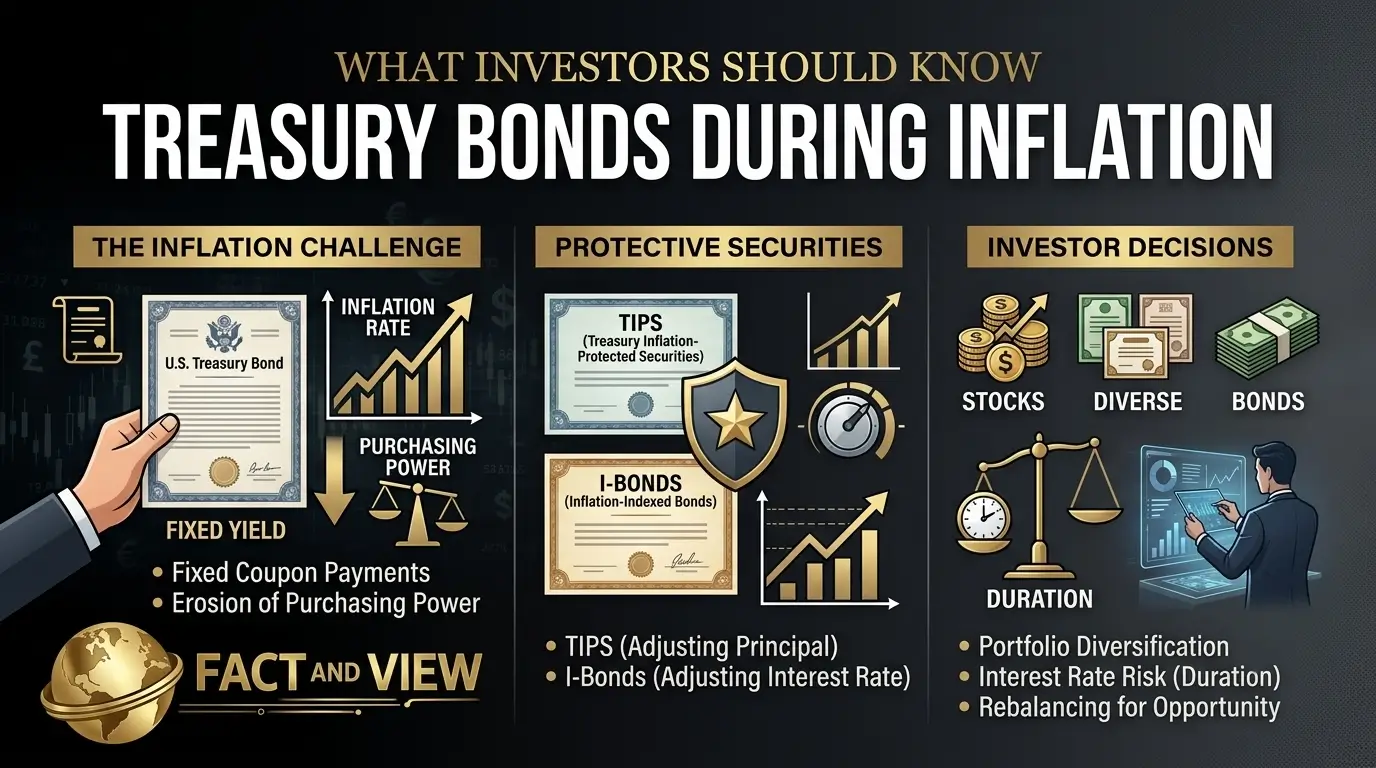
A traditional Treasury bond pays a fixed interest rate, called a coupon, for the life of the bond. If you buy a 10-year Treasury note paying 4%, you’ll receive exactly that rate every year, and the government will return your principal at maturity, regardless of what happens to inflation in the meantime.
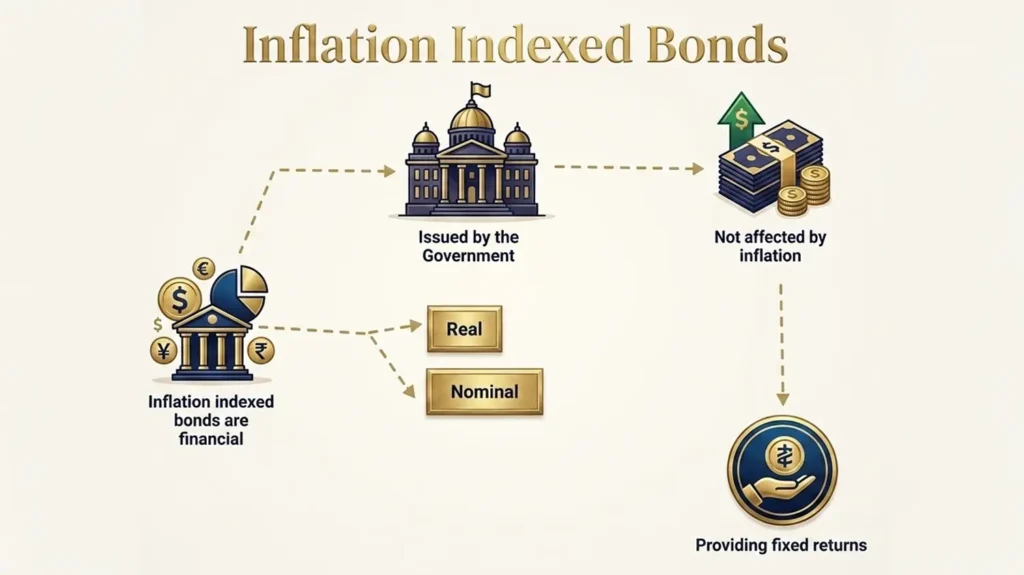
The problem is that “4%” doesn’t mean much on its own. If inflation runs at 2% a year, your money is growing at a real, inflation-adjusted rate of roughly 2%. If inflation runs at 5%, that same 4% bond is actually losing purchasing power every year, even though you’re receiving every payment exactly as promised. This is why economists distinguish between the nominal yield, the rate printed on the bond, and the real yield, what you actually earn after subtracting inflation.
There’s a second, related risk called duration risk. When inflation rises, the Federal Reserve typically responds by raising or maintaining higher interest rates to cool the economy. Newly issued bonds then offer higher coupons to match. That makes existing, lower-coupon bonds less attractive, so their market price falls, since bond prices and yields move in opposite directions. Longer-term bonds, such as 20- or 30-year Treasuries, are more sensitive to this effect than short-term bills, which is why duration matters as much as credit quality when evaluating inflation risk.
Not All Treasuries Are Equal
The U.S. Treasury issues several distinct types of debt, and they behave very differently during inflationary periods.
- Treasury bills mature in a year or less and are the least exposed to inflation risk, simply because there’s less time for inflation to erode their value before you’re repaid.
- Treasury notes (2 to 10 years) and Treasury bonds (20 to 30 years) carry fixed coupons and are the most exposed to the purchasing-power problem described above, especially at the longer end.
- Treasury Inflation-Protected Securities, or TIPS, are structured differently on purpose, and are the government’s direct answer to this exact question.
As of mid-July 2026, the Treasury yield curve was upward-sloping, meaning longer maturities paid more than shorter ones, a signal that investors expect the Fed to hold rates steady for a while rather than cut soon. The 10-year Treasury note was yielding around 4.57%, and the 30-year around 5.09%, according to Treasury market data, while short-term 3-month bills were closer to 3.79%. That gap reflects investors demanding more compensation for locking up money over longer periods amid persistent inflation uncertainty.
TIPS: The Bonds Built for Inflation
TIPS work differently from ordinary Treasuries. Instead of a fixed principal, the face value of a TIPS bond adjusts up or down with the Consumer Price Index. You still receive a fixed coupon rate, but that rate applies to a principal balance that grows with inflation, so your actual dollar payments rise as prices rise. At maturity, you’re guaranteed to receive at least the original principal, even if there had been a period of deflation along the way.
The yield on a TIPS bond is quoted as a “real yield,” since it already reflects protection against inflation. As of mid-July 2026, real yields on TIPS ranged from around 1.9% on 5-year securities to roughly 2.3% on 10-year TIPS and 2.9% on 30-year TIPS, according to Treasury market data. The difference between a regular Treasury’s yield and a TIPS yield of the same maturity is called the “breakeven inflation rate,” essentially the market’s implied forecast for average inflation over that period. The 10-year breakeven rate stood at about 2.22% in mid-July 2026, according to Federal Reserve Bank of St. Louis data, meaning if inflation averages above that over the next decade, TIPS would outperform a comparable nominal Treasury bond, and if inflation comes in lower, the nominal bond would have been the better bet.
I Bonds: The Retail Investor’s Alternative
For individual savers rather than institutional investors, Series I Savings Bonds offer a related but distinct option. I Bonds combine a fixed rate, set at issuance and held for the bond’s life, with a variable rate that adjusts every six months based on CPI inflation. They’re purchased directly from the Treasury, are exempt from state and local taxes, and are limited to $10,000 per person per calendar year in electronic form, making them more of a savings tool for individuals than a portfolio-scale investment for institutions. Because the inflation component resets twice a year rather than continuously, I Bonds can lag or lead actual inflation slightly depending on timing, but over the long run they’ve tracked it closely.
The Historical Lesson: What the 1970s Taught Bond Investors
The clearest historical warning about fixed-rate bonds and inflation comes from the 1970s, when U.S. inflation repeatedly ran into double digits while bond yields, though they eventually rose too, initially lagged behind. Investors holding long-term bonds purchased earlier in the decade watched their real returns turn sharply negative for years. TIPS didn’t exist yet, having been introduced by the Treasury only in 1997, which is precisely why they were created: to give investors a way to hold government debt without betting blindly on where inflation would land.
Risks Investors Should Still Weigh
Even inflation-protected securities carry tradeoffs worth understanding before assuming they’re a complete solution.
- Opportunity cost in low-inflation scenarios. If inflation comes in below the breakeven rate, a comparable nominal Treasury would have paid more. TIPS aren’t a bet that beats every scenario; they’re a hedge against a specific risk.
- Tax treatment. The inflation adjustment to TIPS principal is taxable as income in the year it accrues, even though you don’t receive that money until maturity or sale, an issue sometimes called “phantom income” that catches new investors off guard.
- Liquidity and pricing. TIPS are somewhat less liquid than standard Treasuries, and their prices can be more volatile in the short term than the “safe government bond” label might suggest.
- Rate-hike risk isn’t fully eliminated. If real yields themselves rise, meaning the Fed keeps policy tighter for longer, TIPS prices can still fall in the short term even though their inflation protection remains intact for buy-and-hold investors.
So, Is It Safe to Invest in Bonds During High Inflation?
The honest, complete answer is: it depends on which bonds, and what “safe” means to you. In terms of credit risk, Treasury securities of every type remain among the safest instruments in the world, backed by the full faith and credit of the U.S. government. In terms of purchasing-power risk, fixed-rate Treasury bonds, particularly long-dated ones, can genuinely lose real value during high inflation, while TIPS and I Bonds are specifically designed to avoid that outcome. Many financial advisors suggest a mix, using short-duration Treasuries and inflation-protected securities to manage inflation risk, while reserving longer-dated fixed bonds for when inflation expectations are more settled. As always, this is general education rather than a personal recommendation, and individual circumstances, from tax situation to time horizon, should shape any real decision, ideally with input from a licensed financial advisor.
The Bottom Line
Treasury bonds aren’t a single, uniform investment; they’re a family of instruments that respond to inflation in very different ways. Fixed-rate Treasuries offer certainty of payment but not certainty of purchasing power. TIPS and I Bonds trade some yield for explicit inflation protection. What’s clear from current market data is that investors in mid-2026 are pricing in continued, moderate inflation rather than a return to very low, pre-pandemic levels, which is exactly the environment in which understanding this distinction matters most.
Related Reading
- US Regional Banking Crisis — Treasury yields discussed in this article are also the benchmark rate driving stress across regional bank balance sheets.
- How the US Treasury Prints and Borrows Money — for the fundamentals of how Treasury auctions work and how bond yields get set in the first place.
- What Is Stagflation? Why Economists Fear It Again — the same inflation dynamics discussed here are central to the stagflation debate.
Sources
- Trading Economics — “US 10 Year Treasury Note Yield”
- CNBC — “Treasury yields slide after June CPI slows much more than expected”
- CNBC — “Treasury yields fall as traders react to encouraging inflation data”
- Federal Reserve Board — “H.15 Selected Interest Rates”
- StreetStats — “U.S. Treasury Yield Curve” and “TIPS Yield Curve”
- Federal Reserve Bank of St. Louis (FRED) — “10-Year Breakeven Inflation Rate (T10YIE)” and related TIPS/Treasury series
- MacroMicro — “US 10-Year Breakeven Inflation Rate” (en.macromicro.me)
- LM Capital Group — “Do you own enough TIPS?” (lmcapital.com)
- J.P. Morgan Chase Institute — “Reading Inflation Expectations from the Treasury Market” (jpmorganchase.com)
- TIPSwatch — “Treasury Inflation-Protected Securities: Perfect investment for imperfect times?” (tipswatch.com)
- U.S. Department of the Treasury — TreasuryDirect, background on TIPS and I Bond mechanics (treasurydirect.gov)
Disclaimer: This article is for informational and educational purposes only and does not constitute personalized financial or investment advice. Bond yields and inflation data change daily; readers should verify current figures and consult a licensed financial advisor before making investment decisions.