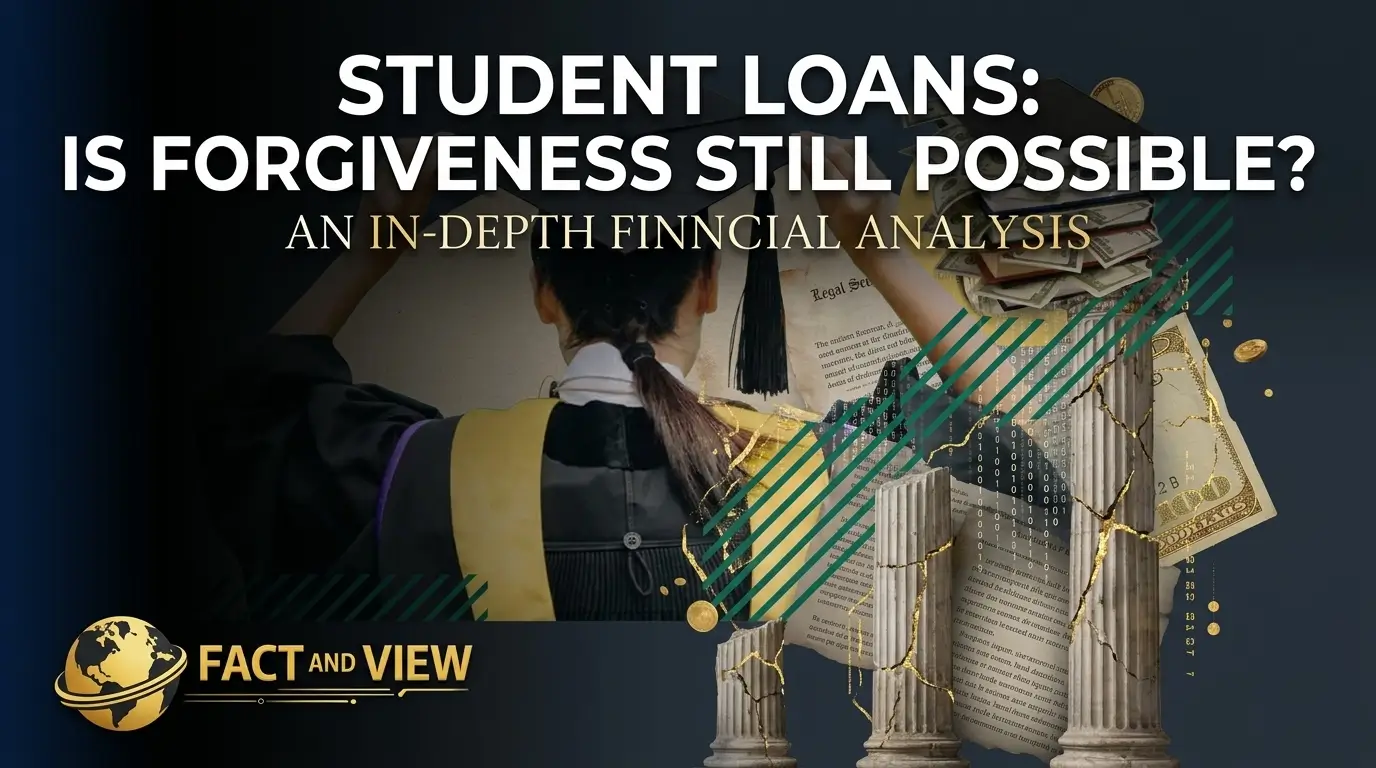
A new federal student loan borrower falls into default every nine seconds. Nearly 9 million Americans are currently in default — the largest number on record — and roughly 1 in 4 borrowers is behind on payments, nearly three times the pre-pandemic rate. The Saving on a Valuable Education (SAVE) plan, once the most generous income-driven repayment option in federal history, was legally terminated by an appeals court ruling on March 9, 2026. And the tax-free treatment that protected forgiven student debt from a surprise IRS bill expired on December 31, 2025.
If you are one of the roughly 42.5 million Americans holding federal student loan debt, the question “is forgiveness still possible?” no longer has a simple yes-or-no answer. It has a different answer depending on which program you’re in, when your loans were disbursed, what job you hold, and how quickly you act before July 1, 2026 — a deadline that reshapes federal student lending more dramatically than any single policy change since the 2010 nationalization of the loan program itself.
The Big Picture: Why Everything Is Changing Right Now
The student loan landscape of 2026 is the product of two forces colliding simultaneously: a Supreme Court-validated legal defeat for Biden-era forgiveness programs, and a sweeping legislative overhaul embedded in the One Big Beautiful Bill Act (OBBBA), signed July 4, 2025.
Fact: Total U.S. student loan debt reached $1.866 trillion as of March 2026, per Federal Reserve data — roughly four times the $481 billion outstanding in early 2006. Federal loans account for more than 90% of that total, with federal debt alone at a record $1.696 trillion as of December 2025.
Fact: On March 9, 2026, the U.S. Court of Appeals for the Eighth Circuit issued a final ruling vacating the SAVE plan in its entirety, ending nearly two years of litigation that began when Republican-led states sued, arguing the Biden administration’s executive action exceeded its statutory authority — a legal theory the Supreme Court had already validated in a related case in June 2023. The Department of Education began notifying all 7.5 million enrolled SAVE borrowers on March 27, 2026.
Fact: The OBBBA’s education provisions are projected to reduce federal spending by $320 billion over the next decade, primarily by transitioning borrowers into active repayment, eliminating SAVE, PAYE, and ICR plans entirely by July 1, 2028, and replacing them with two new structures: the Repayment Assistance Plan (RAP) and the Tiered Standard Plan.
The View: What’s happening in 2026 is not a single forgiveness program ending — it’s the legal and legislative dismantling of the entire income-driven repayment architecture built since 2007. The SAVE plan’s death by court order was a foregone conclusion after the 2023 Supreme Court ruling against broader Biden forgiveness; what makes 2026 distinct is that Congress simultaneously rebuilt the system from scratch through OBBBA, rather than simply reverting to pre-2007 standard repayment. That means the forgiveness conversation isn’t returning to an old normal — it’s adapting to genuinely new rules.
Related reading: New US Laws in 2026: What They Mean for Americans — the full OBBBA breakdown, including the tax provisions intersecting with student loan changes.
Deep Dive: What Forgiveness Pathways Still Exist
1. Public Service Loan Forgiveness (PSLF) — The Most Durable Path
Fact: PSLF remains fully intact and unaffected by the SAVE plan’s termination, because it is explicitly authorized by Congress rather than created through executive rulemaking. Borrowers working full-time in qualifying government or nonprofit roles can still receive forgiveness after 120 qualifying monthly payments — and crucially, PSLF forgiveness remains permanently tax-free under OBBBA.
Fact: Time spent repaying under SAVE, PAYE, IBR, or ICR generally continues to count toward the 120-payment PSLF total, according to Department of Education guidance — meaning borrowers who built up qualifying payments under the now-defunct SAVE plan do not lose that progress.
The View: PSLF is the closest thing to a guaranteed forgiveness pathway left standing in 2026. Its statutory foundation — rather than executive-branch rulemaking — is precisely why it survived the legal challenges that killed SAVE. For borrowers in eligible public-service careers, PSLF should now be treated as the default forgiveness strategy, not a backup option.
2. Income-Based Repayment (IBR) — The Most Legally Solid IDR Option
Fact: IBR remains available to borrowers whose loans were disbursed before July 1, 2026, and is currently the most legally stable income-driven repayment route, since it survives independent of the OBBBA’s broader IDR phase-out (which targets SAVE, PAYE, and ICR specifically, sunsetting them by July 1, 2028). OBBBA also removed IBR’s old “partial financial hardship” eligibility requirement, opening it to more borrowers regardless of income level.
Fact: Under IBR, monthly payments are 10% or 15% of discretionary income (depending on loan vintage), with forgiveness after 20 or 25 years of qualifying payments.
The View: IBR’s survival is not an accident — it has a more explicit statutory basis than SAVE did, which is exactly why litigants didn’t target it in the same lawsuits. For borrowers exiting SAVE in 2026, IBR is generally the closest substitute in terms of payment structure, even though it lacks some of SAVE’s borrower-friendly features like the interest-waiver provision.
3. The Repayment Assistance Plan (RAP) — The New Default
Fact: RAP, the OBBBA’s signature replacement program, became effective July 1, 2026. Monthly payments are calculated as a percentage of adjusted gross income — ranging from 1% to 10%, depending on income level — minus $50 for each dependent claimed, with a $10 monthly minimum. Forgiveness occurs after 30 years of qualifying payments, or 360 on-time payments — significantly longer than IBR’s 20-25 year window.
Fact: RAP includes one borrower-favorable mechanic: it waives any monthly interest that exceeds the borrower’s required payment amount, and includes a “principal-matching” feature designed to ensure low-income borrowers see their principal balance decline every month rather than grow through unpaid interest accrual — a problem that plagued earlier IDR plans.
The View: RAP is a genuine trade-off, not a clear downgrade or upgrade relative to what it replaces. The 30-year forgiveness timeline is materially longer than IBR’s — a real cost for borrowers who would otherwise reach forgiveness sooner. But the interest-waiver and principal-matching features directly address the “growing balance” complaint that made earlier IDR plans politically unpopular. Whether RAP nets out better depends entirely on individual income trajectory: lower-income borrowers benefit from the principal protection; borrowers expecting rising income lose more from the extended timeline.
Related reading: What Happens If US Debt Keeps Rising? — how the $320 billion in projected OBBBA student loan savings fits into the broader federal deficit picture.
4. Borrower Defense to Repayment — A Narrower Window, But Still Open
Fact: A long-running legal dispute over borrower defense claims — for students defrauded by their schools — was resolved on February 23, 2026, when the Supreme Court declined to block the Sweet v. McMahon settlement. Automatic discharges went to borrowers meeting three specific conditions tied to a list of named schools and pending applications as of January 28, 2026.
Fact: For new individual claims filed outside that settlement, the rules reverted to a stricter standard under OBBBA, carrying a higher burden of proof and a tighter filing window than the borrower-friendly rules that applied during the Biden administration.
The View: Borrower defense forgiveness still exists, but the legal bar has risen substantially for anyone outside the automatic-discharge settlement population. This is a pathway that rewards documentation and speed — borrowers who suspect they were defrauded by their school should gather evidence now rather than wait, since the procedural window is measurably narrower than it was two years ago.
The Tax Trap Nobody Is Talking About
Fact: The American Rescue Plan Act’s provision excluding forgiven student debt from taxable income expired on December 31, 2025. IDR forgiveness received in 2026 or later is now taxable at the federal level, unless the borrower qualifies for the IRS insolvency exclusion.
Fact: PSLF forgiveness, along with death and total/permanent disability discharges, remain permanently tax-free under OBBBA — an explicit carve-out that distinguishes these categories from standard IDR forgiveness.
The View: This is arguably the most under-discussed change of 2026. A borrower who spends two decades making IDR payments, finally reaches forgiveness in 2026, and expects a clean slate may instead receive an IRS Form 1099-C reporting the forgiven balance as taxable income — potentially creating a tax bill in the tens of thousands of dollars on income the borrower never actually received in cash. The National Association of Student Financial Aid Administrators has explicitly flagged this as a risk for “low- and middle-income borrowers on income-driven repayment plans” who could face “an unexpected and unaffordable IRS bill” after meeting every requirement for forgiveness.
The Human Cost: Default, Delinquency, and the Credit Score Cliff
Fact: According to a February 2026 analysis by The Century Foundation and Protect Borrowers, 1 in 4 borrowers is now behind on student loan payments — nearly three times the pre-pandemic rate — and nearly 9 million borrowers are in default, the largest number on record. A new borrower defaults approximately every nine seconds.
Fact: Borrowers with delinquent student loans saw their credit scores fall by an average of 57 points in the first three quarters of 2025 alone, with three-quarters dropping into “deep subprime” territory. A separate New York Fed analysis found credit score drops as steep as 171 points once a loan reaches serious delinquency.
Fact: The damage is not contained to student debt alone. Newly defaulted student loan borrowers show sharply elevated delinquency on other credit products: nearly 40% have past-due auto loans, 56% have past-due credit cards, and 20% have past-due mortgages, per the New York Fed’s Liberty Street Economics analysis published in May 2026.
Fact: Delinquency is concentrated unevenly. Pell Grant recipients face delinquency rates of 27%, compared to 15% for non-Pell borrowers. Black and Native American borrowers face delinquency rates near 50%. Geographically, Louisiana (40%) and Mississippi (39%) show the highest state-level rates.
The View: The credit score collapse accompanying this wave of defaults is not a side effect — it’s an active barrier to economic participation. A score drop from 680 to 580 can trigger apartment rental denials (many landlords require 650+ even to apply) and job application rejections at employers who run credit checks. The student loan crisis of 2026 is functioning as a credit-access crisis that extends well beyond the loans themselves, with second-order effects on housing stability and employment that compound the original debt burden.
Related reading: Why Credit Card Debt Is Exploding in America (2026) — the connection between student loan distress and rising credit card delinquency in the same households.
Risks & Opportunities: Three Scenarios
Base Case (~50% probability): Managed Transition, Persistent Distress
The July 1, 2026 transition proceeds with significant servicer confusion but no further legal disruption. RAP enrollment ramps slowly as borrowers default to the Standard Repayment Plan when they miss the 90-day window. Default rates remain elevated through 2027 as the SAVE forbearance population re-enters active repayment.
What this means for you: Act before your 90-day window closes. Borrowers who take no action are automatically enrolled in the Standard Repayment Plan or new Tiered Standard Plan — both typically more expensive than RAP or IBR. Use the Department of Education’s Loan Simulator at StudentAid.gov before your deadline.
Upside Scenario (~20% probability): Targeted Congressional Relief
Bipartisan pressure — driven by the scale of the default crisis and its spillover into auto and credit card delinquency — produces narrow legislative fixes: restoring tax-free treatment for IDR forgiveness, or extending transition deadlines. This would require Congress to revisit OBBBA provisions specifically, which is politically difficult but not unprecedented given past mid-course corrections to federal loan policy.
What this means for you: Borrowers close to IDR forgiveness in 2026-2027 should still document their financial position for a potential insolvency exclusion claim, in case no legislative fix arrives in time.
Downside Scenario (~30% probability): Default Crisis Deepens
Protect Borrowers’ own modeling suggests that if current delinquency trends hold, as many as 13 million borrowers may be in default by the end of 2026 — a number that would exceed even the 2008 mortgage crisis’s peak delinquency rate on single-family home mortgages (just under 12%). Wage garnishment and tax refund seizure, already resumed since May 2025, expand further.
What this means for you: If you’re at risk of default, loan rehabilitation (which removes the default record from your credit history once completed) is generally preferable to consolidation (which keeps that record). Both options exist — but rehabilitation requires sustained, documented payments that many distressed borrowers struggle to maintain.
The Bottom Line
Forgiveness is still possible in 2026 — but the pathways are narrower, slower, and carry new tax exposure that didn’t exist two years ago. The honest answer to “is forgiveness still possible” depends entirely on which of four categories you fall into.
Your action checklist before July 1, 2026:
- Check your loan disbursement date at StudentAid.gov. If all your loans were disbursed before July 1, 2026, you retain access to the older repayment plans, including IBR and the original IDR forgiveness timelines. Loans disbursed after that date face RAP or the Tiered Standard Plan only.
- If you’re a public servant, prioritize PSLF. It’s the only forgiveness program untouched by litigation and permanently tax-free. Confirm your qualifying payment count at StudentAid.gov now.
- If you’re in SAVE, don’t wait for your 90-day notice to expire. Proactively select IBR or RAP rather than risk automatic enrollment in the more expensive Standard Repayment Plan.
- If you’re expecting IDR forgiveness in 2026, consult a tax professional before it happens. The expired tax exclusion means you may owe federal income tax on the forgiven balance — plan your finances for that possibility rather than being surprised by a 1099-C.
- If you’re already delinquent, act before 270 days. Once a loan reaches default, the consequences — wage garnishment, tax refund seizure, a credit score collapse of up to 171 points — become significantly harder to reverse than addressing delinquency early through rehabilitation or a revised repayment plan.
The student loan system of 2026 has not eliminated forgiveness. It has rebuilt the rules around it — rewarding borrowers who act early and understand which of the surviving pathways actually applies to their specific loans.
FAQ
Is the SAVE student loan plan completely over?
Yes. On March 9, 2026, the U.S. Court of Appeals for the Eighth Circuit issued a final ruling vacating the SAVE plan in its entirety, and the Department of Education confirmed the program’s termination, beginning formal notification of all 7.5 million enrolled borrowers on March 27, 2026. Borrowers had a 90-day window from their notice to select a new plan; those who don’t act by their deadline are automatically enrolled in the Standard Repayment Plan or the new Tiered Standard Plan, both of which generally carry higher monthly payments than SAVE did.
Will I have to pay taxes on forgiven student loans in 2026?
It depends on the forgiveness type. The American Rescue Plan Act’s tax exclusion for forgiven student debt expired December 31, 2025. IDR forgiveness (through IBR, RAP, or similar plans) received in 2026 or later is now taxable at the federal level unless you qualify for the IRS insolvency exclusion. However, Public Service Loan Forgiveness (PSLF) remains permanently tax-free, as do death and total/permanent disability discharges, per explicit carve-outs in the OBBBA. Consult a tax professional well before your expected forgiveness date if you’re in an IDR plan.
What is the Repayment Assistance Plan (RAP) and how does it compare to older plans?
RAP is the OBBBA’s new income-driven repayment plan, effective July 1, 2026. Monthly payments equal 1% to 10% of your adjusted gross income, minus $50 per dependent, with a $10 monthly minimum. Forgiveness occurs after 30 years of qualifying payments — longer than IBR’s 20-25 year timeline. RAP’s key advantage is that it waives interest exceeding your required payment and includes principal-matching to ensure your balance declines monthly. Use the Department of Education’s Loan Simulator at StudentAid.gov to compare RAP against IBR for your specific income and loan situation.
How many people are currently in default on student loans?
Nearly 9 million borrowers are currently in federal student loan default, the largest number on record, according to a February 2026 analysis by Protect Borrowers and The Century Foundation. Separately, the New York Fed estimated that roughly 1 million borrowers defaulted in Q4 2025, with an additional 2.6 million defaulting in Q1 2026 alone. Protect Borrowers’ modeling suggests the total could reach as many as 13 million borrowers in default by the end of 2026 if current delinquency trends continue.
Does Public Service Loan Forgiveness (PSLF) still work in 2026?
Yes, fully. PSLF is unaffected by the SAVE plan’s termination because it is explicitly authorized by Congress rather than created through Department of Education rulemaking — the same statutory foundation that makes it more legally durable than the now-defunct SAVE, PAYE, and ICR plans. Borrowers in qualifying full-time public service or nonprofit employment can still receive forgiveness after 120 qualifying monthly payments, and that forgiveness remains permanently tax-free. Time spent repaying under SAVE, IBR, PAYE, or ICR generally still counts toward your 120-payment total.
What happens if my federal student loan goes into default?
After 270 days (about nine months) without a payment, your federal loan enters default. Consequences include loss of eligibility for federal aid, referral to collections, wage garnishment, and tax refund seizure — both of which resumed in May 2025 after a pandemic-era pause. Your credit score can drop by as much as 171 points once a loan reaches serious delinquency, per New York Fed data. To recover, you can pursue loan rehabilitation (which removes the default record from your credit report once completed) or consolidation (which keeps the default record but allows faster re-entry into repayment plans).
Where can I check my specific student loan options for 2026?
The most reliable, official sources:
- StudentAid.gov Loan Simulator — compare RAP, IBR, and Standard Repayment based on your actual loan and income data
- StudentAid.gov IDR Court Actions Page — official Department of Education updates on SAVE termination and transition guidance
- Federal Student Aid PSLF Help Tool — verify your qualifying payment count and employer eligibility
- Protect Borrowers — independent tracking of delinquency, default data, and borrower protections
- Federal Reserve Bank of New York — Household Debt and Credit Report — quarterly official data on student loan balances and delinquency
Sources: ACA International — SAVE Plan Final Ruling, March 11, 2026 · TICAS — Dept. of Ed Announces End of SAVE Plan, March 2026 · NPR — Student Loan Options Change July 1, June 10, 2026 · Britannica Money — Trump Student Loan Plan OBBBA · Tate Law — Student Loan Forgiveness 2026 · NASFAA — Some Student Loan Forgiveness Is Now Taxable · Protect Borrowers — Student Loan Delinquency Spikes to Record 25%, February 20, 2026 · Liberty Street Economics — Federal Student Loan Defaults Return, May 12, 2026 · New York Fed — Q1 2026 Household Debt Report, May 12, 2026 · The Motley Fool — Student Loan Debt Statistics 2026 · Protect Borrowers — Falling Off the Student Loan Default Cliff, June 16, 2026
© Fact and View, 2026. For informational purposes only. Not financial or tax advice. Consult a qualified professional for guidance specific to your situation.