A 20% market drop feels roughly the same whether you’re 35 or 65. The math behind it does not.
A worker in their thirties who watches their 401(k) fall 20% has decades to recover — they keep contributing, keep buying shares at lower prices, and historically, the market keeps eventually going up. A retiree who experiences the same 20% drop while simultaneously withdrawing money to cover living expenses faces an entirely different problem: they’re selling depreciated assets to fund today’s bills, permanently locking in losses that a younger investor would simply ride out.
This is the central, often misunderstood truth about protecting retirement savings from market volatility. The danger isn’t volatility itself — markets have always been volatile, and the S&P 500 has still posted positive annual returns in roughly three out of every four years over the past four and a half decades. The danger is volatility arriving at the wrong moment, combined with withdrawals that don’t adjust for it. Understanding that distinction is the foundation of every effective protection strategy that follows.
Why Protecting Retirement Savings Is Different From Growing Them
During your working years, market volatility is largely a background nuisance. You keep your job, keep contributing to your 401(k) or IRA, and ride out downturns because you have no immediate need to sell. Over long accumulation periods, average returns are what matter, and bad years get smoothed out by the good years that follow.
Retirement changes that equation completely. The moment regular withdrawals begin, that buffer disappears. This specific vulnerability has a name in financial planning circles: sequence of returns risk — the danger that the order in which you experience gains and losses, not just their average, determines whether your money lasts.
Fact: Financial planners consistently identify the first decade of retirement as the period of greatest vulnerability to sequence risk, because a market downturn combined with ongoing withdrawals in those early years can permanently damage a portfolio’s ability to recover, even if long-term average returns eventually look healthy on paper.
Fact: According to Schwab’s analysis of withdrawal timing, the difference between reducing withdrawals modestly during a downturn versus maintaining them at a higher rate can be the difference between needing roughly 11.5 consecutive years of 6% annual gains to recover a depleted portfolio, versus needing approximately 28 consecutive years of the same growth rate. Small changes in withdrawal behavior during bad years produce outsized differences in long-term portfolio survival.
The View: This is the single most important concept for anyone thinking seriously about protecting retirement savings, and it’s routinely absent from casual financial advice. Two retirees can experience the exact same average annual return over 30 years and end up with dramatically different outcomes — one with money to spare, one running out entirely — purely because of when the good and bad years happened to land. You cannot control that timing. You can control how your portfolio and your withdrawals are structured to absorb it.
Related reading: How Beginners Should Invest — the foundational investing principles that make protecting a retirement portfolio possible later on.
The Bucket Strategy: A Practical Framework to Protect Retirement Savings
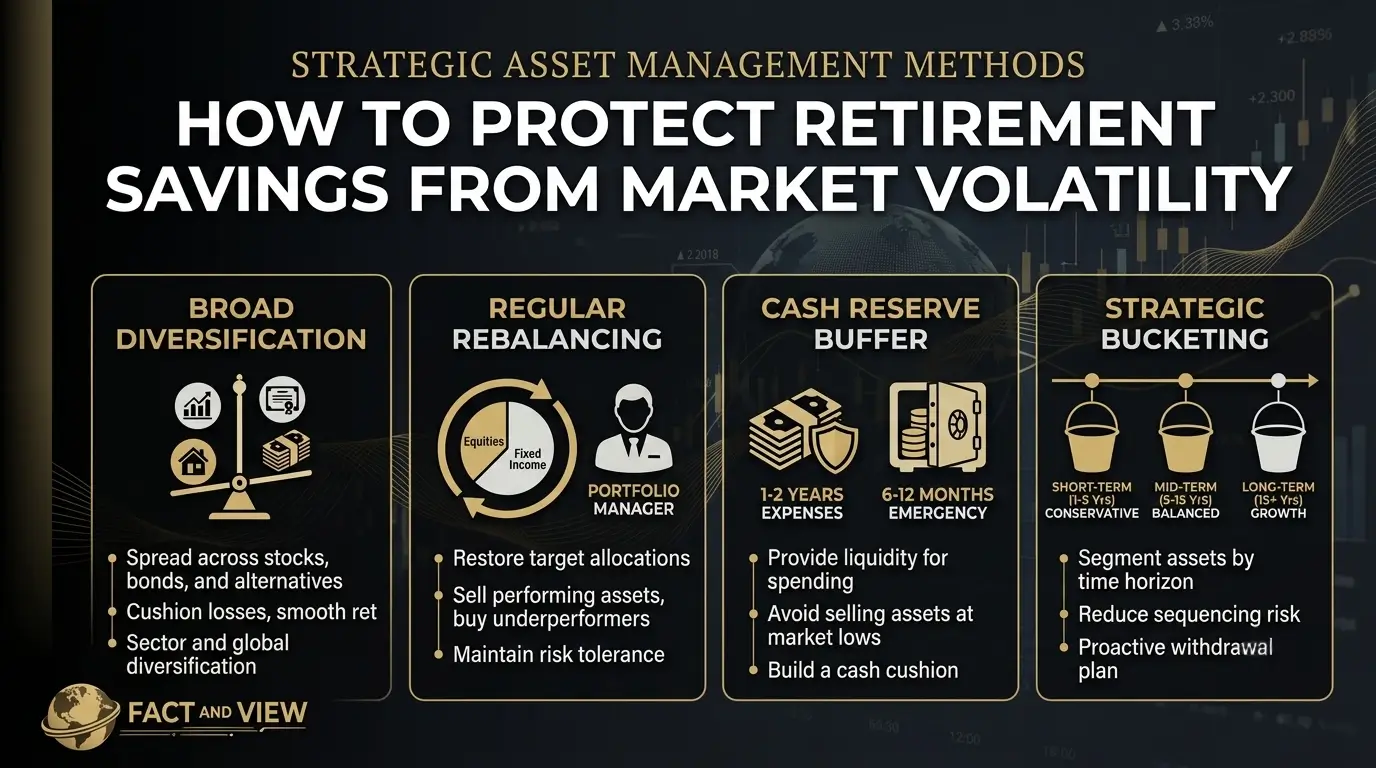
The most widely recommended structural defense against sequence risk is a technique financial planners call the bucket strategy — dividing a retirement portfolio into segments based on when the money will actually be needed, rather than treating it as one undifferentiated pool.

How the three buckets typically work:
- Short-term bucket (roughly 1–3 years of expenses): Held in cash or cash equivalents. This money covers near-term living expenses regardless of what the stock market is doing, ensuring you’re never forced to sell depreciated investments to pay this month’s bills.
- Intermediate bucket (roughly 3–10 years of expenses): Held in bonds and more conservative investments. This segment provides moderate growth with meaningfully less volatility than stocks, refilling the short-term bucket as it’s drawn down.
- Long-term bucket (10+ years out): Held in stocks and other growth-oriented assets. Because this money won’t be touched for a decade or more, it can absorb significant short-term volatility in exchange for the higher returns necessary to fund a retirement that may last 25 to 30 years or longer.
Protect your retirement savings with this must-have book on scams and elder fraud.
Fact: The core mechanical benefit of bucketing is straightforward: when markets decline, withdrawals are drawn from the short-term cash bucket, leaving long-term growth investments completely untouched and able to recover on their own timeline rather than being sold at a loss to generate current income.
Fact: Despite an average intra-year decline of roughly 14% historically, the S&P 500 has still posted positive full-year returns in the substantial majority of years over the past several decades. A properly sized cash bucket allows a retiree to simply wait out these intra-year swings rather than reacting to them.
The View: The bucket strategy’s real value isn’t just psychological comfort, though that matters — retirees who know their near-term expenses are covered regardless of market conditions are demonstrably less likely to panic-sell during a downturn. Its deeper value is structural: it removes the forced-selling mechanism that turns ordinary market volatility into permanent portfolio damage. Skeptics note that bucketing can create behavioral complexity — deciding exactly when and how much to “refill” each bucket during a recovery requires discipline — but most financial planners agree the structural benefit outweighs that added complexity for the majority of retirees.
Related reading: Best Investments During Inflation — how TIPS, short-duration bonds, and other defensive assets fit naturally into a retirement bucket strategy.
How Much Can You Safely Withdraw?
Protecting retirement savings isn’t only about portfolio structure — it’s equally about not withdrawing more than the portfolio can sustainably support, a question financial researchers have studied intensively for decades.
Fact: The widely cited “4% rule” originated from researcher William Bengen’s 1994 analysis, later reinforced by the Trinity Study in 1998, which found that a 4% initial withdrawal rate, adjusted annually for inflation, survived the vast majority of historical 30-year retirement periods using U.S. market data going back to 1926.
Fact: More recent research has refined that figure based on current market conditions rather than purely historical averages. Morningstar’s retirement-income research team has calculated starting safe withdrawal rates ranging from 3.3% to 4.0% across different years, depending on prevailing bond yields, equity valuations, and inflation expectations at the time of retirement — consistently emphasizing that the “right” number is a moving target shaped by market conditions at the moment someone retires, not a fixed universal constant.
Fact: Both Bengen’s original historical approach and Morningstar’s forward-looking, valuation-based approach remain defensible methodologies answering the same underlying question from different angles — one backward-looking at what actually happened, one forward-looking at what current valuations suggest is likely. The gap between the two approaches’ conclusions in any given year is itself a useful signal of how stretched or reasonable current market valuations appear.
Fact: Research also shows that safe withdrawal rates can reasonably increase for retirees with shorter time horizons. A retiree with an anticipated 20-year retirement can generally sustain a higher withdrawal rate than one planning for a 30-year horizon, since there’s simply less time for a bad sequence of returns to compound into a serious problem.
The View: The debate between backward-looking historical safe withdrawal rates and forward-looking valuation-adjusted ones can seem like an argument over decimal points, but the practical difference is real money. On a $1 million portfolio, moving from a 4.0% to a 3.7% withdrawal rate is the difference between $40,000 and $37,000 in year-one income — a meaningful reduction in lifestyle for a retiree, in exchange for a measurably higher probability the money lasts. Rather than anchoring to any single fixed percentage, most planners now recommend flexible, dynamic withdrawal strategies that reduce spending during weak market years and permit more spending during strong ones — directly addressing sequence risk rather than assuming a static, worst-case number every single year regardless of actual conditions.
Related reading: What Happens If Social Security Runs Out? — why building a withdrawal strategy that doesn’t over-rely on any single income source, including Social Security, matters for long-term retirement security.
Diversification: The Foundation Underneath Every Other Strategy
Every technique discussed so far — bucketing, dynamic withdrawal rates, cash reserves — depends on one underlying prerequisite: a genuinely diversified portfolio to begin with.
Fact: Diversification means holding a mix of asset classes — domestic and international stocks, bonds of varying durations, and cash — whose prices don’t move in perfect lockstep with one another. When one asset class declines sharply, a genuinely diversified portfolio typically experiences a smaller overall decline than a concentrated one, because other holdings are behaving differently at the same time.
Fact: Target-date retirement funds — the default investment option in many 401(k) plans — implement a version of this principle automatically through what’s called a “glide path”: a pre-programmed, gradual shift from a higher stock allocation toward a higher bond and cash allocation as the target retirement date approaches. A fund built around a 50% equity allocation at retirement, for example, might gradually reduce that to roughly 30% equities over the subsequent 20 years.
Fact: Diversification also extends beyond simply owning “some stocks and some bonds.” Genuine diversification considers correlation — the degree to which different assets move together. Gold, for instance, has historically shown low or negative correlation to stocks during acute market stress, which is part of why some retirement planners now include a modest allocation to physical gold or gold-related assets specifically as a volatility buffer alongside traditional stock-and-bond diversification.
The View: Diversification is sometimes dismissed as overly conservative advice for retirees who fear missing out on strong bull-market returns. But the mathematics of sequence risk make clear why this framing misses the point: a diversified portfolio isn’t primarily about maximizing returns during good years — it’s about narrowing the range of possible outcomes during the specific bad years that matter most, which happen to be entirely unpredictable in advance.
Related reading: Where Smart Money Is Moving Right Now — how institutional investors are currently diversifying across asset classes to manage the same volatility risks retirees face.
Common Mistakes That Undermine Retirement Protection
Even well-intentioned retirees frequently undermine their own protection strategy through a handful of recurring errors.
Panic selling during downturns. Selling equities after a sharp decline locks in losses permanently and eliminates any chance of participating in the recovery that historically follows nearly every market downturn.
Maintaining a rigid withdrawal amount regardless of market conditions. A retiree who withdraws the same inflation-adjusted dollar amount during a severe downturn as during a strong bull market is mechanically accelerating portfolio depletion exactly when the portfolio can least afford it.
Underestimating how long retirement will actually last. Increasing life expectancies mean many retirees now need their savings to last 30 years or longer, a horizon that requires meaningfully more growth-oriented exposure than many retirees intuitively feel comfortable holding.
Ignoring the tax structure of withdrawals. Distributions from traditional 401(k)s and IRAs are generally taxed as ordinary income, while qualified Roth withdrawals are not — meaning the sequence in which you draw from different account types can meaningfully affect how much of your withdrawal you actually keep.
Failing to revisit the plan as conditions change. A withdrawal rate and asset allocation appropriate at the start of retirement may need adjustment as market valuations shift, as actual portfolio performance diverges from assumptions, or simply as a retiree ages and their time horizon shortens.
The Bottom Line
Protecting retirement savings from market volatility isn’t about avoiding risk entirely — a portfolio with zero volatility exposure typically can’t generate the growth needed to fund a multi-decade retirement against inflation. It’s about structuring that risk so that ordinary, inevitable market downturns don’t force permanent, irreversible damage at exactly the wrong moment.
A practical checklist for building genuine protection:
- Build a cash reserve covering 1–3 years of essential expenses before or immediately upon retiring, so short-term market swings never force a sale of depreciated long-term holdings.
- Maintain meaningful growth exposure for money you won’t need for a decade or more, since a retirement that may last 25–30 years still requires real portfolio growth to outpace inflation.
- Choose a starting withdrawal rate based on current market conditions, not blind adherence to a single historical rule of thumb, and remain willing to adjust it as conditions evolve.
- Diversify genuinely — across asset classes, geographies, and correlation profiles — rather than assuming “some stocks and some bonds” alone provides adequate protection.
- Revisit the entire plan periodically, since the right strategy at the start of retirement is rarely the right strategy for its entire multi-decade duration.
The retirees who weather market volatility most successfully aren’t the ones who correctly predicted when a downturn would happen — nobody reliably does that. They’re the ones whose portfolios were structured, well in advance, to survive a bad sequence regardless of when it eventually arrived.
Sources: Morningstar — What’s a Safe Retirement Withdrawal Rate for 2026? · Morningstar — How Retirees Can Determine a Safe Withdrawal Rate · Morningstar — Finding Your Safe Withdrawal Rate · Kitces.com — Managing Sequence of Return Risk With Bucket Strategies · U.S. Bank — Sequence of Returns Risk and Impact on When to Retire · Charles Schwab — Withdrawal Timing and Portfolio Recovery Analysis · MaxiFi — Sequence of Returns Risk: What It Is & How to Manage · Compound Ladder — 4% Rule 2026 Update · FI Plan Lab — Safe Withdrawal Rate Calculator
© Fact and View. For informational purposes only. Not investment advice. Consult a qualified financial advisor before making retirement planning decisions.