
Most Americans experience healthcare policy as something that happens to them — a premium that rises, a drug that becomes cheaper, a benefit that quietly disappears from a plan they didn’t choose to change. Few trace that experience back to its actual source: a 100-member chamber in Washington that, through a mix of arcane procedural rules and raw vote-counting, decides more about American healthcare than almost any other single institution.
Senate healthcare policy isn’t an abstraction. It is the reason Medicare covers what it covers, the reason Medicaid eligibility varies so dramatically by state, and the reason major reform efforts — from the Affordable Care Act to subsequent attempts to repeal or restructure it — have repeatedly come down to a small handful of senators and a procedural mechanism most voters have never heard of.
This guide explains exactly how the Senate shapes healthcare in America — the tools it uses, the committees that matter, and the pressure points that will keep determining coverage and cost for tens of millions of people for years to come.
How the Senate Influences Healthcare Policy
The Senate’s influence over healthcare runs through three distinct channels, and understanding the difference between them explains why some healthcare fights move quickly while others stall for years.
Legislation. The Senate must pass any bill that changes federal healthcare law — creating a new program, altering Medicare payment formulas, or amending the Affordable Care Act. Because most legislation requires 60 votes to overcome a Senate filibuster, and because no party has held 60 seats in decades except briefly, most ambitious healthcare legislation depends on a specific workaround: budget reconciliation.
Fact: Budget reconciliation, created by the Congressional Budget Act of 1974, allows certain tax, spending, and debt-related legislation to pass the Senate with a simple majority — 51 votes, or 50 plus the vice president’s tie-breaking vote — rather than the 60 votes normally required to end debate. Because Medicare and Medicaid are federal spending programs, healthcare policy is one of the areas most frequently shaped through this process.
Confirmation power. The Senate alone confirms the Secretary of Health and Human Services, the Administrator of the Centers for Medicare and Medicaid Services (CMS), and other senior health officials. These confirmation votes rarely make headlines outside Washington, but the officials they install run the agencies that write the detailed regulations determining how broad statutory language actually functions in practice.
Oversight. Through committee hearings, investigations, and budget reviews, the Senate shapes healthcare policy even without passing new laws — by pressuring agencies, publicizing problems, and setting the terms of future legislative debate.
The View: The 60-vote threshold is the single most important fact in understanding why American healthcare reform happens in occasional, dramatic bursts rather than steady incremental change. Most other developed democracies can pass healthcare legislation with a simple parliamentary majority. The American system, by design, makes that difficult — which is precisely why reconciliation has become the primary vehicle for major healthcare change on both sides of the aisle over the past three decades.
Related reading: How US Elections Affect the Economy and Markets — the broader relationship between congressional control and economic policy outcomes.
Why Senate Elections Matter for Healthcare
Every Senate election is, in a very literal sense, a healthcare election — even when healthcare isn’t the headline issue on the campaign trail.
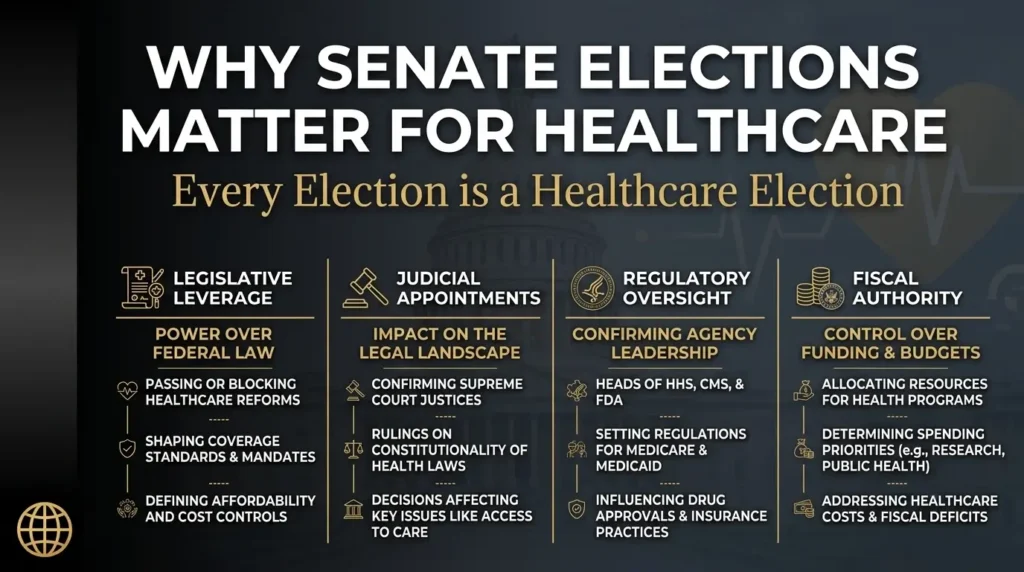
Fact: Senate control determines which party chairs each committee, sets the legislative agenda, and controls the reconciliation process. A shift of even one or two seats can determine whether a narrowly divided chamber flips into unified control for one party, unlocking the reconciliation pathway that makes major healthcare legislation possible without any votes from the minority party.
Fact: Individual senators in narrowly divided chambers wield outsized influence specifically on healthcare votes. The 2009–2010 debate over the Affordable Care Act is the clearest historical illustration: with exactly 60 Senate Democratic caucus votes — the minimum needed to break a filibuster — every single senator in that caucus effectively held veto power over final provisions, and the bill’s structure was shaped by negotiations with a handful of moderate members whose support was not guaranteed.
Fact: Senate elections also determine the composition of the Senate Finance Committee and the Health, Education, Labor and Pensions (HELP) Committee — the two panels with primary jurisdiction over federal healthcare policy — since committee assignments and chairmanships follow directly from which party holds the majority.
The View: Because Senate terms are staggered six-year cycles rather than the House’s uniform two-year terms, the chamber’s composition changes more slowly and unpredictably than most voters realize. A single midterm election can flip control, but the specific senators who become pivotal on any healthcare vote often depend on state-level races that get comparatively little national attention relative to their eventual policy weight.
Related reading: New US Laws in 2026: What They Mean for Americans — how recent Senate-passed legislation is already reshaping tax and healthcare provisions simultaneously.
Could Medicare Change?
Medicare — the federal health insurance program covering Americans 65 and older, along with certain younger people with disabilities — is overseen primarily by the Senate Finance Committee, which controls financing, eligibility, and payment rates.
Fact: The Senate Finance Committee sets Medicare reimbursement rates for doctors and hospitals, determines which services are covered, and manages the program’s overall finances, according to the committee’s own published jurisdiction. This gives the committee direct control over questions that affect nearly every American senior: what a Medicare Advantage plan can charge, what prescription drugs Medicare negotiates prices for, and how quickly the program’s trust funds are projected to be depleted.
Fact: Because Medicare is funded through dedicated payroll taxes and a trust fund structure defined in the Social Security Act, most substantive Medicare changes fall within the Senate Finance Committee’s reconciliation-eligible jurisdiction — meaning major Medicare reforms are more likely to pass through the simple-majority reconciliation process than through standard 60-vote legislation.
Fact: Not every Medicare-related provision can pass through reconciliation, however. The Senate’s Byrd Rule — a set of six tests enforced by the Senate Parliamentarian — strips out provisions that are “extraneous” to the budget, including any changes to Social Security itself. During a recent reconciliation debate over prescription drug pricing, the Senate Parliamentarian ruled that capping insulin costs at $35 per month could be applied to Medicare beneficiaries through reconciliation, but that extending the same cap to people with private insurance could not, because the private-insurance provision’s budgetary effect was ruled merely incidental to its underlying policy purpose.
The View: The Byrd Rule is why so many ambitious Medicare proposals arrive in Congress broader than what ultimately becomes law. Advocates frequently design policies to cover the widest possible population, only to see the Senate Parliamentarian narrow their scope during the reconciliation process — a step that happens almost entirely outside public view but that regularly determines whether tens of millions of Americans are included in or excluded from a given reform.
Related reading: What Happens If Social Security Runs Out? — the related entitlement solvency debate that follows a parallel but distinct legislative path in the Senate.
What About Medicaid?
Medicaid — the joint federal-state program providing coverage to low-income adults, children, pregnant women, and people with disabilities — sits at the intersection of federal Senate authority and significant state-level flexibility, which makes Senate action on Medicaid unusually consequential.
Fact: The Senate Finance Committee holds jurisdiction over Medicaid financing, eligibility formulas, and the federal matching rate — the percentage of each state’s Medicaid spending the federal government reimburses. Because states administer their own Medicaid programs within federal guidelines, a single Senate-passed change to the federal matching formula can ripple into dramatically different outcomes across all fifty state programs simultaneously.
Fact: Medicaid financing structures — including federal matching rates and eligibility rules — are budgetary in nature, which is precisely why Medicaid has repeatedly been a central battleground in reconciliation bills rather than standard legislation. Reconciliation’s simple-majority threshold has made it the vehicle of choice for both expanding and restricting Medicaid financing over the past two decades, regardless of which party controlled the chamber at the time.
Fact: Because Medicaid enrollment and spending levels are directly tied to state budgets, any Senate-driven change to federal Medicaid financing forces state legislatures to respond — either by raising state revenue to maintain coverage levels, tightening eligibility, or reducing optional benefits, since states are not required to offer every Medicaid service beyond a federally mandated minimum.
The View: Medicaid’s dual federal-state structure means the Senate’s decisions don’t simply take effect uniformly — they set the outer boundaries within which fifty separate state governments then make their own choices. This is why identical federal Medicaid legislation can produce meaningfully different real-world coverage outcomes in, say, a state that has expanded Medicaid eligibility under the Affordable Care Act versus one that has not.
Related reading: Medicaid Cuts: Reforming Healthcare or Risking Access? — a detailed look at how recent Senate-passed Medicaid financing changes are affecting coverage and rural hospitals.
How Congress Shapes Healthcare Reform
Major healthcare reform in the United States follows a recognizable procedural pattern, regardless of which party is driving it or what specific policy outcome it seeks.
Step one: committee jurisdiction is established. Because healthcare touches taxation, entitlement spending, and public health regulation simultaneously, major reform bills typically require coordination between the Senate Finance Committee (financing and Medicare/Medicaid structure) and the HELP Committee (public health programs and private insurance regulation) — a division of labor that frequently produces competing drafts of the same underlying policy that must eventually be reconciled.
Step two: the budget resolution sets the boundaries. If reconciliation is the intended vehicle, Congress must first pass a budget resolution containing specific instructions directing relevant committees to achieve particular fiscal targets — a step that effectively pre-determines how large or small the eventual healthcare changes can be.
Step three: the “Byrd Bath.” Before a reconciliation bill reaches the Senate floor, committee staff typically review every provision with the Senate Parliamentarian in a process informally called the “Byrd Bath” — checking each item against the six Byrd Rule tests and removing or revising anything likely to be ruled extraneous to the budget.
Step four: the floor vote. Reconciliation bills receive a maximum of 20 hours of debate and cannot be filibustered, meaning final passage requires only a simple majority — a dramatically lower bar than the 60 votes required for standard legislation.
The View: This procedural pathway explains a pattern that puzzles many casual observers of American politics: major healthcare legislation tends to pass in large, infrequent packages tied to broader budget bills, rather than as smaller standalone healthcare bills addressing one issue at a time. The procedural machinery of the Senate essentially requires it.
What Healthcare Changes Could Affect Americans?
Several categories of Senate-driven healthcare policy carry direct, measurable effects on ordinary Americans’ finances and coverage.
- Premium and subsidy levels for ACA marketplace insurance are set through Senate Finance Committee jurisdiction, directly determining what millions of Americans pay for individual health coverage each month.
- Medicare prescription drug pricing rules, including which drugs are subject to federal price negotiation, flow through the same committee and directly affect out-of-pocket costs for tens of millions of seniors.
- Medicaid eligibility thresholds and work requirements, when altered at the federal level, can add or remove eligibility for millions of low-income Americans depending on how individual states implement the changes.
- Rural hospital funding formulas, tied to Medicare and Medicaid reimbursement rates, directly affect whether hospitals in sparsely populated areas remain financially viable.
- HHS and CMS regulatory priorities shift with each Senate-confirmed HHS Secretary and CMS Administrator, changing enforcement priorities even without any new legislation passing.
Related reading: How Beginners Should Invest — for readers weighing healthcare cost uncertainty alongside broader long-term financial planning decisions.
Key Healthcare Issues Voters Should Watch
For voters trying to track Senate healthcare policy over time, a handful of recurring flashpoints tend to resurface across election cycles regardless of which party holds the majority:
- ACA marketplace subsidy levels — whether enhanced subsidies are extended, reduced, or allowed to expire, directly affecting premium costs for marketplace enrollees.
- Medicare drug price negotiation authority — the scope of which medications are subject to negotiated pricing, and how quickly that scope expands.
- Medicaid federal matching rates — changes to the percentage of state Medicaid spending the federal government reimburses, which shapes state-level coverage decisions.
- Rural healthcare funding — dedicated programs and formula changes intended to offset financial pressure on hospitals in medically underserved areas.
- HHS and CMS leadership confirmations — Senate confirmation votes for the officials who translate broad statutory language into enforceable regulation.
Tracking committee hearing schedules, budget resolution timelines, and confirmation calendars — all publicly available — offers a more reliable early signal of upcoming healthcare policy shifts than most general news coverage, since major changes are typically visible in the procedural pipeline months before they reach a final floor vote.
The Bottom Line
Senate healthcare policy operates through a set of specific, learnable mechanisms — committee jurisdiction, the 60-vote filibuster threshold, the reconciliation process, and the Byrd Rule — that together explain both why major healthcare reform happens rarely and why, when it does happen, it tends to happen quickly and in large packages tied to the federal budget.
For the tens of millions of Americans enrolled in Medicare, Medicaid, or ACA marketplace plans, understanding this machinery isn’t an academic exercise. It’s the clearest available lens for anticipating which healthcare changes are procedurally plausible in any given Congress, and which specific senators and committee votes are worth watching before a policy shift ever reaches the headlines.
Sources: Congress.gov / CRS — The Budget Reconciliation Process: The Senate’s “Byrd Rule” · Brookings — What Is Reconciliation in Congress? · Center for American Progress — How Does Budget Reconciliation Work? · House Budget Committee Democrats — Budget Reconciliation Explainer · Peter G. Peterson Foundation — What Is Budget Reconciliation? · Bipartisan Policy Center — Budget Reconciliation, Simplified · Committee for a Responsible Federal Budget — Reconciliation 101 · KFF — Congress and the Executive Branch and Health Policy · U.S. Senate Committee on Finance — Jurisdiction · U.S. Senate Committee on Health, Education, Labor & Pensions — Issues · National Law Review — Health Care Jurisdiction in the Senate · Chamber Hill Strategies — Committees of Jurisdiction That Shape Health Care Policy
© Fact and View. For informational purposes only.